Seasonal Timeline
Skunks run on a single yearly clock. Breeding happens in February and March, litters are born and stay in the den through spring, and kits follow their mother out on nightly foraging rounds about 2 to 3 months later. Skunks do not hibernate, so activity never fully stops, but in colder regions they slow down through winter and may share a den with other skunks.
Skunks run on a single yearly clock. Breeding happens in February and March, litters are born and stay in the den through spring, and kits…
Where They're Found
Striped skunks are habitat generalists, which is why they turn up almost everywhere people live. They are found from sea level to elevations above 1,800 meters, in woodlands, grasslands, and along agricultural edges, and they do particularly well in suburban and urban neighborhoods. A skunk becomes a structural problem only when it dens against or underneath something you own.
The preferred den is a burrow, and most often it is a burrow something else dug first. Skunks readily take over abandoned ground squirrel, fox, and coyote burrows and enlarge them to fit. Where burrows are scarce they will use brush piles, hollow logs, and culverts, and if nothing suitable exists at all they have the long, non-retractable front claws to dig their own. Around a house that list gets familiar fast: under a deck, under a porch, under a shed, under a mobile home, or in a crawl space.
Range is worth one footnote. Striped skunks are documented in every US state except Alaska and Hawaii, confirmed independently by more than one state wildlife agency, and their native range covers southern Canada, the continental United States, and northern Mexico. Alaska is a clean absence with no established population and no introduction on record. Hawaii is a more interesting absence. There is no resident skunk population there, but individual skunks do arrive now and then as accidental stowaways in cargo, and they get caught at the harbors: one at Honolulu Harbor in 2018, one near Hilo in early 2023, and two more near Hilo within a single week in November 2025. State agriculture officials treat every one of those as an invasive-species and biosecurity incident rather than evidence of a population, and all previously captured animals have tested negative for rabies.
Life Cycle
One litter a year, and the timing is why the calendar matters here. Breeding concentrates in February and March, gestation runs about 9 weeks, and the kits that follow are not mobile enough to leave the den on their own for another 2 to 3 months after that. The stretch when a den under a deck or shed is most obvious is also the stretch when sealing it does the most harm. Confirm every animal has left before anything gets closed up.

Mating and Gestation
Kit
Juvenile
Adult
Identification
Start with the stripe pattern
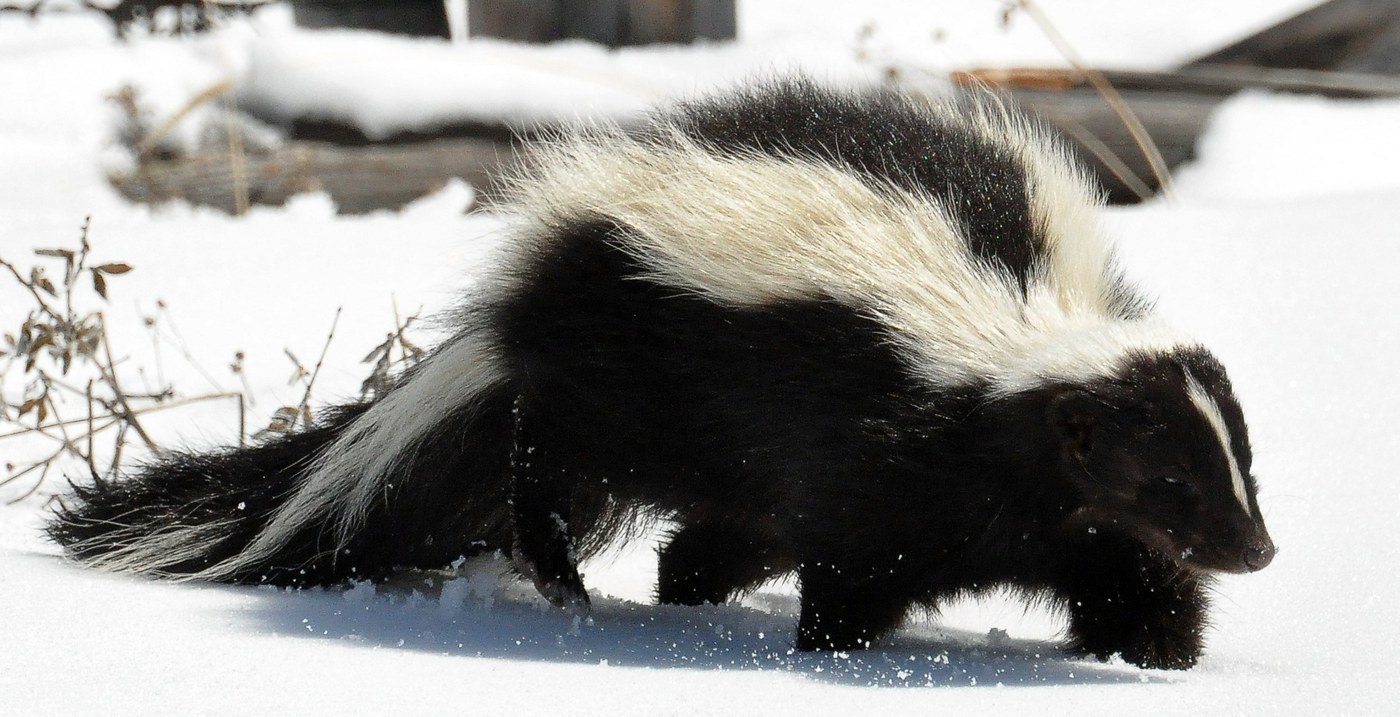
It is the whole identification. The coat is mostly jet black with a prominent white pattern that begins as a triangle on the head and usually splits into two lateral stripes running down the back, sometimes rejoining near the base of the tail. No two animals carry exactly the same pattern. That black-and-white contrast is not camouflage, it is advertising. It functions as a warning signal to predators.
Size and build
About the size of a house cat, up to 29 inches long including the tail, and roughly 4 to 14 pounds, with an average near 8 pounds. Males run slightly larger than females. The build is low and heavy, with a triangular head, short muscular legs, and long non-retractable claws made for digging, which is exactly what the lawn damage comes from.
Rule out the spotted skunk
The species worth ruling out is the spotted skunk. Two things separate them. Size, first: a spotted skunk is roughly half the size of a striped skunk, up to about 21 inches and around 2.2 pounds. Pattern, second: spotted skunks carry white spots and short, broken white streaks scattered through a dense black coat rather than two continuous stripes down the back.
Skunks are not weasels
One taxonomy point explains a common mix-up. Skunks were historically grouped with weasels in the family Mustelidae, and older references still describe them that way. Genetic research moved them into their own family, Mephitidae. If you see a skunk called a weasel relative in an older source, that is why.
The confusion is behavioral
The confusion that actually matters is behavioral, not visual. Canine distemper is common in skunks and other furbearers, and it produces confusion, disorientation, and unusual tameness that looks a great deal like rabies to anyone who is not a veterinarian. People cannot catch distemper and neither can vaccinated pets, while rabies is a different matter entirely. Since the two look alike from a distance, a skunk acting strangely is a reason for distance and a phone call, not a diagnosis either way.
Signs of Infestation
Cone-shaped digging pits
They run 3 to 5 inches across in the lawn. Skunks dig for grubs and insects, and the result is a scattering of small, neat, cone-shaped divots that appear overnight. In some yards you will also find sod rolled back, damage that looks similar to raccoon work. A lawn with a heavy grub population is a lawn a skunk will keep coming back to.
Five toes front and hind
Tracks with five toes on both the front and hind feet, though the fifth toe does not always register. Claw marks are usually visible in the print, and a hind-foot track runs about 2.5 inches long. Soft mud, sand, and fresh soil hold the clearest impressions.
Droppings with visible insect parts
About a quarter inch to a half inch in diameter and 1 to 2 inches long, and they frequently contain undigested pieces of the insects and grubs the animal has been eating, which is often what distinguishes them at a glance.
Sounds, including a direct warning
Sounds, including one that is a direct warning. Skunks screech, whimper, and chirp. They also produce a rapid double-thump stomp of the front feet when agitated. If you hear that stomping, you are close enough that the animal is telling you to leave.
Odor, with two important caveats
A faint but persistent musk in a yard can mean skunks are passing through regularly, even with no actual spray event. But odor alone is not a reliable identification. Opossums produce a similar-smelling defensive odor. And a musk smell that lingers for days and grows stronger rather than fading usually means a skunk has died somewhere nearby and its scent gland has ruptured, not that a live animal is denning on the property.
Denning evidence under a structure
A freshly dug or newly widened opening under a deck, porch, shed, mobile home, or crawl space, often at a spot where soil is loose enough to work. Because skunks readily take over burrows dug by ground squirrels, foxes, and coyotes, the hole may predate the skunk that is now living in it.
Prevention and When to Call a Pro
Never handle a skunk
Never attempt a home capture-and-release either. This rule comes before everything else. Skunk is a rabies vector species, and public health guidance is direct about what that means in practice: when people or pets are exposed to a rabid skunk, more than 20 percent of those skunks are positive for rabies, the highest exposure rate of any rabies reservoir species in the United States, ahead of raccoons. That guidance goes further and says skunks found in raccoon-reservoir states should be treated as high-risk too. There is no version of this where bare-hand contact is acceptable, healthy-looking animal or not, adult or kit. Any bite or scratch, however minor it looks, means a prompt trip to a physician and a call to your local health department, not a wait-and-see.
Learn the warning sequence
A skunk almost always gives you one. Before it sprays, a skunk will rapidly stamp its front feet, hiss, and arch its tail up over its back. That is the last warning, and it is remarkably consistent. Healthy skunks would much rather leave than fight, and they spray only as a final resort because the supply is limited and slow to replenish. Recognizing that sequence and simply backing away calmly is the most useful thing you can do. On distance: sources disagree on exactly how far a skunk can spray accurately, with a university extension source putting it at 6 to 10 feet and widely repeated general sources citing 10 to 15 feet with a maximum reach near 20. Treat it as well outside arm's reach, roughly 15 to 20 feet, and give the animal that much room.
The spray is a chemical
It is not just a smell, and that changes how you clean it up. It is an oily, sulfur-based liquid built from thiol compounds, also called mercaptans, and it can cause nausea and, if it hits the eyes directly, severe burning and temporary blindness. The spray also contains thioacetates, which are odorless on their own but convert back into strong-smelling thiols on contact with water. That is precisely why a pet sprayed once can smell skunky again days later after a bath. Tomato juice does not neutralize any of this chemically, it only masks it. A mixture of hydrogen peroxide, baking soda, and dish soap does work, because it oxidizes the thiols rather than covering them.
Acting strange is not always rabid
A skunk acting strange is not automatically rabid, and the answer is the same either way. Skunks that seem tame or listless, or that wander about in an unusual manner in daylight, should be treated with great caution, since that behavior is consistent with rabies, and a lack of fear paired with aggression raises the odds further. But canine distemper commonly infects skunks and other furbearers and produces very similar-looking confusion and unusual tameness, and distemper cannot be passed to people or to vaccinated pets. Only professional and laboratory handling can tell the two apart. Keep your distance and call animal control instead of getting close enough to judge. Separately and more quietly: skunks carry a roundworm, Baylisascaris columnaris, which is a related but taxonomically separate species from the raccoon roundworm that causes documented human disease. Federal parasitology guidance states plainly that it is not known whether the skunk species can cause that disease in people. That is genuine uncertainty, not a hidden danger. Skunks may also carry leptospirosis, listeriosis, canine hepatitis, Q fever, and tularemia, each named by a single source rather than confirmed across the literature.
Attractant removal is the base
Attractant removal is the practical foundation. Manage lawn grubs, since grubs and insects are a primary food source and the direct cause of the digging damage. Pick up fallen fruit and spilled birdseed promptly. Use garbage cans with tight-fitting lids. Never leave pet food outdoors overnight. And never intentionally feed a skunk. A fed skunk loses its fear of people, and the animal that walks up to the next person it meets is a bite risk that did not need to exist.
Exclude dens once they are empty
Exclude the denning sites, but confirm the den is empty first. Quarter-inch hardware cloth is the standard for burrowing furbearers, applied to close off crawl spaces and the openings under decks, porches, and sheds, and buried at least 6 inches deep anywhere the soil allows an animal to dig underneath. The order of operations matters more than the material. Before sealing anything, confirm nothing is still inside. A patch of flour dusted across the entrance and checked after dark will show tracks going out, and that is your evidence, not a guess. Sealing an occupied spring den traps kits in a space you cannot reach.
Do not attempt DIY trapping
Two reasons, and either one is sufficient. A live-trapped skunk is extremely likely to spray during handling, at close range, in your direction. More importantly, relocating a captured skunk is either illegal or effectively unpermittable in most states, specifically because of rabies risk, which leaves a homeowner who has already trapped one with no good options. This is work for a licensed nuisance wildlife control operator.
The legal picture varies by state
Two real examples show how directly. Pennsylvania's game agency names skunks specifically, alongside raccoons, bats, groundhogs, foxes, and coyotes, and states that because these are rabies vector species they should not be relocated like other wildlife, leaving a homeowner who traps one with a choice between dispatching the animal or releasing it right there. Maryland goes further and codifies it: relocating rabies vector species, naming raccoon, skunk, and fox, is prohibited under the Code of Maryland Regulations 08.03.15.24, specifically to prevent human-assisted spread of the disease. New York's nuisance wildlife rules list skunk in a permit-conditional category rather than an open one. California classifies skunks as nongame mammals that a property owner may lethally remove at any time if they are causing damage, but relocation there requires written state wildlife agency permission that is unlikely to be granted, again because of rabies prevalence in the skunk population. Those are four different answers to the same question. None of them is universal, and yours may be different. Check your own state before acting.
Who to Call, and When
Call for any skunk denning under a structure, whether that is a deck, porch, shed, mobile home, or the house itself, because DIY exclusion risks both sealing kits inside and provoking a spray at close range. Call your physician and your health department, immediately, for any bite or scratch no matter how minor it looks. Call animal control for any skunk behaving tame, listless, disoriented, or aggressive in daylight, since rabies and distemper cannot be told apart by looking and no one should get close enough to try. And call a licensed operator for any situation that has you reaching for a trap, since trapping and relocation carry restrictions that change at the state line.
Frequently Asked Questions
How far can a skunk actually spray?
Sources genuinely disagree, so here are both. A university extension source puts the accurate range at 6 to 10 feet. Other widely repeated sources cite up to 10 to 15 feet accurately with a maximum reach near 20 feet. The safe rule is well outside arm's reach, roughly 15 to 20 feet, especially if the animal is already showing warning behavior.
What warning does a skunk give before it sprays?
A consistent, learnable one. The skunk rapidly stamps its front feet, hisses, and arches its tail up over its back. That sequence almost always comes before an actual spray, because spraying is a last resort with a limited supply that is slow to replenish. Healthy skunks would rather leave than fight. If you see it, back away calmly and give the animal room.
Is skunk rabies the same virus as raccoon rabies?
No, and this is a real distinction rather than a technicality. Federal surveillance data identifies three separate skunk-associated rabies virus variants, the California skunk, South Central skunk, and North Central skunk variants, which are genetically and geographically distinct from the eastern raccoon variant. The California variant sits on its own, and the two central variants span a broad reservoir running roughly from Montana down to Texas. Rabid skunks found in eastern raccoon-reservoir states were typically infected by raccoons rather than carrying a skunk variant. The handling advice does not change: never handle a skunk directly.
My dog got sprayed. Does tomato juice actually get the smell out?
No. Tomato juice masks the odor rather than removing it. Skunk spray is an oily, sulfur-based liquid built from thiol compounds, and those need to be chemically neutralized, not covered. A mixture of hydrogen peroxide, baking soda, and dish soap works because it oxidizes the thiols. This also explains a frustrating detail: the spray contains thioacetates that are odorless until they meet water and convert back into thiols, which is why a washed pet can start smelling skunky again days later.
Can I trap a skunk myself and relocate it somewhere else?
In most states, no. Some prohibit relocating rabies vector species outright by regulation, Maryland among them, which names raccoon, skunk, and fox specifically. Others require a permit that is unlikely to be granted for exactly the same reason, as in California. Pennsylvania's agency states plainly that skunks should not be relocated at all, which leaves a homeowner who has already trapped one in a bind. Add that a trapped skunk is very likely to spray during handling, and this becomes a licensed nuisance wildlife control operator's job rather than a weekend project.
Sources
- Skunks (identification, biology, damage identification, prevention and control methods) Internet Center for Wildlife Damage Management (University of Nebraska-Lincoln / USDA APHIS Wildlife Services)
- Pest Notes: Skunks (UC ANR Publication 74118) University of California Statewide Integrated Pest Management Program
- Rabies in the United States: Protecting Public Health Centers for Disease Control and Prevention
- Baylisascariasis (DPDx parasitology reference) Centers for Disease Control and Prevention
- Wildlife Problems (rabies vector species relocation, COMAR 08.03.15.24) Maryland Department of Natural Resources
Image Credits
- Image: Dan & Lin Dzurisin, cropped by a Wikimedia Commons contributor. CC BY-SA 4.0. This resized copy is offered under the same license.
License.