Seasonal Timeline
Resident Canada geese are present year-round wherever they are established, so the useful question is not when they arrive but when they become a problem. Two windows drive the calls. Nesting and territory defense run roughly March through June in most of the country, earlier in the South and later in Alaska, and that is when geese charge people. The flightless molt follows in roughly mid-June through mid-July, when adults cannot fly, cannot be hazed away, and concentrate with their goslings on the nearest water. Migratory flocks add a separate winter overlay in the southern regions.
Resident Canada geese are present year-round wherever they are established, so the useful question is not when they arrive but when they…
Nesting starts earlier than the old federal calendar assumed, and that change is documented. When the resident goose regulations were first written in 2006, nest and egg destruction was allowed only between March 1 and June 30, the period then understood to be the nesting season. The U.S. Fish and Wildlife Service removed that date restriction effective July 22, 2019, specifically because some resident Canada geese had begun nesting as early as February, particularly in the southern United States. Registration is now open year-round, though it still covers a single nesting season and has to be renewed each year.
One official source has not caught up, and the conflict is worth knowing about. The Service's own homeowner-facing nesting guidance still describes the depredation order as permitting treatment from March 1 to June 30, while the rule text and the 2019 amendment both say activities may be conducted at any time of year. The regulation is the controlling document. If you register, follow what your registration account tells you and confirm with your state wildlife agency, because a stale date on a guidance page is not a legal defense in either direction.
The molt is the window most people misjudge. Adult geese drop their flight feathers in early summer and cannot fly at all until the new ones grow in. Sources put the flightless period at 15 to 20 days beginning near the end of June, at about a month in mid-summer, and at a full molt of 30 to 45 days completed by mid-July. Those figures are describing slightly different things, the flightless span versus the complete feather replacement, which is the most likely reason they do not line up. What matters practically is identical across all of them: for several weeks in early summer the birds physically cannot leave, hazing has nothing to accomplish, and rounding them up or moving them requires a federal permit.
A detail almost nobody covers: some resident geese do migrate, just not the way you would expect. Non-breeding and failed-breeding birds from resident populations undertake a molt migration in late May and early June, flying north as far as Hudson Bay to molt in safety, then returning in September and October. So a pond that empties out in June and refills in fall has not necessarily lost its resident flock.
Where They're Found
Canada geese live near water next to short grass, and that combination is why they moved into developed landscapes so completely. Cornell's own habitat account is blunt about the mechanism: geese are drawn to lawns because they can digest grass and because a manicured lawn gives a feeding family an unobstructed view of approaching predators. Retention ponds, golf courses, corporate and HOA campuses, urban park lakes, athletic fields, and airport grass all satisfy both requirements at once. Canada geese occur in every part of the United States except Hawaii.
The Midwest and Northeast carry the heaviest resident-goose conflict. Large non-migratory breeding populations nest and defend territory on retention ponds, golf courses, and corporate and HOA campuses across metros including Chicago, the Twin Cities, and the densely developed Northeast corridor. New York's state agency estimated its resident population at about 228,000 birds in spring 2024 against a stated management goal of 85,000 or fewer, which is a useful measure of how far ahead of management targets these populations have run. Within the Northeast, resident goose density on Long Island and in suburban New Jersey, Connecticut, and Massachusetts is high enough that local call volume outruns what a region-wide average would suggest.
The Pacific Northwest, California, and Mountain West follow the same resident pattern on different water. Puget Sound and Willamette Valley lakes and parks, Central Valley and coastal California urban lake networks, and the Front Range corridor from Denver through Boulder and Fort Collins all support large resident breeding populations on engineered water. Washington's wildlife agency names the Western Canada goose, Branta canadensis moffitti, as the largest resident subspecies in that state and makes the key point about permanence directly: all following generations of non-migratory Canada geese will also be non-migratory. A resident flock is not a habit, it is inherited.
The Southeast holds resident breeding pairs, and their presence is relatively recent. Nesting and territory defense on retention ponds and HOA common areas is the standard complaint. The giant Canada goose subspecies, Branta canadensis maxima, was widely reintroduced outside its historic range, which ran from southern Manitoba and northern Minnesota south to Kansas, Arkansas, and western Kentucky and Tennessee, and those programs are why the bird is now common across much of the South and East.
South Central is the one region where the migratory population still dominates, and that is a genuine difference rather than a rounding error. This region has a much smaller resident breeding population than the Midwest or Northeast, and most geese present are wintering migrants rather than a year-round nuisance flock. In Texas the state's waterfowl program describes small Canada geese visiting the Panhandle for playa wetlands and then adapting to urban ponds in towns and cities, at one point with tens of thousands of birds roosting on them. Texas breeding records exist but breeding by this species in the state is a recent phenomenon. Practically, a South Central complaint is more likely to be a winter flock that will leave than a nesting pair that will not.
The Southwest is real but small, and water is the limit. Small resident populations occupy golf course ponds, retention ponds, and urban parks with water features around Phoenix, Tucson, and Las Vegas. This is the lowest-conflict region of them all, precisely because an arid landscape offers far fewer of the pond-plus-turf pairings the species needs.
Alaska is the region that needs the most careful wording, and it is the exception in two separate ways. Most of Alaska's Canada geese are migratory. The state's own agency lists three subspecies there, lesser, dusky, which nests primarily in the Copper River Valley, and Vancouver, which occupies forested Southeast Alaska, and notes that some birds live in Alaska year-round in Southeast Alaska including the Mendenhall Wetlands near Juneau, in Prince William Sound, and on Kodiak Island. The resident nuisance population that behaves like a lower-48 problem is concentrated in developed southcentral Alaska, chiefly the Anchorage and Matanuska-Susitna areas, and its history is documented in unusual detail. The Anchorage Bowl population grew more than tenfold across the 1970s and 1980s, with growth reaching 14.6 percent a year since 1974, and exceeded 4,600 birds by the summer of 1998, with projections of 15,000 to 20,000 by 2007 if left alone. Management brought it back down and it has stayed at a lower level since. Alaska also sits outside the federal nest-and-egg registration entirely, and that is the single most important regional exception to know.
Hawaii is excluded, deliberately and for two reasons. Canada goose is not established in Hawaii; it occurs there only infrequently, as a vagrant. More importantly, the goose you will actually see on a Hawaii golf course or resort lawn is almost certainly the nene, or Hawaiian goose, Branta sandvicensis, which is a separate species descended from Canada geese that reached the islands hundreds of thousands of years ago, is Hawaii's state bird, and is federally protected as threatened after being downlisted from endangered in 2020. None of the hazing, nest, or egg guidance here applies to a nene. If you are in Hawaii, identify the bird before you do anything at all.
Related Pests
Life Cycle
One brood a year, a long life, and a bird that comes back to the same spot. Canada geese produce a single brood per season, pairs frequently return to the same nest site in consecutive years, and the Service's own guidance points out the consequence: geese live 10 to 25 years in the wild and have one defined nesting season, so no realistic amount of nest and egg work reduces a local population quickly. That is the honest expectation to set before anyone registers for anything.
The nuisance population is a conservation success story that overshot, and this is the fact a generic pest page will not tell you. The giant Canada goose, Branta canadensis maxima, was believed extinct by the 1950s after a century of hunting and habitat loss. In 1962 biologists confirmed a surviving flock on Silver Lake in Rochester, Minnesota, a water body kept partly open through winter by warm discharge from a nearby power plant. That population traced back to birds introduced onto a private estate in 1924 and a small city-introduced flock in 1936. Because geese choose mates by size and then stay paired for life, the giants had kept breeding true. State agencies and private breeders then propagated and translocated that stock widely, well outside the subspecies' historic range, and the reintroductions worked so well that the birds became a nuisance across much of the suburban South and East. The flock on your pond is downstream of a rescue.
A note on the size figures above. The 105.8 to 317.5 ounce weight range and the 29.9 to 43.3 inch length come from Cornell's combined figures across the whole species. Individual agency pages give much narrower numbers for their local subspecies, for example Washington describing adult males averaging 30 inches with a 60 inch wingspan, and Alaska describing dusky and Vancouver birds at eight to 10 pounds and the largest birds reaching 45 inches with a wingspan up to 75 inches. Those are not contradictions, they are different subspecies. If a size figure matters for your situation, use your own state agency's number rather than the species-wide range.

Egg
Gosling
Juvenile
Adult2
Identification
The white chinstrap
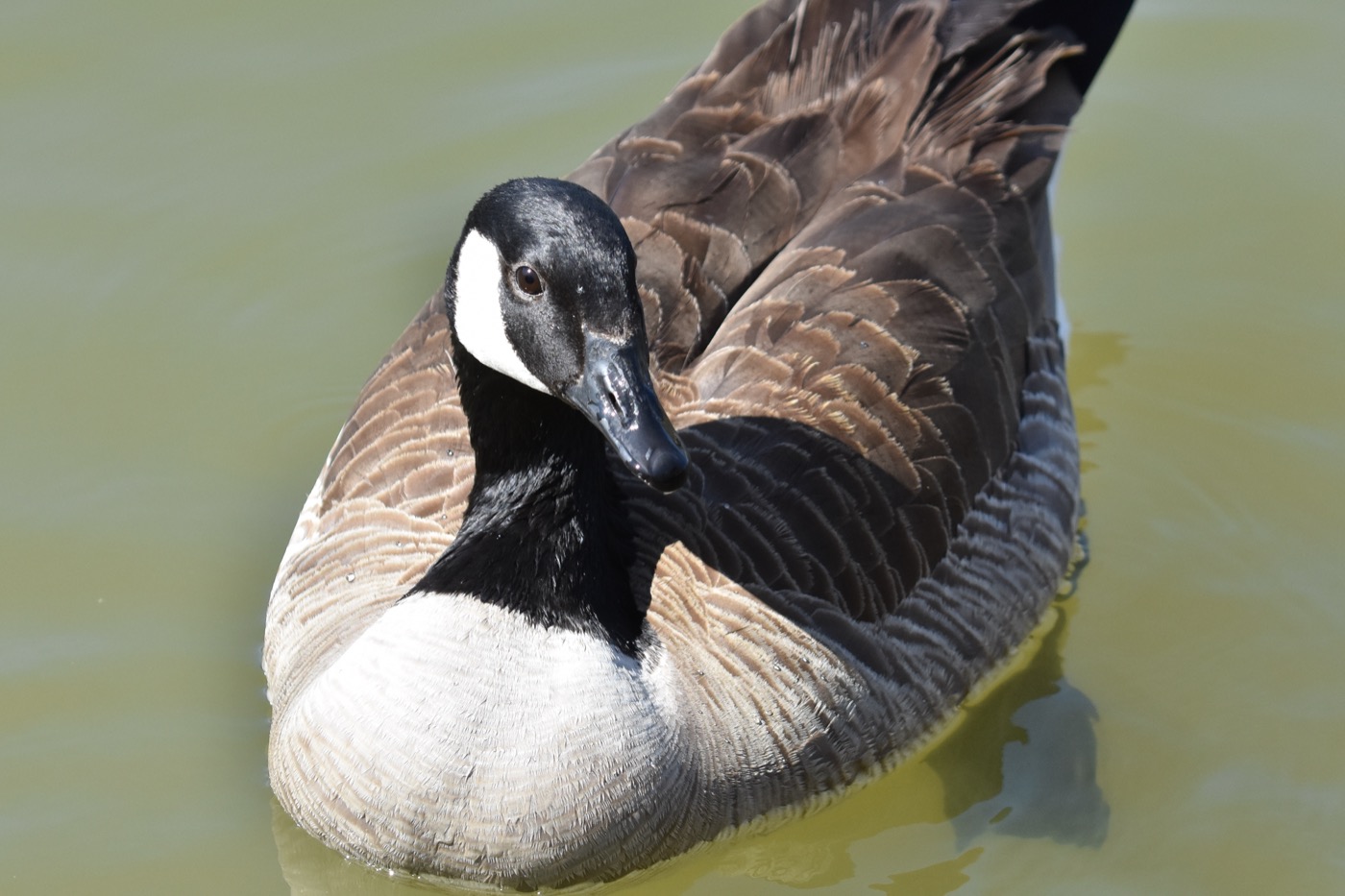
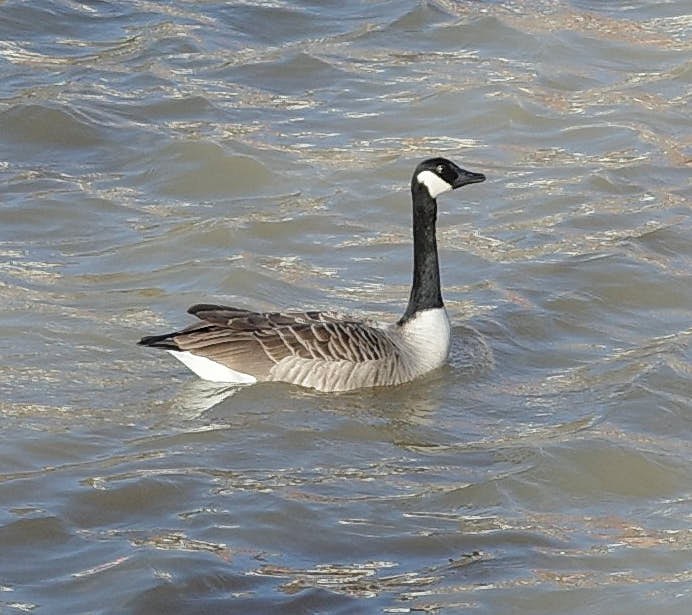
It is the whole identification. A black head and a long black neck with a white cheek patch that wraps under the chin, a brown body with a paler chest, a white undertail, and black legs and feet. In flight the bird shows a prominent white U on the dark uppertail against a black tail. No other large goose in these regions carries that pattern.
Size will not identify it
Size is not a reliable identifier for this species, and that trips people up. The published range spans 29.9 to 43.3 inches long and 105.8 to 317.5 ounces because the species includes seven subspecies. Cornell's own note on flock photographs makes the point: expect considerable size variation among birds standing side by side in a single flock. Do not use size to identify a Canada goose, and do not use it to decide two birds are different species.
Cackling goose is now separate
Cackling goose is the real look-alike, and it is a separate species now. In 2004 the American Ornithologists' Union split the old Canada goose complex in two, leaving seven large-bodied subspecies as Canada goose, Branta canadensis, and moving four small-bodied subspecies into cackling goose, Branta hutchinsii. Mitochondrial DNA suggests the two lineages separated roughly a million years ago. A cackling goose has the same black neck and white chinstrap, so plumage will not separate them.
Look at the bill for the split
For the cackling goose split, look at the bill, and accept that some birds cannot be called. Actual and proportional bill length is the single most useful feature: cackling geese have shorter, stubbier, proportionally smaller bills, while Canada geese have longer, proportionally larger ones. The hardest pairing is the smallest Canada subspecies, lesser Canada goose Branta canadensis parvipes, against the largest cackling subspecies, and there the measurements genuinely overlap. In the West and Pacific Northwest especially, a small white-chinstrapped goose is worth a second look before anyone acts on it.
Appearance shifts by region
Regional appearance shifts in a predictable direction. Canada geese get smaller as you move north and darker as you move west. Pacific coastal birds of the occidentalis and fulva types are evenly dark brown with little contrast against the black neck, which can look like a different bird to someone used to eastern geese.
Which subspecies, by coast
The subspecies you are most likely dealing with depends on which side of the country you are on. Branta canadensis maxima, the giant Canada goose, is the resident bird of the eastern United States, and Branta canadensis moffitti, the Western Canada goose, is the resident bird of the West, with their ranges meeting around central Nebraska. Washington's agency also cautions that local taxonomy is genuinely confused in places because so many subspecies were introduced and mixed.
Behavior marks a resident bird
Behavior identifies a resident bird when plumage cannot. A migratory and a resident Canada goose are indistinguishable in the hand. What separates them is that resident birds nest inside the lower 48, hold territory on the same pond year after year, and are present in July and August when migratory birds are on northern breeding grounds. Presence in midsummer, aggressive territory defense in spring, and goslings on the property are all resident indicators.
In Hawaii, not a nene
Do not confuse this bird with a nene if you are in Hawaii. The nene, or Hawaiian goose, has black only on the face, cap, and hindneck, with buff-colored cheeks and buff sides and front of the neck marked by dark furrows, produced by diagonal rows of white feathers over black skin. A Canada goose's entire neck is black. The nene is also smaller, roughly 21 to 26 inches. It is a federally protected threatened species and Hawaii's state bird, and it is not a nuisance animal.
Signs of Infestation
Droppings, in volume
Droppings on turf, walkways, docks, and beaches, in volume. This is the complaint that actually generates the call. New Hampshire's environmental services agency puts one goose at up to four pounds of grass consumed and about three pounds of fecal matter produced per day, and figures of 1 to 3 pounds a day circulate widely. A substantially lower measured figure, roughly a third of a pound of wet droppings a day, also circulates attributed to a federal fishery biologist, but it could not be traced to a primary publication, so treat it as unverified rather than fact. The honest summary is that the per-bird number is not well settled, while the aggregate fouling on a small amenity pond plainly is.
Overgrazed, thinned turf next to water
Geese digest grass directly and graze the same lawn repeatedly, which shows up as worn, patchy, short-cropped areas radiating from the pond bank rather than as isolated damage.
A pair holding spring territory
A pair holding territory in spring, and behaving aggressively about it. In spring, pairs break out of flocks and defend a nesting area. Even in dense populations they will fight repeatedly and still end up nesting within sight of one another, and some populations are effectively semi-colonial.
Charging, hissing, wing-striking
Charging, hissing, and wing-striking near a nest or goslings. The escalation sequence is documented: head pumping, an open bill with the tongue raised, hissing, honking, vibrating neck feathers, then physical contact. Washington's agency states plainly that geese may charge and can inflict bruises with their beaks and wings. Treat an aggressive goose in March through June as a bird with a nest nearby, not as an unprovoked attack.
Adults that will not fly in summer
Adults that will not fly away in early summer. If geese walk or swim off but never take flight in late June or early July, they are in the flightless molt. That is a diagnostic sign, and it changes what is legal and what is possible.
A ground nest near water
A ground nest on a slightly raised site near water. Look on muskrat mounds, pond islands, landscape berms, planter boxes, and rooftop or elevated platforms. Cornell notes this species will sometimes nest on raised platforms or in trees. The nest is a bulky open cup of grasses and moss lined with gray down.
Measurable nutrient loading
Nutrient loading in the pond itself, which is measurable. New York's state agency lists nutrient loading to ponds among the standard resident-goose problems, alongside overgrazed lawns and public health concerns at beaches, dining areas, and healthcare facilities. A peer-reviewed study of resident goose droppings at eight sites in the North Carolina Triangle measured total Kjeldahl nitrogen at an average 24.2 milligrams per gram of dry matter, range 12.6 to 55.7, and total phosphorus at 3.6 milligrams per gram, range 1.4 to 8.3, and concluded that resident geese do have the potential to contribute nutrients to adjacent surface water. Algae blooms and water quality complaints on a small amenity pond with a resident flock are part of the same problem, not a separate one.
What they do not do: spread weeds
What geese do not appear to do, which is worth knowing before you pay to fix it: spread weeds. The same North Carolina study planted 127 fresh resident-goose droppings in a greenhouse and germinated only 4 plants, 3.1 percent, and concluded that geese in suburban and urban areas are not frequent vectors of viable seed. If a turf manager is being sold goose control as a weed-prevention measure, that specific claim is not supported.
A fixed daily pattern between sites
Loud honking flocks and family groups moving between water and turf on a fixed daily pattern. Geese communicate constantly in flight and gather in large related flocks, and a predictable dawn and dusk route between a roosting water body and a grazing lawn is normal resident behavior rather than a sign of passage.
Prevention and When to Call a Pro
Start with the federal law
Start with the law, because it controls everything else here. The Canada goose is federally protected under the Migratory Bird Treaty Act. You may not kill, capture, or relocate a Canada goose, and you may not disturb an active nest, without federal authorization. That applies to homeowners, HOAs, groundskeepers, and licensed operators alike. This species is native and fully covered, unlike the introduced birds that sit outside the Act, so do not reason from what is legal with a rock pigeon or a European starling.
Hazing needs no permit
Harassment and hazing need no permit, and that is where every response should begin. New York's state agency states it directly: no federal or state permits are needed to scare, herd, or chase away geese, whether with trained dogs, noisemakers, flags, or lasers. Habitat modification and exclusion need no permit either. The important condition is timing. Once a nest has been built, hazing family groups is no longer viable until the molt has ended, so effective harassment starts before nesting, not after somebody complains.
The nest and egg carve-out
There is a real federal carve-out for nests and eggs, and it is the single most misreported thing about this species. Under the resident Canada goose nest and egg depredation order at 50 CFR 21.162, private landowners, homeowners' associations, public land managers, and local governments in the lower 48 states and the District of Columbia may destroy resident Canada goose nests and eggs on property under their control, with no individual federal permit, after registering free with the U.S. Fish and Wildlife Service at its resident Canada goose registration site. The rule authorizes egg oiling with 100 percent corn oil and egg and nest destruction including removal and disposal, and registrants may conduct these activities at any time of year. Registration carries a mandatory annual report even in a year when nothing was destroyed, and failure to report makes you ineligible to register again.
Three conditions on that carve-out
They matter more than the permission does. First, Alaska is not covered. The registration applies to the lower 48 states and the District of Columbia only, and it explicitly excludes Alaska, Hawaii, Puerto Rico, and the territories, so an Anchorage or Mat-Su property owner needs a federal permit instead and should start with the state wildlife agency. Second, the Service warns that some states do not participate in the program or impose additional or stricter requirements, and some states with their own federal special Canada goose permit substitute their own authorization, so state-level verification is not optional. Third, all state and local law still applies, and registrants must avoid harm to endangered species, with the rule naming whooping crane, bald eagle, and California-specific endangered species habitat protections.
Official guidance conflicts
Official guidance genuinely conflicts on whether you need a permit or a registration, and you should know that before you call anyone. The federal rule and the federal registration site both describe a free registration, not an individual permit, for nests and eggs in the lower 48. At least one state agency fact sheet states instead that a permit is required from the U.S. Fish and Wildlife Service before tampering with a Canada goose nest. Both cannot be literally correct, and the likeliest explanation is a state document that predates or simplifies the registration program rather than a real difference in the law. The safe reading is that federal authorization of some kind is always required, that the registration is the normal route in the lower 48, and that your own state may add requirements on top. Confirm the current mechanism with the Service and your state agency rather than with a contractor.
No addling instructions here
You will not find egg addling instructions here, on purpose. Oiling, puncturing, and shaking are the authorized methods and the Service publishes technique guidance for registrants, but that guidance belongs to people who have registered, reported, and confirmed their own state's rules. Handling eggs while an adult goose defends the nest is also how people get hurt. Read the restriction and the registration path here, then get the technique from the agency or a licensed operator.
Stop the feeding, permanently
Stop the feeding, first and permanently. Resident populations persist where they have no predators, restricted hunting, and reliable handouts. Deliberate feeding by neighbors or residents will defeat every other measure on this list, and on an HOA or campus property a posted, enforced no-feeding rule is the cheapest intervention available.
Break the pond and short-grass pair
Break the pond-plus-short-grass pairing, since that is what the birds are actually selecting for. Geese choose mown turf because they can digest grass and because it gives them long sight lines to spot predators. Letting grass grow tall reverses both: guidance ranges from about 6 inches to 10 to 14 inches depending on the source, so treat it as a mowing-height policy rather than a single magic number. Planting a dense, tall buffer of shrubs or unmown vegetation along the pond bank works on the same principle by cutting the sight lines, and reducing the open sight line to less than about 30 feet will generally push birds to more comfortable ground.
Fence the walk-up before the molt
Fence the walk-up route from water to lawn, and do it before the molt. Geese walk out of the water to graze, and during the flightless weeks they cannot go over a barrier at all. Published specifications differ and both are in use: a welded-wire or similar fence at least 30 inches tall with 2 by 4 inch mesh, or a line-and-wire barrier strung at 4, 8, 12, 18, and 24 inches above the ground. Either way the barrier has to run long enough that birds will not simply walk around the ends, with no gap larger than three inches. A barrier installed in May is worth far more than the same barrier installed in July.
Expect hazing to decay, and rotate
Geese habituate to stationary scare devices in as little as one to two weeks, and they learn quickly whether something can actually hurt them. Effectiveness comes from moving devices, varying methods, and above all starting before the birds are committed to a site. Two EPA-registered chemical repellents exist for turf, anthraquinone and methyl anthranilate, and both wash off and mow off, so weekly mowing means reapplication.
Airports are a different category
Airports and water supplies are a different category, not a worse version of the same problem. Canada geese are a genuine aviation hazard, and the reference case is not hypothetical: in September 1995 a U.S. Air Force E-3 aircraft crashed at Elmendorf Air Force Base in Alaska after ingesting Canada geese into two engines, killing 24 people. Separate federal control orders cover resident Canada geese at airports and military airfields, at agricultural facilities, and where a public health agency has determined an immediate human health threat. If your property is inside an airport operations area, or the flock is fouling a drinking water supply, that is an agency conversation from the start.
Who to Call, and When
Call in help when nesting has already started, when the birds are aggressive, during the molt, or when you are weighing lethal control. Those four situations are where the legal exposure and the injury risk both sit. A licensed nuisance wildlife control operator or your state wildlife agency can tell you which federal order or permit applies to your specific property, whether your state participates in the nest and egg registration, and what the current-year dates and reporting obligations are. In Alaska, treat the state agency as the required first call rather than an optional one.
Frequently Asked Questions
Why won't the geese on our pond leave?
Because they are almost certainly resident geese, not migratory ones, and they have nowhere to go. The U.S. Fish and Wildlife Service defines resident Canada geese as birds nesting within the lower 48 states and the District of Columbia, or residing there, and they are the population behind nearly all homeowner and HOA complaints. Washington's wildlife agency makes the harder point: all following generations of non-migratory Canada geese will also be non-migratory. The behavior is inherited, so waiting for them to migrate is not a plan. What holds them is the combination they need, open water beside short grass with long sight lines, plus no predators, restricted hunting, and often deliberate feeding.
Is it legal to remove a Canada goose nest or destroy the eggs?
In the lower 48 states and the District of Columbia, yes, but only after you register. The nest and egg depredation order at 50 CFR 21.162 lets private landowners, homeowners' associations, public land managers, and local governments destroy resident Canada goose nests and eggs on property under their control with no individual federal permit, once they have registered free with the U.S. Fish and Wildlife Service through its resident Canada goose registration site. Authorized methods are egg oiling with 100 percent corn oil, and egg and nest destruction including removal and disposal. Three catches: Alaska, Hawaii, Puerto Rico, and the territories are excluded outright; some states do not participate or add stricter requirements; and an annual report is mandatory even in a year you did nothing, or you lose eligibility to register again.
What can I do about geese without any permit at all?
Scare, herd, and chase them, and change the property. New York's state agency states that no federal or state permits are needed to scare, herd, or chase away geese, and habitat work needs no permit either. The measures with the best track record are stopping all feeding, letting grass grow tall instead of mowing it short, planting or leaving a tall buffer along the water's edge to cut the sight lines geese rely on, fencing the walk-up route from water to lawn, and rotating hazing tools such as trained dogs, noisemakers, flags, and lasers. Start before the birds nest. Once a nest exists, hazing family groups is no longer viable until the molt has ended.
Why are the geese suddenly aggressive, and will they actually hurt me?
Aggression in roughly March through June means a nest or goslings are nearby. The threat sequence is well described: head pumping, an open bill with the tongue raised, hissing, honking, and vibrating neck feathers, then grabbing an opponent by the breast or throat and striking with the wings. Washington's wildlife agency states directly that geese may charge and can inflict bruises with their beaks and wings, and that they vigorously defend their goslings. Back away rather than turning your back and running, keep children and dogs away from pond banks in spring, and treat the aggressive bird as a signal to locate the nest so you can route foot traffic around it.
Why can't the geese fly in June and July?
They are molting their flight feathers and are physically flightless. Sources put the flightless period at 15 to 20 days beginning near the end of June, at about a month in mid-summer, and at a complete molt of 30 to 45 days finishing by mid-July, partly because they are measuring the flightless span and the full feather replacement as different things. Goslings cannot fly during the same window because their flight feathers have not grown in. Practically it means hazing accomplishes nothing for several weeks, the flock concentrates near water, and rounding up or moving the birds requires a federal permit. It also means an exclusion fence installed in spring is worth far more than the same fence installed in July.
Are goose droppings a health risk?
Pathogens are present in goose feces, but the evidence for direct transmission to people is thinner than most pest-control pages imply. Published surveys have found Campylobacter, Salmonella, Cryptosporidium, Giardia, and antimicrobial-resistant Escherichia coli in Canada goose droppings at varying rates by location. A survey of 204 fecal samples from resident Canada geese at 11 recreational sites in three north-central Oklahoma counties detected zero Campylobacter, zero Salmonella, zero Cryptosporidium, and zero Giardia, and its authors concluded those geese may not play a major role in transmitting those zoonotic pathogens; the study did find coccidian oocysts at 75 percent and resistance to at least one antimicrobial in 53.1 percent of the E. coli isolates tested. A southern Ontario study by contrast reported Salmonella at 0 percent, Campylobacter at 11.2 percent, and E. coli at 72.6 percent. Reasonable reading: wash hands, keep droppings off dining areas, beaches, and healthcare grounds, and take fouling of a drinking water supply seriously, without claiming geese are a proven source of human illness on your property.
How did resident Canada geese get so numerous in the first place?
They were deliberately restored, and the restoration worked too well. The giant Canada goose, Branta canadensis maxima, was believed extinct by the 1950s. In 1962 biologists confirmed a surviving flock on Silver Lake in Rochester, Minnesota, a lake kept partly ice-free by warm discharge from a power plant, descended from birds introduced to a private estate in 1924 and a city-introduced flock in 1936. Because geese pick mates by size and stay paired for life, the giants had kept breeding true. That stock was then propagated and translocated far outside its historic range. Federal figures show the total Canada goose population rising from about 1.08 million in 1970 to about 5.01 million by 2005, with resident birds going from roughly 0.2 million to 3.4 million, a fifteenfold increase.
Do the same rules apply in Alaska?
No, and this is the most important regional exception there is. The federal nest and egg registration covers the lower 48 states and the District of Columbia and explicitly excludes Alaska, so an Alaska property owner needs a federal permit rather than a registration. Most of Alaska's Canada geese are migratory in any case; the state's agency lists lesser, dusky, and Vancouver subspecies, with year-round birds in Southeast Alaska including the Mendenhall Wetlands, Prince William Sound, and Kodiak Island. The resident population that behaves like a lower-48 nuisance flock sits in developed southcentral Alaska, chiefly Anchorage and the Matanuska-Susitna area, where the Anchorage Bowl population grew more than tenfold across the 1970s and 1980s to over 4,600 birds by 1998 before coordinated management brought it down. Start with the state wildlife agency.
Is that small goose on our pond even a Canada goose?
Possibly not. In 2004 the American Ornithologists' Union split the old Canada goose complex into two species, keeping seven large-bodied subspecies as Canada goose, Branta canadensis, and moving four small-bodied subspecies into cackling goose, Branta hutchinsii. Both have the black neck and white chinstrap, so plumage will not separate them, and size will not either, because a single Canada goose flock normally shows considerable size variation. Bill length, actual and proportional, is the most useful feature: cackling geese have shorter, stubbier, proportionally smaller bills. The hardest call is the smallest Canada subspecies against the largest cackling subspecies, where measurements genuinely overlap. In Hawaii the question is different again, because the buff-necked bird you are looking at is probably a nene, a protected threatened species, not a Canada goose at all.
Sources
- Canada Goose life history: habitat and lawn selection, nest placement and description, clutch size, incubation and nestling periods, egg dimensions, condition at hatching, gang broods, assortative mating, age at first breeding, threat displays, and population trend Cornell Lab of Ornithology, All About Birds
- Canada Goose identification: species-wide length, wingspan and weight measurements, plumage pattern, white uppertail U in flight, flock size variation, and regional size and color differences Cornell Lab of Ornithology, All About Birds
- 50 CFR 21.162, Depredation order for resident Canada geese nests and eggs: authorized parties, lower 48 and District of Columbia scope, registration requirement, permitted methods, year-round timing, annual report, and endangered species conditions Legal Information Institute, Cornell Law School
- Resident Canada Goose Registration site: who may register, what registration authorizes, the reporting deadline and grace period, and the warning that some states do not participate or impose stricter requirements U.S. Fish and Wildlife Service
- Resident Canada Goose Registration FAQ: exclusion of Alaska, Hawaii, Puerto Rico and the territories, the federal permit requirement in Alaska, authorized egg treatment methods, state special-permit substitution, and the definition of a resident Canada goose U.S. Fish and Wildlife Service
- Management of Canada Goose Nesting: nesting window and southern-state earlier start, one-egg-per-day laying, clutch and incubation figures, authorized oiling, puncturing and addling methods, the stated March 1 to June 30 window, the mid-June to early July molt, and the 10 to 25 year wild lifespan U.S. Fish and Wildlife Service
- Text of Regulation: the July 22, 2019 removal of the March 1 to June 30 date restriction on nest and egg destruction, and the finding that some resident geese now nest as early as February in the southern United States U.S. Fish and Wildlife Service
- 50 CFR 21.165, Depredation order for resident Canada geese at agricultural facilities Legal Information Institute, Cornell Law School
- Nuisance Canada Geese: New York resident population estimate and management goal, the list of resident-goose problems including nutrient loading and public health concerns, and the statement that no federal or state permits are needed to scare, herd, or chase geese New York State Department of Environmental Conservation
- Canada Geese: Washington resident versus migratory populations, the inherited non-migratory behavior, Branta canadensis moffitti as the largest resident subspecies, mixed-subspecies taxonomic confusion, nesting and fledging timing, the 30 to 45 day molt, charging and wing-strike injuries, and landowner options Washington Department of Fish and Wildlife
- Canada Goose Species Profile: Alaska subspecies and their ranges, year-round populations in Southeast Alaska, Prince William Sound and Kodiak Island, clutch and incubation figures, the roughly month-long midsummer flightless period, and the Anchorage resident population history Alaska Department of Fish and Game
- Living with Wildlife in Anchorage: Anchorage Bowl population growth rate and 1998 count, the projected 2007 figure, the September 1995 Elmendorf aircraft crash, annual hazing and habitat costs, and the control methods used Alaska Department of Fish and Game
- Canada Goose Damage Prevention and Control Methods: exclusion fence height and mesh specifications, electric and monofilament line spacing, the 10 to 14 inch vegetation height, habituation to stationary devices in one to two weeks, and the anthraquinone and methyl anthranilate repellents Internet Center for Wildlife Damage Management
- Canada Geese Human and Habitat Modification: the 6 inch grass height and under-30-foot sight line guidance, the 4, 8, 12, 18 and 24 inch line-barrier spacing and three-inch gap limit, the 15 to 20 day flightless period beginning near the end of June, and the rule that hazing is not viable once nests are built until the molt ends Indiana Department of Natural Resources, Division of Fish and Wildlife
- Survey of zoonotic parasites and bacteria in faeces of Canada geese (Branta canadensis) in North-Central Oklahoma: 204 samples from 11 recreational sites, zero detections of Campylobacter, Salmonella, Cryptosporidium and Giardia, 75 percent coccidian oocysts, 53.1 percent antimicrobial resistance among E. coli isolates, and the authors' conclusion on transmission risk Zoonoses and Public Health, via National Library of Medicine (PubMed Central)
- Epidemiology of Campylobacter, Salmonella and antimicrobial resistant Escherichia coli in free-living Canada geese (Branta canadensis) from three sources in southern Ontario: prevalence of 0 percent, 11.2 percent and 72.6 percent respectively Zoonoses and Public Health, via PubMed
- Giant Canada Goose, Long Believed Extinct, Rediscovered in Minnesota: the 1962 Rochester confirmation of a surviving Branta canadensis maxima flock U.S. Fish and Wildlife Service (news release archive)
- Canada Goose species account: Branta canadensis maxima and moffitti as the resident subspecies of the eastern and western United States meeting in central Nebraska, the historic maxima range and its reintroduction outside it, and the late-May to early-June molt migration north to Hudson Bay by non-breeders Nebraska Ornithologists' Union, via Nebraska Game and Parks Commission
- Canada Goose species account: recent and limited breeding by Canada geese in Texas, with small numbers of Panhandle summer residents Texas Breeding Bird Atlas, Texas A&M University
- Drought, weather impacting goose behavior: Texas Parks and Wildlife waterfowl program on small Canada geese in the Panhandle shifting from playa wetlands to urban ponds, with tens of thousands roosting on them Texas Farm Bureau, quoting the Texas Parks and Wildlife Department waterfowl program leader
- The New Goose, Canada and Cackling Goose split: the 2004 American Ornithologists' Union decision separating seven large-bodied subspecies as Branta canadensis from four small-bodied subspecies as Branta hutchinsii, the roughly one-million-year mitochondrial divergence, and bill length as the most useful separating feature Utah Bird Records Committee, Utah Birds
- Hawaiian Goose identification: buff cheeks and buff neck with dark furrows against the Canada goose's fully black neck, and the smaller 21 to 26 inch size Cornell Lab of Ornithology, All About Birds
- Nene (Branta sandvicensis): federal listing status, including the 2020 downlisting from endangered to threatened, and its relationship to the Canada goose U.S. Fish and Wildlife Service
- Canada Goose Populations and Strikes with Civil Aircraft, Positive Trends for Aviation Industry: total population of 1.08 million in 1970 against 5.01 million in 2005, resident geese rising from 0.2 million to 3.4 to 3.6 million, the 13.8 percent mean annual growth rate through the 1990s, and relative stability since 2000 USDA Wildlife Services, Bird Strike Committee USA Proceedings, via University of Nebraska-Lincoln Digital Commons
- Canada Geese Facts and Management Options (WD-BB-53): up to four pounds of grass eaten and about three pounds of fecal matter produced per goose per day, fecal nutrient composition, swimmer's itch and E. coli statements, the 6 inch grass height, shoreline buffer and string-barrier guidance, and the statement that a federal permit is required before tampering with a nest New Hampshire Department of Environmental Services
- Canada Goose Weed Dispersal and Nutrient Loading in Turfgrass Systems, Applied Turfgrass Science: total Kjeldahl nitrogen and total phosphorus content of resident goose droppings at eight North Carolina sites, and the 3.1 percent germination result showing geese are not frequent vectors of viable weed seed North Carolina State University, Fisheries and Wildlife Sciences and Turf Sciences Programs
- 1995 Alaska Boeing E-3 Sentry accident: the September 22, 1995 Elmendorf Air Force Base crash caused by Canada geese ingested into two engines, with 24 fatalities Bureau of Aircraft Accidents Archives
Image Credits
- Image: NPMA. Used under NPMA member image license.
- Image: Anthony O'Neil via Wikimedia Commons. CC BY-SA 2.0. This resized copy is offered under the same license.
License.