Seasonal Timeline
Nēnē are present year-round, so the question is not when they arrive but when the property risk peaks. Nesting can occur in any month except May, June, and July, with most birds nesting October through March and most clutches laid October through December. The dangerous stretch is December through April, when peak breeding overlaps the wing molt and both adults and goslings spend time unable to fly.
Nēnē are present year-round, so the question is not when they arrive but when the property risk peaks. Nesting can occur in any month…
Three different breeding seasons are in circulation for this bird, and all three are correct for different purposes. Hawaii's wildlife division describes the biology: nesting may occur in all months except May, June, and July, the majority of birds nest between October and March, and most clutches are laid between October and December. The federal 4(d) rule defines the nēnē breeding season as September through April, and that is the definition with legal force, because it sets when a qualified biologist must survey for nests before anyone may lawfully haze a bird. The multi-agency hazing program running on Kauai treats its operational season as August to March. If a date matters to something you are about to do, use the September to April federal window, because that is the one written into the regulation.
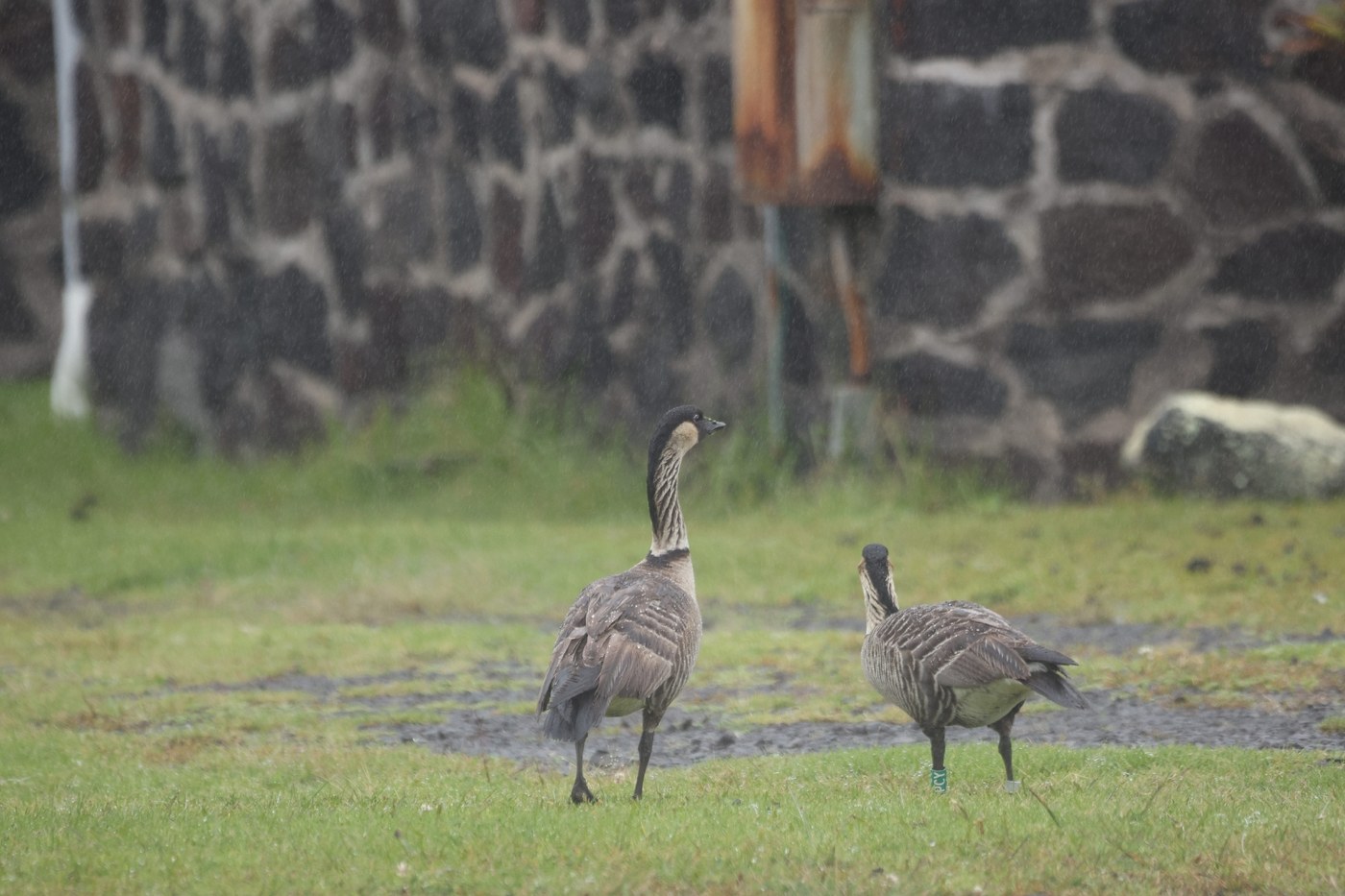
The molt is what makes December through April dangerous, and it is widely misunderstood. Nēnē are not a flightless species. They fly, including between islands, and some birds commute daily between nesting and feeding areas. What happens seasonally is a wing molt, during which adults temporarily cannot fly, at the same time of year goslings have not yet grown flight feathers. Federal analysis states the greatest number of vehicle collisions occurs between December and April, during peak breeding and molting season, when both adults and goslings are flightless for a period and are especially vulnerable. One number is missing: no authoritative source puts a duration in days on the nēnē flightless molt. The fact of it is well documented. The length is not.
The molt also changes what is legal. Under the federal rule, brooding adults and adults in molt may not be subject to intentional harassment at any time, with no seasonal exception and no workaround. A hazing program that is lawful in September can become unlawful on the same property in January without anything on paper changing.
Where They're Found
Hawaii, and nowhere else on earth. The nēnē is endemic to the Hawaiian Islands, does not migrate out of the archipelago. Alaska is confirmed absent: no record places this species anywhere in the United States outside Hawaii.
Four islands hold it, and the distribution is extremely lopsided. Nēnē occur from sea level to about 2,400 meters, roughly 7,800 feet, on Hawaii Island, Maui, Kauai, and Molokai. A single pair turned up on Oahu in 2014, nested at a national wildlife refuge, and produced three offspring; both parents and one offspring have since died, leaving two birds. Kauai holds well over half of every nēnē alive.
The population figures do not fully agree, so both are worth knowing. The 2019 federal rule reported a 2017 statewide count of 3,252 birds: 1,104 on Hawaii Island, 1,482 on Kauai, 627 on Maui, 37 on Molokai, and 2 on Oahu. Two federal documents then described the same 2022 count differently. A 2024 five-year status review gives about 3,545 statewide, with 1,034 on Hawaii Island, 306 on Maui, 6 on Molokai, and 2,199 on Kauai. A federal public advisory issued weeks later gives 3,862 statewide with 2,430 on Kauai, about 60 percent of the total. Both are federal wildlife service publications describing the same year. The one thing every source agrees on is the shape: Kauai carries the majority, and Cornell independently puts more than 60 percent of the global population on that single island.
Why Kauai, and why that answer explains this whole page. Kauai does not have an established mongoose population. The small Indian mongoose reached the archipelago in 1883 and spread across Oahu, Molokai, Maui, and Hawaii Island up to about 7,000 feet, but not Kauai, and the federal five-year review states plainly that nēnē fare best on Kauai because that predator is missing, plus there is far more lowland habitat available. The origin of the Kauai flock is documented and slightly absurd: in 1982, twelve captive geese on the island escaped and bred in the wild, and a planned release augmented them in 1991. With no mongoose finding their ground nests, they flourished. Every resort and golf course conflict on Kauai traces back to that escape.
On the ground, look for short irrigated grass, not for water. Nēnē are terrestrial. They use fresh water when it is there but do not require it and do not forage in it. Current habitat is unusually broad and heavily shaped by where captive-bred birds were released: coastal dune vegetation, nonnative grasslands including golf courses, pastures, and rural areas, sparsely vegetated lava flows at both low and high elevation, midelevation shrubland, cinder deserts, and alpine grassland. On Kauai most birds live year-round below about 1,000 feet in pastures, golf courses, and other human-altered ground.
The nesting shrub differs by island, which matters if you manage landscaping. On Hawaii Island and Maui most nests sit under native vegetation such as pūkiawe, ʻaʻaliʻi, and ʻōhiʻa. On Kauai most nesting areas are dominated by introduced species, and nēnē commonly nest under Christmas berry, shrub verbena, and ironwood. On Kauai, in other words, the shrubs a crew is most likely to want to trim are the shrubs most likely to be holding a nest.
Life Cycle
This is a bird that was rebuilt one clutch at a time, and the numbers behind that are worth knowing before anyone treats it as a nuisance. Around the middle of the last century the entire wild population was roughly 30 birds. Hawaii's wildlife division puts it at as few as 30 in the 1950s, Cornell at an estimated 30 individuals by 1957, and the federal record describes the population as below 30 when the species was listed as Endangered in 1967. The date moves; the number does not. A captive propagation program began at Pohakuloa on Hawaii Island in 1949, well before federal listing, and ran continuously until 2011, when it was stopped because the wild birds were finally breeding on their own. Federal records name the Territory and later the State of Hawaii, The Peregrine Fund, and the Zoological Society of San Diego as the partners. More than 2,000 captive-reared birds were released between 1960 and 1997.
There is a British chapter to this, and it is genuinely part of the story. A parallel captive flock was established at Slimbridge in England in the early 1950s under Peter Scott, founded on birds from a private Hawaii Island flock. The start was unpromising, because the first two birds sent over both turned out to be female, and a gander had to be flown out afterward. The flock then bred so well that Slimbridge-raised geese were shipped back to Hawaii from 1962 onward for release on Hawaii Island and Maui. The sourcing is worth being clear about: the federal rule confirms the 1949 to 2011 Hawaii program and the existence of overseas captive flocks but does not name Slimbridge, so the British detail rests on the trust's own account and on a peer-reviewed environmental history rather than on a government source.
Productivity depends enormously on where the nest is, and the gap is not subtle. A federal study of wild birds on Hawaii Island and Maui in 1978 to 1981 found that of 140 breeding attempts, 36 percent produced a successful nest and only 7 percent produced fledglings. Compare that with one managed lowland resort property on mongoose-free Kauai in the 2022 to 2023 season, where 88 percent of nests hatched at least one gosling and 68 percent of all eggs laid produced a fledged bird. Predator-free lowland grass is a far better place to be a nēnē than a high-elevation lava field, and that single contrast explains both the recovery and the conflict.

Egg
Gosling
Juvenile
Adult2
Flightless Molt3
Identification
The neck is the identification
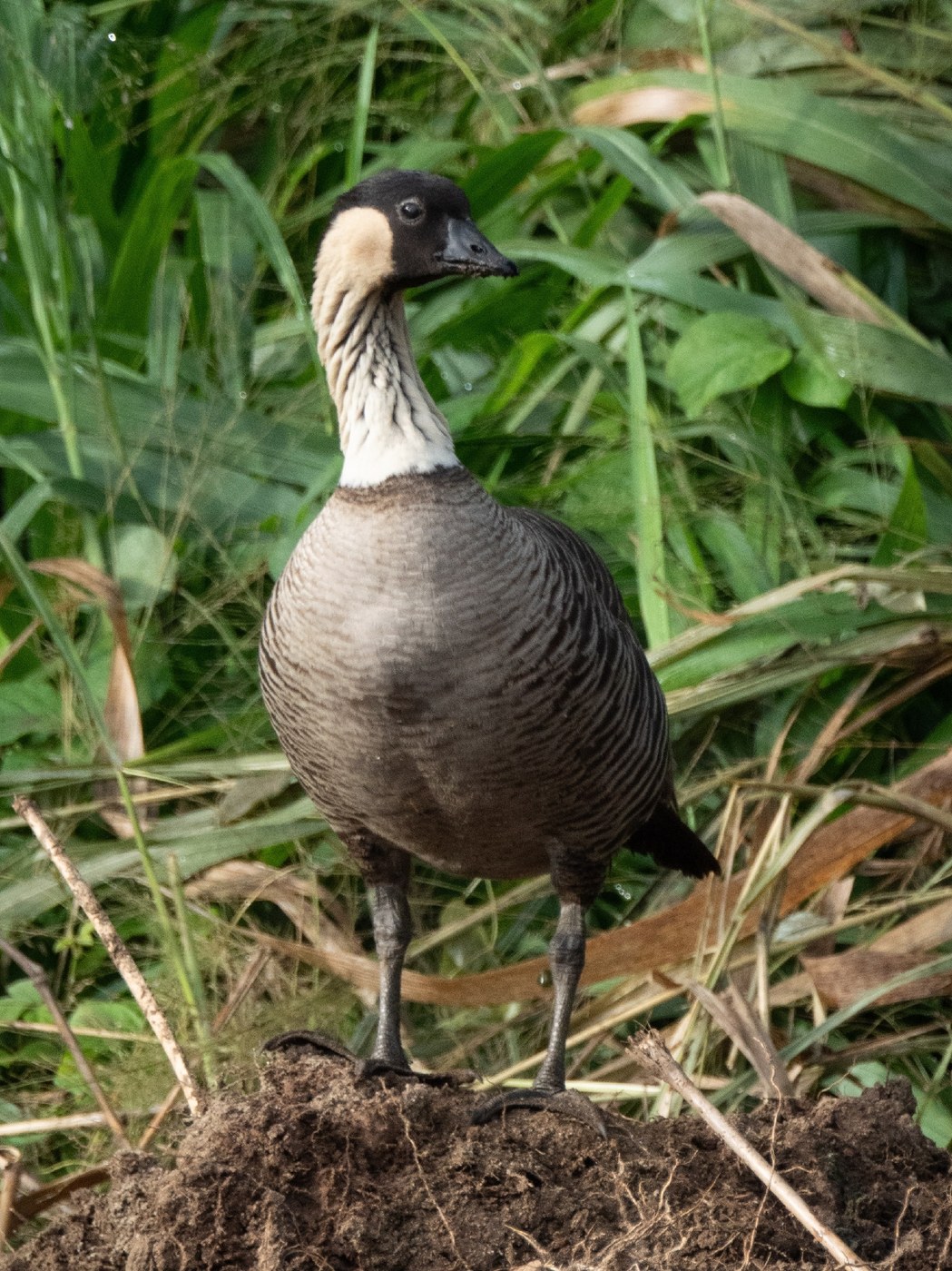
It is unlike any other goose. Black face, cap, and hindneck, a large cream to buff cheek patch, and a whitish to pale yellow neck with deep furrows, marked by black and white diagonal stripes produced by rows of white feathers over dark skin. Bill, legs, and feet are black. The body is dark brown or sepia above with extensive white feather edging, lighter brown below with some dark barring.
Reduced webbing between the toes
It is the structural tell, and two independent sources give the same reason for it. Hawaii's wildlife division states that nēnē are more terrestrial than other geese and have longer legs and less webbing between their toes, which likely helps them walk on hardened lava. Cornell describes less foot webbing plus long toes and large nails helping them walk over lava and other rugged terrain. The bird also stands more upright than geese of similar weight, which lets it reach up into shrubs to browse.
They are not flightless
Nēnē are not flightless, though the mistake is a common one. They fly, they are capable of inter-island flight, and some birds commute daily between nesting and feeding areas. What is true is that the wings are small for the body, they are weak fliers compared with a Canada goose, they take off from and land on the ground rather than water, and they go through a seasonal wing molt during which they genuinely cannot fly. Flightless for part of the year is a very different statement from flightless.
Canada goose, settled by the neck
Canada goose is the look-alike, and the neck settles it in one glance. A Canada goose has an entirely black head and neck broken only by a white chinstrap that wraps under the chin. A nēnē has black confined to the face, cap, and hindneck, with buff cheeks and a buff to whitish furrowed neck. Nēnē is also the smaller bird and has the reduced toe webbing that a Canada goose does not. In practical terms the question rarely comes up, because Canada goose is not established in Hawaii and occurs there only as an infrequent vagrant. If you are on a Hawaiian island looking at a goose, it is almost certainly a nēnē, and the burden should be on proving otherwise before anyone acts.
The relationship has been dated
The relationship to Canada goose is real, not just a resemblance, and the divergence has been dated. Analysis of mitochondrial DNA from fossils indicates a single resident population of Canada goose in the Hawaiian Islands gave rise to at least three, and possibly five, true goose species, of which only the nēnē survives. A 2024 federal status review puts the divergence of the Hawaiian lineage from the Canada goose lineage at an estimated 0.890 million years. Cornell calls Canada goose the nēnē's closest living relative. So the visitor who says it looks like a Canada goose is not wrong about the family, only about the species and about everything that follows legally from that.
A note on the scientific name
You may see two versions. Older federal documents and some database entries carry Branta (=Nesochen) sandvicensis. The 2019 final rule corrected the federal list, stating that Nesochen is not currently a scientifically accepted generic name for this species, and at the same time formally added the Hawaiian name to the list as an alternative common name alongside Hawaiian goose.
Group size is a quiet identifier
Nēnē are less social than other geese. Pairs and families stay tight, but flocks are usually smaller than 30 birds, and even within a flock unrelated individuals keep their distance from one another. A large, dense, mixing flock of geese on a water body does not fit this species.
Many Kauai birds are banded
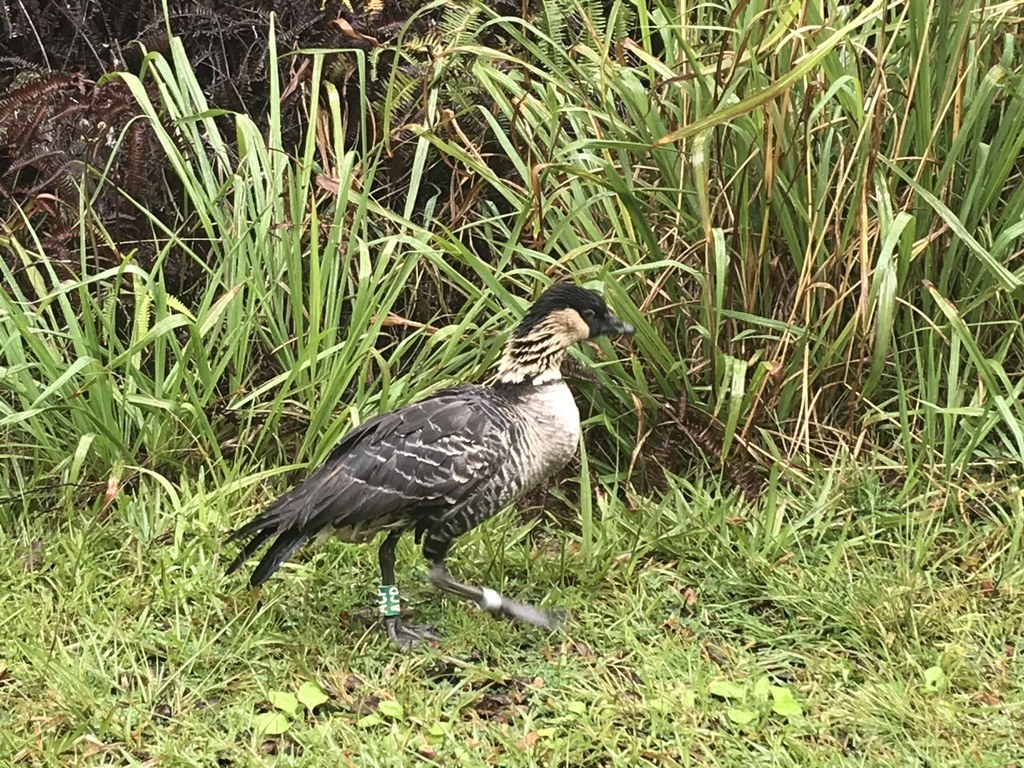
Many of the birds on a managed Kauai property are individually banded. Resort and golf properties operating under conservation agreements track nēnē by colored, coded leg bands, with band numbers recorded against pair bonds and nest locations. One Kauai property's 2022 to 2023 season recorded 50 state-banded birds and one federally banded bird using the grounds on top of the 25 nesting pairs it was already monitoring. A band is a sign that this bird is already in somebody's dataset.
Signs of Infestation
This is not an infestation
There are no signs of one. Nēnē do not enter buildings, do not nest in structures, and no property damage, foundation damage, chewing, attic noise, or odor is documented for the species. What follows is what a homeowner, groundskeeper, or property manager would actually notice.
A family grazing on irrigated turf
A pair or family group grazing on short, irrigated, fertilized turf. That is the whole attraction. Federal analysis names the young shoots of recently mown or irrigated lawns along roadsides and golf courses as a specific draw, and notes the birds forage along highway edges and ditches because mowing plus pavement runoff produces better grass there than anywhere nearby.
A ground nest from late October
A ground nest under a shrub, from as early as late October. Look for a shallow scrape with a raised rim of soil, leaves, twigs, and feathers, lined with down. On Kauai check under Christmas berry, shrub verbena, and ironwood; on Hawaii Island and Maui under native pūkiawe, ʻaʻaliʻi, and ʻōhiʻa. One Kauai property found its first nest of the 2022 to 2023 season on October 25 and its last on January 3.
Goslings with two attending adults
Goslings on the ground with two attending adults. They leave the nest within a day or two of hatching and feed themselves immediately, so a walking brood is normal and does not mean anything has gone wrong.
Birds that will not fly off in midwinter
Between December and April adults are molting and goslings have not grown flight feathers. If a family group walks away from you instead of flying, that is the diagnostic sign for this season, and it changes what is legal on the property.
Birds standing on pavement
Hawaii's wildlife division gives the reason, and it is worth repeating to anyone who wonders why the birds keep choosing the road: paved surfaces look like pahoehoe lava to a nēnē, which makes them a good place to warm cold feet in the morning.
Colored leg bands
On Kauai, resort properties working under a habitat conservation plan band their resident birds and track them individually. Do not attempt to read a band by approaching the bird.
What you will not find
No droppings inside a structure, no gnawing, no wall or attic sounds, no burrows, no smell. If something is getting into your building, it is not this bird.
Prevention and When to Call a Pro
Removal is not an option
There is no lawful way to make it one. The nēnē is federally listed as Threatened, protected under the Migratory Bird Treaty Act, and listed as Endangered by the State of Hawaii under that state's own rule exhibit, which is three separate bodies of law covering one bird. There is nothing to exclude, because the species never enters a structure. What follows is what you must not do, the narrow set of things a landowner may lawfully do, and who to call.
Never harm or relocate a nēnē
Never take, harm, harass, capture, kill, or relocate a nēnē. The 2019 downlisting did not relax the take prohibition. The federal special rule expressly keeps it in place, along with prohibitions on import and export, possession of unlawfully taken specimens, interstate or foreign commerce, and sale. State law prohibits take independently, and the species is still state-listed as Endangered even though it is federally Threatened.
Never disturb a nest
Do not reason from Canada goose rules either. This is the mistake most likely to get a property manager in trouble. Canada goose has a federal nest and egg depredation order that a registered landowner may use to oil or destroy eggs. Nēnē has no equivalent. No registration, no order, no homeowner path to touching a nest, an egg, or a gosling. Anyone applying Canada goose logic to a nēnē is applying the wrong species' rules.
Never feed them
Never leave pet food outside either. This is the instruction both the federal and state agencies repeat hardest, because it is the upstream cause of most nēnē deaths. Feeding conditions the birds to be unafraid of people, which brings them to cars, roads, parking lots, and homes. Hawaii's wildlife division states directly that nēnē should not eat human food or cat food, and that leaving food out for feral cats causes the same problem while adding a disease pathway.
Never haze a brooding adult
That covers an adult with goslings and an adult in molt. For a landowner working under the 4(d) rule, that bar holds at any time, with no seasonal exception and no property-type exception.
Do not expect a removal company
Do not call a pest control or nuisance wildlife company expecting a removal. There is no lawful removal service for this species. A licensed operator has no more authority over a listed bird than a homeowner does, and no service to perform.
There is a legal way to deter
Here is the part that is genuinely useful, and that almost no general-audience source covers correctly: there is a legal way to deter nēnē, and it was written for exactly this situation. When the species was downlisted in 2019, the federal government adopted a section 4(d) rule specifically to give landowners management flexibility, because concern about penalties had itself become a barrier to recovery. Under that rule, intentional harassment that is not likely to cause direct injury or mortality is excepted from the take prohibition, and a person may haze nēnē on lands they own, rent, or lease, with no individual federal permit.
The permitted techniques
The rule names the permitted techniques, and this list is the actual regulatory text rather than someone's best guess. Predator effigies including raptor kites and predator replicas. Commercial chemical bird repellents. Ultrasonic repellers. Audio deterrents such as noisemakers and pyrotechnics. Herding or harassing with trained or tethered dogs. Access control including netting and fencing. Nēnē may also be harassed during surveys that benefit and further their recovery. All of it must avoid causing direct injury or mortality.
Four conditions ride on it
Four conditions ride on that permission, and they are not optional. First, before any intentional harassment during the breeding season, defined in the rule as September through April, a qualified biologist knowledgeable about nēnē nesting behavior must survey in and around the area for nests and goslings. The rule defines a qualified biologist as someone with both academic training in wildlife biology or a related discipline and demonstrated field experience with this species. Second, if a nest is found, federal and authorized state wildlife officials must be notified within 72 hours. Third, no disruptive activity may occur within a 100-foot buffer around any active nest or brood until the goslings have fledged, brooding and molting adults may never be harassed, and the landowner must arrange follow-up surveys by qualified biologists. Fourth, any injury or death connected to these activities must be reported within 72 hours, and remains may only be disposed of as the wildlife service directs.
Hawaii law may not line up
The most important caveat is that the federal rule does not change Hawaii law, and the two may not line up. The rule says so itself and then goes further. It states the federal understanding that Hawaii's endangered species statute contains no authority to issue an equivalent rule, that state incidental take requires a license attached to a habitat conservation plan or safe harbor agreement plus consultation with the state's recovery committee, and that Hawaii's own administrative rules for endangered and threatened wildlife did not allow permits for intentional harassment or hazing of a listed species, so changes to those state rules may be necessary. Nēnē is state-listed as Endangered, and that is not just the wildlife division's description of itself: the state's own administrative rule exhibit, the List of Species of Endangered Wildlife in Hawaii, carries the Hawaiian goose by name for its entire range. Nothing in the available research confirms that Hawaii has since amended its hazing-permit rules, and the chapter that contains them is in flux, with proposed amendments still posted against a Board of Land and Natural Resources meeting date in May 2026. So the federal government has expressly permitted landowner hazing under conditions, while the state may not have a mechanism to permit it. Confirm the current state position with the forestry and wildlife division before you start, not after.
Two other federal exceptions
Neither is a homeowner activity. Incidental take during nonnative predator control or habitat management carried out for nēnē conservation purposes, with reasonable care, is excepted. So are actions by state and local law enforcement officers, working with authorized biologists and rehabilitators, to aid or euthanize a sick, injured, or orphaned bird or to dispose of or salvage a dead one.
Stop the feeding, permanently
Stop the feeding first, permanently, and enforce it. On a resort, golf course, or association property, a posted and enforced no-feeding rule is the cheapest and highest-value intervention available, and it addresses the mechanism behind vehicle strikes, habituation, and much of the aggression risk to the birds themselves. Feeding feral cats counts, both because it draws nēnē to the food and because cats carry toxoplasmosis, which Hawaii's wildlife division names as a deadly disease that reproduces only in cats and that kills nēnē.
Slow the vehicles down
Put it in writing. Vehicle collision is the leading cause of death for adult nēnē. The Kauai resort with the best-documented program runs a 14 mile per hour property speed limit backed by speed bumps and dozens of crossing, slow-down, and do-not-feed signs, some permanent and some portable and repositioned as bird activity shifts across the property. That is the standard worth borrowing.
What a legal golf course does
What a legally operating golf course actually does, since this is the real-world template. On the Kauai property operating under federal and state incidental take authorizations, every golf cart carries a GPS system that maps current nest locations, flashes a warning as a cart nears a nest, throttles the cart to 5 miles per hour or less near a protected bird, and physically stops the cart from continuing on a route toward one. The course maintains a local rule allowing a player to move a ball away from a nest area. Starters and marshals get additional species training beyond the standard staff program, and grounds and golf staff are briefed every morning on where the birds are. Supplemental grain feeders are prohibited. Nests are monitored daily from September 15 through March 31 by designated biological monitors recording band numbers, pair bonds, nest locations, eggs laid, eggs hatched, goslings fledged, and mortalities. Predator control runs year-round: in one twelve-month reporting period that property removed 26 cats, 22 pigs, and 1,149 feral chickens across traps checked daily.
Federal specialists run the hazing
Hazing on that property is run by federal wildlife specialists, not by the resort, and the detail is instructive. A program that began in June 2019 and was announced that August puts professionally trained border collies and their handlers on the ground to flush nēnē away from the runways of the adjacent airport, which surrounds the resort. Handlers also work from golf carts, on foot at a walk or run, and with handheld flags and flashlights. A spotter with an infrared scope or night-vision binoculars tracks where flushed birds land so they can be moved again. The program deliberately excludes noise deterrents so as not to disturb resort guests, which is a real operational constraint worth knowing about before anyone buys a propane cannon. Only nēnē may be hazed, and not if they have goslings or are molting. Partners include the federal agriculture and wildlife agencies, the state land and natural resources and transportation departments, and the resort itself.
Translocation was abandoned
Translocation was tried at scale on Kauai and was abandoned. Between 2011 and 2016, 646 nēnē were moved off the island, 598 to Hawaii Island and 48 to Maui, under an emergency proclamation and a five-year management plan. State capture and translocation ended in March 2016, and nesting numbers on the resort began climbing again afterward. One professional-society account of the same program gives 652 birds rather than 646; the federal rule's figure is used here. The state's stated alternative, announced alongside the canine program, was to establish two new nēnē sanctuaries east and south of the airport in the hope that displaced birds would settle there instead.
Talk about a conservation agreement
A large landowner with recurring nēnē presence should be discussing a conservation agreement, not a deterrent purchase. Incidental take in Hawaii is authorized through a temporary license attached to a habitat conservation plan or a safe harbor agreement, with consultation by the state's endangered species recovery committee. That is a multi-year commitment with real obligations, including monitoring, predator control, financial assurances, and annual public reporting. The Kauai resort described above paid a one-time 85,000 dollar mitigation payment into the state endangered species trust fund and maintains a bond of 153,667 dollars as a financial assurance, against a permitted take ceiling of 17 birds over the life of the permit.
Call at once for an injured bird
Call immediately if a nēnē is injured, sick, or dead on your property. Federal reporting for injury or mortality connected to any excepted activity is required within 72 hours. The numbers come straight out of the federal rule: the wildlife service law enforcement office at 808-861-8525, the Pacific Islands fish and wildlife office at 808-792-9400, and Hawaii's division of forestry and wildlife at 808-587-0166.
Call before any deterrent
Call before you do anything if you are contemplating deterrents on a property nēnē use, especially between September and April. The pre-hazing nest survey by a qualified biologist is a condition of the federal exception, and Hawaii's own permitting position needs confirming separately. To report someone harming a protected species, Hawaii runs a 643-DLNR tip line and a reporting app.
Stop work if a nest turns up
Stop work and call if a nest, eggs, or goslings turn up on a construction, grading, or landscaping site. That is a take liability situation under both federal and state law. Permitted biologists exist for exactly this circumstance. Guessing does not.
Five things a resident can do
The five things a resident can actually do, in the state agency's own framing. Keep your food to yourself, meaning do not feed nēnē, do not feed feral cats, and do not leave pet food outside. Keep your dogs on a leash, because even well-behaved dogs can threaten or kill these birds and every Hawaii county has a leash law. Keep your cats indoors, because fed cats still hunt goslings and their waste spreads toxoplasmosis. Keep your speed down near nēnē, because a large bird needs a long runway to take off and cannot jump into the air to dodge a car. Keep your distance, because approaching for a photo can push a bird into a road, keep it from eating, or drive it off a nest.
Frequently Asked Questions
Is the nēnē endangered or threatened?
Both answers are correct depending on which government you ask, which is why so much content on this gets it wrong. Federally it is Threatened. It was listed as Endangered on March 11, 1967, and a final rule published December 19, 2019 reclassified it to Threatened effective January 21, 2020. The State of Hawaii still lists it as Endangered. It is separately protected under the Migratory Bird Treaty Act. A federal five-year status review completed in 2024 recommended no change to the federal listing. None of that changes what you may do: taking, harming, or harassing one is prohibited under all three.
There are nēnē all over our golf course. Can we get rid of them?
You cannot remove or relocate them, but the 2019 downlisting created a real legal path for deterring them, and that path is the most useful thing to know. The federal special rule excepts intentional harassment that is not likely to cause direct injury or mortality when a person conducts it on land they own, rent, or lease, with no individual permit. The rule names the techniques: predator effigies such as raptor kites and predator replicas, commercial chemical bird repellents, ultrasonic repellers, audio deterrents including noisemakers and pyrotechnics, herding or harassing with trained or tethered dogs, and access control such as netting and fencing. The conditions are strict. During the September through April breeding season a qualified biologist must survey for nests and goslings first. Any nest found must be reported to federal and state officials within 72 hours. A 100-foot buffer applies around active nests and broods until the goslings fledge. Brooding and molting adults may never be hazed. Follow-up surveys are required. And one more thing to settle before you start: the federal rule itself notes that Hawaii's own regulations did not, as of 2019, allow permits for hazing a listed species, so confirm the current state position with the forestry and wildlife division first.
Can we move a nēnē nest off the fairway, or oil the eggs the way people do with Canada geese?
No. There is no nēnē equivalent of the Canada goose nest and egg depredation order, no registration program, and no homeowner path to handling a nēnē nest, egg, or gosling. Anyone applying Canada goose logic here is applying the wrong species' rules. The federal rule keeps the full take prohibition in place and requires a 100-foot buffer around any active nest until the goslings have fledged. The only lawful golf course response to a nest on the course is to work around it, which is exactly what the Kauai property operating under a conservation agreement does: it posts warning signs, programs the nest location into every cart's GPS, and maintains a local rule letting players move a ball away from the nest area.
Why are there so many nēnē on Kauai in particular?
Because Kauai has no established mongoose population, and mongoose are the principal introduced nest predator everywhere else. The small Indian mongoose reached the archipelago in 1883 and spread across Oahu, Molokai, Maui, and Hawaii Island up to about 7,000 feet, but not Kauai. A federal status review states directly that nēnē fare best on Kauai because that predator is absent and because there is far more lowland habitat there. The origin of the flock is a small accident with large consequences: in 1982, twelve captive geese on Kauai escaped and bred in the wild, augmented by a planned release in 1991. With nothing finding their ground nests, they thrived. More than 60 percent of the world's nēnē now live on that one island, which is also why the resort and golf course conflicts are concentrated there.
Why won't the nēnē on our property fly away in the winter?
They probably cannot. Adults replace their flight feathers in a seasonal wing molt and are temporarily unable to fly, and goslings cannot fly until their flight feathers grow in. Federal analysis reports that the greatest number of nēnē vehicle collisions happens between December and April, during peak breeding and molting season, precisely because both adults and goslings are flightless for part of it. Two consequences follow. Drive slower on the property in those months than you think you need to. And understand that hazing molting or brooding adults is not merely ineffective during that window, it is expressly prohibited at any time. No duration in days for the flightless period is available, because no authoritative source provides one.
Is it really that bad to feed them?
Yes, and it is the mistake agencies flag hardest, because it is the upstream cause of most nēnē deaths. Feeding conditions the birds to be unafraid of people, which brings them to cars, roads, parking lots, and homes, and vehicle collision is the leading cause of death for adult nēnē. There is a second-order version people miss entirely: leaving food out for feral cats draws nēnē to the same spot and adds toxoplasmosis, a disease that reproduces only in cats and that Hawaii's wildlife division names as a killer of nēnē, monk seals, and other native wildlife. Hawaii's own guidance is blunt about it. Do not feed nēnē, do not feed feral cats, and do not leave pet food outside.
How did the nēnē come back, and how close did it get?
Very close. Around the middle of the last century the entire wild population was roughly 30 birds, all on Hawaii Island. Hawaii's wildlife division says as few as 30 in the 1950s, Cornell gives an estimated 30 by 1957, and the federal record describes the population as below 30 at the 1967 listing. A captive propagation program started at Pohakuloa in 1949, before there was any federal listing to require it, and ran until 2011 when it was stopped because wild birds were finally breeding on their own. More than 2,000 captive-reared birds were released between 1960 and 1997. A parallel flock was established at Slimbridge in England in the early 1950s, and Slimbridge-raised geese were shipped back to Hawaii from 1962 for release on Hawaii Island and Maui. The statewide population today is somewhere above 3,500, with federal sources giving about 3,545 and 3,862 for the same 2022 count. The species remains dependent on active management, which is why it is Threatened rather than delisted.
Will nēnē damage my house, roof, or lawn?
No. They are ground-feeding grazers that do not enter structures, do not nest in buildings, and no structural, foundation, or hardscape damage from the species is documented. What they do is graze turf and leave droppings on it. The property risk with this bird is legal, not physical. If something is getting into your building, it is not a nēnē.
Is that a Canada goose on our Hawaii property?
Almost certainly not. Canada goose is not established in Hawaii and occurs there only infrequently as a vagrant, while nēnē is endemic and present on four islands. The neck decides it in one glance. A Canada goose has an entirely black head and neck broken by a white chinstrap under the chin. A nēnē has black only on the face, cap, and hindneck, with large buff cheeks and a buff to whitish neck marked by deep furrows and black and white diagonal striping. Nēnē is the smaller bird and has reduced webbing between its toes. The two are genuinely related, which is why the mistake happens: fossil DNA indicates a single resident Canada goose population in Hawaii gave rise to at least three and possibly five goose species, of which only the nēnē survives, with the lineages diverging an estimated 0.890 million years ago. But nothing about Canada goose management, hazing, nests, or eggs transfers to a nēnē. Identify the bird before you do anything at all.
Sources
- Endangered and Threatened Wildlife and Plants; Reclassifying the Hawaiian Goose From Endangered to Threatened With a Section 4(d) Rule, final rule, 84 FR 69918, December 19, 2019, effective January 21, 2020: the complete 4(d) rule text and its four conditions, the September through April breeding season definition, the 100-foot buffer, the 72-hour reporting requirements and contact numbers, the retained take prohibitions, Migratory Bird Treaty Act coverage, the state-law caveat about HRS 195D and HAR 13-124, the 2017 statewide count by island, the 646 translocations off Kauai, the absence of an established mongoose population on Kauai, the 1949 to 2011 captive propagation program, the December to April vehicle collision peak and the flightless molt, golf ball strikes, and the Oahu pair U.S. Fish and Wildlife Service, via the Government Publishing Office
- 50 CFR 17.41(d), Special rules for birds, Hawaiian goose (Branta sandvicensis) (nene): the codified special rule, including the definitions of intentional harassment and qualified biologist, the named permitted deterrent techniques, the nest survey trigger, and the prohibition on harassing brooding or molting adults Electronic Code of Federal Regulations
- Nēnē (Branta sandvicensis) species profile: current Threatened status, taxonomy including the superseded Nesochen name, the 21 to 26 inch size figure, and the buff cheek and striped neck description against Canada goose U.S. Fish and Wildlife Service
- Nēnē or Hawaiian Goose (Branta sandvicensis) 5-Year Review, Short Form Summary, 2024: the 2022 statewide estimate of about 3,545 birds with the per-island breakdown, the recommendation of no change in listing status, the estimated 0.890 million year divergence from the Canada goose lineage, and the delisting criterion requiring 15 further years of stable to increasing trends U.S. Fish and Wildlife Service, Pacific Islands Fish and Wildlife Office
- Nēnē or Hawaiian Goose (Branta sandvicensis) 5-Year Review: Summary and Evaluation, 2011: the finding that nēnē fare best on Kauai because of the lack of an established mongoose population and greater lowland habitat, the roughly 400 birds using the Kauai resort during the breeding season as the island's fastest growing breeding population, and the aviation safety concern U.S. Fish and Wildlife Service, Pacific Islands Fish and Wildlife Office
- Be Pono To Nēnē, September 2024: the 2022 statewide figure of 3,862 with 2,430 on Kauai, vehicle collision as the leading cause of death for adult nēnē, golf ball strikes, and the do-not-feed, leash-your-dog, indoor-cat and drive-slowly guidance U.S. Fish and Wildlife Service
- Nēnē species page: State of Hawaii Endangered listing alongside the federal Threatened status, the reduced webbing and longer legs for walking on hardened lava, the diet across at least 50 plant species, the extended nesting season with the October to March majority and October to December clutch peak, clutch size and 30-day incubation, distribution and elevation, the island-specific nesting shrubs, the roughly 30 birds remaining in the 1950s, toxoplasmosis from feral cats, and the Five Keeps public guidance State of Hawaii Department of Land and Natural Resources, Division of Forestry and Wildlife
- Protect Hawaiian Species: Don't Feed Wild Animals: toxoplasmosis spread by feral cats killing nēnē and other native wildlife, the statement that endangered species on privately owned land remain protected under federal and state law, and the 643-DLNR reporting channels State of Hawaii Department of Land and Natural Resources, Division of Forestry and Wildlife
- News release NR19-151, Multiple Agency Effort Involving Canines to Help Keep Hawaii's Official State Bird Protected, August 20, 2019: the canine hazing pilot at Lihue Airport and the adjacent resort, the two border collies and handlers, the golf cart, walking, running, flag and flashlight methods, the partner agencies, and the plan to establish two new nēnē sanctuaries east and south of the airport State of Hawaii Department of Land and Natural Resources
- Hokuala Habitat Conservation Plan Annual Report, July 1 2022 to June 30 2023: the federal and state incidental take authorizations and permitted take ceiling, the 85,000 dollar mitigation payment and 153,667 dollar bond, the 14 mile per hour speed limit and signage inventory, the golf cart GPS nest avoidance system and 5 mile per hour throttle, the local golf rule on moving a ball away from a nest, the supplemental feeder prohibition, daily nest monitoring from September 15 to March 31, the 2022 to 2023 nesting results, the banded bird counts, the year's predator removals, the March 2016 end of state translocation, and the June 2019 start of federal canine hazing AECOS Inc. and Timbers Hokuala, filed with and hosted by the State of Hawaii Department of Land and Natural Resources
- Hokuala Habitat Conservation Plan Annual Report 2020 to 2021: the endangered species awareness training module, including the operator's own statement of civil and criminal penalties per incident and the site rules against approaching nests or feeding, petting, or approaching nēnē Timbers Hokuala, hosted by the State of Hawaii Department of Land and Natural Resources
- Kauai Lagoons Incidental Take License, signed April 11, 2012: the state license authorizing a ceiling of 17 nēnē mortality or non-lethal take over the life of the permit and the three-day mortality notification requirement State of Hawaii Department of Land and Natural Resources
- Hawaiian Goose identification: length 24.8 to 27.2 inches and weight 59.1 to 107.6 ounces, the grooved neck and cream cheek description, goslings attaining adult plumage in five months, and the note that the species does not require aquatic habitat Cornell Lab of Ornithology, All About Birds
- Hawaiian Goose life history: clutch size and egg dimensions, the 29 to 32 day incubation and the longest-incubation-of-any-goose note, precocial goslings leaving the nest in one to two days, lifelong pair bonds formed at one year and courtship on land, flocks under 30 birds, reduced webbing with long toes and large nails for walking on lava, small wings and weak flight relative to Canada goose, the 1957 estimate of about 30 wild birds, the more than 2,000 captive-reared birds released between 1960 and 1997, the 1982 escape of 12 captive geese on Kauai and the 1991 augmentation, and the more than 60 percent of the global population on Kauai Cornell Lab of Ornithology, All About Birds, drawing on Banko, Black and Banko 2020 in Birds of the World
- Constraints on productivity of wild Nene or Hawaiian geese Branta sandvicensis: of 140 breeding attempts studied on Hawaii Island and Maui during 1978 to 1981, 36 percent produced a successful nest and 7 percent produced fledglings U.S. Geological Survey
- APHIS-Trained Canines are Ready for their Close-ups: the federal canine teams working the Kauai resort between the two main runways of Lihue Airport, and the agency's framing of the work as nonlethal protection of both the nēnē and the flying public U.S. Department of Agriculture, Animal and Plant Health Inspection Service
- Watch: Hazing Hawaii's endangered geese shows early success, November 2019: the August to March hazing operational window, the emergency proclamation and five-year management plan behind the Kauai translocations, the alternative figure of 652 birds translocated, the resumption of nesting growth after translocation stopped in 2016, and the June 2019 satellite tagging of ten adult nēnē The Wildlife Society
- How Sir Peter Scott saved the nene goose: the establishment of the parallel captive flock at Slimbridge in England in the 1950s from Hawaii Island stock, the two birds that both turned out to be female before a gander arrived, and the return of Slimbridge-raised geese to Hawaii from 1962 for release on Hawaii Island and Maui Wildfowl and Wetlands Trust
- Making the Nene Matter: Valuing Life in Postwar Conservation, Environmental History: the private Hawaii Island flock that supplied the founder birds, the 1949 territorial funding of the Pohakuloa breeding project, the 1950 curator visit that transferred rearing technique, and the first successful Slimbridge breeding season in 1952 Environmental History, published by the University of Chicago Press
- Hawaii Administrative Rules Chapter 13-124 and its Exhibits, Indigenous Wildlife, Endangered and Threatened Wildlife, Injurious Wildlife, Introduced Wild Birds, and Introduced Wildlife: the definitions of endangered wildlife, threatened wildlife and take, the two independent routes by which a species becomes state endangered wildlife, and Exhibit 2, the List of Species of Endangered Wildlife in Hawaii, which carries the Hawaiian goose for its entire range. This is the primary-source confirmation of the state Endangered listing State of Hawaii Department of Land and Natural Resources, Division of Forestry and Wildlife
- Administrative Rules of the Division of Forestry and Wildlife: the currently posted proposed amendments to Chapter 124 against a Board of Land and Natural Resources meeting date of May 8, 2026, establishing that the chapter governing endangered and threatened wildlife is under active revision, plus the three enforcement routes available to the department State of Hawaii Department of Land and Natural Resources, Division of Forestry and Wildlife