Seasonal Timeline
Nesting season on the mainland pattern runs roughly early April through late July with a peak in June; no published source gives a Hawaii-specific nesting-season date range, so treat spring through mid-summer as the window to act in before a colony has eggs or young. Outside of active nesting, cattle egrets forage year-round in Hawaii's pastures, wetlands, and open grasslands.
Nesting season on the mainland pattern runs roughly early April through late July with a peak in June; no published source gives a…
The season that matters here is a legal one as much as a biological one. Before a colony forms, a property owner can legally and effectively make a site less attractive to nesting egrets. Once eggs or young are present, that option closes, because the birds and the active nest are protected under federal law. The practical lesson is to act on the calendar, not on the complaint, since the complaint usually arrives after the legal window to prevent it has already closed.
One gap in the record: the mainland breeding-season window (April to late July, peaking in June) is well documented, but no published source gives a Hawaii-specific nesting calendar. Hawaii's subtropical climate plausibly shifts or extends that window relative to the mainland population, though that has not been confirmed, so treat the mainland window as the working assumption rather than a verified Hawaii fact.
Where They're Found
In Hawaii, cattle egret is established on every main island. The population did not arrive on its own. In 1959, Hawaii's Board of Agriculture and Forestry released roughly 105 to 150 birds, imported from near Miami, Florida, across Kauai, Oahu, Molokai, Maui, and the Big Island, in a cooperative effort with cattle ranchers, the Honolulu Zoo, and a local bird club, with the explicit goal of controlling flies, ticks, and other insect pests that reduce cattle weight gain and damage hides. Nesting was observed on Oahu within a year of release. By the early 1980s the state's own population estimate had reached roughly 13,000 birds, about 120 times the original release, with the heaviest concentrations on Oahu and Kauai and smaller populations on Maui, Molokai, and Hawaii Island.
The mainland population has a completely different history. The same species naturally expanded its own range out of Africa beginning in the late 1800s, crossed the Atlantic on its own, and reached North America by the early 1950s without any human introduction at all, going on to become one of the most common herons across the southern and eastern mainland United States. Neither history decides the legal question. Federal protection runs with the species' listing at 50 CFR 10.13, not with how a particular population got where it is, which is why the deliberate 1959 Hawaii release changes nothing about the bird's status there. Both things are true about the same bird, and conflating them is the single easiest way to get this species' legal status wrong.
Alaska: no published record places an established cattle egret population in Alaska. The species is a warm-climate forager whose US range concentrates in the South, Southeast, and mild-winter coastal areas, and no evidence supports an Alaska population.
Within Hawaii, cattle egrets range across wetland areas, atolls, open pastures, and grasslands on every main island, and their nesting colonies cluster near bodies of water, including managed wetlands that also host Hawaii's endangered native waterbirds. That overlap in habitat, not distance, is exactly why the two species collide.
Related Pests
Life Cycle
The biology is ordinary. The legal weight attached to it is not. Nothing about cattle egret's life cycle in Hawaii differs from the mainland pattern in any sourced way. What differs is the legal weight the egg and nestling stages carry specifically in Hawaii, because of the standing federal control order. Once there is an active nest, the regulatory stakes change completely.

Egg
Nestling
Fledgling
Adult
Identification
Size and shape come before plumage
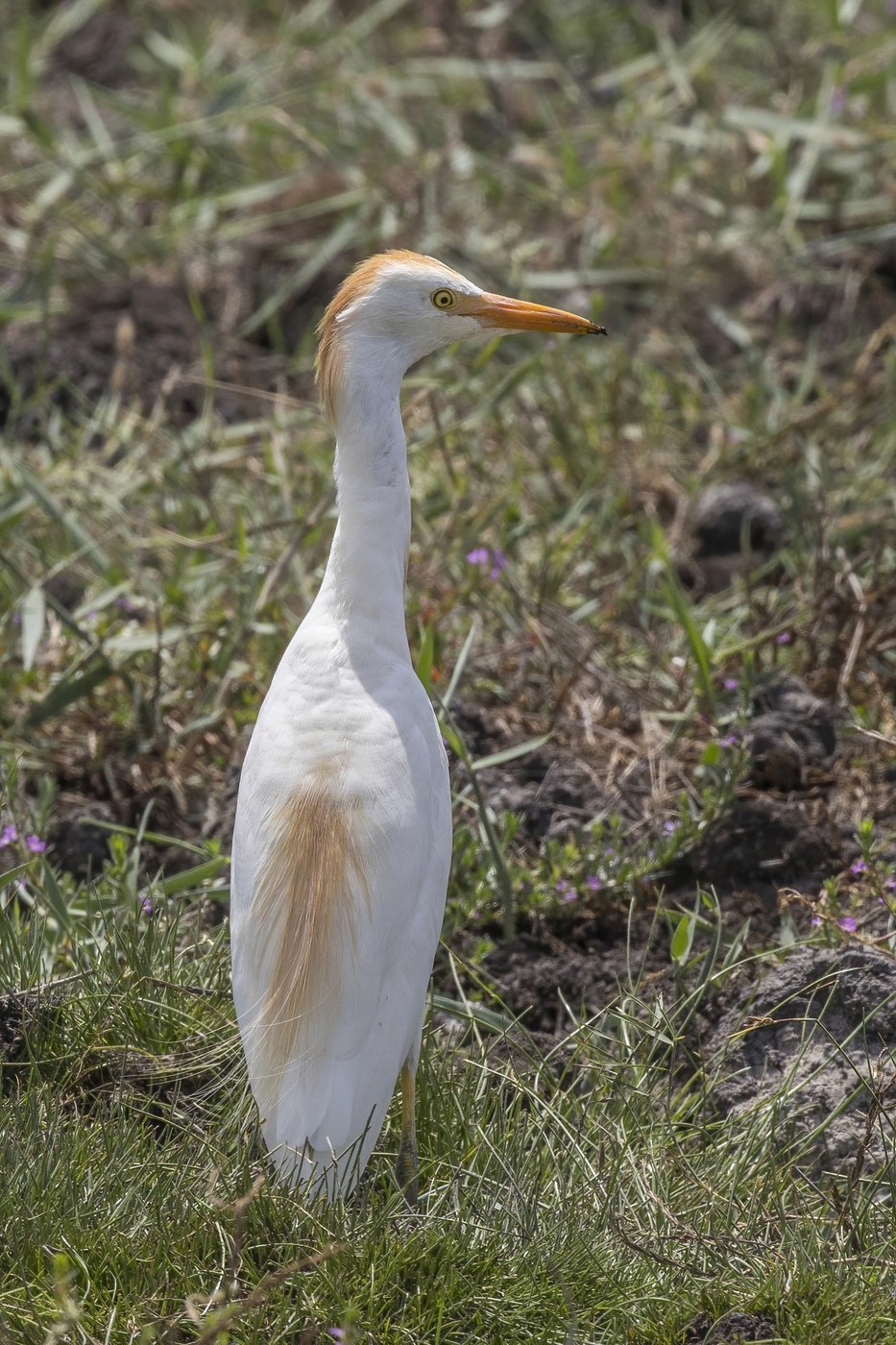
Size and shape separate this bird from every other white wading bird before plumage even matters. Cattle egret is noticeably small and compact for a heron, 18.1 to 22.1 inches long with a 34.6 to 37.8 inch wingspan and a weight of 9.5 to 18.1 ounces. It has relatively short legs, a short thick neck, and a short, thick, straight, dagger-like bill that is visibly shorter and thicker than any other egret's bill.
Seasonal color throws people
Color changes hard between seasons, and that is the point people miss. Outside breeding season, adults are entirely white with a yellow bill and yellow legs. During a short breeding window, golden buff plumes appear on the head, chest, and back, and the bill, legs, and eyes can flush red at the peak of breeding. Juveniles have dark legs and a dark bill, sometimes retained briefly after fledging, which can cause identification confusion with other dark-legged young herons.
Against snowy egret
Commonly confused with snowy egret, and the tell is size, bill, and habitat together, not any one feature alone. Cattle egret is smaller and stockier than a snowy egret. Its bill is short, thick, and yellow to orange, versus the snowy egret's long, slender, black bill with a contrasting yellow patch of skin near the eye. Its legs run yellow to gray-green (red in peak breeding), versus the snowy egret's black legs with bright yellow feet. Habitat is the fastest field check: a bird standing in a dry pasture or field, often near cattle or machinery, is almost certainly a cattle egret, while a bird wading in shallow water is more likely a snowy egret.
Against great egret, it is size
Great egret is the second bird people confuse this with, and the tell there is simpler: size. Great egret is much larger, closer in scale to a great blue heron, with a longer neck and a longer, thinner bill that stays orange to yellow year-round. Cattle egret's stockier build and shorter neck rule it out at a glance once the size difference is anchored.
What it stands next to
Behaviorally, this bird gives itself away by what it stands next to. Cattle egret forages on dry ground, in pastures, fields, and lawns, following livestock, tractors, or mowing equipment to catch insects flushed by their movement, and it is seen far less often standing in open water than other herons and egrets. In Hawaii, it rarely perches directly on livestock, preferring to forage on the ground nearby and follow mowing or plowing equipment.
Signs of Infestation
A loose flock in open pasture
A loose flock foraging in an open pasture, field, or lawn, especially near livestock or recently mowed ground, is the everyday sign. Cattle egret is the most gregarious heron species and forages in flocks of up to hundreds, walking or running with a swaying gait, necks folded in an S-shape in flight.
A heronry in a tall tree
A colony, or heronry, in the crown of a tall tree or a stand of trees is the sign that matters for a property. Colonies are often shared with other native heron and egret species and show an accumulation of stick nests, whitewashed droppings coating branches and the ground beneath, and, once nesting is underway, near-constant adult traffic to and from the site through the morning, afternoon, and an hour before sunset.
Noise and odor at an active colony
Noise and odor from an active colony are documented, common nuisance signs, not exaggerations. Multiple municipal reports describe large nesting colonies as noisy and smelly, especially once they establish close to homes, and note visible dropping accumulation on trees, sidewalks, cars, and mailboxes near the site.
Vegetation dieback under the tree
Vegetation stress or dieback under a long-used colony tree is a slower-developing sign. Heavy, repeated dropping accumulation over a nesting season can visibly damage the trees and shrubs a colony occupies.
Around aquaculture ponds in Hawaii
Foraging behavior around aquaculture ponds is a Hawaii-specific sign worth knowing. Cattle egrets have been documented taking prawns and shrimp directly from Hawaii aquaculture operations, a detail distinct from their ordinary insect-foraging habit.
Prevention and When to Call a Pro
The legal baseline
Start with the legal baseline, because it changes what "prevention" can mean here. Cattle egret (Bubulcus ibis) is explicitly named on the US Fish and Wildlife Service's list of birds protected under the Migratory Bird Treaty Act. For a homeowner or a private company, that protection applies in Hawaii exactly as it does everywhere else in the country. Hawaii does carry one narrow federal carve-out, and it reaches named agencies only, not the public. The bird's 1959 deliberate introduction to Hawaii does not remove it from that federal list, because MBTA coverage runs with the species as listed, not with whether a specific state's population arrived naturally or was released on purpose. This is the opposite situation from a genuinely MBTA-exempt introduced species like house sparrow, European starling, or rock pigeon, none of which appear on that federal list at all. No homeowner, landlord, or private pest control company may kill, trap, relocate, or intentionally disturb an active cattle egret nest, egg, or bird in Hawaii without a federal permit.
Hawaii's narrow carve-out
A specific, narrow carve-out exists in Hawaii, and it is easy to misread as a general license. It is not. Since 2013, a standing federal control order lets the personnel of ten named agencies remove or destroy cattle egrets and their nests or eggs anywhere in the state without applying for an individual permit each time. Those agencies are the Federal Aviation Administration, the Hawaii Department of Agriculture, the Hawaii Department of Land and Natural Resources' Division of Forestry and Wildlife, the National Oceanic and Atmospheric Administration, the National Park Service, the U.S. Department of Agriculture's Animal and Plant Health Inspection Service Wildlife Services, the U.S. Department of Defense, the U.S. Fish and Wildlife Service, the U.S. Geological Survey, and University of Hawaii Pacific Cooperative Studies Units with program mandates for invasive species eradication. The Fish and Wildlife Service's own stated reason is that cattle egrets "are invasive in Hawai'i and threaten native wildlife with extinction," and that nonlethal control had already proven ineffective. That order authorizes the personnel of those named agencies only. It does not authorize a homeowner, an HOA, or a private wildlife or pest control company to remove a colony on their own, no matter how invasive the species is described as being elsewhere.
Predation, not property damage
The reason this species carries that unusual federal attention is predation, not property damage. Federal rulemaking documents cattle egrets preying on the young of four of Hawaii's own endangered native waterbirds, the Hawaiian stilt, Hawaiian coot, Hawaiian common moorhen, and Hawaiian duck, with increased egret foraging activity documented on managed wetlands right as those endangered chicks are hatching. The same federal record documents egrets preying on native ground-nesting seabird chicks, including terns, noddies, and petrels, in the Northwestern Hawaiian Islands and on Midway, and describes likely predation on chicks of the pueo, the Hawaiian short-eared owl, with predation confirmed on Lanai. This is the actual mechanism behind the invasive-species designation for this bird in Hawaii, and it is a wildlife-conservation problem before it is ever a homeowner problem.
Act before nesting starts
That is the entire homeowner-level playbook for this species. The mainland nesting pattern runs roughly early April through late July, peaking in June; a Hawaii-specific nesting calendar is not documented, so treat spring through midsummer as the window to assume. Before that window, discouraging a colony from forming is legal and effective: manage or reduce the tall trees egrets favor as colony sites, and address standing water or dense wetland-adjacent vegetation near a residence that could draw birds toward the property. Once eggs or young are present in an active nest, none of this is available to a private party, and the options narrow to contacting the right agency.
Netting on aquaculture operations
Netting or exclusion barriers are the standard non-lethal answer on aquaculture or livestock operations specifically. Given the documented Hawaii problem of egrets taking prawns and shrimp directly from aquaculture ponds, physical exclusion over the water is the general direction published guidance points to. No published source gives a detailed installation specification, so treat this as a direction to pursue with a wildlife control professional rather than a do-it-yourself method.
Who to Call, and When
When to call, and who to call, matters more for this species than for most wildlife problems. If a colony is forming, call before nesting season, not after, since the legal window to act narrows sharply once eggs or young are present. The correct first call for a Hawaii property owner is the Hawaii Department of Land and Natural Resources' Division of Forestry and Wildlife or the Hawaii Department of Agriculture, both named as authorized agencies under the federal control order. They can advise directly, act if the situation qualifies under that order, or refer the case to a USFWS-permitted contractor. Do not attempt removal, nest disturbance, or any lethal method without agency involvement, and do not assume that this species' well-documented invasive status in Hawaii means a private removal is legal. It is not, for anyone outside that named list of agencies.
Frequently Asked Questions
Is it legal to remove a cattle egret nest in Hawaii?
Not for a homeowner or a private company. Cattle egret is protected nationwide under the Migratory Bird Treaty Act, and it is explicitly named on the federal list of protected species. A 2013 federal control order, now codified at 50 CFR 21.177, lets the personnel of ten named state and federal agencies remove cattle egrets and their nests without an individual permit, because of the extinction-level risk they pose to native Hawaiian wildlife. The order applies only to those ten agencies, each of which it names. It does not authorize private removal.
Why were cattle egrets brought to Hawaii in the first place?
In 1959, Hawaii's own Board of Agriculture and Forestry released roughly 105 to 150 cattle egrets across the main islands, working with cattle ranchers and the Honolulu Zoo, specifically to control the flies and ticks that damage cattle hides and reduce weight gain. It was a deliberate, documented agricultural release, not an accidental introduction.
Did introducing cattle egrets to Hawaii solve the fly problem?
No. Studies indicate cattle egrets have not been effective at controlling the agricultural pests they were released to manage. Meanwhile the population grew from roughly 105 to 150 birds in 1959 to an estimated 13,000 statewide by 1982, about a 120-fold increase, and the bird is now federally documented as a predator of Hawaii's own endangered native waterbirds.
Are cattle egrets dangerous to people or pets?
Not directly. There is no established bite, sting, or disease-transmission risk to people or pets from ordinary contact. The real, well-documented risks are a noisy, smelly nesting colony with heavy dropping accumulation, a historical aircraft-strike hazard near some airports, and predation on Hawaii's own endangered native birds.
What is the actual problem cattle egrets cause in Hawaii today?
Predation on native, often endangered, wildlife. Federal wildlife officials have documented cattle egrets preying on the young of the endangered Hawaiian stilt, Hawaiian coot, Hawaiian common moorhen, and Hawaiian duck, on native seabird chicks in the Northwestern Hawaiian Islands, and likely on chicks of the pueo, the Hawaiian short-eared owl. That ecological impact, not a threat to people or property, is what drove the species' unusual regulatory treatment in the state.
How is cattle egret different from house sparrow or European starling, which aren't protected at all?
House sparrow, European starling, and rock pigeon do not appear anywhere on the federal Migratory Bird Treaty Act's protected-species list, because none of them are native to any part of the Americas; they were introduced from Europe and have no federal protection anywhere in the US. Cattle egret is different. It is explicitly named on that same federal protected-species list, because the species naturally expanded its own range out of Africa into the Americas beginning in the late 1800s, reaching the mainland US on its own by the early 1950s. That natural colonization history is why cattle egret keeps full federal protection even in Hawaii, where a separate, deliberate 1959 release also happened.
Sources
- 50 CFR 10.13, List of Birds Protected by the Migratory Bird Treaty Act: confirms Cattle Egret (Bubulcus ibis) is explicitly named as a federally protected migratory bird species nationwide US Fish and Wildlife Service, via Cornell Legal Information Institute and eCFR
- Migratory Bird Permits; Control Order for Introduced Migratory Bird Species in Hawaii (Federal Register, November 4, 2013): the federal rulemaking documenting cattle egret predation on endangered Hawaiian stilt, coot, common moorhen, and duck young, predation on native seabird chicks in the Northwestern Hawaiian Islands, likely predation on pueo chicks, the 1959 introduction history and its stated failure to control target agricultural pests, and the named list of authorized control agencies US Fish and Wildlife Service, Federal Register
- 50 CFR 21.177, Control order for invasive migratory birds in Hawaii (current codification, formerly 21.55): full operative text of the agency-only no-permit-required removal authority, the ten named agencies, and the express limit that this authority does not extend beyond those agencies US Fish and Wildlife Service, via Cornell Legal Information Institute and eCFR
- Western Cattle-Egret Life History and Identification: size, weight, wingspan, plumage, habitat, diet, nesting facts (clutch size, incubation period, nestling period), behavior, predators, conservation status, and natural African-to-Americas range expansion history Cornell Lab of Ornithology, All About Birds
- 'Elepaio journal article on Cattle Egret roost and population survey in Hawaii: primary population-history data on the 1959 release of 105 birds, early nesting observations on Oahu, and the 13,000-bird statewide population estimate by 1982 US Forest Service Research (Treesearch)
- It's not a pet, it's a Cattle Egret: Hawaii-specific foraging behavior, diet, and predation on endangered native waterbirds Hawaii Audubon Society
- World Travelers Cattle Egret Bulbulcus ibis (Elepaio back issue): full 1959 introduction narrative including the Hawaii Board of Agriculture and Forestry, cattle ranchers, Honolulu Zoo, and Hui Manu bird club involvement, and historical Salmonella and Newcastle-disease-susceptibility notes Hawaii Audubon Society (Elepaio)
- Snowy Egret / Cattle Egret comparison fact sheet: diagnostic size, bill, and leg-color differences used to distinguish cattle egret from snowy egret, plus breeding-season and clutch data Florida Atlantic University Center for Environmental Studies
- Egret Nuisances: municipal government description of nesting-colony noise, dropping, and vegetation-damage nuisance, and confirmation that active nests are protected under the Migratory Bird Treaty Act City of Taylor, Texas
Image Credits
- Image: Charles J. Sharp via Wikimedia Commons. CC BY-SA 4.0. Resized, so this version is offered under the same license.
License.