Seasonal Timeline
Gull conflict in Alaska peaks May through August, when long summer daylight and a compressed subarctic breeding season concentrate nesting on flat commercial and industrial rooftops, landfills and transfer stations, canneries and waterfront facilities, and parking areas near food. Aggressive dive-bombing defense of nests and chicks is the single biggest driver of calls inside that window.
Gull conflict in Alaska peaks May through August, when long summer daylight and a compressed subarctic breeding season concentrate nesting…
Both species raise one brood per year, so there is exactly one nesting window per season and it is short. Egg laying for Glaucous-winged Gull runs late May into July, and chicks stay dependent for roughly five to six weeks after hatching before their first flight. That means the most aggressive stretch of the year for a property is the hatching-to-fledging period inside the May through August peak.
Do not plan against a lower 48 calendar. National deterrent and permit guidance is often written around a March and April preparation window with eggs laid from May onward. Alaska's breeding season runs later and is more compressed than that, so schedule any exclusion or deterrent work against Alaska's own window rather than a calendar transplanted from farther south. The safe planning rule is simply that the work has to be finished before eggs appear, not on a specific date.
Where They're Found
Both species are fully outdoor birds that have adapted heavily to human infrastructure. In populated Alaska, the conflict sites are consistent: flat commercial and industrial rooftops, landfills and transfer stations, cannery and waterfront facilities, and parking lots next to a food source. Natural Glaucous-winged Gull nests are ground scrapes, sometimes on cliffs, and a flat gravel roof or an open vacant lot reads to the bird as the same thing. The Alaska Department of Fish and Game's own Anchorage wildlife planning material documents more than 100 ground nests on a single midtown Anchorage lot in one spring, which is a useful measure of how fast an unmanaged site can go from a few birds to a colony.
Short-billed Gull adds a habit no other gull in this group has. It is the only white-headed gull that regularly nests in trees, building either a ground scrape near water or a platform nest up to about 20 feet up in a stump or a dense low spruce. It breeds in both marine and freshwater settings, including tundra, marshes, streams, and islands, and it is documented in south-central Alaska and the Anchorage area specifically. If a nest is above your head in a spruce rather than out on the gravel, that is a strong clue to which of the two species you are dealing with.
Alaska is where these two gulls turn into a property problem. Both species range farther south along the Pacific coast, and Glaucous-winged Gull is a year-round resident well south of Alaska, but the nuisance pattern described here, meaning canneries, landfills, and flat commercial roofs, is the Alaska community pattern. Neither species is established in Hawaii. Short-billed Gull turns up there only as a rare vagrant, and no source places Glaucous-winged Gull in Hawaii at all.
Life Cycle
Both species are colonial breeders, and that is what turns one nest into a property problem. Glaucous-winged Gull nests in colonies that are often densely packed, and Short-billed Gull is loosely colonial with variable colony size. A flat roof or open lot that produces a few nests one summer can produce many more the next, because the site itself is what the birds are selecting. The multi-year path to adult plumage compounds it: birds that are too young to breed still associate with the colony, so the visible flock is always larger than the number of active nests.

Egg
Chick
Fledgling
Subadult
Adult
Identification
Glaucous-winged wingtips
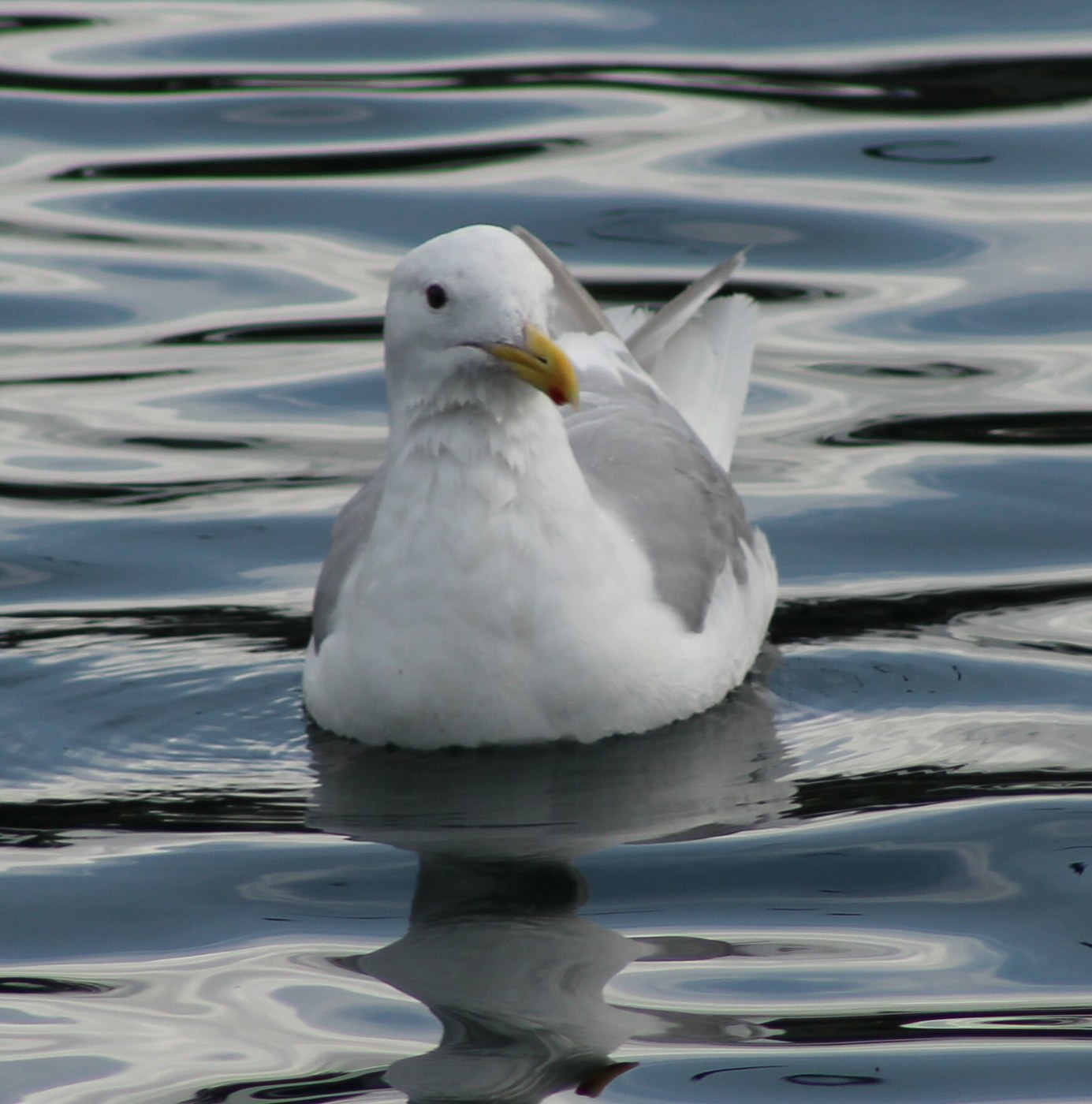
The Glaucous-winged Gull's wingtips are the single best mark, and they are unusual. This species has no black in its wingtips at any age or plumage. The tips are pearly gray, the same shade as the back and mantle, with white spots called mirrors. Almost every other gull you will see has black out at the wingtip, so a large pale gull whose wingtips and back are the same color is very likely this species.
Short-billed Gull is much smaller
Short-billed Gull goes the other way, and it is much smaller. Adults have a medium gray back, a white head and underparts, and black wingtips with white spots. It runs 16 to 18 inches long with a 42 to 45 inch wingspan against the Glaucous-winged Gull's 20 to 27 inches and 47 to 59 inch wingspan, which is roughly half the wingspan and a third of the weight. If you are not going to analyze wingtip color, size alone separates them most of the time.
Check the bill and legs on the smaller bird
Short-billed Gull has a short, slender, unmarked yellow bill, yellow legs, and a dark eye with red orbital skin. Its small rounded head and short neck give it a gentle expression next to bulkier gulls. Glaucous-winged Gull has pink legs and a heavier yellow bill with a red spot near the tip.
Herring Gull, on the large bird
Herring Gull is the look-alike that trips people up on the large bird. Herring Gull also occurs in Alaska and has a pale gray mantle, but its wingtips are vividly black and contrast sharply with the back. Glaucous-winged Gull's do not contrast at all.
Glaucous Gull errs the other way
Glaucous Gull is the other large look-alike, and it errs the opposite way. Its wingtips are pure white rather than gray. So on a big pale gull, the sequence is black wingtips for Herring, white for Glaucous, and gray matching the back for Glaucous-winged.
Ring-billed and Bonaparte's
Ring-billed Gull and Bonaparte's Gull are the confusions on the small bird. Ring-billed Gull is larger with a paler gray back and a distinct dark ring encircling the bill near the tip, which Short-billed Gull's plain yellow bill lacks. Bonaparte's Gull is smaller still, with a thin black bill instead of a yellow one and red legs in breeding plumage rather than yellowish.
Some birds will not key out
Expect some birds that do not key out cleanly. Glaucous-winged Gull hybridizes regularly with Western Gull, producing the informally named Olympic Gull, and with Herring Gull. Hybrids show intermediate wingtip shades that complicate field identification even for experienced birders. If a bird looks like it is halfway between two of the descriptions above, that is a real possibility rather than an error on your part.
Most are not in adult plumage
Most of the year, a lot of the gulls you see are not in adult plumage at all. Glaucous-winged Gull needs 4 years to reach full adult plumage and Short-billed Gull needs 3, so brown and mottled intermediate birds are common and normal. Identify from the adults in a group first, then work outward.
Signs of Infestation
Nests on flat roofs, ledges, or open ground
Glaucous-winged Gull builds a shallow scrape lined with grass, moss, seaweed, and debris, and a flat gravel roof or a vacant lot suits it as well as a natural site. Short-billed Gull may instead build an elevated platform nest in a stump or a dense low spruce, up to about 20 feet up.
Droppings on roofs and vehicles
Accumulated droppings on roofs, vehicles, and walkways. Persistent fouling is usually the first complaint from a property manager, and it is also what accelerates wear on roofing material.
Torn bags near dumpsters
Torn garbage bags and scattered food waste near dumpsters. Glaucous-winged Gull in particular is a broad omnivore and scavenger that readily opens unprotected garbage bags, which is precisely why canneries, landfills, and dumpster areas draw them.
Adults loitering at a food source
Large numbers of adult birds loitering at a food source, in parking lots, at landfills and transfer stations, or around cannery and waterfront facilities, often well before any nest is visible. Loitering birds are the early warning that the site is being evaluated.
Roof damage
The Alaska Department of Fish and Game describes urban gulls destroying roofing while vigorously defending nests on roofs and other structures, along with fouling water and increasing nest predation on other birds.
Repeated calling near a nest
Loud, repeated calling, especially near a nest. Calling intensifies sharply during breeding season territorial defense and when the birds are reacting to someone approaching a nest.
Dive-bombing at people on foot
Nesting gulls swoop at anyone they read as a threat near a nest, egg, or chick, and sometimes defecate or vomit on them, with the behavior most intense in the roughly six-week stretch between hatching and first flight. Around a commercial building, this often becomes a staff safety and access complaint before it becomes a property complaint.
Odor from droppings and garbage
Odor from accumulated droppings and from the unsecured garbage that drew the birds in. The smell tends to point back to the attractant, which is where the fix has to start.
Prevention and When to Call a Pro
Both gulls are federally protected
Start with the fact that governs everything else: both of these gulls are federally protected under the Migratory Bird Treaty Act. They are native North American migratory birds, and they are not among the four introduced species the Act specifically exempts, which are the House Sparrow, the European Starling, the Rock Pigeon, and the Eurasian Collared-Dove. Killing, capturing, or possessing a gull, its eggs, or its chicks is illegal without a federal permit, and so is destroying, disturbing, or removing an active nest, meaning one that currently holds eggs or dependent young or is otherwise in use for breeding. That prohibition applies to a licensed operator the same way it applies to a homeowner.
The active-nest permit is real
The permit that covers an active nest is a real federal process, not a formality. Managing an active nest, its eggs, or its chicks requires a federal Migratory Bird Depredation Permit from the U.S. Fish and Wildlife Service. The Service's own guidance is that nest removal permits are usually only issued when the particular nest is causing a human health or safety concern or the birds are in immediate danger, so a permit is not something a property should assume it can obtain on request. Plan on a review period measured in months rather than days. Practically, that means a property discovering an active nest in June is very unlikely to get federal relief inside the same season.
Active versus inactive nests
The active versus inactive distinction is the line the law actually draws, and it is worth stating precisely. The Fish and Wildlife Service is explicit that the Act contains no prohibition on the destruction of a bird nest alone, with no eggs or birds in it, provided no possession occurs. That is a legal fact, not a do-it-yourself instruction. Judging whether a nest is genuinely inactive, and doing anything about it without straying across the line, is exactly the call to hand to a licensed nuisance wildlife control operator, because getting it wrong is a federal violation rather than a bad outcome.
What is fully legal, no permit
Now the part that is fully legal without any permit, and it is not a workaround. It is a separate category. None of it touches a bird, an egg, or an active nest, which is precisely why none of it requires federal authorization at any time of year.
Secure food attractants year-round
Covered and gull-proof dumpster lids, no open food waste, and no intentional or incidental feeding of birds. This is the approach the Alaska Department of Fish and Game names first for reducing gull conflict in Anchorage, and it is the one measure that carries no legal complication in any month. It is also the measure that decides whether the property is attractive enough to be selected for nesting in the first place.
Exclude before nesting starts
Install physical exclusion before nesting starts, while the site is completely free of any nest, egg, or chick. Netting, wire mesh, overhead grid-wire systems, and anti-perching spike strips on flat rooftops and ledges prevent birds from reaching a nesting surface at all. Installed ahead of the season, this is prevention rather than take, it requires no federal permit, and it is the most durable option available. It has to be in place early and it must not trap or injure birds that are already present.
Hazing is also permit-free
Non-lethal hazing and deterrents are also permit-free. Harassing or scaring live gulls does not require a federal depredation permit, with the general exceptions being eagles and federally listed threatened or endangered species, neither of which applies here. Visual scare devices, laser deterrents, and professional deterrent programs are all in this category, and they work best applied consistently and early, before eggs are laid.
Once eggs are laid, you are done
Once eggs are laid, exclusion and hazing are off the table on that surface for the season. Netting, spikes, grid-wire, and deterrents aimed at an active nest stop being prevention and become disturbance of protected birds. Securing garbage and food attractants is the exception and stays legal in every month, because it never touches a bird, an egg, or a nest. This is why the calendar is the whole strategy with gulls, and why the right question in early spring is not whether you have a gull problem yet but whether you had one last year.
Call now for an active nest
Call a professional immediately, before doing anything else, if an active nest with eggs or chicks already exists or if dive-bombing has already started. At that point the legal options have closed for the season and the correct next call is a licensed nuisance wildlife control operator who can work the federal permit process if the situation genuinely warrants one, or the Alaska Department of Fish and Game for state-level guidance. It is not a trip to buy a deterrent. Note which agency does what: the Alaska Department of Fish and Game is the state wildlife authority, but the federal migratory bird permit itself is issued by the U.S. Fish and Wildlife Service.
Call proactively in late winter
Do it if the property has any history of gull nesting. A flat commercial roof, a waterfront or cannery site, or a lot next to a landfill that hosted gulls last year will be evaluated again this year. Exclusion installed before the May through August peak avoids the permit question entirely, which is a far better position than trying to solve an active nest in July.
Frequently Asked Questions
Is it legal to remove a seagull nest from my roof in Alaska?
Only if the nest is genuinely inactive, meaning no eggs and no chicks. Both the Glaucous-winged Gull and the Short-billed Gull, still widely called the Mew Gull, are federally protected native species under the Migratory Bird Treaty Act, and removing an active nest or handling eggs or chicks requires a federal Migratory Bird Depredation Permit. The U.S. Fish and Wildlife Service is clear that the Act carries no prohibition against destroying an empty nest by itself, but deciding whether a nest is actually inactive is the part worth handing to a licensed wildlife control operator, because a wrong call is a federal violation rather than a minor error.
Why do gulls dive-bomb people near my building?
It is nest defense, not aggression at random. Gulls swoop at anyone they perceive as a threat near their nest, eggs, or chicks, and they sometimes defecate or vomit on the target as part of the same behavior. It is most intense in the roughly six-week window between hatching and the chicks' first flight, which in Alaska falls inside the May through August peak. If dive-bombing has started, an active nest is nearby, and that means the legal options for the season have already narrowed.
What is the difference between a Glaucous-winged Gull and a Mew, or Short-billed, Gull?
Size and wingtip color. Glaucous-winged Gull is much larger, up to 27 inches long with a wingspan up to 59 inches, and its wingtips are gray, matching its own back, with no black at any age. Short-billed Gull is far smaller, up to about 18 inches long with a wingspan around 45 inches, and its wingtips are black with white spots. The smaller bird also has yellow legs and a slim, unmarked yellow bill. Short-billed Gull is the current correct name for the bird long known in North America as the Mew Gull, renamed in 2021 when the American Ornithological Society split it from the Eurasian Common Gull.
Can I use netting or spikes to keep gulls off my roof without a permit?
Yes, as long as you install them before nesting begins and the site holds no nest, egg, or bird at the time. Netting, wire mesh, overhead grid-wire, and anti-perching spikes prevent access rather than disturbing a protected nest, so they are treated as prevention and do not require a federal permit. The same is true of non-lethal hazing and of securing dumpsters and food waste. What changes the answer is timing. Once eggs are laid, work on that surface stops being prevention and becomes disturbance of a protected nest, and the permit-free path closes until the following season.
Do gulls carry disease?
Treat it as a sanitation concern rather than a specific named disease risk. Alaska Department of Fish and Game material on urban gulls in Anchorage notes that they contribute to spreading avian diseases in a garbage-scavenging context, but that is a general statement, and no source identifies particular pathogens for these two species. The concrete, well-documented problems are accumulated droppings on roofs, vehicles, and walkways, fouled water, torn garbage, and injury risk from dive-bombing during nesting season.
Sources
- Glaucous-winged Gull species profile: federally protected migratory bird species record, plumage, and wingtip coloration U.S. Fish and Wildlife Service
- Bird nests: active versus inactive nests, when a federal permit is required, and the standard for issuing nest removal permits U.S. Fish and Wildlife Service
- Migratory Bird Depredation Permit Process: harassing or scaring birds without a federal permit, and how a depredation permit is obtained U.S. Department of Agriculture, Animal and Plant Health Inspection Service
- Living with Wildlife in Anchorage, Chapter 4: urban gull colonies, garbage as the driver, roof damage and nest defense, and recommended non-lethal management Alaska Department of Fish and Game
- Short-billed Gull overview and identification: size, bill and leg color, black white-spotted wingtips, and comparison with Ring-billed and Bonaparte's Gull Cornell Lab of Ornithology, All About Birds
- Short-billed Gull introduction: breeding range in Alaska and northwest Canada, marine and freshwater habitat, colonial nesting, tree nesting, and diet Cornell Lab of Ornithology, Birds of the World
- Glaucous-winged Gull life history: clutch size, incubation period, single brood per season, nest sites, and colony structure Cornell Lab of Ornithology, All About Birds
- Glaucous-winged Gull identification: wingtips and back approximately the same color, and separation from Herring and Glaucous Gull Cornell Lab of Ornithology, All About Birds
Image Credits
- Image: 66dodge via iNaturalist. CC BY 4.0.
License.