Seasonal Timeline
Black Vultures are year-round residents wherever they are established, not seasonal arrivals. What shifts through the year is not whether the birds are present but when the conflict peaks, and that follows the livestock calendar rather than the weather.
Black Vultures are year-round residents wherever they are established, not seasonal arrivals. What shifts through the year is not whether…
The livestock depredation window is tied to calving and lambing. That is why the federal depredation-permit mechanism is written around the calving or lambing season specifically rather than around a set of calendar months.
The species produces one brood per year, and pairs reuse the same nest site across seasons. A nest in a cave, hollow tree, abandoned building, brush pile, or stump is not a problem that clears itself at the end of a season, because the pair is likely to come back to it.
Communal roosts are the other constant. A roost can hold anywhere from a few dozen birds to several hundred, and the fouling, odor, and property damage that come with it accumulate year-round as long as the roost stays occupied.
Where They're Found
The Black Vulture forages in open country: agricultural fields, roadsides, pastures during calving and lambing season, landfills, and around dumpsters. It roosts communally in tall undisturbed trees such as sycamores, pines, hickories, oaks, junipers, and bald cypress, and just as readily on human structures, including electrical transmission towers, communication towers, water tanks, and building roofs and ledges. Roosts are often near water and near terrain that generates the updrafts the flock uses to get airborne. There is no strong climate restriction inside the range, though the species is most abundant at low elevations and is rarely found above roughly 9,200 feet.
The Black Vulture is established in the Southeast, South Central, Northeast, Midwest, California, and the Southwest. The Mountain West, Pacific Northwest, Alaska, and Hawaii have no established population on record with the state and provincial bird records committees that keep the count.
The Southeast, South Central, Northeast, and Midwest hold the core and expanding range. The historic breeding range runs from central and southwestern Texas east through the Gulf Coast and southern Atlantic states and north through the Mid-Atlantic. Over the last several decades the species has pushed north and is now seen regularly as far north as New England, with breeding confirmed north to southern Illinois, southern Indiana, central Ohio, south-central Pennsylvania, and New Jersey.
California holds an established but scarcer presence. The California Bird Records Committee has accepted multiple records, concentrated in northern and coastal counties such as Marin and Sonoma, including repeat individuals documented across multiple years in the Point Reyes and Mount Tamalpais area, plus older accepted records dating back to 1972.
In the Southwest, Arizona holds a genuinely separate breeding population, not an overflow from the east. The species was first reported in Arizona in the 1920s, with a consistent core breeding range along the Arizona and Mexico borderlands near Patagonia and Nogales and in the Santa Cruz Valley documented since at least the mid-1960s. It has since expanded north along the Salt and Gila River confluence west of Phoenix, with nesting confirmed as far north as the White Tank Mountains in Maricopa County, and the population is stable to slightly increasing. New Mexico also carries accepted records. This western outpost is decades old and self-sustaining, and it has never been shown to connect to the much larger eastern range.
The Mountain West is vagrant territory only. Colorado's own Bird Records Committee documents 9 total accepted state records, the first from 1978 and the five most recent all since 2023 and 2024. Nebraska's state ornithological records summary corroborates it independently, describing three records in Colorado, two in Wyoming, and a single record for Montana. Idaho carries zero accepted records.
The Pacific Northwest and Alaska are confirmed absent, with zero accepted records at all. The British Columbia Rare Bird Records Committee's own species account states plainly that there are no accepted records for Oregon, Washington, Idaho, or Alaska. British Columbia itself holds only 6 accidental records spanning 1975 to 2018, treated by that province's committee as too rare and scattered to establish a pattern. No source places any wild vulture in Hawaii.
Related Pests
Life Cycle
The trait that drives most of this species' conflict with people is its social structure, not its size. Black Vultures are highly gregarious and form communal roosts, called committees, that run from a few dozen birds to several hundred. Mated pairs stay together year-round and feed their fledged young for months, and roost members are aggressive toward outsiders trying to join the group or follow it to food, using pecking, biting, wing-pummeling, and foot-grappling. The species also has no functional sense of smell, so it finds food visually and by watching other scavengers, then descends in numbers and displaces them. That combination is why a single problem bird rarely stays a single bird, whether the draw is a carcass, a dumpster, or a newborn calf.

Egg
Nestling
Fledgling/Juvenile
Adult
Identification
Head color, and one caveat
The head color is the fastest tell, with one caveat. A Black Vulture has a bare, wrinkled gray to black head and neck at every age. It is never red. An adult Turkey Vulture has a bright red head, so on adults this separates them instantly. The caveat is that a juvenile Turkey Vulture is also dark-headed, so head color alone is not enough when the bird is young.
The wing pattern settles it from below
A Black Vulture shows silvery-white star patches confined to the underside of the outer wingtips only. A Turkey Vulture is pale or silvery along the entire trailing edge of the wing. This works at distances where head color is useless.
Tail shape
The tail is short and squared, barely extending past the wingtips. A Turkey Vulture's tail is noticeably longer.
A different rhythm in flight
Flight style is a different rhythm, not just a different speed. Black Vultures fly with a few quick, snappy, labored flaps followed by a short glide on flat wings held slightly forward, with the primary finger feathers visibly splayed at the tip. Turkey Vultures rock and teeter in a shallow V dihedral and flap much less often.
Sooty black, small head
Entirely sooty black plumage with a small head on a stocky body. Adults run 23.6 to 26.8 inches long with a wingspan of 53.9 to 59.1 inches and a weight of 56.4 to 77.6 ounces.
No sense of smell
The bird has no functional sense of smell, which is a behavior clue as much as an anatomy fact. Black Vultures find carrion by soaring and looking, and by watching Turkey Vultures, which do smell. If a group of vultures arrives after one or two birds have already been circling, the late arrivals are often Black Vultures.
The word buzzard is not an identification
Buzzard is a folk name used across parts of the South Central and Southeast for both vulture species, and true buzzards are Old World hawks. If someone reports buzzards on the roof, the species still has to be confirmed from the head, wings, and tail.
Signs of Infestation
A communal roost
Large black birds with bare gray heads. Roosts run from a few dozen birds to several hundred.
Whitewash below the roost
White streaking, called whitewash, accumulating below the roost on roofs, ledges, and structures, along with shed feathers and regurgitated pellets at loafing sites.
The smell at an active roost
A strong ammonia-like odor at an active roost, coming from accumulated droppings and regurgitated material.
Torn building materials
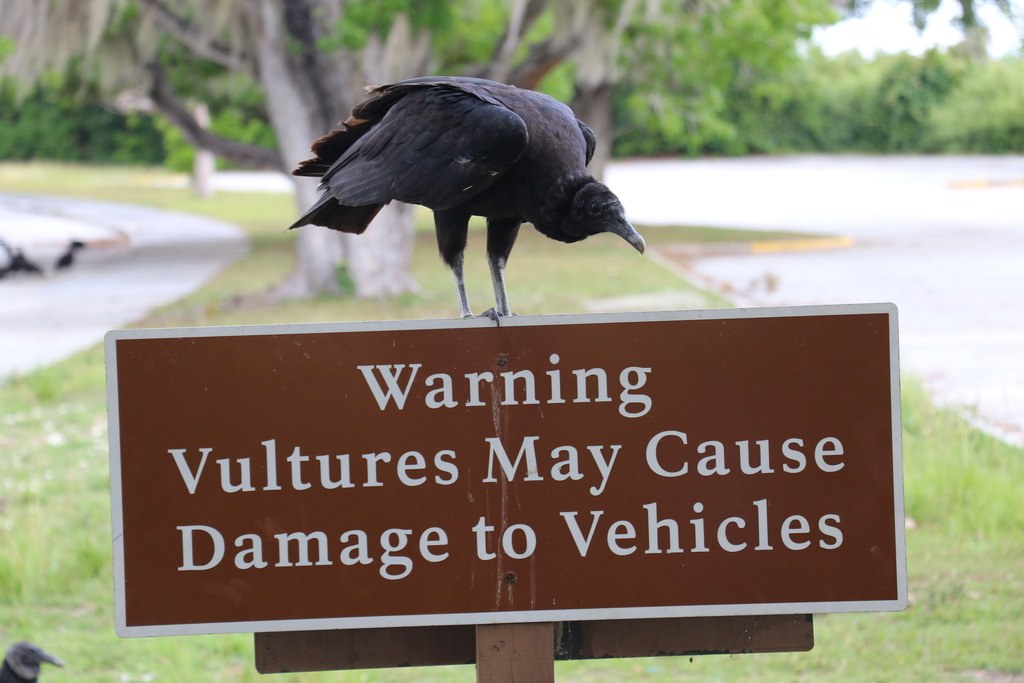
It is one of this species' signatures. Look for pulled window caulking, torn roof shingles, damaged vent seals, shredded rubber roof liners, and torn pool covers. Extension and federal wildlife-damage sources name the Black Vulture specifically for this, and note that Turkey Vultures rarely cause conflicts with buildings at all.
Vehicle and equipment damage near a roost
Scratched paint, removed rubber seals and wiper blades, and vinyl seat covers ripped out of boats and tractors are all documented.
A depredation wound pattern
In livestock settings, a characteristic depredation wound pattern on newborn or weakened animals. The eyes are struck first, then the rectum, genitals, and nose, and very young or weak animals are sometimes disemboweled. Attacks have been documented during birthing itself, with birds drawn in by afterbirth. That pattern is what distinguishes bird depredation from a mammalian predator.
Almost no vocal signs
The species is generally silent and produces only an eerie hiss when alarmed or approached closely, so do not expect calling birds the way you would with crows or ravens.
No interior structural occupation
Black Vultures do not gnaw, burrow, or live inside occupied buildings the way bats or rodents do. Roof and exterior damage, fouling, and depredation are the complaints, not damaged wiring or attic nesting inside living space.
Prevention and When to Call a Pro
Federal law comes first
Start here, because it governs everything else: the Black Vulture is federally protected, and no killing, capture, relocation, or active-nest and egg disturbance is legal without a federal permit. Vultures are migratory birds protected under the Migratory Bird Treaty Act, administered by the U.S. Fish and Wildlife Service, and lawful take requires a federal Migratory Bird Depredation Permit issued under 50 CFR 21.100. This species is native to North America and sits in a family the treaty fully covers, so it is not one of the introduced species such as house sparrow, European starling, or rock pigeon that fall outside the Act. Do not trap it, do not move it, do not shoot it, do not disturb an active nest or its eggs, and do not let a contractor do any of those things on your behalf.
Harassment needs no permit
What you can legally do without a permit is harass and disperse. USDA APHIS states directly that a federal depredation permit is not needed to harass or scare birds, with eagles and federally listed threatened or endangered species excepted. That covers visual deterrents such as effigies and lasers, auditory deterrents such as propane cannons, and motion-activated sprinklers on roofs, docks, and patios. Be realistic about results: the reported effectiveness of these tools in the published literature is still largely anecdotal rather than rigorously tested, so plan on persistence and on combining methods.
Make the roost less attractive
The roost is what anchors the damage. Removing dead or dying trees that the birds favor for roosting, and netting or spiking ledges and flat roofs, are the standard property-level steps recommended by federal and state extension sources. None of that takes a bird or disturbs an active nest, so none of it requires a permit.
What they actually go after
Protect the materials this species actually goes after. Cover boats, vehicles, tractors, pool covers, and outdoor cushions when a roost is active nearby. The damage list is specific and well documented: window caulking, roof shingles, vent seals, rubber roof liners, pool covers, vehicle paint, rubber seals and wipers, and vinyl upholstery.
Droppings are a sanitation problem
Treat roost droppings as a sanitation problem, not just a mess. Federal wildlife-damage guidance documents vultures contaminating water sources with their droppings, including coliform bacteria entering water towers and springs used for residential drinking water. Droppings accumulating on electrical transmission towers have also caused arcing and power outages. If a roost sits above a water source or over electrical infrastructure, that is a reason to escalate rather than wait.
The livestock producer pathway
Livestock producers have a specific legal pathway, and it is this species' defining prevention story. The first step is non-lethal: move calving and lambing into sheds, barns, or paddocks close to buildings with regular human activity, because close monitoring during birthing is the single most effective documented non-lethal measure. If depredation is already happening, contact USDA Wildlife Services first at 866-487-3297. They conduct a damage evaluation and, if warranted, issue Form 37, which supports an application to the U.S. Fish and Wildlife Service for a Migratory Bird Depredation Permit.
A standing federal program
There is now a standing federal program built specifically around this conflict. Congress enacted 7 U.S.C. 8356 in 2020, authorizing depredation permits for black vulture and common raven take during calving or lambing season for producers in areas with documented prior-year impact. A 2024 amendment added a standing black vulture livestock protection program running through fiscal year 2030, which lets one public entity or Farm Bureau organization per state hold a statewide depredation permit and subpermit it to individual producers instead of every rancher applying separately. The U.S. Fish and Wildlife Service formalized the operating framework for that program in February 2026. It is a narrow statutory exception with conditions and reporting attached, not a workaround, and nothing is authorized before the permit or subpermit is in hand.
Who to Call, and When
An active communal roost on or over your property, ongoing structural or vehicle damage, fouled equipment, or any depredation on newborn livestock. For the first three, contact your state wildlife agency or a permitted nuisance wildlife control professional for a non-lethal dispersal plan. For depredation, contact USDA Wildlife Services rather than a general pest control company, because the Form 37 evaluation and any resulting federal permit or statewide subpermit both flow through that referral.
Frequently Asked Questions
Is it illegal to kill or trap a black vulture?
Yes, without a federal permit. Vultures are protected under the Migratory Bird Treaty Act, which the U.S. Fish and Wildlife Service administers, and killing, trapping, relocating, or disturbing an active nest without a federal Migratory Bird Depredation Permit is a federal violation. That applies to licensed operators as well as homeowners. Harassing or scaring the birds to move them along does not require a permit, so non-lethal dispersal is where any response should start.
Do black vultures really kill live calves and lambs, or only eat animals that are already dead?
Both. Black Vultures scavenge carrion like any vulture, but USDA APHIS states directly that they also attack and kill calves, lambs, piglets, and other vulnerable animals, targeting the eyes and soft membranous tissue, and that the livestock often die from the attack or have to be euthanized. Independent federal and wildlife-damage research documents the same mechanism and adds that one attracted bird quickly draws a flock, because the group's social feeding behavior lets several birds overwhelm an animal a single bird could not.
Why is there a special federal program just for black vultures and livestock?
Because the problem was significant and specific enough that Congress wrote a dedicated statute for it. 7 U.S.C. 8356, enacted in 2020, authorizes depredation permits for black vulture take during calving or lambing season for producers in areas with documented prior-year impact. A 2024 amendment added a standing black vulture livestock protection program through fiscal year 2030, allowing one public entity or Farm Bureau organization per state to hold a statewide depredation permit and subpermit it to individual producers. The U.S. Fish and Wildlife Service formalized that framework in February 2026.
How much livestock loss do vultures actually cause?
The most recent federal figure carried in USDA's own vulture damage guidance is from 2010, and it should be read with its scope. That year, vultures were attributed with 11,900 cattle and calf deaths, roughly 4.64 million dollars, out of 98.48 million dollars in total cattle and calf predation losses from all causes. So vultures are a real and measurable share of livestock predation loss, not the whole of it. No newer federal resurvey of that figure has been published, so treat it as a 2010 snapshot rather than a current number.
Can black vultures actually damage my roof or my car?
Yes, and this is one of the clearest differences between the two common vultures. Federal and state extension sources document Black Vultures tearing window caulking, roof shingles, vent seals, rubber roof liners, and pool covers, and damaging vehicles by scratching paint, removing rubber seals and wipers, and ripping vinyl seat covers out of boats and tractors. The University of Illinois Extension names the species directly, noting that Turkey Vultures rarely cause conflicts with people while Black Vultures may damage homes and commercial buildings this way.
Is a vulture roost a health risk?
The documented risk is sanitation and water contamination rather than anything the birds transmit directly. USDA's vulture guidance states that vultures can create human health and safety problems by contaminating water sources with their droppings, and documents coliform bacteria from droppings entering water towers and springs used as residential drinking water. Droppings on electrical transmission towers have also caused arcing and power outages. Active roosts also carry a strong ammonia-like odor from accumulated droppings and regurgitated material.
How do I tell a black vulture from a turkey vulture?
Check the head first, then the wings. A Black Vulture's bare head is gray to black at every age and never red, while an adult Turkey Vulture's head is bright red. Head color alone is not enough on young birds, because a juvenile Turkey Vulture is also dark-headed. From below, a Black Vulture shows silvery-white patches only at the outer wingtips, while a Turkey Vulture is pale along the whole trailing edge of the wing. The Black Vulture's tail is short and squared, and its flight is a few quick labored flaps followed by a flat-winged glide, versus the Turkey Vulture's teetering soar on wings held in a shallow V.
Are black vultures found everywhere in the United States?
No. The range covers the Southeast, South Central, Northeast, and Midwest and is still expanding north, and there is a separate, long-established breeding population in Arizona plus an established if scarcer presence in California. Beyond that, the record thins out sharply. Colorado's state bird records committee has accepted 9 records total, Wyoming and Montana have single-digit counts, and Idaho, Oregon, Washington, and Alaska have zero accepted records at all.
Sources
- Black Vulture overview and life history: size, plumage, range, longevity, nesting, incubation, and nestling period Cornell Lab of Ornithology, All About Birds
- Black Vulture identification: head color, wingtip patches, tail shape, and flight style compared with Turkey Vulture Cornell Lab of Ornithology, All About Birds
- Black Vulture distribution: historic breeding range and northward range expansion Cornell Lab of Ornithology, Birds of the World
- Black Vulture species account: clutch size, egg description, nest sites, parental care, and post-fledging dependence Audubon Field Guide, National Audubon Society
- Operational Activities, Vultures: Migratory Bird Treaty Act protection and documented predation on calves, lambs, and piglets U.S. Department of Agriculture, Animal and Plant Health Inspection Service
- Managing Vulture Damage: structural and vehicle damage caused by black vultures, and non-lethal management options U.S. Department of Agriculture, Animal and Plant Health Inspection Service
- Vultures: water contamination from droppings, transmission-tower fouling, livestock loss figures, and calving-shed management U.S. Department of Agriculture, National Wildlife Research Center
- Migratory Bird Depredation Permit Process: harassment without a permit, Wildlife Services damage evaluation, and Form 37 U.S. Department of Agriculture, Animal and Plant Health Inspection Service
- Black vulture conflict and management in the United States: damage trends, management overview, and research needs USDA National Wildlife Research Center, via University of Nebraska-Lincoln Digital Commons
- Managing Black Vulture Damage in Illinois: black vulture named as the species responsible for building damage University of Illinois Extension, Wildlife Illinois
- Managing Vulture Damage: regional damage identification and management guidance Texas A&M AgriLife Extension Service and Texas Wildlife Services
- 3-200-13 Migratory Bird Depredation Permit, issued under 50 CFR 21.100 U.S. Fish and Wildlife Service
- 7 U.S.C. 8356, Depredation permits for black vultures and common ravens, and the black vulture livestock protection program Office of the Law Revision Counsel, United States Code
- MBPM-7-02, Black Vulture Livestock Protection Permitting Framework, February 6, 2026: statewide permits and subpermitting U.S. Fish and Wildlife Service, Migratory Bird Permit Memorandum
- Black Vulture accepted state records: northern and coastal California occurrences and repeat individuals California Bird Records Committee, Western Field Ornithologists
- Status and Distribution of Black Vulture in Arizona: established breeding population and northward expansion in the state Arizona Birds, Arizona Field Ornithologists
- 88th Report of the Colorado Bird Records Committee: total accepted Black Vulture state records Colorado Bird Records Committee
- Black Vulture species account: scarcity of Great Plains records, including Colorado, Wyoming, and Montana totals Nebraska Ornithologists' Union, via Nebraska Game and Parks Commission
- Black Vulture species account: no accepted records for Oregon, Washington, Idaho, or Alaska, and British Columbia vagrant totals British Columbia Rare Bird Records Committee
Image Credits
- Image: Cricket Raspet via iNaturalist. CC BY 4.0.
License.