Seasonal Timeline
Plains pocket gophers are active year-round and do not hibernate. Surface mound building concentrates in spring and fall, when soil conditions favor tunneling, and Nebraska Extension describes early March and April as the point when the animals are most active while populations are still at their annual low.
Plains pocket gophers are active year-round and do not hibernate. Surface mound building concentrates in spring and fall, when soil…
There is no month when this animal goes quiet. It stays awake and stays underground all twelve, running its feeding tunnels shallower in summer, around 8 to 12 inches, and deeper in winter. What changes through the year is how much dirt reaches the surface. Spring and fall are when soil is workable enough that a homeowner walks out and finds several fresh mounds that were not there the day before. Nebraska Extension and wildlife damage management sources both time direct control to those windows for exactly that reason, because fresh mounds are what tell you where the active tunnels run.
One number is worth holding onto through all of this. Nebraska Extension reports that populations rarely exceed 8 animals per acre, even though a single gopher can throw up dozens of mounds within a few days. A yard or a field edge that looks overrun is usually a much smaller animal problem than it appears.
Where They're Found
The plains pocket gopher is a Great Plains species whose range overlaps the Midwest across its northern and eastern portions. Sourced state-level occurrence data places established populations in Minnesota, where field collections in the northwest of the state document the species at its northern range boundary, in Iowa, where extension describes it as common across most of the state and less common in the eastern quarter, and in Nebraska, where the state extension guide is built around it as the largest pocket gopher present. It also occurs in Kansas in appropriate soils, along the eastern edges of North Dakota and South Dakota, in western Wisconsin, and in a restricted band through the central third of Illinois. The Illinois population is the genetically distinct subspecies Geomys bursarius illinoensis, the only one of the eight recognized subspecies persisting east of the Mississippi River.
Soil sets the boundary, not climate. Distribution is patchy and limited by soil type, with a strong preference for deep, sandy, crumbly ground that is easy to burrow through. That is a genuinely different limiting factor from most wildlife, which is usually bounded by cold tolerance or water access, and it explains why gopher pressure can stop at a property line. Heavy or waterlogged ground next door may simply be unworkable while your amended beds are ideal. The habitats that follow from that are open to sparsely wooded grassland: prairie, pasture, hay meadow, alfalfa, lawns, golf courses, roadsides, and rangeland.
The species is not found in Alaska or in Hawaii. No source places Geomys bursarius, or any member of the pocket gopher family, in either state. The documented range sits between the Rockies and the Mississippi and reaches its natural northern limit near the Canadian border in Minnesota and North Dakota. Alaska's permafrost and boreal soils are incompatible with the deep friable ground this animal requires, and Hawaii is a volcanic island chain with no native or introduced pocket gopher of any kind.
Life Cycle
One litter a year is the pattern Midwest extension sources describe, and it is the number that keeps this animal's math manageable. Nebraska and Iowa State both report a single annual litter, bred late winter into spring, with young dispersing in late summer. The disagreements between sources are small and worth stating rather than averaging away: litter size is given as 1 to 3 in the mammalogy literature and 3 to 4 by both extension services, and female sexual maturity is placed within the birth year by one source and at one year of age by another. No university, government, or academic source gives a wild lifespan figure, only the 7.2 year captive average, so none is stated.

Newborn Pup
Weaning Juvenile
Dispersing Sub-adult
Adult
Signs of Activity
Identification
Identify the mound, not the animal
You will almost never see the animal, so identify the mound. This is an exclusively fossorial species that spends its life below ground and surfaces only briefly. Field identification is mound identification, and the specific shape test is in the signs section below.
Size and build
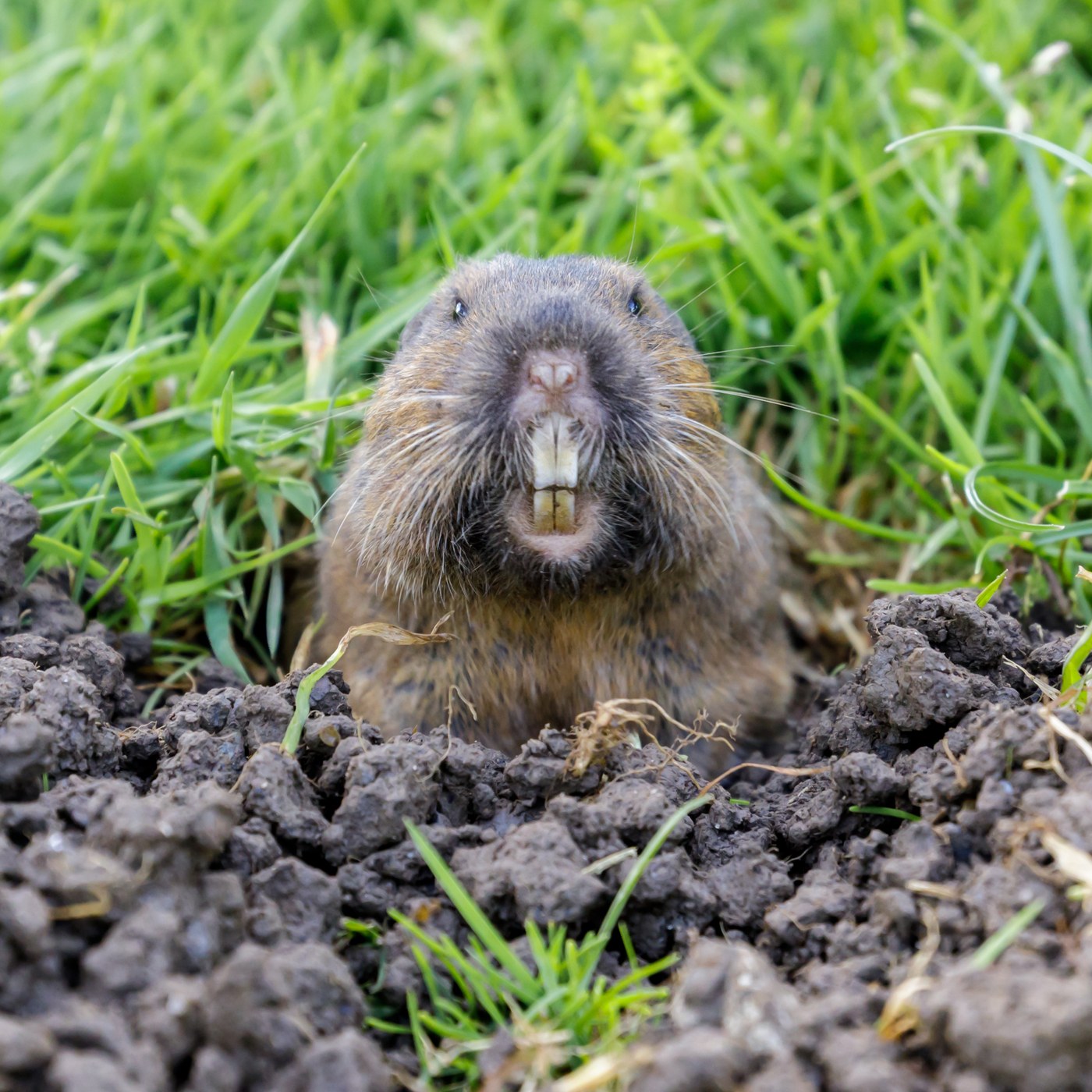
Body length 187 to 357 mm with a tail of 51 to 107 mm, and weight from 300 to 450 grams. Nebraska Extension describes it as the largest pocket gopher in that state, at up to 14 ounces. The body is built for one job: a heavily reinforced skull with strong jaw muscles, large fast-growing foreclaws for digging, and small eyes and ears.
The namesake cheek pouches
The external cheek pouches are the family's namesake feature. Large, fur-lined pouches open on either side of the mouth, outside the mouth cavity rather than inside it. They are carrying bags for food, not part of the mouth. Loaded pouches bulging on both sides of the face settle the identification on any clear photo.
The tail is a tool, not a marker
Long and sparsely haired, it works as a tactile organ that lets the animal navigate and back up through a dark tunnel. It is nothing like the flat paddle of a true beaver or the naked tail of a rat.
Color will not identify this animal
The short fur ranges from pale brown to black and is paler underneath, and it varies geographically to match the local soil, running sandy-brown at the western edge of a range and dark chocolate brown at the eastern edge. Color alone neither confirms nor rules out the species.
Moles, not other gophers
Moles are the look-alike that matters here, not other gophers. The eastern mole shares Midwest turf and lawns with this species across Iowa, Nebraska, Kansas, and Minnesota, and it is an insectivore rather than a rodent, so the plant damage and the mound shape both separate them. The northern, Botta's, and Mazama pocket gophers are western and Pacific species. No sourced range data places any of them in the Midwest, so they are not a practical field confusion in this region.
Fresh mounds in any month are normal
This animal does not hibernate and is active year-round, so mounds appearing in January do not point to some other species.
Signs of Infestation
Fan-shaped mounds, hole off-center
Fan or crescent shaped mounds with a plugged, off-center hole. This is the primary sign and the shape is the whole test. The gopher pushes excavated soil out of a lateral tunnel angled at roughly 45 degrees, so the dirt fans out to one side rather than piling evenly around a center. Nebraska Extension puts these mounds at roughly 8 to 12 inches across, while wildlife damage management sources give a 1 to 3 inch figure for the mound opening itself. Those are two different measurements of the same structure, the spread of the fan and the hole at its edge, so expect both numbers in the literature.
A mole mound looks nothing like it
That holds once you know what to compare. Mole mounds are conical or volcano shaped with a circular base and a center opening, because a mole pushes soil straight up a vertical shaft. No fan, no off-center plug. Getting this right decides which animal you are dealing with, and the traps and methods for the two are not interchangeable.
Voles leave no mound at all
If there is no excavated soil, only shallow unraised surface runways 1 to 2 inches wide worn through matted or dead grass, you are looking at vole activity rather than a gopher.
Mounds arrive in clusters and arrive fast
A single gopher can produce dozens of mounds within a few days, which is why one animal makes a lawn or a field edge look overrun. Nebraska Extension notes populations rarely exceed 8 animals per acre.
Dead plants in lines, sunken turf
Dead or wilting plants in lines, and sunken tunnel lines in turf. Vegetation following the path of a feeding tunnel dies back as roots are severed, and the tunnel itself can slump or collapse, leaving a visible depression running across a lawn.
Girdled stems near ground level
Girdled tree stems and bark near ground level. Damage concentrates at the base of young trees and can extend up to about 10 inches above ground, and it happens especially under winter snow cover where nobody is looking. Roots up to 6 inches in diameter get chewed or severed outright.
No reliable sound or smell
No specific audible or olfactory sign is documented for this species in university, government, or academic sources. Do not expect noise in a wall or an odor to tip you off, because neither is how this animal announces itself.
Prevention and When to Call a Pro
Health risk, stated accurately
Health risk, stated once and stated accurately. No cross-verified disease risk is documented for this species. University extension, government, and academic sources, including Nebraska Extension, Iowa State Extension, and the mammalogy literature, discuss agricultural and property damage and control methods at length and do not raise a human health or disease section for pocket gophers at all. Claims about hantavirus, plague, leptospirosis, and rabies in this animal appear only in pest control company marketing content, which is not a reliable source. Treat this as no confirmed disease risk rather than a settled scientific negative. What this species is, unambiguously, is an agricultural and property damage animal rather than a disease vector concern.
Check your state rule first
Check your current state and local wildlife rules before you trap or relocate anything. Rules for handling this species vary from state to state and they change over time, so the only reliable answer is the current one from your own state wildlife agency. Do not assume a rule you read about one state applies where you live, and do not assume that the absence of a rule about trapping means there is no rule about what you may do with a live animal afterward.
Two Midwest states, as examples
Two Midwest states have a directly sourced status, and they are examples rather than a regional rule. Minnesota law classifies the plains pocket gopher as an unprotected wild animal under Minnesota Statutes section 97A.015, subdivision 53, which places it outside the state's wildlife protection framework. Nebraska Extension separately states that pocket gophers are not protected by law in Nebraska. Those are two states with a citable answer. They say nothing about the rule in Iowa, Kansas, Illinois, Wisconsin, or the Dakotas, and no restrictive rule should be assumed for those states either. Verify yours.
Unprotected is not unregulated
Unprotected is not the same as unregulated, and relocation is where that bites. A species can sit outside a state's protection framework while the state still governs what happens to any wild animal you catch. A common pattern nationally is prohibiting the release of trapped wildlife anywhere other than the property where it was caught, for disease and territorial displacement reasons, whether or not the species itself is protected. Trapping law and relocation law are separate questions, and answering one does not answer the other.
Toxicants add a second layer
Toxicants add a second, independent layer of regulation. Nebraska Extension notes that strychnine and zinc phosphide above 5 pounds are Restricted Use Pesticides in that state, requiring a certified applicator license through the Nebraska Department of Agriculture. That is a product restriction rather than a wildlife restriction, so it applies on top of whatever your state says about trapping, and it varies by state and by product. Read the label and confirm the classification before buying anything.
A licensed operator is safer
The safer default is a licensed nuisance wildlife control operator. Do-it-yourself trapping is genuinely documented for this species, and extension sources describe consumer-available body-gripping traps sold under names like DK-1, Macabee, and Cinch, along with PVC and hardware cloth cage traps, set in located lateral tunnels near fresh mounds. That is a real option. It is still the right call to bring in a licensed operator or pest management professional when there is any uncertainty about current local rules on trapping, relocation, disposal, or restricted-use products, because that uncertainty is exactly the situation where a homeowner buying a trap or a bait first and reading the rules second gets into trouble.
Exclusion, with dimensions
Exclusion for gardens, raised beds, and valuable plantings, with specific dimensions. Bury 1/4 inch or 1/2 inch hardware cloth at least 24 inches deep with an additional 6 inch skirt bent outward at the bottom of the trench, which is what stops the animal from simply tunneling laterally under the barrier. Depth without the skirt is a half measure.
Protect seedlings individually
Cylindrical plastic netting placed over the whole seedling, including the bare root ball, significantly reduces damage to new plantings. This is the practical fix in windbreaks and shelterbelts, where the loosened soil left behind by tree planting machinery gives gophers an easy path straight down the row.
Buried cable has its own spec
Buried cable and pipe get their own specification. Surround buried utility cable or pipe with 6 inches of 1 to 2 inch gravel, or use jacketing larger than roughly 2.1 inches in diameter. Angular gravel and larger diameters are both harder for a gopher to gnaw or displace, and this is worth doing while a trench is already open.
Cultural controls at scale
Cultural controls work at property scale. Flood irrigation, crop rotation, removing preferred forage plants near structures, and buffer plantings of less preferred crops all reduce local pressure. None of them is instant, and they are the tools for acreage rather than a single lawn.
What does not work
This is worth stating plainly, so you do not spend money finding out. Nebraska Extension reports that home remedies including mothballs, plant repellents, and electronic, magnetic, and vibrating devices have not been proven effective. Predators cannot control a population on their own either, because this animal rarely leaves the safety of its tunnels long enough to be caught.
When to Call a Pest Control Professional
Call when mound activity reaches structural elements, foundations, retaining walls, driveways, buried utility lines, drainage tile, or an earthen dam or dike, rather than when the damage is cosmetic lawn scarring. Call when crop or forage losses reach a scale worth measuring, since extension yield data shows those losses can justify professional grade control on hay and alfalfa ground. Call when a genuine trapping effort has failed, and note that traps unvisited within about 48 hours should be moved rather than left, and that hand baiting rarely reaches 70 percent control in a single pass. And call whenever you are not certain what your state currently allows.
Frequently Asked Questions
What does a pocket gopher mound look like compared to a mole hill?
A gopher mound is fan or crescent shaped with a plugged entrance set off to one side, because the animal pushes soil out of a tunnel angled at about 45 degrees and the dirt spreads to one side. A mole hill is cone or volcano shaped with a circular base and a center opening, because a mole digs straight up a vertical shaft. Nebraska Extension puts gopher mounds at roughly 8 to 12 inches across, while wildlife damage management sources cite 1 to 3 inches for the entrance opening itself. Since neither animal is often seen above ground, the mound is what you identify, and getting it right matters because the control methods are not the same.
Do pocket gophers come inside houses?
No. This species is exclusively fossorial, meaning it lives below ground, and no source documents an indoor infestation pattern for it. It does not enter attics, walls, or crawl spaces the way mice and rats do. Everything it damages, from turf to tree roots to buried irrigation and drainage tile, happens out in the soil.
Are pocket gophers dangerous to people or pets, and do they carry disease?
No university extension, government, or academic source documents a disease risk for this species. Those sources cover pocket gopher damage and control in detail and do not raise a human health section at all, which is informative in itself, since a real risk would normally be flagged there. Claims about disease risk in this animal circulate online almost entirely through pest control company marketing content, which is not a reliable source. The honest answer is that this is an open question with no confirmed risk, not a settled yes or no.
Is it legal to trap or relocate a pocket gopher myself?
It depends on your state, and the rules change, so check current state and local wildlife regulations before you do anything. Two Midwest states have a directly citable status: Minnesota law classifies the plains pocket gopher as an unprotected wild animal under Minnesota Statutes section 97A.015, subdivision 53, and Nebraska Extension states that pocket gophers are not protected by law there. Neither of those tells you the rule anywhere else. Relocation in particular is often governed separately from trapping, and many states restrict where a live-caught animal may be released even when the species itself is unprotected. When the answer is not clear, a licensed nuisance wildlife control operator is the safer route.
How much damage can a pocket gopher really do to a farm field?
More than the mounds suggest, and the extension numbers are specific. Nebraska Extension documents forage yield reductions of 21 to 49 percent on western Nebraska rangeland depending on the range site, along with hay meadow losses up to 30 percent. On alfalfa the two main sources give different measured figures: Nebraska Extension reports losses up to 35 percent in dryland alfalfa and 17 percent in irrigated, while Iowa State Extension reports 46 percent non-irrigated and 35 percent irrigated. Both are university extension data, so treat the percentages as an illustrative range rather than one fixed number. On top of yield, there is damage to young trees and shelterbelt seedlings, severed roots up to 6 inches across, buried cable and irrigation pipe, drainage tile, earthen dams and roadbeds, and hay harvesting equipment dulled by mound soil.
Sources
- Controlling Pocket Gophers in Nebraska (G1509): biology, damage figures, exclusion specifications, legal status, and control methods University of Nebraska-Lincoln Extension
- Pocket Gophers: Damage Management Iowa State University Extension and Outreach, Natural Resources
- Pocket Gopher Damage Identification: mound shape, mole and vole comparison, and girdling damage Internet Center for Wildlife Damage Management
- Pocket Gopher Damage Prevention and Control Methods: exclusion dimensions, seedling protection, and trapping Internet Center for Wildlife Damage Management
- Geomys bursarius (plains pocket gopher) species account Animal Diversity Web, University of Michigan Museum of Zoology
- Geomys bursarius (Rodentia: Geomyidae), Mammalian Species 43(879):104-117 American Society of Mammalogists
- Minnesota Statutes section 97A.015, subdivision 53: unprotected wild animals definition Minnesota Office of the Revisor of Statutes
- Arthropod and helminth parasites from the plains pocket gopher, Geomys bursarius bursarius, from the hosts' northern boundary range in Minnesota Journal of Parasitology, via PubMed, National Library of Medicine
- Extension Wildlife Damage Control, Chapter 25 Kansas State University Historical Extension Publications
- Kansas Mammal Atlas, Plains Pocket Gopher species account Fort Hays State University
- Mammals of Texas online edition, Plains Pocket Gopher species account Texas Tech University Natural Science Research Laboratory
Image Credits
- Image: Adobe Stock, licensed.