Seasonal Timeline
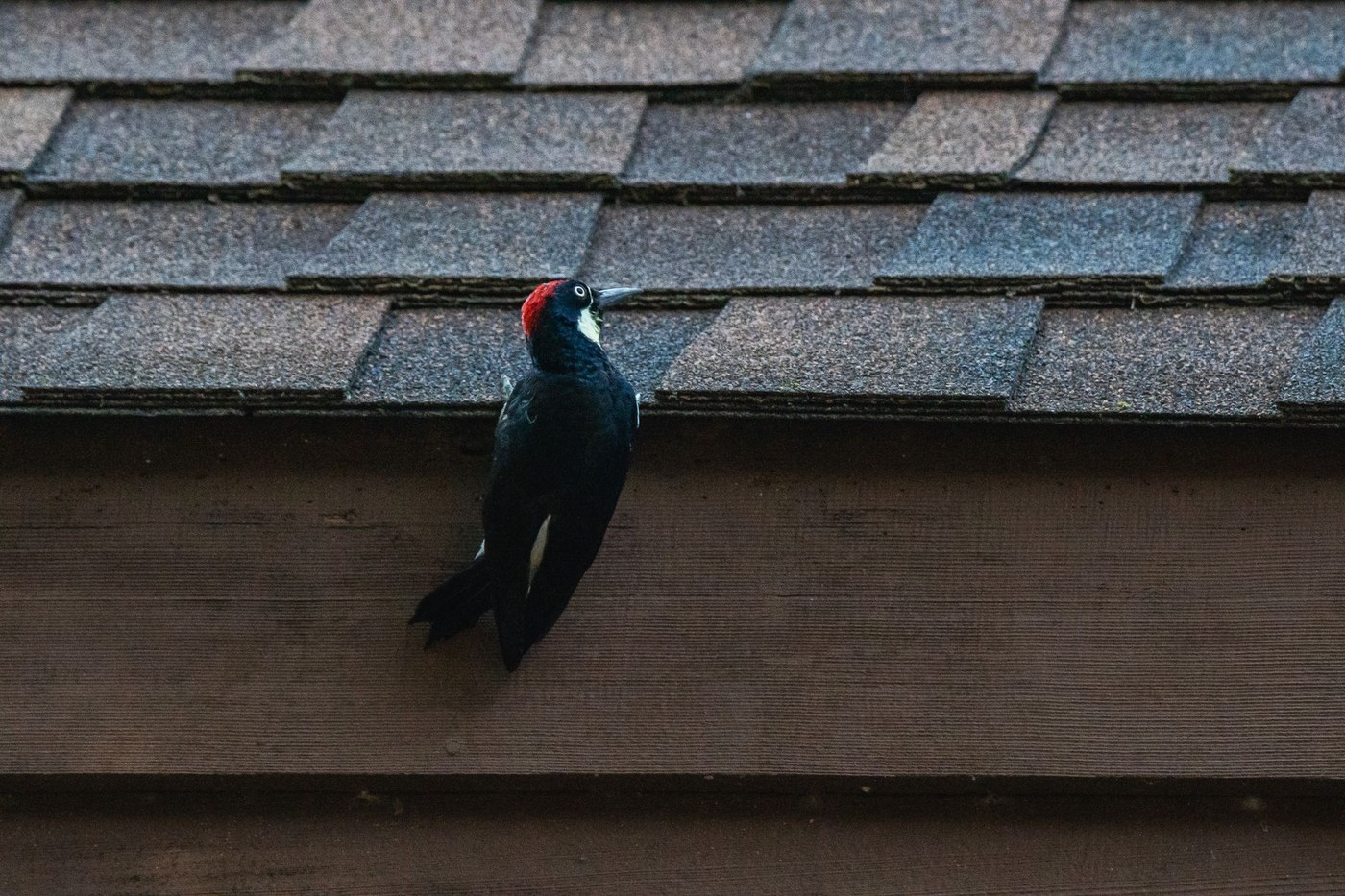
Woodpecker damage to buildings has two peaks a year, not one. The national wildlife damage extension program puts most damage between February and June, matching the breeding season, and then again in the fall during dispersal and the establishment of territories. Spring damage is drumming plus nest-cavity excavation happening at the same time. Fall damage skews toward large chipped holes, because the bird is cutting a winter roost cavity rather than a nest.
Woodpecker damage to buildings has two peaks a year, not one. The national wildlife damage extension program puts most damage between…
Two peaks, and they leave different damage. Michigan State University Extension splits building damage into two forms: closely placed horizontal straight lines of holes, occasionally vertical, and one or more large chipped holes in one spot. The large chipped holes turn up more often in the fall, when the bird is looking for winter shelter rather than a nest. Cornell Cooperative Extension separates the calendar the same way: nest holes are cut at the start of the breeding season, usually late April and May, while roosting holes are usually built in late summer and fall in preparation for winter.
The Northeast has the most specific timing on record, and it names names. Cornell Cooperative Extension attributes most fall damage to hairy and downy woodpeckers, and most spring damage to flickers and migrating downy woodpeckers, with flicker activity beginning in mid-April and continuing through mid-May until courting birds have paired and settled into nesting. Resident downy woodpeckers court and pair as early as the first of February, which is why they add less to the spring spike than the arriving migrants do. Minnesota's state wildlife agency adds the useful expectation for a drumming complaint: both sexes drum, primarily in spring, and a bout at one site may continue a few days to a month.
Presence is not seasonal, so do not wait for the birds to leave. These are resident birds across most of their range, and the two damage windows are behavioral rather than migratory. The extension guidance is unanimous that control should start at the first tap, because a bird that has already adopted a wall is persistent and hard to move once its territory is established.
Where They're Found
These birds turn up across six regions: Pacific Northwest, Southwest, Midwest, South Central, Northeast, and Southeast. Two regions belong to different birds. California is Acorn Woodpecker country, whose granary-drilling damage is a genuinely different mechanism, and in the Mountain West the damage species is Northern Flicker, which Colorado State University Extension identifies as responsible for most woodpecker damage to homes in that region. Both of those birds also occur inside these six regions, and where they do they are the birds to read up on.
The species mix changes by region, which is why it pays to think regionally rather than treating these birds as one animal. In the Northeast and Midwest the working list is downy, hairy, red-bellied, red-headed, pileated, northern flicker, and yellow-bellied sapsucker, which is exactly the seven species Penn State Extension calls common to Pennsylvania and the same seven Purdue Extension lists for Indiana. Connecticut's state environmental agency narrows the house-damage complaint further, to downy, hairy, and northern flicker, the three that habituate to living among homes. In the Southeast, NC State Extension names northern flicker as the most common offender, followed by red-bellied, red-headed, yellow-bellied sapsucker, and hairy. In the South Central region the additional bird is golden-fronted woodpecker, which Cornell places in dry, semi-open woodlands and brushlands in Texas and southwestern Oklahoma. In the desert Southwest the additions are Gila woodpecker, in strictly arid habitat below about 3,300 feet in elevation and famously tied to saguaro stands in Arizona, and ladder-backed woodpecker, in thorn forest, desert, and desert scrub from the lowest elevations up to about 7,600 feet. Pileated woodpecker spans the Pacific Northwest through the Northeast and Southeast, in mature deciduous or mixed woodland of nearly every type, from tall western hemlock stands of the Northwest to beech and maple forests in New England and cypress swamps of the Southeast.
On a property, the exposure is set by the siding, not by the yard. The extension record is consistent and unusually specific. Cedar and redwood siding are the most vulnerable, and the national extension guidance adds that pine, fir, and cypress get damaged too. Natural or stained wood is preferred over painted wood, and UC IPM reports research finding that houses stained or painted in earth tones suffer more damage than white or pastel ones, with one study finding that in wooded yards stained houses suffered more damage than painted or non-wood houses. Rough-hewn veneer-type plywood is singled out, and reverse board-and-batten veneer plywood most of all, because gaps left by the manufacturing process shelter insects. UC IPM also notes that this damage concentrates on houses in or near natural wooded areas, most often in suburban or rural settings, which is a fair description of where these birds and their food supply overlap with buildings.
Alaska and Hawaii sit outside this group's damage range. No woodpecker of any kind is native to Hawaii, and no published source places any of these species there. Alaska does hold woodpeckers, including downy woodpecker and northern flicker in the southern part of the state, but no published source documents building-damage complaints from this species group in Alaska, and none of the six core species is centered there.
Life Cycle
The life-cycle figures are a range across species rather than one set of numbers, because this is not one bird. Where Cornell publishes a species-level figure, it is given by species. Where a figure is genuinely missing from the record, it stays missing rather than being filled in from a relative: Cornell publishes no nestling period for Gila woodpecker and neither an incubation nor a nestling period for ladder-backed woodpecker.
Broods per year is the one place the sources genuinely disagree, and the disagreement matters for prevention. The national wildlife damage extension program states that 2 broods per year is common and that some species may have 3. Cornell's own species tables do not support that as a general rule for this group: pileated, downy, and ladder-backed are each listed at 1 brood, golden-fronted at 1 to 2, and red-bellied and Gila at 1 to 3. The most likely explanation is that the extension figure describes the family across its full geographic spread, including the southern multi-brood species, rather than the average bird on a Midwestern house. Both figures are worth keeping in mind, because a homeowner who assumes the bird will finish and leave after one nesting attempt may be planning around the wrong calendar in the South.
Cavity dimensions are the most useful numbers here, because they are what you actually measure on a wall. Cornell gives downy a round entrance hole of 1 to 1.5 inches with a cavity 6 to 12 inches deep, ladder-backed a circular or oval opening of 1.25 to 1.6 inches with a cavity 7 to 14 inches deep, Gila an oval entrance about 2 inches across with a cavity averaging about 6.8 inches wide by 11 inches deep, golden-fronted an entrance about 2 inches across with a cavity about 12.5 inches deep, and pileated an oblong rather than circular entrance with a cavity 10 to 24 inches deep. Cornell Cooperative Extension states the rule that ties those together: nesting and roosting cavities are usually only slightly larger than the width of the bird, and are round, rectangular, or gourd-shaped. Measuring the hole is therefore a real way to narrow down which bird you have.

Egg
Nestling
Fledgling2
Adult
Signs of Activity
Identification
Start by making sure you have the right bird
The woodpeckers that damage buildings are treated as a group, because a row of holes in siding rarely comes with a clear look at the bird. Two species are separate cases: Acorn Woodpecker, whose damage is acorn storage and whose granary holes are uniformly acorn-sized with a nut wedged in each one, and Northern Flicker, the Mountain West's dominant house-damage species and a ground-foraging bird you will often see on a lawn. If your bird flashes a white rump in flight, it is a northern flicker. If your holes each hold an acorn, it is an acorn woodpecker.
The nine most damaging species
The national wildlife damage extension program names nine species as the ones most damaging to human structures. Red-headed, acorn, golden-fronted, red-bellied, ladder-backed, downy, hairy, northern flicker, and pileated. That list, not a single species, is what a woodpecker damage call actually means.
Size is the fastest sort
The ladder is wide. Downy is 5.5 to 6.7 inches long at 0.7 to 1.0 ounce with a 9.8 to 11.8 inch wingspan. Ladder-backed is 6.3 to 7.1 inches. Penn State puts hairy at 8.5 to 10.5 inches and red-bellied at 8 to 9 inches, and Cornell gives red-bellied as 9.4 inches with a 13 to 16.5 inch wingspan. Gila is 8.7 to 9.4 inches, golden-fronted 8.7 to 10.2 inches. Pileated is in a different class entirely at 15.8 to 19.3 inches, 8.8 to 12.3 ounces, and a 26 to 29.5 inch wingspan, which Cornell describes as nearly the size of an American Crow.
Downy against hairy: the bill
Downy against hairy is the classic mistake, and the tell is the bill, not the body. Penn State Extension gives the rule cleanly: a hairy woodpecker's beak is as long as or longer than the width of its head, and a downy woodpecker's beak is shorter than the width of its head. Both are checkered black and white with a white back stripe and a bold striped head, and in both, males carry a small red patch on the back of the head that females lack. Cornell adds that downy's bill looks small for the bird even before you measure it against the head, and that downy is about two-thirds the size of a hairy.
Red-bellied against red-headed
It is the second classic mistake, and the name is the trap. A red-bellied woodpecker has a black-and-white barred, zebra-patterned back with red confined to the crown and nape, and Penn State notes the red belly itself is usually hidden by surrounding feathers and hard to see. A red-headed woodpecker is, in Penn State's words, the only eastern woodpecker with an entirely red head. On red-bellied, males carry red across the crown and nape and females carry red on the nape only.
Pileated is unmistakable
So is its damage. Crow-sized, mostly black with white face and neck stripes and a flaming-red triangular crest, with extensive white underwings that flash in flight. Males add a red cheek stripe that females lack. Cornell describes its foraging excavations as rectangular holes a foot or more long, deep enough that they can break small trees in half, made by pulling the head far back and striking hard enough that the thunk carries, leaving large wood chips on the ground below. Minnesota's state wildlife agency gives it as about 16 inches long with a wingspan up to 29 inches and calls out carpenter ants as its food, which matches Cornell's finding that ants made up 40 percent of the diet in some studies and up to 97 percent in some individuals.
Golden-fronted, in South Central
Golden-fronted is the South Central bird, and it is the one Cornell links directly to man-made structures. Grayish-brown head and body, golden nape and nasal tufts, black-and-white barred wings, and a black tail, with males carrying a red central crown and females a yellow patch in front of the eye and a yellow nape. It is the only one of the six core species whose Cornell account states plainly that some have nested in utility poles and fence posts. Cornell also flags Gila woodpecker as the species most easily confused with it.
The desert Southwest pair
They separate on size and back pattern. Gila woodpecker is grayish-brown with brilliant black-and-white barring on wings, back, and tail, a plain tan head, and on males a red patch in the center of the crown, at 8.7 to 9.4 inches. Ladder-backed woodpecker is much smaller at 6.3 to 7.1 inches, black and white above with neat ladder-rung stripes across the back, a buffy white face crossed by black lines running back from bill and eye, and a red crown on males against a blackish crown on females. Cornell separates them by size directly: Gila is larger than a ladder-backed and smaller than a gilded flicker.
Excavation intensity differs
It differs sharply across the group, and Cornell says so explicitly, which is genuinely useful for damage triage. Pileated digs rectangular holes a foot or more long. Red-bellied picks at the bark surface more often than drilling into it. Gila seldom drills or excavates large portions of dead trees. Ladder-backed rarely digs deep into the wood. Golden-fronted forages rarely by excavation. In other words, a deep, gouged, chipped-out hole in siding points at the larger, harder-hitting end of this list, while a shallow row of small holes points at a smaller bird working a seam.
Sapsuckers get blamed unfairly
Sapsuckers get blamed for house damage they usually did not do. Yellow-bellied sapsucker, one of the Sphyrapicus group rather than the species above, drills orderly rows of small holes in tree bark for sap, described as a series of parallel rows of quarter-inch to three-eighths-inch closely spaced holes, or as neat rows of quarter-inch holes. That is tree damage, not siding damage, and the neatness is the tell. Penn State gives the bird as 8 to 9 inches long.
Two carry extra protection
Two woodpeckers in these regions carry protection beyond the ordinary federal baseline, and they must not be treated as interchangeable with the rest. Red-cockaded woodpecker occupies patchy longleaf pine habitat in Alabama, Arkansas, Florida, Georgia, Louisiana, Mississippi, North Carolina, Oklahoma, South Carolina, Texas, and Virginia, which is to say across both the Southeast and South Central regions. Gila woodpecker, along with gilded flicker, is a California-listed endangered species, and UC IPM states that those two cannot be harassed or bothered in any way. Gila woodpecker in Arizona is not under that California listing, but the point stands that a desert or longleaf-pine property is not a place to guess.
A note on scientific names
A small note on scientific names, because both spellings are in current use. Downy woodpecker and ladder-backed woodpecker are printed by the federal protected-species list and by Cornell as Dryobates pubescens and Dryobates scalaris, while older literature and even some current Cornell citation lines still carry the previous genus, Picoides. Both refer to the same birds. The spellings used above are the ones on the federal list.
Signs of Infestation
A neat row of holes is feeding
A neat row of small holes following a seam is feeding damage. UC IPM describes it as a series of small holes all in a row, which is the characteristic damage. Connecticut's state environmental agency describes the same thing as long, narrow furrows following horizontal or vertical seams or along window frames, and attributes it to a bird hunting wood-boring bees, carpenter ants, wasps, or other insects. Michigan State University Extension notes the holes are usually horizontal and only rarely vertical.
Large chipped holes are nesting
One or more large chipped holes, up to 2 to 3 inches across, is nest or roost excavation. Connecticut's agency gives that 2 to 3 inch diameter figure and adds that reports of woodpeckers successfully nesting in the walls of homes are not uncommon. USFWS gives foraging holes as usually in a line or as large as two inches in diameter. Minnesota's state wildlife agency adds where to look: nests on buildings tend to be high up, under ledges, usually in corners, and a bird may excavate several trial cavities before committing to one.
Hammering with no hole is drumming
Loud rhythmic hammering that leaves no hole at all is drumming, and metal is the giveaway. UC IPM states that woodpeckers prefer surfaces that resonate loudly and frequently bypass wood in favor of metal gutters and downspouts, metal chimney caps, or metal rooftop ventilators, and that both sexes drum. Minnesota's agency adds metal flashing, metal spouts, and television antennae, and Cornell Cooperative Extension adds eaves, downspouts, and old antennas. Cornell's explanation of why one wall gets picked is the most useful part: drumming is roughly the woodpecker equivalent of a songbird's song, and its effectiveness is largely determined by the resonance of the site, so a bird tests sites around the margins of its territory and keeps returning to the loudest one.
Dry cedar shakes are a target
Dry cedar shakes are a drumming target as well as a feeding target. Cornell Cooperative Extension notes that wooden shingles, especially cedar shakes, form excellent drumming sites, because dry shingles are satisfyingly resonant from the bird's point of view and the rough surface gives good footing while drumming.
Look at the top third of the structure first
Michigan State University Extension notes that holes typically appear in the top third of the building and occasionally go all the way through the siding.
Large chips on the ground
Large wood chips on the ground below the damage. The national extension guidance lists wood chips beneath damaged areas as a sign, and Cornell describes large chips collecting on the ground under pileated excavations specifically.
Half-finished holes at corners
Half-finished holes and clusters of tiny holes at corners. Cornell Cooperative Extension notes that a larger hole is often surrounded by smaller half-finished holes, or by clusters of tiny holes at corners, on eaves, and on corner boards, and that those small clusters are often the result of drumming rather than of feeding or nesting.
Insulation pulled out, and eggs
Insulation pulled out of a wall, and eggs inside it. NC State Extension notes that nesting birds may pull out insulation and lay eggs inside walls, which turns a siding repair into a federally regulated situation, because an active nest with eggs or young cannot legally be disturbed.
Cedar plywood means leaf-cutting bees
Rows of holes through cedar plywood usually mean leaf-cutting bees, and the mechanism is specific. Minnesota's state wildlife agency explains it precisely: when cedar plywood siding is manufactured, the subsurface crossband sheets are not butted together, so a tunnel is left when the cedar veneer goes on. Bees get in at the sheet edge or through the grooving, and the woodpecker can hear and feel their movement in the tunnel and pecks through the cedar face to reach them. On shingled siding, the bird most often drills through the thin end just below the butt of the overlapping shingle above.
A bird at a window is territorial
A bird attacking a window is a territorial fight, not damage. NC State Extension notes that woodpeckers can mistake their own reflection for a rival and attack the glass. It is the same territorial drive that produces drumming.
Being woken at five or six in the morning
Cornell Cooperative Extension names that hour specifically, and UC IPM notes that drumming is most annoying when it starts in the early morning. As a symptom it is diagnostic: feeding does not run on that schedule.
Holes are not proof of insects
What you should not read into this: holes are not proof of an insect problem. Purdue Extension states that structural holes are rarely an indication of insect infestation, and Michigan State University Extension makes the same point. The national extension guidance goes further and notes that woodpeckers often attack siding, poles, and posts that are sound and without insects. Sometimes the insects are real, as with the cedar-plywood bee tunnels above, and sometimes the wall is simply resonant or soft.
Prevention and When to Call a Pro
Federal law comes first
Start here, because it governs everything else: every woodpecker in this group is federally protected, and no removal, relocation, killing, or active-nest disturbance is legal without a federal permit. The Migratory Bird Treaty Act list at 50 CFR 10.13 names each of these birds individually under Family Picidae, including Dryocopus pileatus, Dryobates pubescens, Dryobates villosus, Melanerpes carolinus, Melanerpes aurifrons, Melanerpes uropygialis, and Dryobates scalaris. The national wildlife damage extension program and UC IPM both state it flatly: all woodpeckers are classified as migratory non-game birds protected under the Act. Do not trap one, do not shoot one, do not seal or knock down a cavity that has eggs or young in it, and do not let a contractor do any of those things on your behalf. USFWS documents what that can cost: a Wisconsin pest control operator who killed 108 woodpeckers pled guilty to several state violations and paid 4,185 dollars in fines and restitution.
Netting has the best record
Netting is the method with the best record, and the specification is unusually consistent across sources. Use lightweight three-quarter-inch mesh bird netting, run it from the eaves down the side of the building, and keep at least 3 inches of clearance between the netting and the damaged surface so the bird cannot reach through it. Pull it taut with no loose pockets or wrinkles. That is the national extension figure and UC IPM's figure, and Penn State gives the same 3 inch standoff for plastic, nylon webbing, or plastic storm-window material. USFWS confirms netting from the outer eaves down the side of the building as typically effective and adds the maintenance point: netting has to stay taut and gets checked, because it develops holes over time.
Close the holes and match the finish
Close the existing holes immediately, and match the finish. Cornell Cooperative Extension says to repair holes right away with putty or copper wool and then paint or stain, specifically to avoid attracting more woodpeckers. NC State Extension recommends covering holes with sheet metal or quarter-inch mesh hardware cloth as soon as they are detected. Connecticut's agency suggests metal flashing painted to match. Minnesota's agency lists rope caulk, silly putty, or floral clay for plugging and camouflaging. An open hole is an advertisement, and the national extension guidance is explicit that fresh damage draws other woodpeckers in to check out the potential food source.
If it is noise, treat the resonance
If the complaint is noise rather than holes, treat the resonance, not the bird. Cornell Cooperative Extension's advice is to remove loose pieces of wood or place padding behind the affected area to deaden the sound, since resonance is a requirement for a drumming site. NC State Extension adds padding behind frequently used drumming boards and covering metal drumming sites with burlap. This is the single most underused fix available, because it removes the reason the bird chose that spot.
Give it somewhere else to drum
Give the bird somewhere else to drum. Minnesota's state wildlife agency describes building an alternate drumming site by fastening two overlapping boards together and securing the back board to a solid post or tree trunk, and offers plans for what it calls a woodpecker bongo. NC State Extension describes the same idea using overlapping cedar boards for a flexible resonating surface, and separately suggests nest boxes and suet feeders in nearby trees to draw birds away from the house. Nobody presents this as a primary fix, but for a drumming-only complaint it addresses the actual motive.
Visual deterrents, sometimes
Visual deterrents work sometimes, and one has a real number attached. The national extension guidance reports that Irri-Tape eliminated woodpecker damage at 50 percent of homes tested in the northeastern United States. Hang reflective mylar or flash tape in long streamers from the eaves so they hang below the damaged area and move freely in the wind, or run the tape in taut horizontal rows held slightly off the wall and twisted so both sides show. Pie tins, unusable CDs, plastic twirlers, windmills, and windsocks all get named the same way. Deploy them at the first tap, because UC IPM notes that once established, woodpeckers are persistent and are not easily driven from their territory.
Several deterrents do not work
Several popular deterrents do not work, and the record on them is blunt. The national extension guidance states that stationary hawk, owl, snake, and cat silhouettes usually are ineffective, and that large rubber balloons painted with owl-like eyes have not been effective in trials. It also lists radio noise and ultrasonic devices among the failures. UC IPM says models of hawks, owls, and snakes are ineffective, and reports little or no success from chemical repellents. Do not build a plan around a plastic owl.
On sticky repellents, follow federal
On sticky repellents, two agencies genuinely disagree, and the federal position is the one to follow. Minnesota's state wildlife agency suggests tacking a thin board treated with a sticky product such as Tanglefoot where the bird would perch. USFWS advises the opposite, telling homeowners to avoid tactile deterrents such as gels or sticky substances because they can impair a bird's flight and its ability to stay warm, and Colorado State University Extension warns that products like Tanglefoot can trap or fatally injure birds. That is a welfare objection on top of an efficacy one, applied to a federally protected species, so sticky products are the wrong choice even where a state agency still suggests them.
Fix the insect attractant
Do it when there is one, and do not assume there is. Where the damage is a row of holes through cedar plywood, Minnesota's agency identifies leaf-cutting bees in the plywood crossband tunnels and recommends sealing the tunnels and caulking openings in the siding so the bees cannot get in. NC State Extension says to treat insect-infested siding before trying to control the bird. Cornell Cooperative Extension recommends having the insect actually identified rather than guessing, and notes that woodpecker injury can itself be a signal that rotted wood needs repair. But Purdue Extension is equally clear that structural holes are rarely an indication of insect infestation, so this is a step to take when there is evidence, not by default.
The long-term fix is the wall
The long-term fix on a repeatedly hit wall is the wall. The national extension guidance names aluminum or hard composite siding among the methods that work, and Connecticut's agency lists protective aluminum or vinyl siding as a permanent long-term solution. Where cedar or redwood siding has been damaged repeatedly across seasons, that is worth pricing against the repair cycle. The national extension guidance reports an average loss of 300 dollars per incident from a survey of woodpecker damage to homes, and a Cornell University survey in 2001 and 2002 found that 33 percent of 1,185 houses in Tompkins County, New York carried some type of damage.
Two species need more caution
Two species in these regions require more caution than the rest, and the difference is legal, not practical. Red-cockaded woodpecker was reclassified from endangered to threatened under the Endangered Species Act by a final rule published on 25 October 2024, and that rule's section 4(d) provisions continue the same prohibitions that applied when it was listed as endangered. Its range runs across Alabama, Arkansas, Florida, Georgia, Louisiana, Mississippi, North Carolina, Oklahoma, South Carolina, Texas, and Virginia. Gila woodpecker and gilded flicker are California-listed endangered species, and UC IPM states that they cannot be harassed or bothered in any way, with physical exclusion allowed only if installed before the bird is in the area. If you are in longleaf pine country or the desert Southwest, confirm the species before installing anything.
Call when netting is not holding
Call a licensed wildlife control professional when netting has been installed correctly and maintained and the damage is still going, or when the damage is already at the level of real structural loss. That is the practical threshold. Beyond it, the only legal route to removal is a federal depredation permit, and assembling that case is professional-level work. USFWS treats a depredation permit as a last resort, available only after non-lethal methods have been tried and failed and only with strong justification such as significant structural damage to a building. UC IPM describes the mechanics: a permit issued by the Law Enforcement Division of the U.S. Fish and Wildlife Service on the recommendation of USDA APHIS Wildlife Services personnel, with the caution that there must be a good case to justify a permit and that the process is time-consuming. Connecticut's agency routes homeowners to its own wildlife division and to the USFWS regional office rather than to a trap.
Call before closing a spring hole
Call before you close a hole in spring or early summer. If eggs or young are in the cavity, sealing it is illegal and lethal. This is the one step where doing the obvious thing at the wrong time of year creates the legal problem. Nest holes go in at the start of the breeding season, late April and May in the Northeast, and the damage season runs February through June, so the safe window for permanently closing a cavity is outside that range, once the cavity is confirmed empty.
On health risk
No disease transmission, bite, or allergen risk is documented for these species in any university extension, state wildlife agency, federal, or ornithological source. The documented risk from woodpeckers is property damage and noise, not illness. One secondary property risk is worth stating as reasoning rather than as a sourced finding: a cavity cut clean through siding is an opening in the building envelope, so water intrusion and follow-on rot are a plausible consequence of leaving one open. No published source quantifies that.
Frequently Asked Questions
Why is a woodpecker hammering on my metal gutter or chimney cap when there are obviously no insects in there?
Because it is not feeding. That is drumming, a rhythmic pecking sequence used to claim a territory and attract a mate, and Cornell says the confusion directly: people sometimes think the drumming is part of the birds' feeding habits, but it isn't. UC IPM adds that woodpeckers prefer surfaces that resonate loudly and frequently bypass wood in favor of metal gutters and downspouts, metal chimney caps, and metal rooftop ventilators, and that both males and females do it. It peaks in spring, often at five or six in the morning, and Minnesota's state wildlife agency says a bout at one site can run anywhere from a few days to a month.
Which woodpecker is damaging my house?
Read the damage before you try to read the bird. A neat row of small holes along a seam is feeding. One or more large chipped holes, up to 2 to 3 inches across, is a nest or roost cavity. Loud hammering with no hole at all is drumming. Then use size: downy is 5.5 to 6.7 inches, ladder-backed 6.3 to 7.1, red-bellied about 9.4, Gila 8.7 to 9.4, golden-fronted 8.7 to 10.2, and pileated 15.8 to 19.3 inches with a wingspan up to 29.5 inches. Cavity size narrows it further, since Cornell Cooperative Extension notes cavities are usually only slightly larger than the width of the bird: roughly a 1 to 1.5 inch entrance for downy, 1.25 to 1.6 for ladder-backed, and about 2 inches for Gila and golden-fronted. If the bird flashes a white rump in flight it is a northern flicker, and if every hole holds a wedged acorn it is an acorn woodpecker.
Can I trap, remove, or shoot a woodpecker that is wrecking my siding?
No, not without a federal permit. Every one of these species is named individually in the federal list of birds protected by the Migratory Bird Treaty Act at 50 CFR 10.13, and both UC IPM and the national wildlife damage extension program state that all woodpeckers are protected under the Act as migratory non-game birds. That applies to licensed pest control operators as well as homeowners. USFWS treats a depredation permit as a last resort, granted only after non-lethal methods have been tried and failed and only with strong justification such as significant structural damage, and UC IPM notes the permit comes from the USFWS Law Enforcement Division on a USDA APHIS Wildlife Services recommendation and that the process is time-consuming. USFWS also documents a Wisconsin pest control operator who killed 108 woodpeckers and paid 4,185 dollars in fines and restitution.
What actually stops woodpecker damage?
Netting, installed properly and early. Use three-quarter-inch mesh, run it from the eaves down the side of the building, keep at least 3 inches of clearance from the damaged surface so the bird cannot peck through it, and pull it taut with no loose pockets. Repair and repaint or restain existing holes immediately, since an open hole draws more birds in. If the complaint is noise rather than holes, pad behind the resonant siding or remove loose wood to kill the resonance, and consider putting up an alternate drumming board away from the house. Reflective mylar or flash tape hung so it moves in the wind is worth trying, and one product, Irri-Tape, eliminated damage at 50 percent of homes tested in the northeastern United States. Skip the plastic owl, the owl-eye balloon, and the ultrasonic device, all of which the extension record reports as ineffective, and skip sticky gels, which USFWS warns can leave a bird unable to fly or stay warm.
Do woodpecker holes in my siding mean I have an insect problem?
Sometimes, but usually not. Purdue Extension states that structural holes are rarely an indication of insect infestation, and the national extension guidance notes that woodpeckers often attack siding, poles, and posts that are sound and without insects. The main real exception is worth knowing: Minnesota's state wildlife agency explains that cedar plywood siding leaves tunnels between crossband sheets that were never butted together, leaf-cutting bees nest in those tunnels, and the woodpecker can hear and feel them moving and pecks through the cedar face to get at them. Carpenter bees, carpenter ants, and wasps behind siding can draw the same behavior. Have the insect identified before you treat for one.
When is woodpecker damage worst, and will it stop on its own?
There are two peaks a year. The national wildlife damage extension program puts most damage from February through June, matching the breeding season, and again in the fall during dispersal and territory establishment. Spring damage is drumming and nest excavation together, and fall damage skews toward the large chipped holes of a winter roost cavity, which Michigan State University Extension notes turn up more often in fall. It does not reliably stop on its own. UC IPM warns that once established, woodpeckers are persistent and are not easily driven from their territory, and the extension consensus is to start control at the first tap rather than waiting the season out.
Are some woodpeckers protected more than others?
Yes, and the distinction matters in two regions in particular. Red-cockaded woodpecker, a longleaf pine specialist found in Alabama, Arkansas, Florida, Georgia, Louisiana, Mississippi, North Carolina, Oklahoma, South Carolina, Texas, and Virginia, is listed under the Endangered Species Act; a final rule published on 25 October 2024 reclassified it from endangered to threatened while continuing the same prohibitions through a section 4(d) rule. Gila woodpecker and gilded flicker are California-listed endangered species, and UC IPM states they cannot be harassed or bothered in any way, with exclusion allowed only if it is installed before the bird is in the area. Everywhere else, the federal Migratory Bird Treaty Act baseline still applies to every woodpecker.
Sources
- Woodpeckers: the nine species named as most damaging to human structures, drumming as territorial signaling, and the family-level classification as protected migratory non-game birds Internet Center for Wildlife Damage Management, University of Nebraska-Lincoln and cooperating institutions
- Woodpecker Damage Identification: the February through June and fall damage peaks, siding material preferences, stained versus painted wood, and laminated plywood damage patterns Internet Center for Wildlife Damage Management, University of Nebraska-Lincoln and cooperating institutions
- Woodpecker Damage Prevention and Control Methods: the three-quarter-inch mesh and 3 inch standoff netting specification, the Irri-Tape 50 percent result, the ineffective-deterrent list, the 300 dollar average loss, and the Tompkins County survey of 1,185 houses Internet Center for Wildlife Damage Management, University of Nebraska-Lincoln and cooperating institutions
- Woodpecker Biology: family-level clutch size, incubation and nestling periods, broods per year, and cavity reuse differences between downy, hairy, and flickers Internet Center for Wildlife Damage Management, University of Nebraska-Lincoln and cooperating institutions
- Woodpeckers, UC IPM Pest Notes Publication 74124, revised April 2022: drumming on metal surfaces, the four conflict behaviors, cedar and redwood and reverse board-and-batten vulnerability, netting specification, deterrent effectiveness, Migratory Bird Treaty Act status, the California endangered listing for Gila woodpecker and gilded flicker, and the federal depredation permit process University of California Statewide IPM Program, UC Agriculture and Natural Resources
- Woodpeckers: sizes and field marks for the seven species common to Pennsylvania, the downy versus hairy bill-to-head-width rule, the red-headed woodpecker distinction, exclusion material and 3 inch standoff, and state and federal protection Penn State Extension
- Deterring Woodpeckers, Cornell Cooperative Extension fact sheet Hort 212, August 2011, drawn from Cornell Laboratory of Ornithology material: fall damage attributed to hairy and downy woodpeckers, spring damage from flickers mid-April through mid-May, resident downy pairing by the first of February, drumming resonance and site testing, cedar shakes as drumming sites, cavity shape and size rule, and sound-deadening and immediate-repair guidance Cornell Cooperative Extension, Cornell University
- Woodpecker Control Information: the three reasons woodpeckers peck, drumming on pipes and metal flashing lasting a few days to a month, the cedar plywood crossband tunnel and leaf-cutting bee mechanism, shingle drilling location, nest placement high under ledges in corners, downy hairy and pileated sizes, the alternate drumming site and woodpecker bongo, and a sticky-product recommendation Minnesota Department of Natural Resources
- Woodpeckers and your home: foraging holes up to two inches in diameter, spring nesting and drumming timing, netting from the outer eaves and its maintenance, the warning against tactile gels and sticky substances, the last-resort depredation permit conditions, and the Wisconsin enforcement case of 108 woodpeckers and 4,185 dollars in fines and restitution U.S. Fish and Wildlife Service
- 50 CFR 10.13, List of Birds Protected by the Migratory Bird Treaty Act, Family Picidae entries confirmed individually for Dryocopus pileatus, Dryobates pubescens, Dryobates villosus, Melanerpes carolinus, Melanerpes aurifrons, Melanerpes uropygialis, and Dryobates scalaris Legal Information Institute, Cornell Law School, reproducing the Code of Federal Regulations
- Woodpeckers and the house: it's your siding versus their chipped holes: the two damage forms, holes in the top third of the structure, and the spring and fall peaks with large holes more frequent in fall Michigan State University Extension
- Problems with Woodpeckers: the downy, hairy, and northern flicker house-damage shortlist, feeding furrows along seams and window frames, 2 to 3 inch hole diameters, nesting inside home walls, and the federal depredation permit requirement Connecticut Department of Energy and Environmental Protection, Wildlife Division
- Extension Gardener Handbook, chapter 20, Wildlife: the Southeast damage species list led by northern flicker, insulation pulled into wall nests, window-reflection attacks, quarter-inch hardware cloth over holes, padding and burlap for drumming sites, the overlapping cedar board alternate drumming site, and red-cockaded woodpecker protection NC State Extension, North Carolina State University
- These Birds Aren't Musicians, but They Are Drummers: the Indiana species list, the finding that structural holes are rarely an indication of insect infestation, sapsucker quarter-inch tree holes, and eave-to-base netting Purdue University Extension
- Pileated Woodpecker species account, identification and life history: size and weight, crest and cheek stripe sex difference, rectangular excavations a foot or more long, cavity depth of 10 to 24 inches, carpenter ant diet percentages, and the Maryland longevity record Cornell Lab of Ornithology, All About Birds
- Downy Woodpecker species account, identification and life history: size, bill proportion, red nape on males, 1 to 1.5 inch round entrance hole and 6 to 12 inch cavity, the statement that people mistake drumming for feeding, nesting inside building walls, and the California longevity record Cornell Lab of Ornithology, All About Birds
- Red-bellied Woodpecker species account, identification and life history: length and wingspan, red crown versus red nape by sex, bark-surface foraging rather than drilling, fence post nesting, cavity dimensions, eastern United States range below about 2,000 feet, and the Georgia longevity record Cornell Lab of Ornithology, All About Birds
- Gila Woodpecker species account, identification and life history: size relative to ladder-backed and gilded flicker, barred back with plain tan head and male red crown patch, saguaro nesting with an oval entrance about 2 inches across and a cavity about 6.8 by 11 inches, arid range below about 3,300 feet, the note that it seldom excavates large portions of dead trees, and the Arizona longevity record Cornell Lab of Ornithology, All About Birds
- Ladder-backed Woodpecker species account, identification and life history: size, ladder-rung back pattern and red versus blackish crown by sex, nesting in yucca agave and old fence posts with a 1.25 to 1.6 inch opening and 7 to 14 inch cavity, desert range up to about 7,600 feet, the note that it rarely digs deep into wood, and the Texas longevity record Cornell Lab of Ornithology, All About Birds
- Golden-fronted Woodpecker species account, identification and life history: size, golden nape and male red crown, the statement that some have nested in utility poles and fence posts, cavity about 12.5 inches deep with a 2 inch entrance, Texas and southwestern Oklahoma range, drumming concentrated in the early nesting season, and the Texas longevity record Cornell Lab of Ornithology, All About Birds
- Endangered and Threatened Wildlife and Plants; Reclassification of the Red-Cockaded Woodpecker From Endangered to Threatened With a Section 4(d) Rule, final rule published 25 October 2024, including the continuation of the same prohibitions under the 4(d) rule U.S. Fish and Wildlife Service, published in the Federal Register
- Red-cockaded woodpecker species profile: the eleven-state patchy distribution across Alabama, Arkansas, Florida, Georgia, Louisiana, Mississippi, North Carolina, Oklahoma, South Carolina, Texas, and Virginia U.S. Fish and Wildlife Service
- Preventing Woodpecker Damage, CSU Fact Sheet 6.516: the warning that products like Tanglefoot can trap or fatally injure birds, and the identification of northern flicker as responsible for most woodpecker damage to homes in the Mountain West Colorado State University Extension
Image Credits
- Image: Robert So via Pexels. Pexels License, commercial use permitted.
- Image: Adrien Stachowiak via Pexels. Pexels License, commercial use permitted.