Seasonal Timeline
This is a two-season bird, and both seasons cause different problems. Spring and summer are the breeding season, when a pair moves into a vent, a soffit gap, or a nest box and raises one to two broods. Fall and winter are the flocking season, when local birds merge with migrants from the north into the enormous communal roosts that drive the droppings, the noise, and the agricultural damage this species is known for.
This is a two-season bird, and both seasons cause different problems. Spring and summer are the breeding season, when a pair moves into a…
The whole nesting cycle, from the male starting the nest through the young leaving the cavity, runs about 40 days end to end. That is fast enough that a vent noticed in April and ignored is an empty vent again by early summer, and an occupied vent again the following spring, because the site itself never changed. Fall and winter are when the numbers get hard to picture. USDA APHIS estimates the combined winter population of starlings, blackbirds, and crows in North America at 750 million to 1 billion birds, and individual roosts have been documented at a quarter million starlings at a single Colorado feedlot.
Where They're Found
This species is established across the continental United States and into Alaska. Cornell Lab of Ornithology describes the current range as running from Alaska to Mexico, and Audubon's own regional listing for the bird includes Alaska and the North alongside every other mapped region. There is no meaningful part of the lower 48 where a property owner is safely out of range.
Hawaii is the exception, and it is the rare case where absence is a documented event rather than a blank spot. A single European Starling was recorded on Sand Island, Oahu, over December 1980 and January 1981. The Hawaii Division of Forestry and Wildlife, concerned specifically that the species could become established in the islands and develop into a serious pest, shot the bird on January 14, 1981 and had the specimen deposited at the Bishop Museum. The account of the record notes the nearest established population was roughly 3,850 kilometers away on the North American west coast. No other Hawaii record and no established island population has been documented since. Hawaii carries no established starling population, and that absence is documented rather than simply unexamined.
The habitat pattern is human landscapes, and the nesting pattern is cavities. Starlings concentrate on farms, feedlots, dairies, orchards, open fields, groves, and urban and suburban neighborhoods. California's own vertebrate pest control handbook describes the bird as a year-round lowland resident joined by large migrant flocks out of the northern states each fall and winter. The birds feed and roost outdoors but nest inside structural cavities without hesitation: stove, dryer, and bathroom exhaust vents, ductwork, attics, gutters, downspouts, and nest boxes put up for native songbirds. Climate is close to a non-factor, with established populations from subarctic Alaska to the year-round Southeast and Southwest.
Related Pests
Life Cycle
Two features of this life cycle drive everything a property owner deals with. The first is that the nest goes in a cavity, not on a branch, and the cavities this bird prefers on a building are the ones people already own: stove and dryer vents, bathroom exhausts, ductwork, soffits, and gutters. The second is speed. Nest to fledging is about 40 days, and the birds run one to two rounds of it a season. Pulling a nest without closing the opening is a 40 day fix at best.

Egg
Nestling
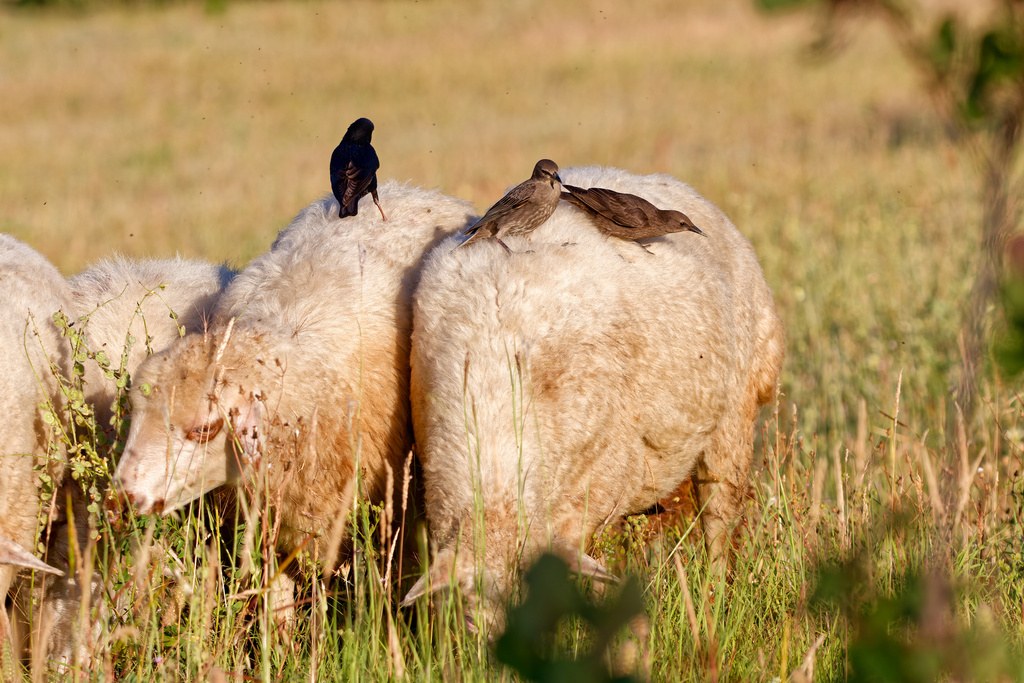
Fledgling2
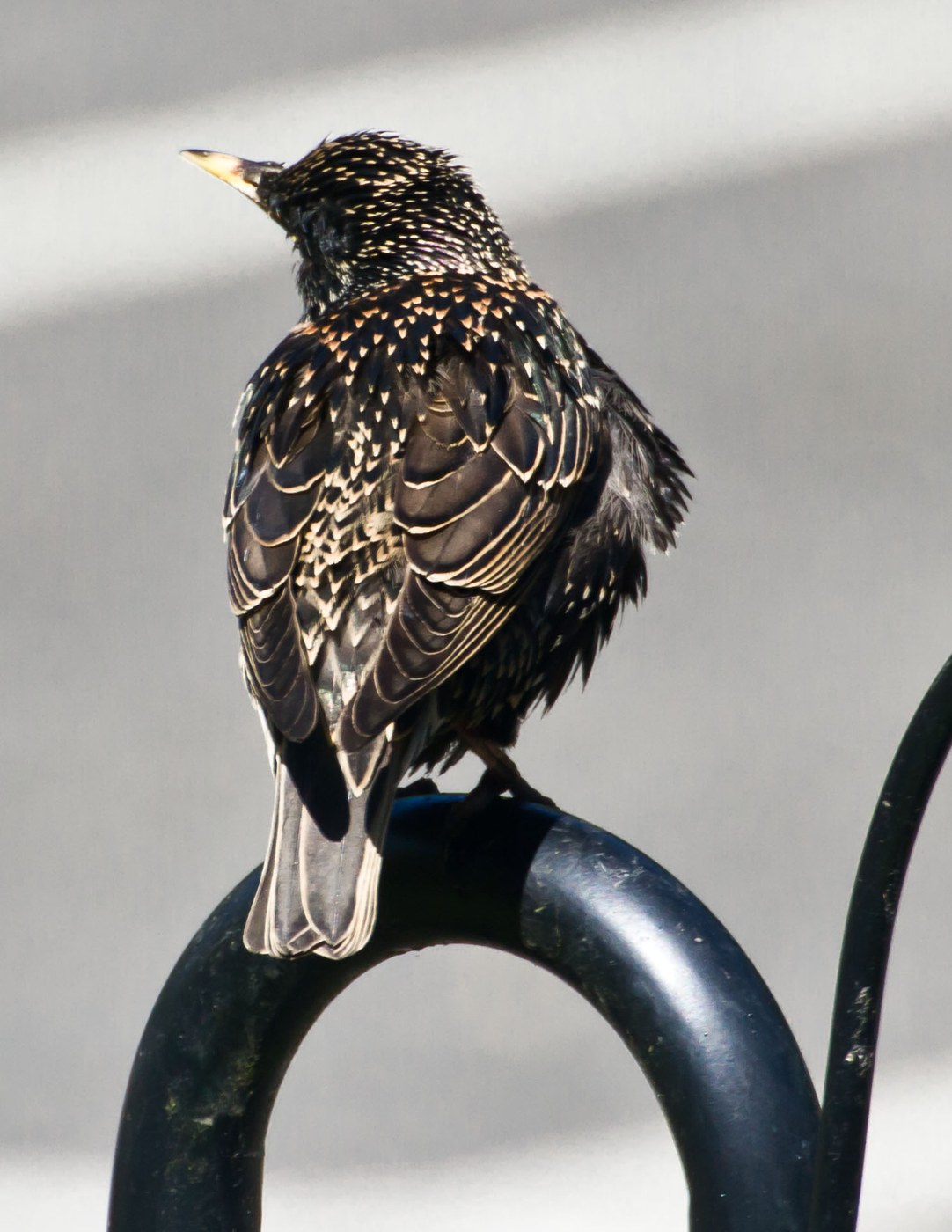
Adult3
Identification
Size
7.9 to 9.1 inches long, a 12.2 to 15.8 inch wingspan, and roughly 2.1 to 3.4 ounces in weight. Stocky and short tailed rather than long and lean.
Shape beats color
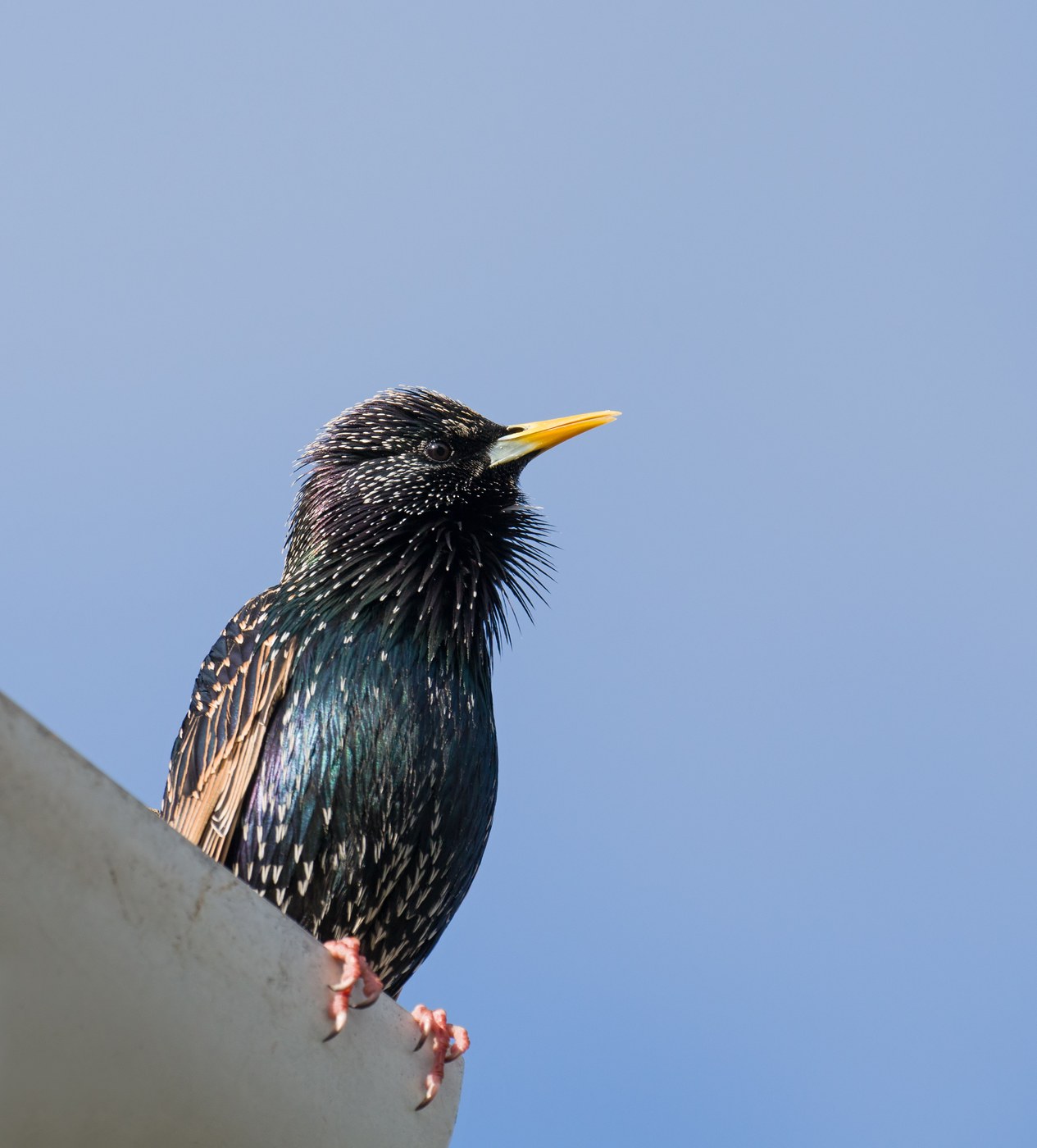
Shape is the most reliable tell, because the color changes. Look for a short squared tail, a long thin pointed bill, and triangular pointed wings that give the bird a distinct star shape in flight, which is where the name comes from.
Breeding plumage
Looks black at a distance, glossy purplish green iridescence up close, with a bright yellow bill.
Winter plumage
The same bird turns brown to blackish and heavily covered in white spots, with a blackish bill that yellows again as breeding season approaches. People routinely report these as two different birds.
Pinkish legs, every season
Legs are pinkish to reddish orange in every season, which makes them one of the few marks that hold steady year round.
Common Grackle
Common Grackle is the first look-alike, and the two frequently flock together in mixed winter roosts. The grackle has a dark bill and dark legs against the starling's yellow bill and orangish legs, and the grackle's glossy blue-purple sheen concentrates on the head, while the starling's iridescence runs over the whole bird.
Brewer's Blackbird
Brewer's Blackbird is the second look-alike, and the same bill and leg checks separate it from a starling.
Brown-headed Cowbird is easy
Brown-headed Cowbird is the easy one to rule out. It shows a contrasting brown head against a black body, a pattern the starling does not have at all.
Despite the look, this is not a blackbird
Grackles, cowbirds, and red-winged blackbirds are New World blackbirds in the family Icteridae. Starlings belong to the unrelated Old World family Sturnidae. That distinction is not trivia here, because it is exactly why the legal status of this bird differs from the native black birds it flocks with.
How vocal it is
The bird is extremely vocal, running a constant mix of clicks, whistles, warbles, gurgles, and rattles, and an individual will mimic the calls of up to 20 other bird species.
Signs of Infestation
A nest packed into a vent
A duct, gutter, or wall cavity does just as well. Grass, pine needles, feathers, and often cloth, string, or trash stuffed into a stove, dryer, or bathroom exhaust vent is the single most common structural sign on a home.
Noise coming from inside the structure
Because the nest sits in a cavity rather than on a ledge, an occupied vent or wall void produces audible activity from inside the building itself.
A mechanical racket outdoors
A constant, varied, almost mechanical vocal racket outdoors. Clicks, whistles, warbles, gurgles, rattles, and mimicry of other species' calls. It does not sound like one bird making one call.
Large flocks working open ground
Large noisy flocks working open lawns and fields. Starlings forage on the ground in groups, probing the turf with their bills, and they routinely mix in with blackbirds, grackles, and cowbirds.
Droppings accumulating under a roost site
Where a communal roost holds, buildup under the perch line is usually noticed before anyone identifies the birds.
An ammonia-like odor at a heavy roost
Same mechanism as any concentrated bird roost, coming off accumulated droppings.
Murmurations at dusk
The coordinated aerial flocking display this species is most known for is a direct visual indicator that a roost is nearby. Documented flock sizes range into the tens of thousands, with an average near 30,000 birds and recorded high ends around 750,000.
Prevention and When to Call a Pro
The legal question is settled
It is settled in the property owner's favor. The European Starling is not protected by the Migratory Bird Treaty Act. The Federal Register's published response to public comment on the Service's list of non-protected bird species explains that the starling family, Sturnidae, is not among the bird families covered by the underlying migratory bird treaties at all, and names European starling directly. A separate U.S. Fish and Wildlife Service news release 15 years earlier says the same thing in plainer words, naming European starling among introduced species that do not belong to MBTA-covered families. USDA APHIS states it outright: as an invasive species, European starlings are not protected by the Migratory Bird Treaty Act and receive no federal protection. Standard removal, exclusion, and prevention work applies with no federal permit.
State agencies agree
State wildlife agencies land in the same place. Montana Fish, Wildlife and Parks states that European starlings are not protected by federal or state law. Nevada's Department of Wildlife lists the state conservation status as unprotected and the game status as non-game. No state wildlife agency source treats the species as protected.
California's statute, and its nuance
California has an explicit statute, and one real piece of nuance attached to it. California Fish and Game Code Section 3801 names starling, Sturnus vulgaris, by name as a nongame bird that may be taken or possessed at any time by any person, without a hunting license or depredation permit, on land the taker owns or leases. UC IPM's own citrus guideline adds the part people miss: shooting starlings in other contexts, such as protecting someone else's crop or a commercial operation, may still require checking with the state wildlife agency, the Fish and Wildlife Service, and the county agricultural commissioner first, because a permit can attach to the method even when the species itself is unprotected. Unprotected is not the same as unregulated in every situation.
Seal openings over an inch
Seal every structural opening larger than 1 inch, and do it before nesting starts. A university extension damage prevention handbook co-authored with USDA APHIS specifies closing openings larger than 1 inch as the permanent solution, on the same logic that applies to any roosting bird: exclusion before a site establishes is dramatically cheaper and cleaner than removal afterward.
Vents are the specific problem
That is where it goes on a house. Because this bird targets stove, dryer, and bathroom exhaust vents as nest cavities, check and cover every vent opening before nesting season each year. If a nest has already been started but no eggs are present, remove it and cover the opening immediately. If eggs or young are already in place, the guidance from national homeowner-facing wildlife advice is to stop using that appliance and leave the vent alone until the brood fledges, rather than disturbing an active nest.
Nest box holes, 1.5 inch or less
Use 1.5 inch or smaller entrance holes on nest boxes. Cornell's NestWatch program gives the exact number: an entrance hole of 1.5 inches or less physically excludes an adult starling from a box intended for a smaller native bird. This is the cheapest single intervention available to anyone who puts up birdhouses.
Deny the ledges and beams
Deny the ledges and open beams. Forty-five degree angled coverings over flat ledges and beams, porcupine wire products, and netting across open farm-building beams all remove the roosting surface itself, which is the only version of this fix that holds.
Farms have a federal referral
Agricultural operators have a federal referral point, and homeowners do not. USDA Wildlife Services offers site visits to feedlot and dairy operators with starling damage and can apply DRC-1339, a restricted-use avicide selectively toxic to starlings that spares mammals and raptors, with documented population reductions of 75 to 95 percent in treated operations where bait acceptance is established properly. This is a licensed-applicator program administered by USDA Wildlife Services. It is not a retail product, it is not a homeowner option, and the correct move for an affected feedlot or dairy is to contact Wildlife Services directly rather than to look for something to buy.
Droppings are a respiratory risk
Treat heavy droppings accumulations as a respiratory exposure, not a sweeping job. The Illinois Department of Public Health states that histoplasmosis is transmitted by airborne fungus spores from soil contaminated by pigeon and starling droppings, and notes that soil under an active roost generally needs two years or more of accumulation to reach infectious levels. The CDC's own peer-reviewed journal literature cites a documented urban histoplasmosis outbreak traced directly to a starling roost as a foundational historical case. A large accumulation cleanup belongs to a crew with dust suppression and respiratory protection.
Nobody asks you to report it
No agency asks you to report sightings of this one. Wildlife management sources treat the European Starling as an established, actively controlled damage species rather than one with a reporting program aimed at tracking new occurrences. There is no hotline and no bounty.
When to Call a Pest Control Professional
Any active nest inside a vent, duct, chimney, or wall or attic cavity, especially one already holding eggs or young. DIY removal at that point risks trapping or injuring the birds, and a blocked dryer or exhaust vent is a genuine fire and appliance-malfunction hazard that should not sit through a nesting cycle. That job belongs to a licensed pest or wildlife control operator. For roost or feedlot damage at agricultural scale, USDA Wildlife Services is the direct referral.
Frequently Asked Questions
Are European starlings protected by federal law?
No. Two U.S. Fish and Wildlife Service documents published 15 years apart both name European starling directly as a species outside Migratory Bird Treaty Act coverage. The mechanism is that the starling family, Sturnidae, is not one of the bird families covered by the underlying migratory bird treaties. Multiple state wildlife agencies confirm there is no state protection either: Montana states the birds are not protected by federal or state law, Nevada lists them as unprotected, and California's Fish and Game Code names the species by name as takeable at any time on land you own or lease. Standard exclusion and removal work does not require a federal permit for this bird.
Is it true starlings were released in New York to bring every bird in Shakespeare to America?
That is the popular version, and it is probably not true. What is documented is that Eugene Schieffelin, a member of the American Acclimatization Society, released 60 starlings in Central Park in 1890 and 40 more in 1891, which is the documented introduction of the species to North America. The Shakespeare motivation is a different matter. A 2021 literary history study published by Duke University Press found no record of any Shakespeare connection before a 1948 retelling, decades after Schieffelin had died. The release happened. The reason usually given for it looks like a story that grew later.
How many European starlings are there in North America now?
Fewer than there used to be, though still an enormous number. Estimates vary by source and year: the population peaked around 200 million birds decades ago, Cornell Lab of Ornithology currently puts it at roughly 93 million, and a 2021 Cornell-affiliated genetics study reported a drop from 166.2 million in 1970 to 85.1 million. The sources disagree on the exact figures but agree on the direction. This population has been declining for decades rather than still expanding.
Do starlings really hurt bluebirds and woodpeckers?
The honest answer is more complicated than the popular one, and both halves matter. Individual starlings do aggressively evict other cavity-nesting birds and destroy their eggs. That behavior is real and directly observed, and Audubon documents it against bluebirds, woodpeckers, and swallows. But a peer-reviewed synthesis of nearly a century of bird count data, published in Conservation Biology in 2003, found no clear evidence of a population-level decline in most native cavity nesters attributable to starling competition, with the sapsucker group of woodpeckers as a possible exception. University of Illinois Extension reaches the same conclusion. So: a real problem at the individual nest box, not a documented continent-wide collapse of native cavity nesters. Putting a 1.5 inch entrance hole on your nest boxes solves the version of this that is actually in your yard.
How much agricultural damage do starlings actually cause?
Two very different numbers get quoted, and they are not measuring the same thing, so both belong here. USDA APHIS's current research page puts combined starling, blackbird, and crow damage to grain, fruit, and berry crops at more than $150 million a year in direct costs nationally. A separate and older academic estimate from 2000, cited by the federal National Invasive Species Information Center, puts starling-specific agricultural damage at roughly $800 million a year using a broader damage scope. The APHIS figure is current and covers several species together. The $800 million figure is older and covers this species alone across a wider range of damage. Livestock operations carry a separate cost: a 2009 survey of Pennsylvania dairy producers found veterinary costs ran 38 percent higher at dairies hosting starling flocks, $91 per cow per year against $66, and APHIS links starlings and blackbirds to salmonellosis and gastrointestinal disease outbreaks in livestock costing producers over $600 million annually.
Why are starlings such a big deal for airplanes?
Because of one accident and a long statistical tail behind it. The FAA's own wildlife strike reporting guidance states that European starlings are responsible for the greatest loss of human life among all wildlife species tracked in the National Wildlife Strike Database. That record traces to October 4, 1960, when Eastern Air Lines Flight 375, a Lockheed L-188 Electra, struck a large flock of starlings at about 120 feet immediately after takeoff from Boston's Logan International Airport, ingested birds into three of its four engines, and crashed. Sixty-two of the 72 people aboard were killed. Investigators recovered roughly 75 starling carcasses on and near the runway. It remains the deadliest bird-strike accident in United States aviation history. The tail behind it is ongoing: USDA APHIS counts 7,534 blackbird and starling strikes to civil aircraft between 1990 and 2018, causing more than $9 million in damage.
Can starling droppings make you sick?
Under a heavy roost, yes. Histoplasmosis is the specific risk. The Illinois Department of Public Health names starling droppings alongside pigeon droppings as a growth substrate for the fungus that causes it, and notes that soil under an active roost typically needs about two years or more of accumulated droppings to reach infectious levels. The CDC's peer-reviewed journal literature cites a documented urban histoplasmosis outbreak traced to a starling roost as a foundational case. The exposure route is the important part: it is breathing dust raised while disturbing a large dried accumulation, not walking past a bird. That is why a significant cleanup is professional work with dust suppression and respiratory protection rather than a broom job.
Sources
- Operational Activities, Starlings and Blackbirds: the no-federal-protection statement, the Pennsylvania dairy veterinary cost study, the $600 million livestock disease figure, the DRC-1339 program, the 1960 Logan Airport crash, and the 1990 to 2018 birdstrike counts USDA Animal and Plant Health Inspection Service
- List of Bird Species To Which the Migratory Bird Treaty Act Does Not Apply, 85 FR 21262, whose published comment response names European starling and explains that Sturnidae is not a treaty-covered family U.S. Fish and Wildlife Service, via the Federal Register
- Service Publishes Final List of Non-Native Bird Species, naming European starling among introduced species outside MBTA-covered families U.S. Fish and Wildlife Service
- NWRC Research Areas, Bird Damage: the current $150 million combined crop damage estimate and the 750 million to 1 billion combined winter population estimate USDA APHIS, National Wildlife Research Center
- European Starlings, a USDA-affiliated wildlife damage management chapter covering introduction history, spread timeline, and peak and current population figures USDA National Wildlife Research Center, via the University of Nebraska Digital Commons
- European Starling Overview: the Alaska to Mexico range statement, the roughly 93 million population estimate, physical description, and vocal mimicry of up to 20 species Cornell Lab of Ornithology, All About Birds
- European Starling Life History: clutch size, 12-day incubation, 21 to 23 day nestling period, brood count, nest construction, and hatchling condition Cornell Lab of Ornithology, All About Birds
- European Starling Identification: the direct comparison against Common Grackle and Brewer's Blackbird, seasonal plumage change, and mixed-flock behavior Cornell Lab of Ornithology, All About Birds
- Starling success traced to rapid adaptation, reporting the genetics study behind the 166.2 million to 85.1 million population decline figures Cornell University, Cornell Chronicle
- Shall I Compare Thee to an Invasive Species, summarizing the 2021 Duke University Press literary history study that found no record of a Shakespeare motivation before 1948 Chesapeake Bay Program, summarizing Fugate and Miller, Duke University Press
- 'Elepaio vol. 45 no. 4: the first-hand dated account of the single 1980 to 1981 Oahu starling record and its deliberate removal by the Hawaii Division of Forestry and Wildlife to prevent establishment Hawaii Audubon Society
- European Starling: the federal invasive species profile carrying the roughly $800 million per year agricultural damage estimate from Pimentel and colleagues National Invasive Species Information Center
- European Starlings and Their Effect on Native Cavity-Nesting Birds, Conservation Biology 17:1134-1140, the century-long count-data analysis finding no unambiguous population-level threat to most native cavity nesters, with sapsuckers as a possible exception Peer-reviewed study by Walter D. Koenig, cited in Cornell's own life history bibliography
- European Starlings: diet, the non-MBTA-protection statement, and the finding that other cavity-nesting birds appear largely unaffected except for the sapsucker group University of Illinois Extension
- The Day We Didn't Save the Starling: documented individual-nest aggression, eviction, and egg destruction against bluebirds, woodpeckers, and swallows National Audubon Society
- Draft Advisory Circular 150/5200-32C, Reporting Wildlife Aircraft Strikes, stating that European starlings are responsible for the greatest loss of human life among wildlife strike species Federal Aviation Administration
- Lessons Learned, Lockheed Electra L-188, registration N5533: the agency account of the October 4, 1960 Eastern Air Lines Flight 375 crash mechanism and fatality count Federal Aviation Administration
- Accident record, Lockheed L-188A Electra N5533: independent corroboration of the crash mechanism and fatality count, plus the roughly 75 starling carcasses recovered near the runway Aviation Safety Network
- European Starling: size, weight, lifespan, state conservation status Unprotected, non-game status, and non-native invasive classification Nevada Department of Wildlife
- Living With Starlings: the direct not-protected-by-federal-or-state-law statement and control method guidance Montana Fish, Wildlife and Parks
- Vertebrate Pest Control Handbook, Starling chapter: California legal status, in-state range and establishment history, and physical description California Department of Food and Agriculture
- California Fish and Game Code Section 3801, naming Starling, Sturnus vulgaris, as a nongame bird takeable at any time without a hunting license or depredation permit on owned or leased land State of California statute text, via the Animal Legal and Historical Center, Michigan State University College of Law
- European Starling, Citrus, Pest Management Guidelines: California control guidance and the nuance that depredation permits can still apply to shooting as a method even for an unprotected species University of California Agriculture and Natural Resources, UC IPM
- Managing Starling Damage at Dairies and Feedlots in Colorado: USDA Wildlife Services program mechanics, bait acceptance, and the documented 75 to 95 percent reduction range Colorado Livestock Association, republishing USDA Wildlife Services program information
- Efficacy of European starling control to reduce Salmonella enterica contamination in a concentrated animal feeding operation in the Texas panhandle: the 65.7 percent starling reduction and direct Salmonella contamination linkage Peer-reviewed study, via PubMed Central
- Health Hazards Associated with Bird and Bat Droppings, naming starling droppings alongside pigeon droppings as a histoplasmosis growth substrate and giving the two-year accumulation threshold Illinois Department of Public Health
- Histoplasmosis Outbreaks, United States, citing the 1965 starling roost outbreak as a foundational documented case Centers for Disease Control and Prevention, Emerging Infectious Diseases journal
- Managing House Sparrows and European Starlings: the 1.5 inch nest box entrance hole exclusion specification and the non-protection legal note NestWatch, Cornell Lab of Ornithology
- European Starling, Prevention and Control of Wildlife Damage: exclusion specifications for openings over 1 inch, 45-degree ledge covers, and netting, plus roost-associated health and aircraft risk framing University of Nebraska-Lincoln Extension, co-authored with USDA APHIS
- What to do about starlings: homeowner-facing vent and cavity nest exclusion guidance, including how to handle a nest that already holds eggs or young Humane World for Animals
Image Credits
- Image: Adobe Stock, licensed.
- Image: Donsky via iNaturalist. CC BY 4.0.
- Image: Michael Palmer via Wikimedia Commons. CC BY-SA 4.0. This resized copy is offered under the same license.
License.