Seasonal Timeline
Acorn Woodpeckers are year-round residents wherever oaks grow, living in permanent family groups rather than arriving and leaving with a season. What changes through the year is what they are eating and storing, not whether they are present.
Acorn Woodpeckers are year-round residents wherever oaks grow, living in permanent family groups rather than arriving and leaving with a…
Acorns make up roughly half the annual diet and are of major importance in winter, which is what the whole granary system exists to make possible. Storing in quantity is how a group carries itself through the months when little else is available, and a granary tree, or a granary wall, holds hundreds to thousands of acorns in a single season.
In spring, groups gather to drink sap from small holes they dig in bark, and they often reuse the same sap holes for several years. Despite the name and the storing behavior, these birds actually prefer catching flying insects when insects are available, hunting ants, beetles, and other arthropods by flying out from high perches. The diet is genuinely omnivorous beyond that: almonds, walnuts, hazelnuts, pecans, and pinyon pine nuts are all stored the same way as acorns, and fruit, oak catkins, flower nectar, grass seeds, and lizards all turn up in it.
Groups produce 1 to 2 broods a year. Because the birds are present and defending the same territory in every month, damage to a structure is not a seasonal window that closes on its own. Once a wall has been adopted as storage, it stays adopted.
Where They're Found
Acorn Woodpeckers occupy oak and pine-oak woodlands, and their distribution tracks oak distribution rather than a climate band. Where oaks grow, from sea level up to the elevation limit of oak trees, the birds can be present. Beyond classic oak woodland they also turn up in streamside forests, Douglas-fir forests, redwood forests, tropical hardwood forests, suburban neighborhoods, and urban parks, so long as oaks are present or nearby. They are most common where several oak species grow together, since a mix of species hedges against any one species' acorn crop failing in a given year.
California is where the species is most familiar to homeowners. A group defends a territory of roughly 15 acres centered on its granary, and that territory does not move. The species is native to the United States and is additionally classified as a non-game bird by the State of California. Two other California woodpeckers, the Gila Woodpecker and the Gilded Flicker, carry California endangered status and stricter protection. The Acorn Woodpecker is not one of them, though as covered in the prevention section below, federal protection still applies to it in full.
The range extends beyond California, and the map now shows it. Established populations also occur in western Oregon and across the Arizona and New Mexico oak woodlands, and the range continues through Mexico and Central America, with disjunct populations in Colombia. The map lights California, Oregon, Arizona, and New Mexico. Washington, Nevada, and Utah sit inside the region shading but have no oak-woodland population and stay unshaded.
Alaska and Hawaii are not included, and that is a finding rather than an omission. Every published distribution account places the U.S. range in western Oregon, California, and the Southwest, and none lists either state. The species' entire range is tied to oak woodland, which does not occur in Alaska or Hawaii.
Life Cycle
This is a bird that does not live in pairs, and that is why the damage compounds. Acorn Woodpeckers live in permanent family groups of up to a dozen or more individuals that cooperate in raising young and in gathering, storing, and guarding food. Their breeding system is polygynandrous: about half of groups have multiple co-breeding males and multiple joint-nesting females sharing a single communal nest. In the long-running California study population, that has meant up to 7 co-breeding males and up to 4 joint-nesting females in a single group, with roughly 55.8 percent of males and 31.3 percent of females co-breeding at any given time, and co-breeders of the same sex are typically first-order kin, brothers or a father and sons, sisters or a mother and daughters. Roughly 65 percent of groups also include non-breeding helpers, the group's own prior offspring, which stay on the territory to incubate, feed young, and defend the granary without breeding themselves. When a breeding vacancy opens, same-sex coalitions of related birds from other groups compete for it in contests researchers call power struggles. The practical consequence for a property owner is straightforward. The thing using your siding is not one bird making one decision. It is a standing, multi-generational group with a territory built around a storage site, and every member of it defends that site.

Egg
Nestling
Juvenile
Adult
Identification
The face is the fastest tell
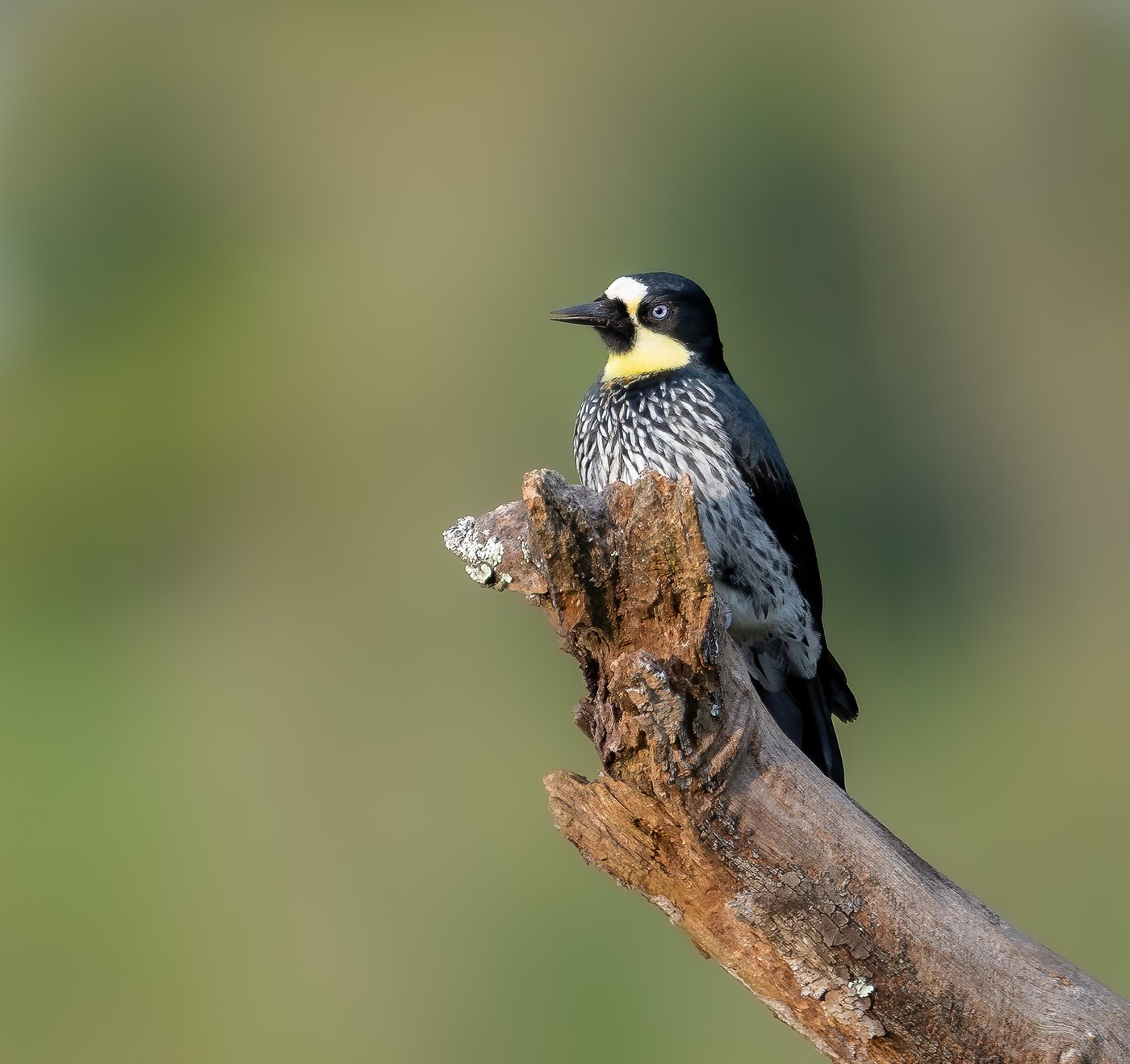
Mostly black above and across the chest, with a red cap, a creamy-white face, and a black patch around the bill. The pattern is commonly described as clown-faced, and no other California woodpecker combines a red cap, a creamy-white face, and a pale iris.
The white iris is the confirming detail
Adults have a genuinely distinctive pale, whitish eye, and that is what produces the wide-eyed, clownish look. A clear look at the face is usually enough to settle the identification.
Sexes differ in one specific place
Males have solid red running unbroken from the bill back over the crown. Females have a black bar separating the red cap from the white forehead.
Three white patches in flight
Three white patches show in flight, one in each wing and one on the rump, which is often the only thing you get on a bird crossing an opening.
Size is robin-sized
Length 7.5 to 9.1 inches, wingspan 13.8 to 16.9 inches, weight 2.3 to 3.2 ounces.
Telling a young bird
Juveniles are dark-eyed, so a bird carrying the face pattern without the pale adult eye is a young bird.
The confusion is behavioral
The useful confusion to clear up is behavioral, not visual. Granary drilling gets mistaken for termite damage, carpenter bee damage, or generic woodpecker damage. The tell is the pattern: tightly packed, uniformly acorn-sized holes with an acorn wedged into each one. Other woodpeckers hunting insects leave irregular rows of holes and no stored nuts. Cornell's own species-comparison tool flags no single look-alike bird as a common field confusion here, because the birds that resemble it at all have limited range overlap and none combines a red cap, a white face, and a white iris.
Signs of Infestation
The granary itself is the signature sign
A dead snag, utility pole, fence post, or wood-sided wall studded with small, precisely acorn-sized holes, each with a single acorn wedged in tightly enough that other animals cannot pull it out. A long-used granary can carry up to 50,000 holes.
Rows of uniform holes on a building
On a building, look for rows of uniform, closely spaced holes in wood siding, eaves, trim boards, or window frames. Uniform spacing and uniform hole size are what separate this from insect damage or from another woodpecker's insect-search holes.
Acorns wedged under shingles
Acorns wedged beneath wooden shakes or shingles. This is the faster route for the bird and the more destructive one for the roof, and UC IPM describes it in exactly those terms.
Visible group activity at one spot
Several birds guarding, checking, or re-sorting stored acorns at the same location is itself a sign, because groups defend a granary aggressively against other groups and other species. A single bird passing through is ambiguous. A crew working one wall is not.
The call
A loud, raucous, parrotlike call, usually written as waka-waka, and also transcribed as ja-cob, ja-cob or wake-up, wake-up. It carries.
Drumming
Drumming on resonant surfaces for territorial and social signaling. Note that these birds drum less conspicuously than some other woodpeckers, since they rarely excavate wood hunting for insects. Heavy insect-search excavation on your siding points at a different species.
Sap holes in bark
Small sap holes dug in bark, visited by groups in spring and often reused for several years.
Prevention and When to Call a Pro
Federal law comes first
Start here, because it governs everything else: the Acorn Woodpecker is federally protected, and no removal, relocation, capture, killing, or nest disturbance is legal. The Migratory Bird Treaty Act of 1918 protects more than a thousand native U.S. bird species. The U.S. Fish and Wildlife Service states plainly that this protection is not limited to species that migrate and that it includes woodpeckers, the federal list of protected species at 50 CFR 10.13 includes the woodpecker family, and UC IPM confirms independently that all woodpeckers are protected under the Act as migratory insectivorous birds. Unauthorized take is a federal violation. Do not trap it, do not move it, do not knock down or seal a nest cavity, and do not let a well-meaning contractor do any of those things on your behalf.
Exclude the birds from the wood
What you can legally do is exclude the birds from the wood, and that is also what works best. Both UC IPM and USFWS name bird netting as the single most effective legal method to stop the damage. Use 3/4-inch mesh, install it from the eaves down the side of the building, and hold it taut with at least 3 inches of clearance from the damaged surface. Methods that do not harm the bird or an active nest are permitted, and netting is the one with the best record.
Fix the underlying attractant
It is usually damaged wood. Cedar and redwood siding are the most vulnerable, especially rough-hewn or reverse board-and-batten veneer plywood, because the gaps left by how that material is manufactured harbor the wood-boring insects that draw woodpeckers to a structure in the first place. Repair or replace insect-damaged, rotting, or gapped siding rather than treating the birds as the whole problem.
Fill and repaint the holes
Fill existing exploratory holes with wood putty and repaint promptly. An open hole is itself a visual cue that keeps drawing attention back to the same wall.
Do not rely on scare devices
Do not lean on frightening devices as your only strategy. Decoy owls and hawks, spinners, and reflective tape are legal, but both UC IPM and USFWS report inconsistent results, particularly once a bird has already keyed in on a location.
Skip the sticky repellents
Do not use sticky or tactile repellent gels. USFWS explicitly warns against them because they can impair a bird's flight and its ability to stay warm. That is a welfare objection, not just an efficacy one, and it applies to a federally protected species.
When a permit becomes the path
Anything beyond netting and passive deterrence should go to a licensed wildlife control professional, and the escalation path is a federal permit. Removal, trapping, and killing require a permit issued by the Law Enforcement Division of the U.S. Fish and Wildlife Service on the recommendation of USDA APHIS Wildlife Services personnel. That is true even for a licensed operator, and even though the species is classified as a non-game bird in California. UC IPM notes plainly that there must be a good case to justify a permit and that the process is time-consuming. USFWS describes a depredation permit as a last resort, issued only after non-lethal exclusion and harassment have been tried and have failed, and only with strong justification such as documented economic hardship from structural damage.
Who to Call, and When
Netting has been properly installed and maintained and the damage is continuing, or the damage is already severe enough to represent real structural and financial loss. At that point a federal depredation permit is the only legal route to removal, and assembling the case for one, including the documentation and the USDA APHIS coordination, is professional-level work rather than a homeowner task. A licensed wildlife control professional and the U.S. Fish and Wildlife Service Migratory Bird Permits program are the two right calls.
On health risk
No disease transmission, bite, or allergen risk is documented for this species in any published wildlife agency, university extension, or ornithological account. The documented risk from Acorn Woodpeckers is damage to wood, not illness.
Frequently Asked Questions
Why do acorn woodpeckers drill so many holes in one tree?
They are building a granary, a single storage site that the group fills with acorns and comes back to for years. One long-used granary tree can end up riddled with up to 50,000 individually drilled holes, and each hole is sized so that the acorn wedges in tightly enough that other animals cannot pull it back out. The drilling is not feeding damage and it is not nest excavation. It is storage, which is why it keeps going and going in the same spot.
Will acorn woodpeckers actually damage my house?
Yes. They will drill granary-style holes straight into wood siding, fence posts, and utility poles, exactly as they would into a dead tree snag, and they will also take the faster route of wedging acorns beneath wooden shakes and shingles, which UC IPM describes as very destructive. Cedar and redwood siding are the most vulnerable, especially rough-hewn or reverse board-and-batten veneer plywood. A group can place hundreds to thousands of acorns in a single season.
Can I trap or remove an acorn woodpecker that is damaging my property?
No, not without a federal permit. Acorn Woodpeckers are protected under the Migratory Bird Treaty Act, and removal, trapping, or killing requires a depredation permit issued by the Law Enforcement Division of the U.S. Fish and Wildlife Service on the recommendation of USDA APHIS Wildlife Services. That applies to licensed operators too, not just homeowners. The permit is treated as a last resort, granted only after non-lethal exclusion has been tried and failed and only with strong justification such as documented economic hardship. Nest disturbance is not permitted either.
Why do acorn woodpeckers live in groups instead of pairs?
They are cooperative breeders. A group can include multiple co-breeding males and multiple joint-nesting females sharing one communal nest, plus non-breeding helpers that are the group's own prior offspring and that stay on the territory to feed young and defend it. Everyone in the group, breeders and helpers alike, defends the granary and the territory. The system has been studied continuously at a California field station since 1968, which makes it one of the longest-running behavioral studies of any bird species.
What can I legally do to stop woodpecker damage myself?
Install taut bird netting over the affected wood, 3/4-inch mesh, run from the eaves down the side of the building and held at least 3 inches off the surface. UC IPM and USFWS both name netting as the most effective legal, non-lethal method. Pair it with repairing the insect-damaged or rotting wood that attracted the birds in the first place, and fill and repaint any holes already drilled. Passive deterrents such as spinners and reflective strips are legal but work inconsistently, and sticky repellent gels should be avoided because they can leave a bird unable to fly or stay warm.
Sources
- Acorn Woodpecker Life History: size, plumage, diet, nesting, broods, clutch size, group living, and territory size Cornell Lab of Ornithology, All About Birds
- Acorn Woodpecker Identification and species-comparison module Cornell Lab of Ornithology, All About Birds
- Woodpeckers, UC IPM Pest Notes Publication 74124: structural damage, bird netting specifications, Migratory Bird Treaty Act protection, and the federal depredation permit process University of California Statewide IPM Program, UC Agriculture and Natural Resources
- Woodpeckers and your home: legal non-lethal deterrents, netting, repellent warnings, and when a depredation permit applies U.S. Fish and Wildlife Service
- Acorn Woodpecker (Melanerpes formicivorus) species profile U.S. Fish and Wildlife Service
- 50 CFR 10.13, List of Birds Protected by the Migratory Bird Treaty Act, including the family Picidae Electronic Code of Federal Regulations, U.S. Government Publishing Office
- North American bird longevity records: oldest known Acorn Woodpecker, at least 17 years 3 months, banded and resighted in California U.S. Geological Survey, Bird Banding Laboratory, Patuxent Wildlife Research Center
- Acorn Woodpeckers research program: cooperative breeding group composition, power struggles, and the study population monitored continuously since 1968 Hastings Natural History Reservation, University of California, Berkeley
- Lifetime reproductive benefits of cooperative polygamy vary for males and females in the acorn woodpecker Proceedings of the Royal Society B, via PubMed Central, National Institutes of Health
Image Credits
- Image: Derek Spencer via iNaturalist. CC BY 4.0.
License.