Seasonal Timeline
Northern flickers are present in the Mountain West year-round, so the identification question is rarely whether the bird is there. What changes through the year is what it is doing: spring is the drumming and nesting season that generates nearly every homeowner complaint, while fall and winter activity is quieter and centered on foraging rather than territory or nest defense.
Northern flickers are present in the Mountain West year-round, so the identification question is rarely whether the bird is there. What…
The spring drumming window and its typical July 1 end point come from Colorado State University Extension's Mountain West-specific fact sheet on this exact species, so it is treated as the more locally reliable figure rather than a generic national average.
Where They're Found
Northern flickers occupy open woodlands, forest edges, open fields with scattered trees, city parks, and suburban yards. In the western mountains of the Mountain West, they occur in most forest types, including burned forest, all the way up to treeline, and they also turn up in streamside woods, flooded swamps, and marsh edges. Unlike most woodpeckers, a flicker spends much of its day foraging on open ground rather than working a tree trunk, so a bird on a lawn or in mulch is a normal sighting, not a stray.
The Mountain West is where the damage is documented, and Colorado State University Extension names the Northern Flicker as the woodpecker behind most home damage there. The seasonal timing below follows that Mountain West data. The map shows the species' full range, since the bird is a resident or breeding-season presence across every mainland region and into Alaska. For flicker activity in other regions, the Woodpeckers entry carries the region-by-region species breakdown.
The western form of the species is the Red-shafted flicker, which ranges across western North America from southern Alaska to Oaxaca, Mexico. Published range accounts place the Red-shafted group solidly across the Mountain West. The species' full range is considerably wider than that. Red-shafted flickers also occupy the Pacific Northwest, California, and the Southwest, and the species as a whole, combining the Red-shafted and eastern Yellow-shafted groups, covers nearly the entire United States and southern Canada.
Alaska is part of the Red-shafted flicker's range. No source places this species in Hawaii, and published accounts describe it as a temperate North and Central American bird with no Hawaiian range or introduction history.
Related Pests
Life Cycle
Two figures in the source record genuinely conflict. Cornell's own nesting-facts table gives a clutch of 5 to 8 eggs and 1 brood, while a university natural-history database gives a wider range of 3 to 12 eggs and 1 to 2 broods depending on region. Both are kept here rather than collapsing to a single number, since the two sources are measuring different things: Cornell's table reflects North American populations broadly, while the wider figure captures regional variation and the fact that unusually large clutches usually mean more than one female laid in the same cavity.

Egg
Nestling
Fledgling
Adult
Signs of Activity
Identification
The white rump patch in flight
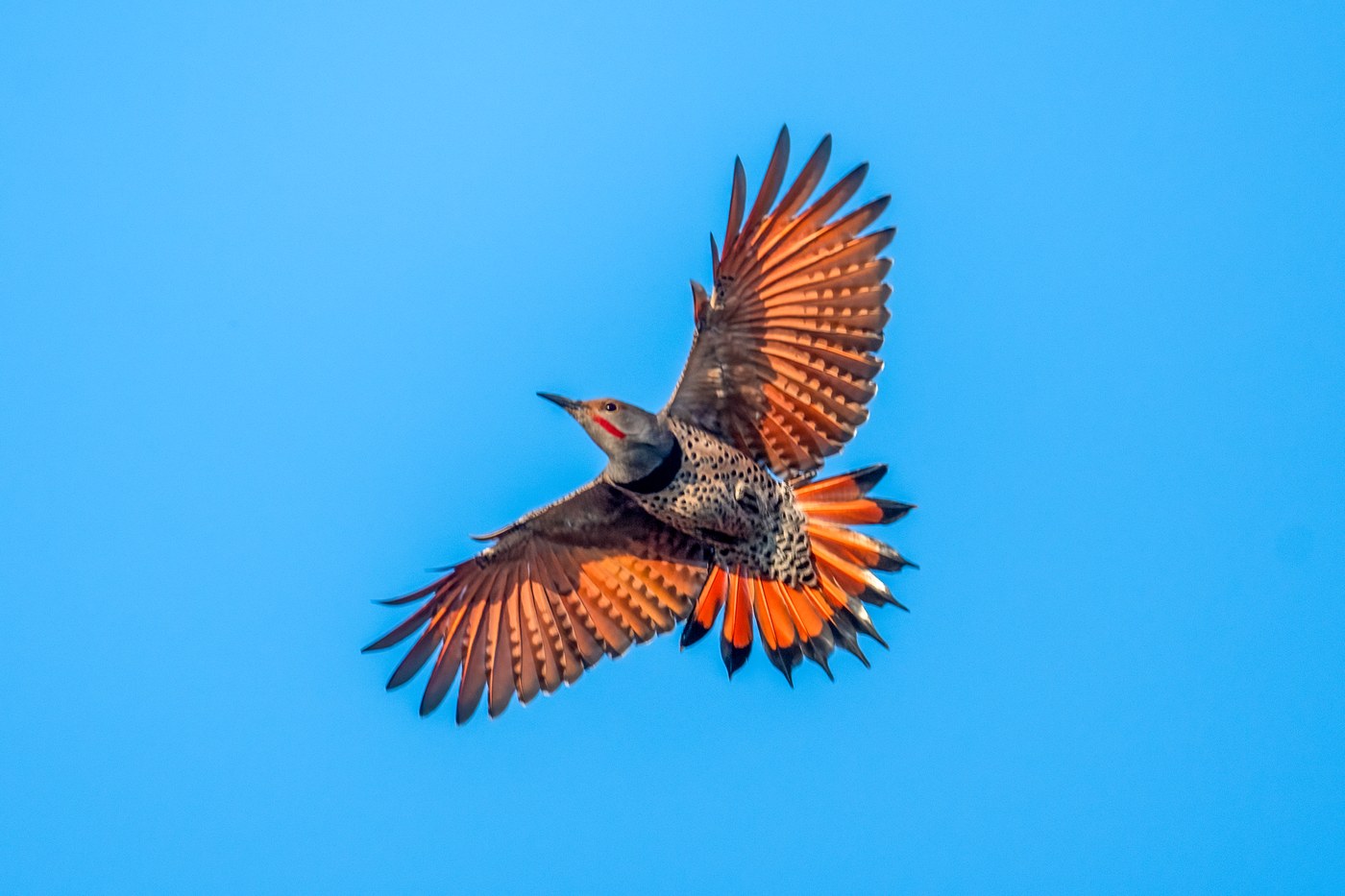
It is the fastest field mark. Northern flicker is brownish overall, richly patterned with black spots, bars, and crescents, with a black bib crescent across the upper breast and a conspicuous white rump that shows in flight and is often visible when perched. This is the only North American woodpecker with a gray-brown barred back combined with a white rump.
The underwing flash confirms it
The colored underwing and undertail flash is the confirming detail for this region. The subspecies group found across the Mountain West, the Red-shafted flicker, shows red under the flight and tail feathers, a gray face, a brown crown, and no red crescent on the nape. The eastern Yellow-shafted group, by contrast, flashes yellow and has a tan face with a gray crown and a red nape crescent. Hybrids with intermediate coloring occur where the two groups' ranges meet.
Only the male has the mustache
Only the male carries the colored mustache stripe. A male Red-shafted flicker has a red mustache running from the bill toward the cheek. Females of both subspecies groups lack any mustache stripe at all.
Large for a woodpecker
Size is large for a woodpecker but mid-sized overall, 11 to 12.2 inches long with a 16.5 to 20.1 inch wingspan, larger than a Hairy Woodpecker and smaller than a Pileated Woodpecker.
Behavior is itself a tell
Flickers spend much of the day on the ground, something most other woodpeckers do not do, and when they do perch in a tree they sit upright on a horizontal branch rather than leaning against a trunk the way a typical woodpecker does.
The Gilded flicker
The commonly confused species is the Gilded flicker, a Sonoran Desert bird centered on southern Arizona, outside the Mountain West, though the two hybridize where their ranges meet, for example along Sonoita Creek near Patagonia, Arizona. The tell is the same underwing color rule: Gilded flicker flashes yellow rather than red and carries more brown or cinnamon on the crown, versus the grayer crown of a Red-shafted Northern flicker.
Other woodpeckers drum too
Several other Mountain West woodpeckers can also cause drumming or drilling complaints, including red-headed woodpecker, red-naped sapsucker, Williamson's sapsucker, hairy woodpecker, and downy woodpecker, per Colorado State University Extension. None of these are hard to visually confuse with a flicker once seen clearly. They matter because a homeowner assuming every drumming sound on the house is a flicker may be dealing with a different, equally protected species instead.
Signs of Infestation
Round drilled holes, 2 to 3 inches
Round or oval drilled holes, roughly 2 to 3 inches in diameter, in wood siding, eaves, window frames, and trim boards, from nest-cavity excavation. A completed nest cavity runs about 3 inches across at the entrance and 13 to 16 inches deep, widening at the bottom.
Damage to synthetic stucco
Siding takes it too.
Drumming brings most of the calls
Drumming, which is the complaint that most often reaches a pest control company. Rapid, repeated, rhythmic pecking against a resonant surface, most often metal chimney caps, gutters, and light posts, or wood siding, done for territorial and mate-attraction signaling rather than feeding. It is loudest in early morning and late afternoon in spring and is specifically documented on metal because metal amplifies the sound more than wood does.
A loud, far-carrying call
A repeated wik-wik-wik is the usual one.
No distinctive odor
Nothing usable as an olfactory sign is documented for this species.
Prevention and When to Call a Pro
Federal law comes first
Start here, because it governs everything else: the Northern flicker is federally protected, and no removal, relocation, killing, or nest disturbance is legal without a federal permit. Colaptes auratus is listed by name under 50 CFR 10.13, the official regulatory list of species protected under the Migratory Bird Treaty Act, in the Family Picidae section. The U.S. Fish and Wildlife Service states plainly that this Act protects more than a thousand bird species, including woodpeckers, and that protection is not limited to species that migrate. Do not trap it, do not kill it, do not knock down or seal a nest cavity that has eggs or young in it, and do not let a well-meaning contractor do any of those things on your behalf. Nests may only be removed while no eggs or young are present.
Exclude the bird
What you can legally do is exclude the bird, and that is also what works best. Both USFWS and Colorado State University Extension name bird netting as the most effective legal method. Install taut netting from the eaves down the side of the building, held roughly 3 inches off the damaged surface, or angle it back from the eave to the siding below the damage and fasten it securely. Hardware cloth works the same way.
Fill and repaint the holes
Fill and repaint existing holes right away. An open hole is itself a visual cue that keeps drawing the bird back to the same spot. Cover larger holes with aluminum flashing, tin can tops, or metal sheathing, and paint to match.
Deaden the sound if it is drumming
Deaden the sound if drumming, not feeding, is the actual complaint. Filling the hollow space behind drummed siding with expanding foam insulation reduces the resonance that keeps drawing the bird back to that exact spot. Covering nearby perch sites with metal flashing removes the platform it uses.
Visual deterrents are inconsistent
Visual deterrents are legal but inconsistent. Reflective spinners, Mylar strips, aluminum pie tins, and enlarging shaving or cosmetic mirrors are all documented as legal frightening devices with mixed results, and using two or more together works better than relying on just one. Owl decoys are specifically called out as generally unsuccessful.
Skip the sticky repellents
Do not use sticky or tactile repellent gels. Both USFWS and Colorado State University Extension warn that products like Tanglefoot can trap or fatally injure birds. That is a welfare objection on top of an efficacy one, and it applies to a federally protected species.
When a permit becomes the path
Anything beyond netting and passive deterrence should go to a licensed wildlife control professional, and the escalation path is a federal permit. Lethal control is a genuine last resort, available only after non-lethal exclusion and harassment have been tried and failed, and only with strong justification such as documented economic hardship from structural damage. A federal depredation permit application goes through the U.S. Fish and Wildlife Service Migratory Bird Permit Office, and a separate Form 37 must be obtained from USDA Wildlife Services describing the problem and their recommendation. Colorado State University Extension notes a species-specific detail worth knowing up front: flicker control permits are typically not issued from May 15 through August 15, matching the species' spring-to-summer nesting window. County and city ordinances should also be checked before lethal control is even considered.
On health risk
No disease transmission, bite, or allergen risk is documented for this species in the ornithological, wildlife agency, or university extension literature. The documented risk from Northern flickers is property damage and noise, not illness.
Frequently Asked Questions
Why is a woodpecker hammering on my metal chimney cap or gutters instead of a tree?
That is almost certainly a Northern flicker drumming, not feeding. Drumming is a spring territorial and mate-attraction signal, and flickers specifically favor metal chimney caps, gutters, and light posts because metal carries and amplifies the sound better than wood. It is loudest in early morning and late spring and typically stops by around midsummer once pairs have nested.
Can I remove a Northern flicker or its nest myself?
No. Northern flicker is listed by name under 50 CFR 10.13 as a species protected by the Migratory Bird Treaty Act. Killing, trapping, relocating, or disturbing an active nest with eggs or young is a federal violation, whether done by a homeowner or a pest control contractor. Only a federal depredation permit, issued as a last resort after non-lethal methods have failed, allows lethal control.
Will a flicker actually damage my house?
Yes. Colorado State University Extension identifies the Northern flicker as responsible for most woodpecker damage to homes in Colorado, from both nest-cavity excavation, holes roughly 2 to 3 inches across, and repeated drumming on wood siding, synthetic stucco, and trim.
What can I legally do to stop flicker damage myself?
Install taut bird netting or hardware cloth from the eaves down the side of the building, roughly 3 inches off the surface, fill and repaint existing holes right away, and consider filling hollow siding cavities with expanding foam to deaden the drumming sound. Visual deterrents like reflective spinners or enlarging mirrors are legal but work inconsistently. Avoid sticky repellent gels, since they can trap or injure the bird.
Is there a time of year when a depredation permit for a flicker won't be issued?
Yes. Colorado State University Extension states that flicker control permits are not issued from May 15 through August 15 except in special circumstances, matching the species' spring-to-summer nesting season when eggs or young are most likely present.
Sources
- Northern Flicker Identification: field marks, subspecies groups, and species comparison Cornell Lab of Ornithology, All About Birds
- Northern Flicker Life History: habitat, diet, nesting facts, behavior, and conservation status Cornell Lab of Ornithology, All About Birds
- Preventing Woodpecker Damage (CSU Fact Sheet 6.516): flicker-specific damage identification, drumming behavior, exclusion methods, and the federal depredation permit process including the May 15 to August 15 permit restriction Colorado State University Extension
- 50 CFR 10.13, List of Birds Protected by the Migratory Bird Treaty Act, confirmed entry for Colaptes auratus (Northern Flicker) under Family Picidae Electronic Code of Federal Regulations, U.S. Government Publishing Office
- Colaptes auratus (northern flicker) species account Animal Diversity Web, University of Michigan Museum of Zoology
- Woodpeckers and your home: legal non-lethal deterrents, netting, repellent warnings, and when a depredation permit applies U.S. Fish and Wildlife Service
Image Credits
- Image: Jonathan Eisen via iNaturalist. CC BY 4.0.
License.