Seasonal Timeline
Spring is the season. Adults emerge and mate in April and May across most of the country, and as early as February in Georgia, with the tunneling and the male patrolling that generate most service calls running March through June. A second, smaller wave arrives in August and September when the new generation emerges. The off months are not empty months. From October through February the adults are inside the wood, which is exactly why early spring and fall are the two windows when repair and treatment actually work.
Spring is the season. Adults emerge and mate in April and May across most of the country, and as early as February in Georgia, with the…
Do not read the off-season as absence. October through February is when the adults of both sexes are sitting inside the old gallery in diapause, with stored pollen laid in beside them. They never went anywhere. That is also the best time to open, treat, plug and repaint the wood, because nothing is being provisioned and no brood is sealed behind a partition. The August and September activity is a separate event, not a tail of the spring peak. Those are new adults chewing out of the cells they developed in, and they are a different cohort with a better treatment window than the spring bees. California, the Mountain West and the Southwest belong in the range too, on the strength of UC IPM's Pest Note, Utah State University's fact sheet naming the Utah species and counties, and New Mexico State University's native bee guide.
Where They're Found
The Southeast, South Central, Northeast and Midwest all carry Xylocopa virginica, the eastern carpenter bee, and that is the species almost every fact sheet is written about. California, the Mountain West and the Southwest belong in the range too, on state-specific sources: UC IPM publishes a dedicated Pest Note treating carpenter bees as a structural pest of California buildings, Utah State University names two established Utah species and the counties where they turn up, and New Mexico State University treats the genus as an established New Mexico bee group. The species change as you move west, and the eastern advice does not travel with them. Eastern bees want bare, weathered softwood: redwood, cedar, cypress and pine. Western species go for oak, eucalyptus and redwood, so a western list that repeats the eastern one is wrong. And in the Southeast and South Central, the second common large carpenter bee is not a pest at all. The southern carpenter bee, Xylocopa micans, looks like the pest species to a homeowner but has not been documented nesting in the structural timbers of buildings. Treating it accomplishes nothing except killing a pollinator. The Pacific Northwest is not included. The range statements reaching Oregon and Washington all came from sources too weak to establish a regional population, and no Oregon or Washington extension service treats carpenter bees as a structural pest.
Life Cycle
Nobody publishes per-stage durations for this bee. Fourteen university extension publications, the USDA Forest Service and the national trade association all skip the day count for the egg, larval and pupal stages. What is well sourced is the total: about seven weeks from egg to adult, temperature dependent, stated by Ohio State University, Utah State University and LSU. Two other figures exist and disagree with that and with each other. One national trade association figure puts it at about 36 days. UC IPM says about three months. Both figures stand as published rather than averaged into one. Generations per year: one in the North, and sometimes two in the South, which is Ohio State's phrasing. Purdue and UC IPM each report one. A Florida observation condensed by UF/IFAS records at least two generations, with broods in February and March and again in summer. Brood size: a female provisions roughly six to eight cells in a gallery, and an established multi-year nest turns out somewhere between one and twenty adults a year. Lifespan and social structure, where the sources are genuinely split. Males are short-lived and die by early summer soon after mating. Females live about a year on their own, and up to three years in a shared nest. Most fact sheets call this bee strictly solitary, one female per nest. Newer research-led sources at Penn State and UGA describe it instead as facultatively social or semi-social: solitary when nest sites are plentiful, but when they are scarce a single family of a mother and her daughters may hold one nest for years, with one primary egg-laying female and subordinate females that guard. There is no worker caste and no queen in the honey bee sense. The newer research is the better guide, and the older fact sheets have not caught up to it. Penn State also supplies the best explanation of why they reuse holes: the primary female wears herself out excavating and foraging, and inheriting a finished nest is a better reproductive bet than digging a new one.

Egg
Larva
Pupa
New Adult
Overwintering Adult
Nest and Gallery2
Identification
Look at the top of the abdomen
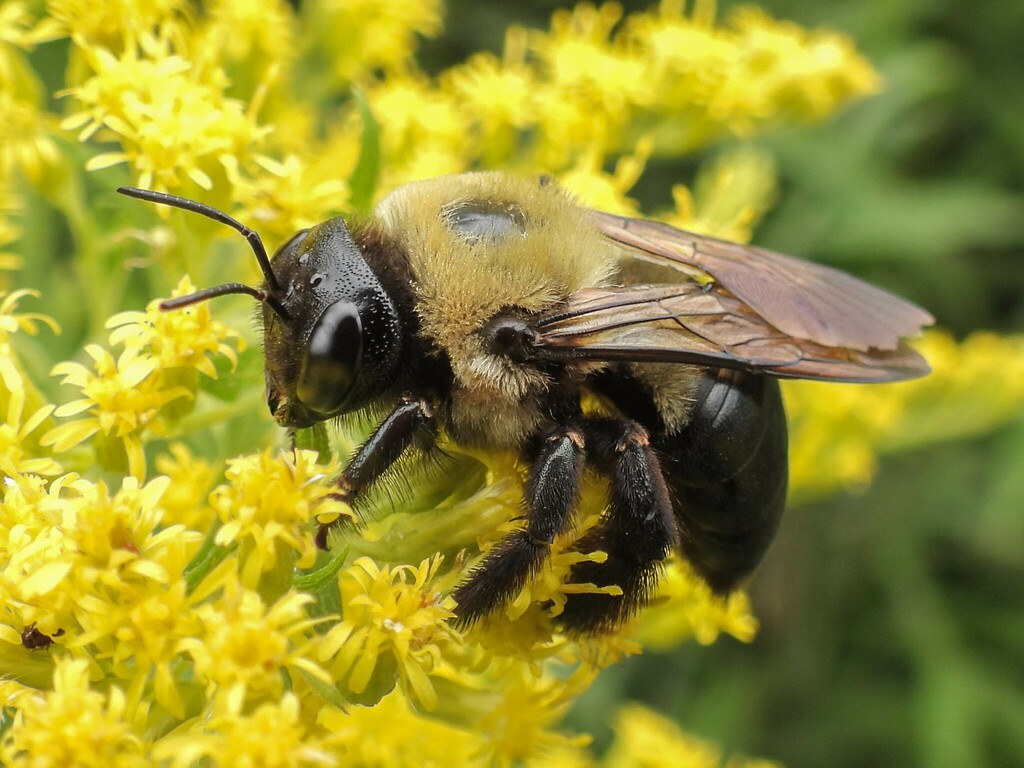
That is the whole identification. A carpenter bee's abdomen is shiny, black and essentially hairless on the upper surface. A bumble bee's is completely clothed in hair, usually with yellow bands or patches. Every source leads with this, and Ohio State's fact sheet puts an arrow on it. The one-sentence version: shiny bare abdomen and a hole in the wood is a carpenter bee, fuzzy abdomen and a hole in the ground is a bumble bee.
The face tells you if it can sting
The face tells you whether it can sting, and you can read it from six feet away. Males have a white or yellow patch in the middle of the face. Females are entirely black-faced. Males have no stinger. It is the single most practically useful feature to check, and it takes nothing but a look.
Two tells for a bee that will not sit
Two more tells that work when the bee will not hold still. The head is almost as wide as the thorax, where a bumble bee's head is much narrower than its thorax. And the hind legs carry a dense brush of black hairs rather than the smooth concave pollen basket a bumble bee has.
How big they are
Size: about three quarters of an inch to an inch. Four independent sources agree on that figure. If what you are holding is a quarter of an inch long, it is not this bee. Small carpenter bees in the genus Ceratina are under 8 mm, nest in pithy plant stems rather than structural lumber, and are not a pest. How many large carpenter bee species live north of Mexico depends on which authority you ask: UF/IFAS and the national trade association both say seven, LSU says nine.
Xylocopa means wood-cutter
The genus name is Xylocopa, which translates as wood-cutter. Worth knowing because it is also a correction: they cut wood, they do not eat it. Not one source describes carpenter bees consuming wood. They chew tunnels and push the chewings back out, and the sawdust below the hole is that waste.
Species changes the advice
Which species you have depends on where you live, and it changes the advice. Across the Northeast, Midwest, Southeast and South Central it is the eastern carpenter bee, Xylocopa virginica. In California, the Mountain West and the Southwest it is western species: the California or western carpenter bee, the mountain or foothill carpenter bee, and the valley carpenter bee. Utah State names X. californica and X. tabaniformis as the established Utah species and points at Washington, Kane and Garfield counties. The valley carpenter bee mostly nests in dead tree limbs rather than structures, and the desert species often use yucca, sotol and agave stalks, so a western hole in a fence post is not automatically the same problem as an eastern hole in a fascia board.
Rule out the southern bee first
In the Southeast and South Central, rule out the southern carpenter bee before anyone treats anything. Xylocopa micans looks like the pest species to a homeowner and is not one. LSU states that it has not been documented nesting in the structural timbers of buildings and is not considered a pest. The tells: micans is smaller, has paler yellow hairs, wider eye spacing and black antennal scapes, and the female is a metallic bluish purple rather than mostly black. If it is micans, it is not damaging anything, and the right answer is to leave it alone.
Signs of Infestation
A perfectly round half-inch hole
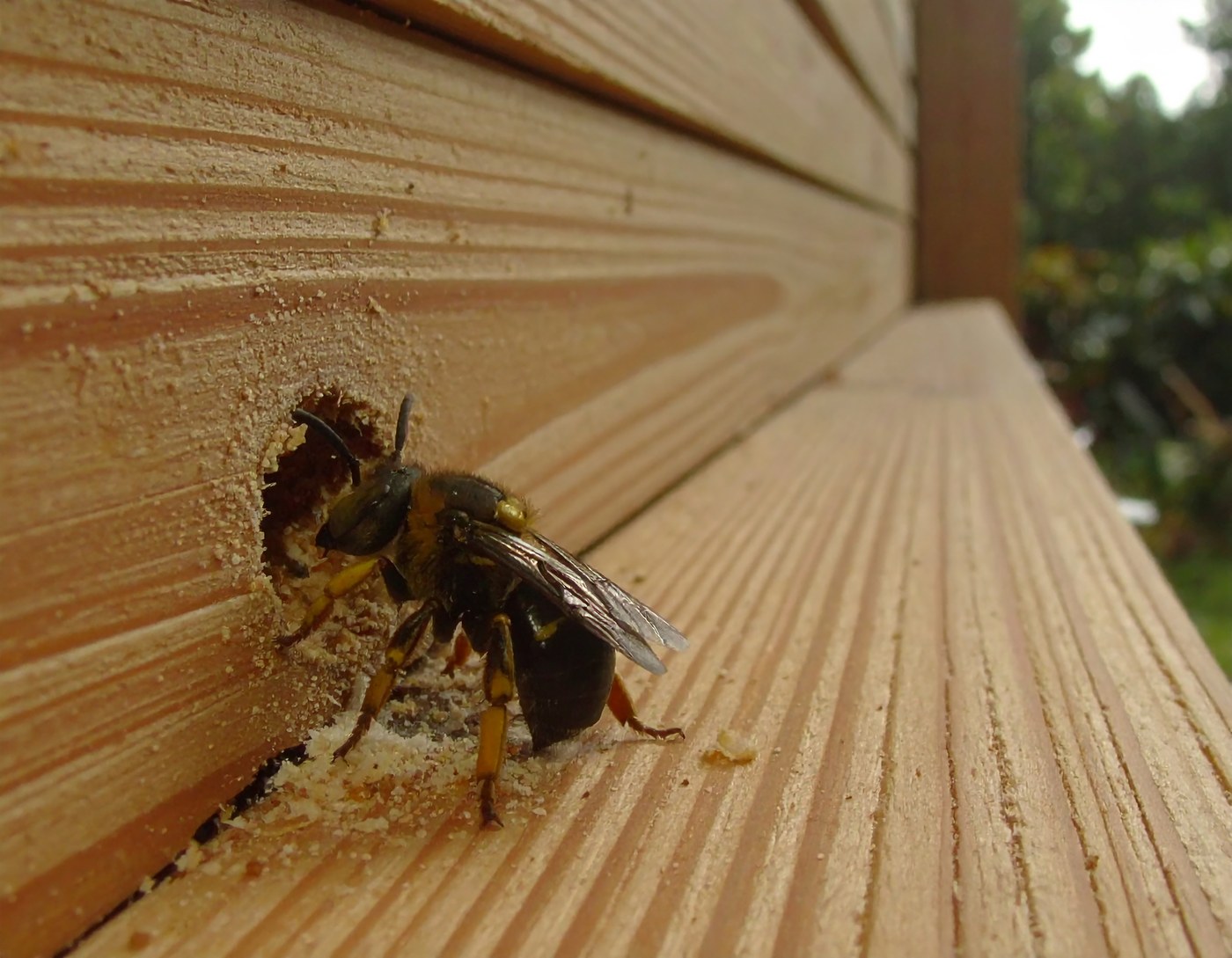
A perfectly round entrance hole, about half an inch across. It is bored to the diameter of the bee's own body. Be aware that the published figures do not all match: across university sources the range runs from roughly four tenths of an inch to eight tenths. Half an inch is the working figure, because no single decimal figure is settled.
Tunnel growth rates are unsettled
How fast the tunnel grows is genuinely unsettled, and the published rates span elevenfold. Penn State says about an inch of tunnel a day. UF/IFAS, condensing Balduf's 1962 life history, gives about 15 mm a day boring against the grain. Ohio State says about an inch in six days. Utah State says 1.5 cm a week. Those are four university sources and they do not reconcile, so all four appear here with names attached rather than averaged into a number nobody published. A typical gallery after the right-angle turn runs roughly four to twelve inches, depending again on the source.
Coarse yellow frass below the hole
A pile of coarse, yellow, sawdust-like frass on the ground, deck or windowsill directly below the hole. Round hole above, sawdust below. That pairing identifies the pest on its own, and the sawdust is often the first thing a homeowner notices when the hole itself is hidden.
Fan-shaped staining, going black
Fan-shaped yellow to brown staining below and beside the hole, going black with mold as it ages. Six sources describe it. This is the sign that finds a hole you cannot see, because the stain runs down the visible face of the board even when the entrance is on the back of the trim.
Look under the boards, not at them
UGA's field observation is that the entrance is usually placed to shed water, meaning the underside of a board facing the ground. Ohio State goes further and describes a shift over time: holes used to be in exposed places, but those bees were the easiest to find and treat, so the population is now dominated by bees that hide the entrance. The inner face of a roof fascia board and the back face of trim under the eaves are the classic spots. UF/IFAS independently describes the same problem, with sawdust on the ground as the only visible clue.
You can often hear them
A buzzing, drilling or scraping sound coming from inside the wood is described by four independent university sources, which is unusually strong corroboration for an audible sign. If you can hear it and cannot find a hole, the hole is on a face you are not looking at.
A bee hovering at one fixed spot
A large bee hovering at head height at one fixed spot near the building, day after day. That is a male holding a mating territory, which means a nest is close by. He will dart at you, at the dog and at passing insects. He cannot sting.
Wood torn open along the grain
Ragged, torn-open wood running along the grain, exposing a tunnel. That is not bee damage, it is woodpecker damage, and homeowners almost never connect the two. UGA's diagnostic phrasing is the useful one: the bee makes a round hole on the underside of a board, the woodpecker makes holes in the face grain. See the woodpecker question below, because this is the point where a cosmetic problem becomes an expensive one.
No smell
Carpenter bees have no characteristic odor. No university or federal source describes one.
Prevention and When to Call a Pro
Does this nest need treating
Start with the question nobody in this industry asks: does this nest actually need treating? Four university sources say control is often unnecessary. The University of Maryland says control is not necessary unless the bees are damaging wooden structures. Utah State says control measures are usually not warranted and insecticides should be a last resort. UC IPM says flatly that under most conditions insecticide use is not recommended. A UGA county office frames the professional version: confine control to where it is needed and effective, to avoid unnecessary pollinator mortality. A hole in a back fence post is not the same problem as a hole in your fascia board, and if the bee is a southern carpenter bee it is not a structural pest at all.
Paint the bare wood
Paint bare wood, and use oil-based paint or polyurethane. This is the best-supported prevention step in the literature, recommended by nine sources. Stain is a different story. Ohio State says wood stains will not prevent damage, Clemson says they give little repelling action, Penn State says stained wood is not usually protected, and Maryland lists stained weathered wood as an attractive nest site. Two sources dissent and recommend paint or stain together. That is five to two against stain. One more honest caveat: UGA notes that the effects of paint and staining are poorly understood and that the support for them is anecdotal rather than tested, and a UGA county office reports that in personal experience paint alone offers little protection. Paint is the best available prevention. It is not a guarantee.
Fill the holes before painting
Fill nail holes, exposed saw cuts, splinters and surface cracks before you paint. Those defects are the actual initiation points, because they give her a head start into the wood. Caulk, wood putty or dowels, then paint over the repair. This is more specific and more useful than generic advice to seal cracks.
Change the material where you can
Vinyl and aluminum siding exclude them entirely, and they do not damage asphalt or composite either. Hardwoods are largely avoided, so building susceptible exterior parts from hardwood is a real preventive choice. UC IPM also suggests wire screening or metal flashing over timber ends and rough areas, which is a cheap fix for deck joist ends, a favorite target. Bees prefer wood thicker than two inches, per Penn State, which explains why 2x6 fascia and deck joists get hit while thin trim usually does not.
Close outbuildings in early spring
Close the garage, the shed and the outbuildings in early spring. Three sources recommend it, it costs nothing, and hardly anyone mentions it. Females are actively searching for nest sites in April and May, and an open outbuilding full of bare rafters is exactly what they are looking for.
Treat first, wait, then plug
On filling holes: treat first, wait, then plug. Never plug first. Every source agrees on that order and the reason is the same in all of them, which is that returning bees have to walk through the treatment and carry it into the gallery. The wait before plugging varies by source, from 24 hours at Clemson to a full week at Maryland, with a few days as the most common answer. What happens if you skip the treatment is genuinely unresolved, and it matters, because it decides whether plugging works at all. Four sources, Maryland, Clemson, Cornell and UC IPM, say trapped bees chew straight back out and bore new openings. Two sources, Ohio State and UGA, say they will not, and Ohio State presents sealing on its own as a promising non-chemical method. Nobody has settled it. Treating first is the sequence that is safe under either reading.
Plug with something they cannot chew
Steel wool plus caulk is the one popular consumer fix squarely backed by the extension literature, recommended by name by both UC IPM and Ohio State. UGA independently recommends stainless steel or copper mesh for the same reason. Wooden dowels set with carpenter's glue, wood putty and plastic wood are all sourced as well, and expanding sealant filling the whole gallery appears in two sources. Then repaint or varnish the repair, because if the surface as a whole is not improved the bees will reinfest the same area.
Do the job early or late in the year
Do the whole job in early spring or in late summer and fall, and know why the middle of the season fails. Three sources agree on those two windows: early spring before nest building begins, or late summer after the new adults have emerged and before they settle in for winter. UC IPM explains the failure mode in the middle. Each brood chamber is sealed with partitions of wood particles at both ends, so a pesticide applied to an active nest in late spring or summer cannot reach the developing bees. Right product, wrong month, no result.
On carpenter bee traps
Carpenter bee traps: three universities recommend them and a fourth says nobody has ever tested whether they work. Kentucky describes the design and says traps may help reduce attacks on wood. Clemson recommends them for monitoring and control. One UGA publication recommends them. But UGA's IPM program states that there have been no objective, peer-reviewed evaluations of the efficacy of repellents or of the ability of carpenter bee traps to manage infestations. It adds the arithmetic that puts the trap catch in perspective: an established nest can produce one to twenty bees a year, so a jar of dead bees is not the same as a solved problem. UGA also warns that sticky traps take bycatch, including paper wasps. All of that is worth knowing before you buy one.
The remedies with no evidence
There is no evidence in either direction. Citrus oil sprays, WD-40, eucalyptus, tea tree and lavender oils, and ultrasonic repellers do not appear in a single university extension publication, for or against. Every result was a retailer, a trap manufacturer or a pest control blog. That is not the same as saying they fail. It means nobody with a lab has checked, and you should treat confident claims about them accordingly. And spraying a flammable petroleum aerosol into a structural cavity is a bad idea regardless of what it does to bees. Almond oil is the one natural treatment with any university behind it, and it is exactly one: Penn State recommends an annual springtime coat over bare wood as a deterrent for people who want a natural finish, and is explicit that it will not do anything to an established nest, because a surface treatment does not reach an excavated gallery.
Two more where sources disagree
Two more where the sources disagree, reported rather than resolved. Borates: Ohio State says stomach poisons such as borates are typically ineffective because the bees do not ingest the wood they excavate, while UC IPM lists a borate dust as labeled for carpenter bees and Purdue lists boric acid dust. Nobody reconciles that. Surface spraying the structure: Kentucky, Clemson and UGA all say the residual lasts under about four weeks, while UGA's IPM program says exterior surface application is not effective and is not recommended, and UC IPM does not recommend insecticides at all under most conditions. The one thing everybody agrees on is that the residual is short.
Offering an alternative nest site
Offering them somewhere else to nest is contested. Penn State suggests untreated pine or cedar as an alternative nest site to lure females away from the structure. NC State is skeptical for this genus specifically, saying carpenter bees are not frequent bee hotel residents and that a bee hotel is unlikely to pull them off a deck, porch or shed. If you try it, NC State supplies the spec: the holes need to be at least three eighths of an inch.
Six situations that warrant a call
Call a professional in six situations, and these are thresholds rather than a sales pitch. The holes are in an eave, soffit or fascia and reaching them means a ladder, which Maryland, Penn State and UGA all name as the point to hire someone. You can hear buzzing in the wood and cannot find the hole, which means it is on a hidden face and finding it is the job. A woodpecker has started working the area. The same boards have been hit several years running. You are about to plug holes and do not know whether bees are inside. Or chemical treatment is being considered at all, because Penn State is blunt that pesticide applications should be performed by an expert, and its own fact sheet spells out the protective clothing, goggles and respirator involved in getting dust into an overhead gallery.
The reason not to wait
Ignore the holes long enough and you do not end up with a few holes. You end up with woodpeckers. Eight sources, including the US Fish and Wildlife Service and the Cornell Lab of Ornithology, describe birds tearing open galleries to eat the larvae and the overwintering adults, and the resulting damage is frequently worse than the bees'. UGA is blunt that there is no way to discourage a woodpecker from looking for food, and that a piece of lumber with carpenter bee nests in it will always be attractive to them. The birds are federally protected under the Migratory Bird Treaty Act, so removing them is not legal. The only lawful fix is removing the food source.
Frequently Asked Questions
Will a carpenter bee sting me?
Almost certainly not, and the one flying at your face definitely cannot. That is a male, and male carpenter bees have no stinger at all. Eleven independent university, federal and trade sources say so. The reason is structural: the sting is a modified egg-laying organ, so no male bee or wasp ever had one to begin with. The dive-bombing and the erratic hovering are territorial bluff, in Ohio State's word. Females do have a sting, and can use it more than once, but eight sources agree they are docile and will only sting if you handle or grab one. You can tell them apart on sight: males have a white or yellow patch in the center of the face, females are all black. No published rating of the pain of a female sting was found, and a rating borrowed from a different insect would not apply.
Is that a carpenter bee or a bumble bee?
Look at the top of the abdomen. A carpenter bee's is shiny, black and bare. A bumble bee's is fully furry, usually with yellow. The nest settles it too: carpenter bees tunnel into wood above ground, bumble bees nest underground, often in an abandoned rodent burrow. Two more checks if the bee will not sit still. A carpenter bee's head is almost as wide as its thorax, where a bumble bee's is much narrower. And a bumble bee carries a smooth concave pollen basket on the hind leg, where a carpenter bee has a brush of hairs. In the Southeast and South Central there is a third possibility worth ruling out: the southern carpenter bee, which looks like the pest species and is not one.
Do carpenter bees eat my house, and how much damage will they actually do?
They do not eat wood at all. They eat nectar and pollen, and chew tunnels purely as a nursery, pushing the chewed wood back out as the sawdust below the hole. One nest does very little. Five university sources say the damage from a single season is minor. The real risk is reuse. The same family refurbishes and extends the same gallery year after year, and each new occupant digs deeper from the far end. UGA researchers pulled seven boards off a decade-old bench and measured them. The worst one, a 7-foot 2x4, carried 15 entrance holes, 13 separate nests and 28 galleries, totaling 28 feet of tunnel, with 18 percent of the board's wood removed over ten years. UGA reports that as a personal observation rather than a peer-reviewed result, and no other published damage figure was found with an actual method behind it. You will see a far larger gallery figure quoted on a lot of pages, including university ones. None of the six publications repeating that number cites a primary source for it, so it is left out.
Why are woodpeckers attacking my siding?
Because there are probably carpenter bee larvae behind it. Woodpeckers and flickers tear open the galleries to eat the grubs and the overwintering adults, and the ragged trench they leave along the face grain is often far worse than the bees' neat round holes. Eight sources describe it, including two from outside entomology entirely: the US Fish and Wildlife Service and the Cornell Lab of Ornithology both name carpenter bee larvae as a primary reason woodpeckers work on houses, with photographs of the damage on cedar trim and fascia boards. Utah State is the one dissenting voice on how often it happens, calling it rare, which may be a real difference between east and west. You cannot deal with the bird. Woodpeckers are federally protected, and UGA says plainly there is no way to discourage one from searching for food. Deal with the bees.
Should I fill the holes, and when?
Yes, but not yet, and not while a bee is inside. The sequence every source gives is: treat the gallery, wait, then plug, then paint over the repair. How long to wait depends on who you ask, from 24 hours at Clemson to a week at Maryland, with a few days as the most common answer. What happens if you skip the treatment is honestly unresolved. Four sources say trapped bees chew through the plug and bore new openings. Two, including Ohio State, say they will not. Treating first is the order that works no matter which camp turns out to be right. Plug with steel wool and caulk, which UC IPM and Ohio State both recommend by name, or a glued dowel or wood putty. Do the whole job in early spring before she starts digging, or in late summer and fall after the new adults are out. Treating in late spring or midsummer largely wastes the product, and UC IPM explains why: each brood cell is sealed behind wood partitions at both ends, so nothing reaches the developing bees.
What actually works: paint, stain, traps, citrus oil, WD-40?
Paint works. Nine sources recommend oil-based paint or polyurethane on bare wood, and you should fill nail holes and saw cuts with putty first, because that is where she starts. Stain mostly does not. Ohio State says stains will not prevent damage, Clemson says they give little repelling action, and Maryland lists stained weathered wood as an attractive nest site. Two sources disagree and recommend paint or stain together, and UGA is honest that the evidence base for the whole paint question is anecdotal rather than tested. Steel wool and caulk in an empty hole is backed by two universities. Traps are unproven. Three universities describe or recommend them, but UGA's IPM program states there have never been any objective, peer-reviewed evaluations of whether carpenter bee traps manage infestations. Almond oil has exactly one university behind it, Penn State, as an annual spring coat on bare wood, and Penn State says it does nothing to an established nest. Citrus oil, WD-40, eucalyptus, tea tree, lavender and ultrasonic devices do not appear in a single university extension publication, in either direction. There is no evidence they work and no evidence they fail, and anyone telling you otherwise is not citing a study.
Should I just leave them alone?
Sometimes, yes, and that is not a dodge. Carpenter bees are native pollinators. They buzz-pollinate by gripping a flower and vibrating their flight muscles to shake pollen loose, which is how the USDA Forest Service describes it, and that technique works on eggplant, tomato and other crops honey bees cannot service the same way. UGA examined 23 nests and estimated the bees made 7,150 foraging trips and collected 8.6 billion pollen grains between May and June, attributed to Tucker and colleagues. UGA also found that the abandoned galleries become housing for other beneficial insects, collecting over 50 mason bees, resin bees, mason wasps, grass-carrying wasps and other arthropods from 45 carpenter bee nests. A gallery is a native bee hotel that built itself. The honest counterweight is that they also rob nectar, cutting a slit at the base of long flowers they are too big to enter and taking the nectar without pollinating, and the research on whether that costs a grower splits: two papers published the same year on the same crop, rabbiteye blueberry, reached opposite conclusions. UGA's own verdict is that they are valuable pollinators despite the robbing. Maryland says control is not necessary unless they are damaging wooden structures, and UC IPM says insecticide use is not recommended under most conditions. A hole in a back fence post is not the same problem as a hole in your fascia board.
Sources
- Eastern carpenter bee (Xylocopa virginica), Pest Profiles University of Georgia Integrated Pest Management
- Carpenter Bees, HYG-2074 The Ohio State University Extension, Ohioline
- Pest Notes: Carpenter Bees, UC ANR Publication 7417 UC Statewide IPM Program
- Carpenter Bees, ENT-128-08 Utah State University Extension and Utah Plant Pest Diagnostic Laboratory
- Pocket Guide to the Native Bees of New Mexico New Mexico State University Cooperative Extension Service
- Carpenter Bees (Xylocopa spp.), Pollinator of the Month USDA Forest Service, Celebrating Wildflowers
Image Credits
- Image: photographer not named via iNaturalist. CC0 1.0.
License. - Image: Adobe Stock, licensed.