Seasonal Timeline
Active roughly April through October, with a shorter season at the northern end and a longer one in the south. The daily schedule flips with the heat: mostly daytime activity in spring and fall, shifting toward dusk and night through the hottest weeks of summer. Winter is spent underground, in crayfish burrows in the Midwest and rodent burrows in Colorado and the Southwest.
Active roughly April through October, with a shorter season at the northern end and a longer one in the south. The daily schedule flips…
The calendar is ordinary. The daily schedule is not. Missouri describes this snake as primarily active by day in April, May, and October, and more nocturnal through the heat of summer, with the season running April through October and stretching into March or November when it is warm enough. Colorado field data say the same thing in numbers: primarily diurnal activity in April and from late September into October, primarily early-evening activity from May through August, with animals moving between 14 and 30 degrees Celsius and an average ambient temperature during activity of 22.1 degrees. Nebraska adds the practical version, that in hot weather in Kansas and Texas the snakes are largely nocturnal and often found on roads shortly before and a few hours after dusk.
Spring and fall are the movement seasons, and that is when people encounter one. Nebraska animals migrate from hibernation sites to summer foraging or gestation areas beginning in May and finishing by early July, then work through shorter movements all summer before a slow return after the August births. Colorado animals do something much bigger: a directed spring migration averaging 1.89 kilometers from shortgrass hibernation ground to mixed-grass and sand sagebrush foraging ground, and back again in October. Colorado activity areas run roughly seven times larger than Nebraska's, with range length nearly four times greater, entirely because of that migration.
Road mortality tracks those same two windows. Nebraska documents dead massasaugas turning up on roads near one population site with some predictability every year, concentrated in April and May and again from August into October. A dead small rattlesnake on a rural road in those months is a real indicator that a population is nearby, and in Iowa, Missouri, or Nebraska it is worth reporting to the state wildlife agency.
Where They're Found
Western massasauga is an outdoor grassland species with no structural damage mechanism at all. It matters because homeowners, landowners, and farm and ranch crews inside its range can encounter one in a field, a pasture, a wet swale, or a roadside ditch. Its range spans four regions: Midwest, South Central, Mountain West, and Southwest.
The range is nine states, and they were counted rather than estimated. A national conservation database assigns this species state-level ranks in exactly nine states: Arizona, Colorado, Iowa, Kansas, Missouri, Nebraska, New Mexico, Oklahoma, and Texas, with a global rank of vulnerable. Two independent range descriptions match that list. Nebraska's own species assessment places the prairie subspecies in Iowa, Nebraska, Missouri, Kansas, Oklahoma, and Texas. The federal 90-day finding on the desert subspecies places it in central-western and southern Texas, southeastern Colorado, southern New Mexico, southeastern Arizona, and northern Mexico, and notes that historical occurrence in far western Oklahoma and extreme southwestern Kansas is possible but present occurrence in both is unknown. Kansas holds the strongest state rank in the entire range. Iowa, Missouri, Nebraska, and Arizona hold the weakest.
Two subspecies, and the difference is real enough to change the advice. The prairie massasauga, Sistrurus tergeminus tergeminus, is the Midwest and South Central animal: bigger, darker, and tied to moist ground. The desert massasauga, Sistrurus tergeminus edwardsii, is the Colorado, New Mexico, Arizona, and west Texas animal: smaller, paler, and tied to dry shortgrass and sand sage. Every measurement below is labeled with which subspecies it came from, because averaging them would produce numbers nobody actually measured.
Midwest habitat is wet, and the wetness is the point. Missouri restricts this snake to marshes and moist prairie inside or near large river floodplains, or moist prairie swales inside upland grassland, on ground dominated by cordgrass, sedges, bulrushes, and smartweeds. Nebraska lists wet-mesic tallgrass prairie, wet meadow, marsh, wet prairie, and cordgrass wet prairie, with upland tallgrass prairie possibly the most preferred type. Look for basking animals in open space among vegetation, coiled on top of a crayfish burrow or an ant mound, or on matted vegetation sitting several feet off the ground.
Mountain West and Southwest habitat is dry, and sits below about 5,500 feet. Colorado Parks and Wildlife confines the species to southeastern Colorado below roughly 5,500 feet, in dry plains grassland and sandhill country, drawn to sandy soils holding good rodent and lizard numbers. The federal account adds shortgrass prairie, sandsage grassland, shinnery oak, Chihuahuan desert, and occasionally sand dune habitat. Colorado's population is centered on Lincoln, Kiowa, and Crowley counties and is significantly disjunct from populations in New Mexico, Oklahoma, and Kansas.
Colorado is a small edge population by area and an important one by numbers. Radiotelemetry ran there across four active seasons, and a state and federally funded study at one 12,000-acre Lincoln County ranch documented roughly 950 locality records and tagged about 800 snakes. The federal finding calls the southeastern Colorado populations reasonably robust and stable, and an exception to the range-wide picture.
Arizona is the weakest part of the range picture. Arizona holds the lowest state rank in the range, and the federal finding quotes the Arizona Game and Fish Department reporting that while quantified data are lacking, the desert massasauga has almost certainly experienced long-term population declines and a general range contraction in the state, confined to its extreme southeastern corner. No published source establishes current Arizona occupancy. The Southwest range rests on New Mexico, where the species holds a middle rank across southeastern New Mexico and isolated middle and lower Rio Grande Valley populations, and Arizona is described as an uncertain edge rather than a live population.
Two absences are confirmed rather than skipped. No published source places any massasauga in Alaska, and no national rank exists for the state. Hawaii has no native snake of any kind and no rank for this species. Every published range description confines it to the Great Plains, the southern Rocky Mountain foothills, southwestern grassland and desert, and two small disjunct populations in Coahuila and Nuevo Leon, Mexico.
Related Pests
Life Cycle
Slow reproduction, and a winter that depends on another animal's construction work. Females on this species usually reproduce every other year, a finding Nebraska, Colorado field work, and the federal account all reach independently, with Missouri the one source allowing an annual litter where weather and prey are good. Litters run 4 to 11 across all sourced figures and cluster at 6 or 7. Maturity comes at 2 to 5 years depending on the state. That is a slow replacement rate for an animal whose habitat has been drained and plowed, and it is the biological reason behind its state listings.
How this snake overwinters splits sharply by region, and that is the most useful thing to know about it. Midwest animals depend on crayfish burrows that reach groundwater below the frost line, which makes the local crayfish population and the water table part of the snake's winter survival. Nebraska names winter water drawdowns, soil compaction from tractors and heavy machinery, and dredge spoil dropped over crayfish burrows as direct harms to hibernation sites, and flags the crayfish themselves as a climate vulnerability for the snake. Colorado animals do not use crayfish burrows at all. They winter singly in rodent burrows in compacted clay shortgrass, then migrate an average of 1.89 kilometers to sandier summer ground where prey surveys confirm significantly more rodents and lizards.
One number is deliberately missing. No wild lifespan figure specific to this species was confirmed. Nebraska states outright that survival estimates for it in that state are unknown, and the range-wide annual survival figure available in the literature is for the eastern massasauga, a different species since 2013. That figure is not carried across the split, so the gap stands rather than being filled in from a different species.

Mating
Gestation
Neonate
Juvenile
Adult
Overwintering
Identification
Nine plates on top of the head
Nine large plates on top of the head. This is the tell that settles the genus, and two state wildlife agencies give it independently. Colorado Parks and Wildlife describes usually nine large, symmetrically arranged scales on top of the head, sometimes with several small scales interspersed. Missouri describes 9 large scales on the top of a head noticeably wider than the neck. That is the Sistrurus character. Prairie rattlesnake, midget faded rattlesnake, and every other Crotalus in this range carries many small irregular scales on the crown instead.
Small, and smaller in the west
Size runs small, and it runs smaller still in the west. Prairie massasauga, the Midwest and South Central subspecies, is 18 to 30 inches with the largest individuals potentially reaching 35. Desert massasauga, the Colorado and Southwest subspecies, has a maximum recorded length of 588 mm, about 23 inches, and averages about 380 mm or 15 inches. Colorado Parks and Wildlife gives Colorado animals as usually under 20 inches snout-vent length, averaging around 15 to 16 inches total. For scale, a prairie rattlesnake in the same Colorado grassland runs 35 to 45 inches.
Suggestive, not decisive
Size is suggestive, not decisive, and the reason matters. A young prairie rattlesnake is small too. Use the crown scales to decide, and treat the size difference as the thing that makes you look at the crown scales in the first place.
One row of blotches, three of spots
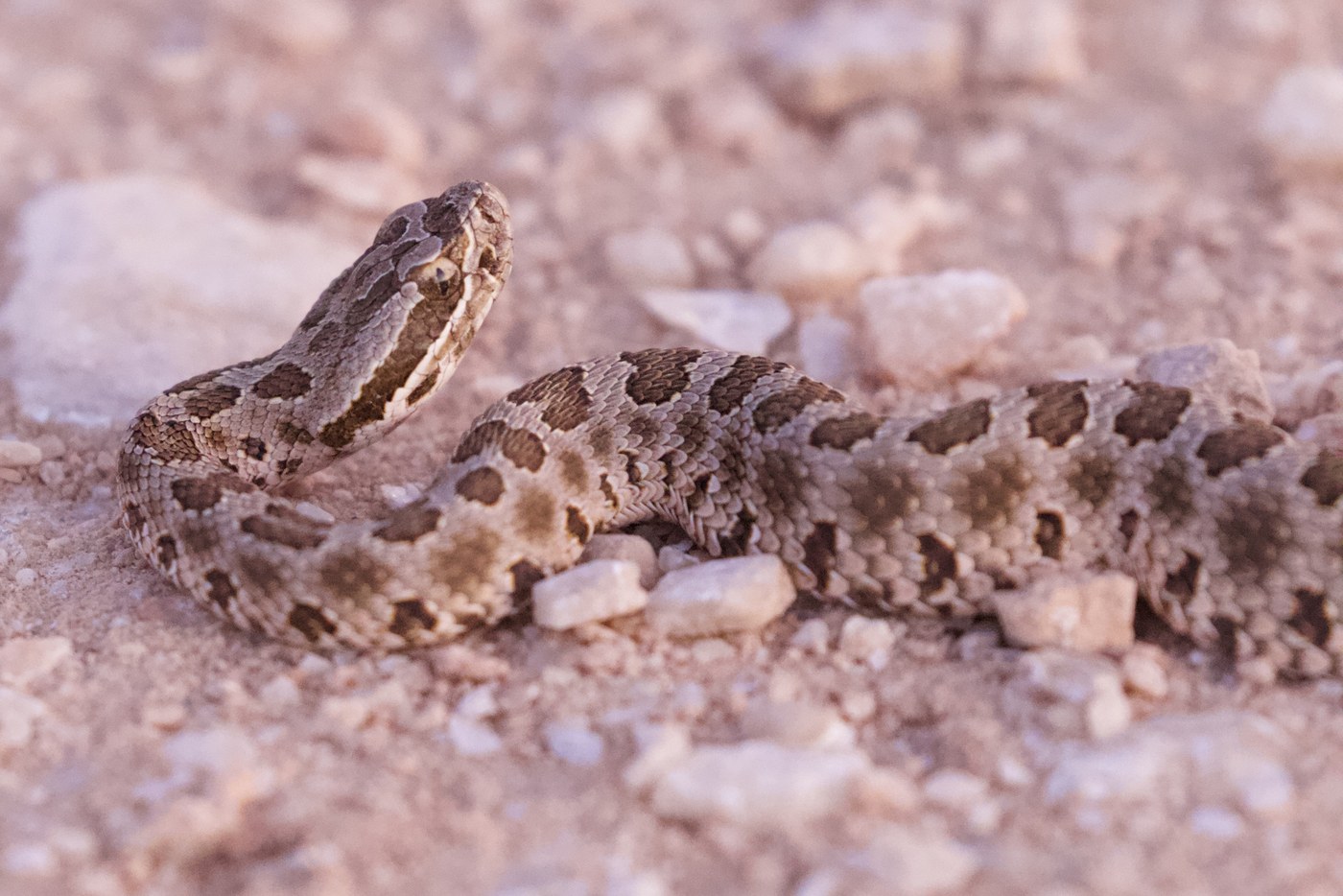
The pattern is a single row of dark blotches with three rows of smaller side spots. Prairie massasauga is light to dark gray or gray-brown with 34 to 50 dark brown or black dorsal blotches, averaging about 40, plus three alternating rows of smaller dark spots along each side, two white-edged dark stripes on each side of the head, a light tail with dark bands, keeled back scales, and a single anal plate. Desert massasauga is paler, gray to light brown with 37 to 40 dark saddles outlined in black, a prominent dark stripe from eye to jaw, a lyre-shaped pair of stripes running from the top of the head to the first body blotch, and a nearly white belly.
Prairie rattlesnake shares its ground
Prairie rattlesnake is the look-alike that matters most, because the two genuinely live together. A peer-reviewed study of venom resistance in eastern Colorado grassland rodents documents prairie rattlesnake and desert massasauga preying on the same rodent community at the same sites. The tells are crown scales first and size second, in that order.
Timber rattlesnake, in Missouri
Timber rattlesnake is the Missouri question, and it is easy. Missouri's own agency names it directly: timber rattlesnake adults run 3 to 5 feet, much larger, and carry a rusty stripe down the back that a massasauga does not have.
Western pygmy is the hard one
Western pygmy rattlesnake is the hard one, because the genus tell does not work on it. Pygmy rattlesnake is the other Sistrurus, so it also has nine large crown plates, and the two ranges overlap in the South Central region. Use the blotches instead. Western pygmy carries 20 to 30 dorsal blotches, only one or two rows of side blotches, and a narrow orange-brown stripe running down the back. Prairie massasauga carries 34 to 50 dorsal blotches, three rows of side blotches, and no dorsal stripe. Pygmy also runs smaller at 15 to 20 inches typical, with a slender tail and a rattle whose sound is described as a faint grasshopper-like buzz audible only about a yard away.
Plains hog-nosed puts on a show
Plains hog-nosed snake is nonvenomous and puts on a convincing show. It hisses, puffs out its head, thrashes, and plays dead. Four tells separate it: an upturned, shovel-like nose scale, a jet-black belly running from the neck to the underside of the tail, one row of dorsal blotches with two rows of side spots rather than three, and a divided anal plate against the massasauga's single one.
Prairie kingsnake fakes the sound
Prairie kingsnake is nonvenomous and fakes the sound rather than the look. Missouri's description is blunt: when alarmed, a prairie kingsnake vibrates its tail, which among dry dead leaves can sound something like a rattlesnake's rattle. The tells are smooth back scales instead of keeled ones, no true rattle at all, up to 60 blotches, a rear-pointing arrowhead marking on top of the head, and an adult length of 30 to 42 inches, occasionally to 56.
Not worth getting closer to check
None of these tells is worth getting closer to check. Crown scales, anal plate, side blotch rows, and dorsal stripe all require a clear look at a live snake's head, belly, or tail. If you are close enough to count scale rows, you are closer than you should be. Back away and let someone equipped for it make the call.
Names, and the outdated one
Names you will see, and the one that is out of date. Prairie massasauga is the Missouri and taxonomic name for the nominate subspecies. Desert massasauga is the name for the western and southwestern one. Massasauga rattlesnake is what Colorado Parks and Wildlife calls it. On the scientific name, Colorado's own public page still gives Sistrurus catenatus, the pre-split binomial, while Colorado's herpetological conservation partnership gives Sistrurus tergeminus for the same animals in the same counties. The taxonomic authorities use Sistrurus tergeminus, so that is the current name, and the older one is still in circulation.
Settled above species, not below
The split is settled at species level and unsettled below it. The 2011 genetics and the 2013 nomenclature ruling separated eastern from western for good, and Iowa's administrative code now lists the two as separate endangered species by name and binomial. But a 2015 study that specifically targeted the north-central Texas contact zone the original work had not sampled found the two western subspecies genetically indistinguishable at both genes tested, and concluded they most likely represent habitat-dependent forms of a single species rather than true subspecies. Two species, yes. Two subspecies inside the western one, still argued.
Signs of Infestation
Nothing to inspect
There is nothing to inspect, because there is nothing this snake damages. It does not chew, does not get into a wall or crawlspace, and leaves no droppings trails, gnaw marks, entry holes, or odor. The sighting is the evidence, and so is a shed skin.
A small blotched snake, wide head
What you actually see is a small blotched snake with a head wider than its neck. Gray or gray-brown, a single row of dark blotches down the back, three rows of smaller spots along the sides, and a small rattle on a banded tail, in or beside wet prairie, marsh edge, floodplain, or moist swale in the Midwest, or shortgrass and sand sage prairie in Colorado and the Southwest.
Habitat predicts better than sightings
The habitat cues predict presence better than sightings do. In the Midwest, look for crayfish burrow fields and ant mounds in moist prairie. In Colorado, look for rodent burrow complexes in firm loamy shortgrass soil sitting next to sandier feeding ground. Those are the winter shelters, and they are the reason a population stays put.
The rattle is small, silence proves nothing
The rattle is real but small, and silence proves nothing. Missouri notes this small rattlesnake will become defensive, sound its rattle, and strike when cornered or harassed. It will also just stay still and let you walk past. Two of the most common nonvenomous snakes in the same range, prairie kingsnake and hog-nosed snake, produce convincing rattle-like or threatening sounds without a rattle, so the sound does not identify the animal either.
Road-killed snakes mean a population
Dead snakes on rural roads in spring and fall mean a population, not a coincidence. Nebraska documents predictable annual road mortality near one population site, concentrated in April and May and again from August into October, matching the two migration windows. Colorado animals bask on hard surfaces and cross roads during their much longer spring and fall migrations.
Several at one burrow field
Several small snakes at one burrow field as the weather turns is a den, in the Midwest. Communal denning through the winter is described as a common occurrence for this species in Nebraska, and multiple massasaugas have been found in a single crayfish burrow. That situation is a call to a professional or the state wildlife agency, not a closer look. Colorado animals do the opposite and appear to winter alone.
Prevention and When to Call a Pro
Three states list it
In Iowa, Missouri, and Nebraska this is a listed animal, and that comes before every other consideration. Do not handle, capture, trap, relocate, or kill a western massasauga in those three states. Missouri's wording leaves no room: both of the state's massasauga species are listed as endangered there, and none can be injured, killed, or taken from the wild for any use. Iowa's administrative code lists Western Massasauga, Sistrurus tergeminus, by name and binomial among its endangered animal species, and Iowa Code section 481B.5 attaches the prohibition to that list directly: a person shall not take, possess, transport, import, export, process, sell, offer for sale, buy, or offer to buy any species appearing on it. Nebraska gives it threatened status and all the protections that designation carries. Contact the state wildlife agency or a licensed nuisance wildlife control operator, and report the sighting. Missouri specifically asks that a massasauga be photographed and reported.
Six states, check the rule first
In Colorado, Arizona, Kansas, New Mexico, Oklahoma, and Texas, check the current state rule before doing anything at all. Colorado Parks and Wildlife designates the massasauga a species of special concern due to declining populations, possibly from habitat loss. Arizona protection is described in the peer-reviewed literature, though the specific state rule is not named there. Kansas, New Mexico, Oklahoma, and Texas have no state listing on record, so check those four directly. Rules vary by state and change, so verify locally, and because this is a venomous animal in all six, the safer default is a licensed nuisance wildlife control operator rather than a trap you bought yourself.
One gap, stated on purpose
One gap is stated rather than filled, on purpose. What Colorado's species of special concern designation actually does to the legality of taking or moving this particular snake is not established by any published source. Colorado publishes general conditions under which a rattlesnake may be relocated, from a road, trail, railway, or building to an unconfined nearby location, or on owned or leased property where the animal causes damage or threatens life or health, released no more than two miles from where it was caught. Whether the special concern designation qualifies any of that for massasauga specifically is a question for Colorado Parks and Wildlife, not something to guess at from the general rule.
Never handle one, listed or not
Never handle one, in any of the nine states, listed or not. Colorado's own rattlesnake guidance is the model: never, under any circumstances, try to catch, kill, provoke, or move a rattlesnake. If you hear one, freeze until you can locate it, then move slowly back the way you came. Keep at least five feet between you and the animal, since a rattlesnake can strike about half its body length.
Never probe a burrow by hand
Do not investigate a burrow by hand. This species winters in crayfish burrows and ant mounds in the Midwest and rodent burrows in Colorado and the Southwest. Reaching into or digging out a burrow on a property inside its range is the single most avoidable way to put a hand where a massasauga is. Note the burrow and leave it alone.
Water management counts as disturbing
Understand that disturbing a hibernation site includes water management, not just digging. Nebraska names winter water drawdowns, compaction of crayfish burrows by tractors and heavy machinery, and dredged material placed over crayfish burrows as direct harms to overwintering animals, and recommends monitoring hibernation sites for water level and invasive vegetation instead. If you manage an impoundment, a ditch, or a wet pasture inside this snake's Midwest range, that is the guidance that applies to you.
Time haying away from the animal
Time haying and mowing away from the animal. This is the most specific, most actionable prevention step available for this species. Nebraska documents that haying happens in August and September, overlapping the birth season, and that massasaugas take cover in mown windrows before baling, where equipment kills them. Two dead massasaugas turned up in a Nebraska hay bale in 2004. Better timing is October through March, with mower blade height set no lower than 15 cm, about 6 inches. Mowing before burning increases mortality rather than limiting it, and mowing gestation areas is specifically flagged as harmful. Leaving un-mowed patches that shift location year to year preserves refuge and foraging cover.
If you burn, burn early
Nebraska recommends prescribed fire before spring emergence, on cool days early in the day, and notes that at its Pawnee County population sites burns run in March and into April on 3, 4, and 5 year rotations. Large-scale fires can suppress the snake's small mammal prey base for a season or more, so a patchy mosaic is better than a single big burn.
Rodent work solves half of it
Reduce rodent activity near structures, and know it only solves half the problem in the west. Rodent prey is the Midwest attractant. In Colorado and the Southwest, lizards make up roughly 59 percent of the desert massasauga's diet, so rodent control alone does not remove the reason the snake is on the ground there.
No fencing spec exists
No reliable fencing or exclusion specification exists for this snake. No published source gives a homeowner-level exclusion spec for this species. Given that three states in its range prohibit take outright, the right gap-filler is a phone call to the state wildlife agency, not a specification borrowed from a different animal.
What the venom does
This is stated at the level the sourcing supports. The venom gland transcriptome of the desert massasauga shows a high abundance of serine proteinase and metalloproteinase transcripts, indicating that disrupting the blood's ability to clot is the principal mechanism of action. An independent proteomic study of the same subspecies' venom, using two different mass spectrometry methods, distinguished ten of eleven predicted serine proteinase isoforms and found protein families the transcriptome work had missed. The same transcriptome study also detected low-abundance transcripts for three-finger toxins, a family typical of elapid venoms and rare in vipers, plus a novel fused toxin. That is a finding about what the venom gland transcribes, not about what happens to a bite victim. No neurotoxic clinical effect in humans is documented for this species in any published source.
How bad is a bite, honestly
Two independent government sources address it and they are describing different things rather than disagreeing. The federal 90-day finding on the desert massasauga states that the venom is toxic to humans, but that because of the snake's small adult size venom yields are low, so bites are potentially serious but not likely to be life-threatening, and adds that the probability of a bite is very low given the animal's nocturnality, spotty distribution, and cryptic, nonaggressive behavior. Missouri, describing the prairie subspecies, states that human deaths from massasauga bites are rare, but that studies show the venom is highly toxic, so these snakes must be respected and classified as dangerous. Combined: potent venom, small delivered dose, a genuine medical emergency that is rarely fatal.
One gap worth naming
One gap in that picture is worth naming. Every published human bite series is for the eastern massasauga, which has been a separate species since 2013. Those studies document real coagulation problems that can persist, recur, or appear late, typically resolving with antivenom. No equivalent bite series has been published for this species, so the eastern figures are not restated as if they applied.
If someone is bitten
This is the protocol. Move away from the snake so a second strike is not possible. Call 911 and treat it as an emergency no matter how mild it looks. Remove rings and watches before swelling starts. Keep the affected limb still and at or below heart level. Do not try to suck out venom, do not apply a tourniquet, do not apply ice, and do not cut the wound. Do not delay care to photograph or capture the animal.
When a Bite Is an Emergency, Who to Call
For any bite, emergency medical care immediately. For any sighting in Iowa, Missouri, or Nebraska, contact the state wildlife agency, because the animal is protected and the sighting has conservation value. For any small blotched rattlesnake you cannot confidently separate from a look-alike, hand it to a licensed operator rather than getting close enough to be sure. For several snakes together at a burrow field in spring or fall in the Midwest, the same call, because a communal den is not a do-it-yourself situation. And before any haying, mowing, burning, dredging, or impoundment work on ground with known or suspected massasauga habitat, get agency guidance on timing first, not afterward.
Frequently Asked Questions
Is the western massasauga the same snake as the eastern massasauga?
No, not since 2013. They were treated as two subspecies of one species for decades. A 2011 study using 18 nuclear DNA loci and one mitochondrial locus found two clearly separate clades, split along the Mississippi River, and recommended elevating the eastern form. Actually doing that ran into a nomenclatural problem, because the type locality of catenatus turned out to sit inside the range of tergeminus, which would have forced the eastern animal to be renamed entirely. The International Commission on Zoological Nomenclature resolved it in 2013 by conserving both names and designating new type specimens for each. The result is two species: Sistrurus catenatus, the eastern massasauga, with no recognized subspecies, and Sistrurus tergeminus, the western massasauga, with two. Iowa's administrative code now lists them as two separate endangered species.
How do I tell a massasauga from a prairie rattlesnake?
Look at the top of the head. A massasauga carries nine large, symmetrically arranged plates on the crown, which both Colorado Parks and Wildlife and Missouri's wildlife agency describe independently. A prairie rattlesnake, like every other Crotalus, carries many small irregular scales there instead. Size supports the call without settling it: massasaugas run 15 to 30 inches depending on subspecies, and Colorado animals average about 15 to 16 inches, against a prairie rattlesnake at 35 to 45 inches. Size alone is not enough, because a young prairie rattlesnake is small too. Both species genuinely live together in eastern Colorado grassland, so this is a real question rather than an academic one, and the safe version of the answer is to back away and let a professional decide.
Is a western massasauga bite dangerous?
Yes, and it needs emergency care, but it is rarely life-threatening. The venom works by disrupting the blood's ability to clot, which the venom gland transcriptome and an independent proteomic study of the same subspecies both support. The federal 90-day finding on the desert massasauga states the venom is toxic to humans but that low venom yields, a consequence of how small the snake is, make bites potentially serious rather than likely fatal. Missouri says the venom is highly toxic and human deaths are rare, and that the snake should be classified as dangerous. Both are right, because they are describing different things. Call 911 for any bite.
Is the western massasauga protected?
In much of its range, yes, and more strictly than most people expect. It is state endangered in Iowa and Missouri, where Missouri states that none can be injured, killed, or taken from the wild for any use. It is state threatened in Nebraska. Colorado Parks and Wildlife designates it a species of special concern. It is not federally listed, but a federal status review of the desert massasauga subspecies has been open since a 2012 finding that a listing petition presented substantial information, and no 12-month finding has appeared in the Federal Register since. For Kansas, Oklahoma, New Mexico, and Texas, no state listing could be confirmed, so check locally rather than assuming either way.
Why do massasaugas live in crayfish burrows?
Because those burrows reach groundwater below the frost line, which is what makes them survivable through a Midwest winter. Missouri states that most individuals there rely on crayfish burrows for exactly that reason, and Nebraska found that massasaugas at its Pawnee County sites brumate solely in crayfish burrows. Multiple massasaugas may share one burrow, sometimes alongside gartersnakes, lined snakes, and brownsnakes. That ties the snake's winter survival to the local crayfish population and the water table, which is why Nebraska treats winter water drawdowns, soil compaction from heavy machinery, and dredge spoil dropped over burrows as direct threats. Colorado animals do something entirely different: they winter singly in rodent burrows in dry compacted shortgrass soil.
How big does a western massasauga get?
Small, and how small depends on the subspecies. Prairie massasauga, the Midwest and South Central animal, runs 18 to 30 inches with the largest individuals potentially reaching 35, and Nebraska measured adult snout-vent length at 45 to 65 cm. Desert massasauga, the Colorado and Southwest animal, has a maximum recorded length of 588 mm, about 23 inches, and averages about 380 mm or 15 inches. Colorado Parks and Wildlife gives Colorado animals as usually under 20 inches snout-vent length and averaging around 15 to 16 inches total. Those two sets of numbers are kept separate here on purpose, because averaging them would produce a figure nobody measured.
Sources
- Western Massasauga (Sistrurus tergeminus) species profile U.S. Fish and Wildlife Service
- Endangered and Threatened Wildlife and Plants; 90-Day Finding on a Petition To List Desert Massasauga as Endangered or Threatened and To Designate Critical Habitat, 77 Fed. Reg. 47583: substantial finding and status review, size and venom yield, range by state, hibernation timing, litter size, and habitat U.S. Fish and Wildlife Service, Federal Register (via GovInfo)
- Eastern Massasauga (Sistrurus catenatus) species profile, stating the reciprocal half of the 2011 reclassification U.S. Fish and Wildlife Service
- Western Massasauga (Sistrurus tergeminus): Species Conservation Assessment, Nebraska Natural Legacy Project: state threatened status, description and snout-vent length, crayfish burrow brumation and communal denning, migration and home range, litter size, maturity, haying and burning guidance, and road mortality Nebraska Game and Parks Commission, Wildlife Division
- Prairie Massasauga (Sistrurus tergeminus tergeminus) field guide: state endangered status and take prohibition, nine large crown scales, blotch counts, size, habitat, crayfish burrow overwintering, diet, reproduction, and the taxonomic split narrated in the agency's own words Missouri Department of Conservation
- Massasauga Rattlesnake species profile: Colorado state special concern designation, the nine-crown-plate description, Colorado size and elevation limit, single-animal rodent burrow hibernation, diet, and the state's rattlesnake relocation conditions Colorado Parks and Wildlife
- Iowa Administrative Code, Natural Resource Commission [571] Chapter 77, Endangered and Threatened Plant and Animal Species, rule 571-77.2(1), listing Western Massasauga (Sistrurus tergeminus) and Eastern Massasauga (Sistrurus catenatus) as separate endangered animal species Iowa Legislature
- NatureServe Explorer taxon record for Sistrurus tergeminus: global rank G3, national rank N3, subnational ranks for all nine range states, and the taxonomic comments tracing Kubatko et al. 2011, Holycross et al. 2008, the Crother et al. petition, and the 2013 ICZN opinion NatureServe
- Report: Sistrurus tergeminus, TSN 1058575, valid species with subspecies tergeminus and edwardsii, referencing SSAR's Scientific and Standard English Names of Amphibians and Reptiles of North America North of Mexico, Eighth Edition Integrated Taxonomic Information System (ITIS)
- Inferring Species-Level Phylogenies and Taxonomic Distinctiveness Using Multilocus Data in Sistrurus Rattlesnakes, Systematic Biology 60(4):393-409: the 18 nuclear plus one mitochondrial locus analysis and the recommendation to elevate the eastern clade Kubatko, Gibbs and Bloomquist, The Ohio State University
- Genetic Structure is Inconsistent with Subspecies Designations in the Western Massasauga Sistrurus tergeminus, Journal of Fish and Wildlife Management 6(2): the ICZN 2013 ruling summarized, and the finding that the two western subspecies are genetically indistinguishable Ryberg, Harvey, Blick, Hibbitts and Voelker, via the Kansas Herpetofaunal Atlas
- Spatial Ecology and Factors Influencing Movement Patterns of Desert Massasauga Rattlesnakes in Southeastern Colorado, Journal of Herpetology 45(3): 1.89 km spring migration, individual rodent burrow hibernation, home range comparison against Nebraska, neonate size, and the 59 percent lizard diet Wastell and Mackessy, University of Northern Colorado, via the Kansas Herpetofaunal Atlas
- Natural History of the Massasauga, Sistrurus catenatus edwardsii, in Southeastern Colorado, The Southwestern Naturalist 49(3): adult snout-vent lengths, activity temperatures and seasonal shift, litter size, and biennial reproduction Hobert, Montgomery, Mackessy and Carpenter
- The Massasauga Rattlesnake (Sistrurus catenatus) in Colorado, Master of Arts thesis: scale count analysis of 268 Colorado snakes assigning the Colorado population to the desert subspecies rather than to intergrade status, and the Lincoln, Kiowa and Crowley county range center Hobert, University of Northern Colorado, via the Kansas Herpetofaunal Atlas
- The Desert Massasauga Rattlesnake in Colorado: Habitat and Resource Utilization, report to the Colorado Division of Wildlife and USFWS: the Lincoln County study site, roughly 950 locality records and about 800 PIT-tagged snakes, and the standing of Colorado populations against Texas, New Mexico and Arizona Mackessy, University of Northern Colorado, hosted by the Colorado Department of Education
- The venom gland transcriptome of the Desert Massasauga rattlesnake (Sistrurus catenatus edwardsii), BMC Molecular Biology 8:115: serine proteinase and metalloproteinase abundance, hemostasis disruption as the principal mechanism, and the low-abundance three-finger toxin and fused toxin transcripts Pahari, Mackessy and Kini, National Institutes of Health (PubMed Central)
- Interrogating the Venom of the Viperid Snake Sistrurus catenatus edwardsii by a Combined Approach of Electrospray and MALDI Mass Spectrometry, PLoS ONE 10(5): independent proteomic confirmation of the serine proteinase isoform complement Chapeaurouge and colleagues, National Institutes of Health (PubMed Central)
- A plethora of rodents: Rattlesnake predators generate unanticipated patterns of venom resistance in a grassland ecosystem, Toxicon: X 21: documented co-occurrence of prairie rattlesnake and desert massasauga in eastern Colorado grassland Balchan, Smith and Mackessy, National Institutes of Health (PubMed Central)
- Western Pygmy Rattlesnake (Sistrurus miliarius streckeri) field guide: blotch counts, side rows, the orange-brown dorsal stripe, size, and the grasshopper-buzz rattle description used to separate it from massasauga Missouri Department of Conservation
- Plains Hog-nosed Snake (Heterodon nasicus nasicus) field guide: the upturned rostral scale, jet-black belly, blotch row counts, divided anal plate, and the hiss and play-dead defensive display Missouri Department of Conservation
- Prairie Kingsnake (Lampropeltis calligaster) field guide: the tail-vibration rattle mimicry, smooth scales, blotch count, head marking, and adult size Missouri Department of Conservation
- Western Massasauga Rattlesnake species account compiled from Hammerson (1999): the Sistrurus tergeminus binomial in Colorado use, the disjunct Colorado range statement, neonate size, and the cathemeral activity pattern Colorado Partners in Amphibian and Reptile Conservation
- In cold blood: Observational descriptive review of Eastern Massasauga rattlesnake bites reported to a single poison center over time, Toxicon 206:14-20. Eastern massasauga, a separate species since 2013, cited only to mark the absence of an equivalent bite series for the western massasauga Jacobs, King and Vohra, Michigan Poison and Drug Information Center, via PubMed
- Epidemiology of Eastern Massasauga (Sistrurus catenatus) Snakebites in the Great Lakes States, 1800 to 2015, Wilderness and Environmental Medicine 32(3):308-314. Eastern massasauga, cited here with the same caveat Wasko, Bullard and Beauvais, via PubMed
- Iowa Code section 481B.5, Prohibitions: the take, possession, transport and sale prohibition attaching to the state endangered and threatened species list adopted by commission rule Iowa Legislature
- Venomous Snakes: A Neglected Hazard for Outdoor Workers, national bite first aid and what not to do Centers for Disease Control and Prevention, National Institute for Occupational Safety and Health
Image Credits
- Image: RJ Baltierra via iNaturalist. CC BY 4.0.
License.