Seasonal Timeline
Activity peaks in early fall, September into October, when the squirrel is cutting and stocking its winter cone cache and defending its territory most aggressively. It is diurnal and does not hibernate, so it stays active year round, retreating to the nest only during severe winter weather.
Activity peaks in early fall, September into October, when the squirrel is cutting and stocking its winter cone cache and defending its…
The fall peak has one clear driver behind it. Douglas squirrels are larder hoarders rather than scatter hoarders, meaning they do not bury individual nuts across a home range the way gray and fox squirrels do. Instead they cut green conifer cones in quantity through the fall and store them in one large cache, kept in a cool, moist spot in a tree cavity or underground so the seeds keep. That single cache is worth a great deal to the animal, which is why territory defense is at its loudest and most persistent during those same weeks. If cone debris is landing on your roof or deck, or the chattering has become constant, September and October are when you would expect it.
The spring shoulder tracks breeding, which runs roughly February through May and occasionally later into summer depending on location and elevation. A second litter timed for August or September happens in some years, tied to how good the cone crop is, and is more common toward the southern and lower-elevation parts of the range. Winter is the quiet stretch. The animal is still out there and still active on mild days, but it is living off the cache rather than building it.
Where They're Found
This is a conifer forest species, and the association is tight enough that some authors treat it as functionally dependent on mature or old-growth forest structure. Look for it in mature or mature second-growth coniferous stands with substantial canopy closure, with large trees and snags that carry cavities. Tree and shrub edges and adjacent riparian areas are preferred habitat in the California field data. Nesting is almost always in a tree: a natural cavity, an old woodpecker hole, occasionally a rock cavity when no tree cavity is available, lined with grass and shredded bark. Where cavities are scarce, the squirrel builds an external nest of twigs, moss, and lichen out on the branches. Nests in human structures are the exception, not the pattern.
Elevation range is wide and unusually well confirmed. Two independent sources, Animal Diversity Web and the California Department of Fish and Wildlife, put it at sea level up to roughly 3,300 meters, about 11,000 feet, which means the same species turns up in coastal spruce forest and in subalpine stands.
The core of the range is the Pacific Northwest, from southwestern British Columbia south through western Washington and Oregon. The species' full native range does not stop there: it continues into northwestern California and south through the Sierra Nevada, Cascade, Klamath, North Coast, and Warner ranges, with an isolated subspecies in a small part of northern Baja California. Douglas squirrel is a legitimate California animal.
Life Cycle
One litter a year in most years, and young may be with the mother well past weaning. Weaning finishes somewhere around 2 to 3 months, but young often stay loosely associated with the mother and littermates through summer and into December. That matters for the same reason it matters with any tree squirrel: work on a structure that has an active nest in it can separate young from the adult. It matters more here because of the permit question covered in the prevention section, which applies before you do anything at all.

Mating
Kits
Juvenile
Adult
Identification
Small, for a tree squirrel
Roughly 10 to 14 inches total length including the tail, with the tail alone running 5 to 7 inches, and a weight of about 5 to 11 ounces. Size is the fastest field tell. The National Park Service describes it as distinctly smaller than the western gray squirrel that overlaps its range.
The orange belly is the signature mark
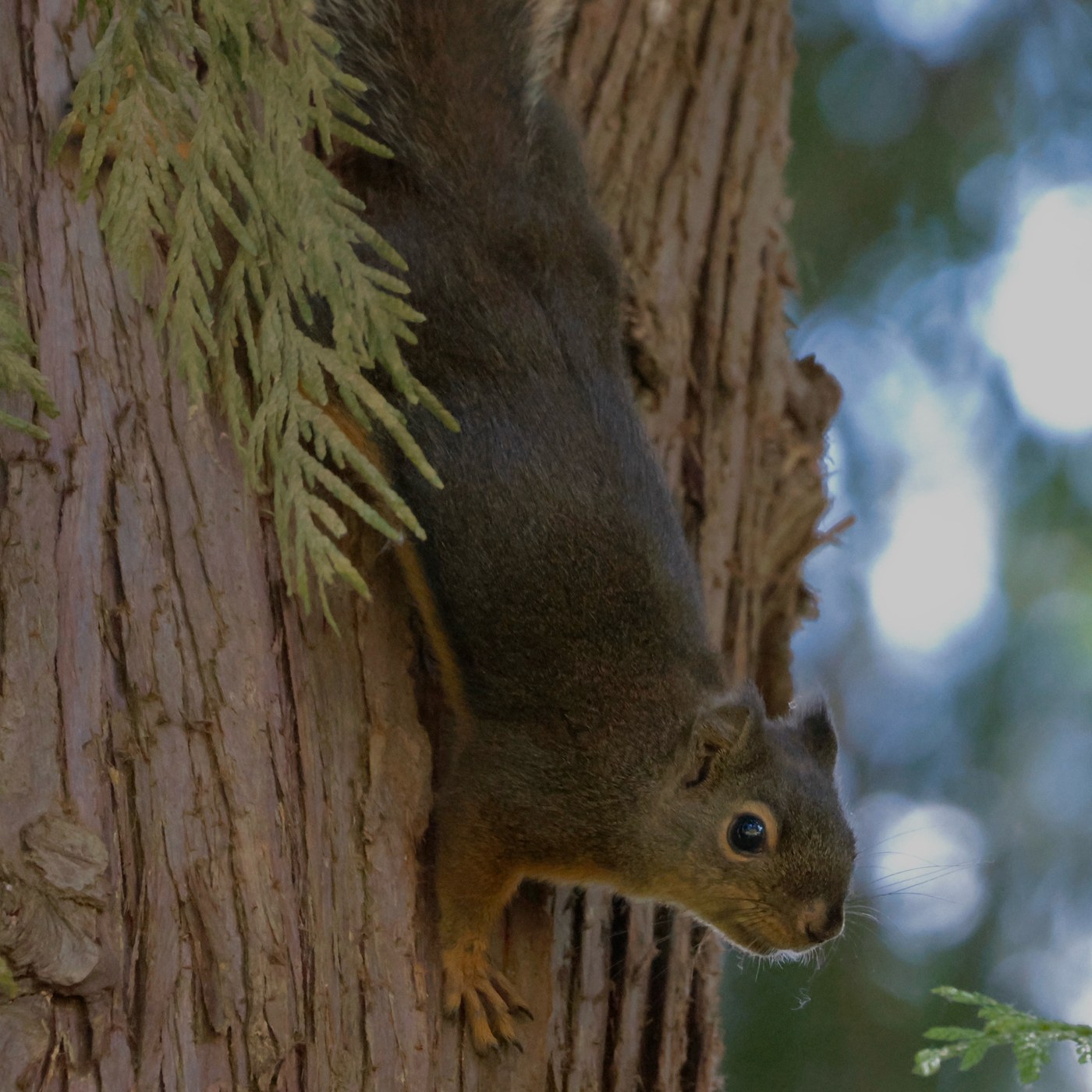
In summer the back is grayish to reddish brown, the underside is tawny orange to orange, and a dark line often shows along the side where the darker back color meets the orange belly. That orange underside is the single most reliable identifying feature on this animal.
A white eye-ring, in every season
Pale to tawny white, ringing the eye, and present in both the summer and winter coats.
The winter coat
It looks like a different animal. The coat turns grayer overall, the orange underside goes muted rather than vivid, and small dark ear tufts appear, more pronounced toward the northern end of the range. A summer sighting and a winter sighting of the same squirrel can read as two species if you are going by color alone.
Tail detail
Bushy, black-tipped, reddish brown underneath near the base, fading to black and then to light orange or white at the edges.
Against western gray squirrel
Western gray squirrel is the look-alike that actually comes up. It shares parts of this range in the Pacific Northwest and it is a considerably larger tree squirrel with an all-gray coat and a white belly. It has neither the orange underside nor the winter ear tufts.
The closest relative, rarely confused
American red squirrel is the closest relative, but rarely the confusion in practice. Douglas squirrel and American red squirrel are sister species in the same genus and function as geographic replacements for one another, with the two ranges meeting only in a narrow contact zone running from southern British Columbia into northeastern Washington, plus a small separate pocket in the Blue Mountains of Oregon, rather than overlapping broadly. In most of the Pacific Northwest you will not encounter both side by side. Where you might, at the edge of the range, the tell is the orange chest and belly, which the American red squirrel lacks.
Signs of Infestation
The sound is the sign
More so than for most tree squirrels. Loud, frequent, and unusually varied vocalizations: chattering, rattle calls, chirps, and screeches, described in the literature as ranging from a low chir or burr to an explosive bauf, bauf, bauf. It gets loudest when a person or a predator approaches a defended territory, which is why the noise often seems to be aimed directly at you. This is the single most commonly reported sign of this species specifically.
Cone middens
Piles of stripped conifer cone scales accumulating below a favorite feeding perch. At a site used across generations of squirrels these can build to several meters across. Early foresters reportedly raided them to collect conifer seed for planting stock.
Cone debris on a roof or deck
A small squirrel working cones in the canopy directly overhead drops scales and cores onto whatever is underneath. On a forest-adjacent house this is the likeliest complaint, and it is a housekeeping problem rather than a structural one.
Daytime activity
Douglas squirrels are diurnal and do not hibernate, so daytime noise and movement is the expected pattern for this species, in every season rather than only in warm months.
Odor: none typical
No characteristic smell is documented for this species, indoors or out. If there is a strong odor in a structure, look for a different animal.
Prevention and When to Call a Pro
An honest picture of the risk
Start with an honest picture of the risk, because it is not the one gray squirrels present. Oregon State University Extension states directly that Douglas squirrels live mostly in conifer forests, are found in some neighborhoods, have declining populations, and rarely require control efforts. Oregon's Department of Fish and Wildlife frames the species around forest ecology and conservation status rather than home invasion, and classifies it as Nongame Protected Wildlife, which means it cannot be hunted. The State Sensitive and Vulnerable listing in the Willamette Valley belongs to the western gray squirrel, not to this animal. Where a Douglas squirrel does get into a structure, it is characteristically a cabin, an outbuilding, or a forest-adjacent home with mature conifers at the roofline. Treating this animal as a routine attic pest overstates what the evidence actually supports.
Trim conifers off the roofline
Trim conifer branches back from the roofline. This is the highest-value step on a forest-adjacent property and it addresses both problems at once. Cone debris landing on a roof or deck and any structural entry both trace back to a squirrel moving from the tree canopy directly onto the building. Branches that overhang or touch the roof are the bridge.
Seal gaps on forest-side walls
Seal existing gaps on forest-adjacent structures. Soffits, fascia boards, roof vents, and uncapped chimneys are the standard tree squirrel entry points documented by Washington's Department of Fish and Wildlife. That is general tree squirrel exclusion guidance applied to this species, not a Douglas squirrel specific study. No such study was found. It is still the right maintenance work on a cabin or forest-edge home.
Leave middens alone
A large cone-scale pile can represent years of a squirrel's stored food, and clearing an outdoor cone pile does nothing about a structural entry point if one actually exists. If cones on the deck are the whole complaint, trimming the overhanging branches is the fix. Disturbing the cache is not.
The legal status changes things
Legal and regulatory status, and this one changes what you are allowed to do. Douglas squirrel is a protected species in both Washington and Oregon, which is unusual for an animal people think of as a nuisance squirrel. Washington's Department of Fish and Wildlife states that red squirrel, Douglas squirrel, and northern flying squirrel are protected species that can be trapped or killed only in emergency situations involving damage to crops or domestic animals, under RCW 77.36.030, and that a special permit is required even then. Oregon classifies the Douglas squirrel as Nongame Protected Wildlife under OAR 635-044, meaning it cannot be hunted, and Oregon State University Extension states that it cannot be killed, or trapped and released, without a special permit from the state. Rules for other states and localities vary, and they change, so check your own state and local wildlife regulations before you trap or relocate anything.
Who to Call, and When
Because of the permit situation above, the threshold here is lower and different from other squirrel work. It is not "call when the damage gets bad." It is "call before you buy a trap," because do-it-yourself trapping or relocation of this species may itself require a state permit in Washington and Oregon and may be illegal without one. A licensed nuisance wildlife control operator who works with state permit requirements is the right first call for any Douglas squirrel that has gotten into a cabin, attic, chimney, or outbuilding. A retail live trap is not. For cone debris, chattering, and middens in the yard, no call is needed at all. That is a forest squirrel doing what forest squirrels do.
Frequently Asked Questions
What is the difference between a Douglas squirrel and a regular gray squirrel?
Size and belly color. Douglas squirrels are noticeably smaller than the western gray squirrel that shares parts of their range, running about 10 to 14 inches including the tail. They carry a tawny orange chest and belly and a white ring around the eye, neither of which the all-gray, white-bellied western gray squirrel has. In winter, Douglas squirrels also grow small dark ear tufts.
Why do I hear so much chattering from the squirrels in the conifers around my property?
That is very likely a Douglas squirrel, and the chattering is exactly where the nickname chickaree comes from. They are unusually vocal for tree squirrels and use chatter, rattle calls, chirps, and screeches to defend a territory and warn of danger. It gets loudest in fall while they are stocking a winter food cache, and it will often seem to be directed at you, because it is.
What are those piles of shredded pinecone scales under the trees in my yard?
That is a cone midden. Douglas squirrels store food differently from gray and fox squirrels. Rather than burying individual nuts in scattered spots, they cut green conifer cones in the fall and stack them in one large cache, and the stripped scales pile up under a favorite feeding perch. A pile at a long-used site can reach several meters across. It is a food store, not debris, so it is best left alone.
Is it legal to trap a Douglas squirrel that has gotten into my cabin or attic?
Not without checking first, and the answer is likely no on your own. In Washington the Douglas squirrel is a protected species under RCW 77.36.030 and can be trapped or killed only in emergency situations involving crop or livestock damage, with a special permit. In Oregon it is classified as Nongame Protected Wildlife under OAR 635-044 and cannot be killed, or trapped and released, without a special state permit. Rules elsewhere in the region vary and change, so verify your state and local regulations. A licensed nuisance wildlife control operator is the safer first call than a retail trap.
Do Douglas squirrels commonly get into attics the way gray squirrels do?
Not typically. Oregon State University Extension describes them as rarely requiring control efforts, because they are primarily a conifer forest species rather than a neighborhood one. Structural entry is documented mainly for cabins and forest-adjacent homes with mature conifers close to the roof, not as a general homeowner problem. If you have a squirrel routinely in a suburban attic, it is more likely a different species.
Sources
- Douglas's Squirrel: identification, size compared to western gray squirrel, coat and eye-ring, vocalizations, nesting, diet and midden behavior, reproduction National Park Service, Klamath Inventory and Monitoring Network
- Squirrels: pest problem guidance, statement that Douglas squirrels rarely require control efforts, and Oregon protected-species permit requirement (OAR 635-044-0430) Oregon State University Extension Service
- Tree Squirrels, Living with Wildlife: Douglas squirrel classified as Nongame Protected Wildlife under OAR 635-044, and conservation status Oregon Department of Fish and Wildlife
- Living with wildlife: Tree squirrels, including general entry points and exclusion, and protected status of Douglas squirrel under RCW 77.36.030 Washington Department of Fish and Wildlife
- Douglas squirrel species page: Washington range and status Washington Department of Fish and Wildlife
- Tamiasciurus douglasii, Douglas's squirrel: measurements, coat and eye-ring detail, gestation and litter size, weaning, territory size, diet and elevation range Animal Diversity Web, University of Michigan Museum of Zoology
- California Wildlife Habitat Relationships (CWHR) life history account M079, Douglas' Squirrel: habitat, nesting, reproduction, territory, and elevation range California Department of Fish and Wildlife
- New records for Douglas's squirrel (Tamiasciurus douglasii) in two mountain ranges of the Great Basin, Western North American Naturalist 79(1), documenting parapatry with American red squirrel USDA Forest Service, Pacific Southwest Research Station
- Tamiasciurus douglasii taxonomy record NatureServe Explorer
- Tamiasciurus douglasii (Douglas's Squirrel) taxonomy record Idaho Department of Fish and Game
Image Credits
- Image: Ben via iNaturalist. CC0 1.0.
License.