Seasonal Timeline
Groundhogs are dormant underground from roughly late October or November through February or March across most of its range, and later still in Alaska, where animals do not emerge to breed until April or May. Activity is heaviest through the growing season, with a brief pre-mating stir in February before most animals go back under for a final stretch of sleep.
Groundhogs are dormant underground from roughly late October or November through February or March across most of its range, and later…
True hibernation is not what most wildlife does. A black bear enters a lighter torpor and can rouse from it fairly easily. A groundhog does not. Body temperature and every bodily function drop for a genuine multi-month sleep, and before going under the animal plugs its own tunnel with a mix of dirt, vegetation, and feces to insulate the nest chamber. It seals itself in rather than simply retreating.
The length of that sleep tracks latitude, which is why one mechanism produces four different regional calendars. Across the general mid-Atlantic and Midwest range, hibernation runs roughly late October or November through late February or March. North Carolina, at the southern edge of the range, reports the shortest window at November through February. Alaska runs the other direction, with a winter long enough that animals there do not emerge to breed until April or May. Same biology, one clean north-to-south gradient.
Spring is a two-step wake-up rather than a single emergence. Males and females both rouse briefly in February to establish territory and pair off, then return to a final stretch of hibernation before emerging for real and mating in March, or anywhere from late February into April depending on the state. It is a sleep, a brief stir, a second sleep, and then the season most people picture when they picture a groundhog.
Where They're Found
Groundhog's native range covers most of the eastern and central United States and southern Canada, running from eastern Alaska across Canada to Labrador and south to Georgia, Alabama, Louisiana, and Arkansas. It is absent from the Great Plains and reaches only as far southwest as northern Idaho. In the United States, that puts groundhogs across the Midwest, Northeast, and Southeast, plus Alaska.
Alaska is not a stray finding or a rounding error. Groundhog is native to east-central Alaska and the Yukon Territory, one of three marmot species resident in the state, with its own dedicated species profile and range map from the Alaska Department of Fish and Game. Animals there den in loess, the wind-deposited soil along Interior river valleys, and the colder climate is exactly why the breeding and hibernation calendar there runs later than anywhere else in its range. Hawaii is a confirmed absence rather than an oversight. No range description places groundhog there, and Hawaii's own invasive-species literature, which documents introduced pigs, goats, axis deer, and mongoose in detail, does not list groundhog among them.
The Southeast carries a genuine range-expansion story. North Carolina's own wildlife agency has mapped groundhog's spread from 1985 through 2020, out of its historical range in the state's western Mountains and northern Piedmont and into the southern Piedmont and Coastal Plain. East of the Appalachians, North Carolina sits at the southernmost edge of the species' range, and that edge has been moving.
Groundhogs favor open clearings, woodland edges, roadsides, fields, pastures, brushy woodlots, and riparian areas, and the site is always chosen for drainage, because a flooded burrow is a useless burrow. Tunnel systems run 4 to 5 feet deep and up to 30 feet long, with a main entrance marked by a mound of excavated dirt, several concealed secondary entrances, and a separate chamber set aside just for waste. They are tidy animals underground.
One thing worth knowing before you decide a burrow is purely a liability. Abandoned and shared groundhog burrows shelter cottontail rabbits, raccoons, foxes, river otters, eastern chipmunks, snakes, and birds, which makes the groundhog something closer to a landlord than a pest across most of its range. That same den-sharing habit is also the documented mechanism behind the rabies risk, since raccoons moving into a burrow to forage or raise a litter is exactly the situation a groundhog defends against.
Life Cycle
One litter a year, and the timing is what governs every removal decision. Gestation runs about 31 to 32 days, and published sources are consistent on it. Kits arrive in spring, wean at about 2 months, and disperse in late summer, so young may be dependent in a burrow from spring through midsummer. That window plus the hibernation window is why timing matters more than technique.
The published numbers do not agree. Lifespan is a real three-way disagreement among the sources, not a figure anyone has settled. The Internet Center for Wildlife Damage Management gives 3 to 6 years in the wild. Rutgers Cooperative Extension gives an average of 4 to 6 years. North Carolina's wildlife agency gives an average of only 1 to 2 years, with few animals living past 4. Treat that as a genuine spread, with the North Carolina figure as the low outlier, rather than as an average nobody actually measured. Size gets the same treatment: published figures span roughly 5 to 15 pounds and 16 to 27 inches, and Alaska's state agency reports a lighter 2 to 9 pounds, which most likely reflects a smaller-bodied northern population rather than a measurement error.

Kit
Juvenile
Adult2
Identification
Groundhog and woodchuck are the same animal
Both names trace back to an Algonquian word, and the sources do not agree on exactly which one. Whistlepig and land beaver are older regional nicknames for the same species. Land beaver is descriptive of the digging only. Groundhogs do not fell trees and do not dam water the way an actual beaver does.
Size runs a real range
It depends on the source and the region. Published figures span roughly 5 to 15 pounds and 16 to 27 inches. Alaska's population trends smaller, at 2 to 9 pounds, which likely reflects a smaller-bodied northern population rather than a sourcing error. Males average about 8 percent heavier than females, with no color difference between the sexes.
A frosted grizzled coat
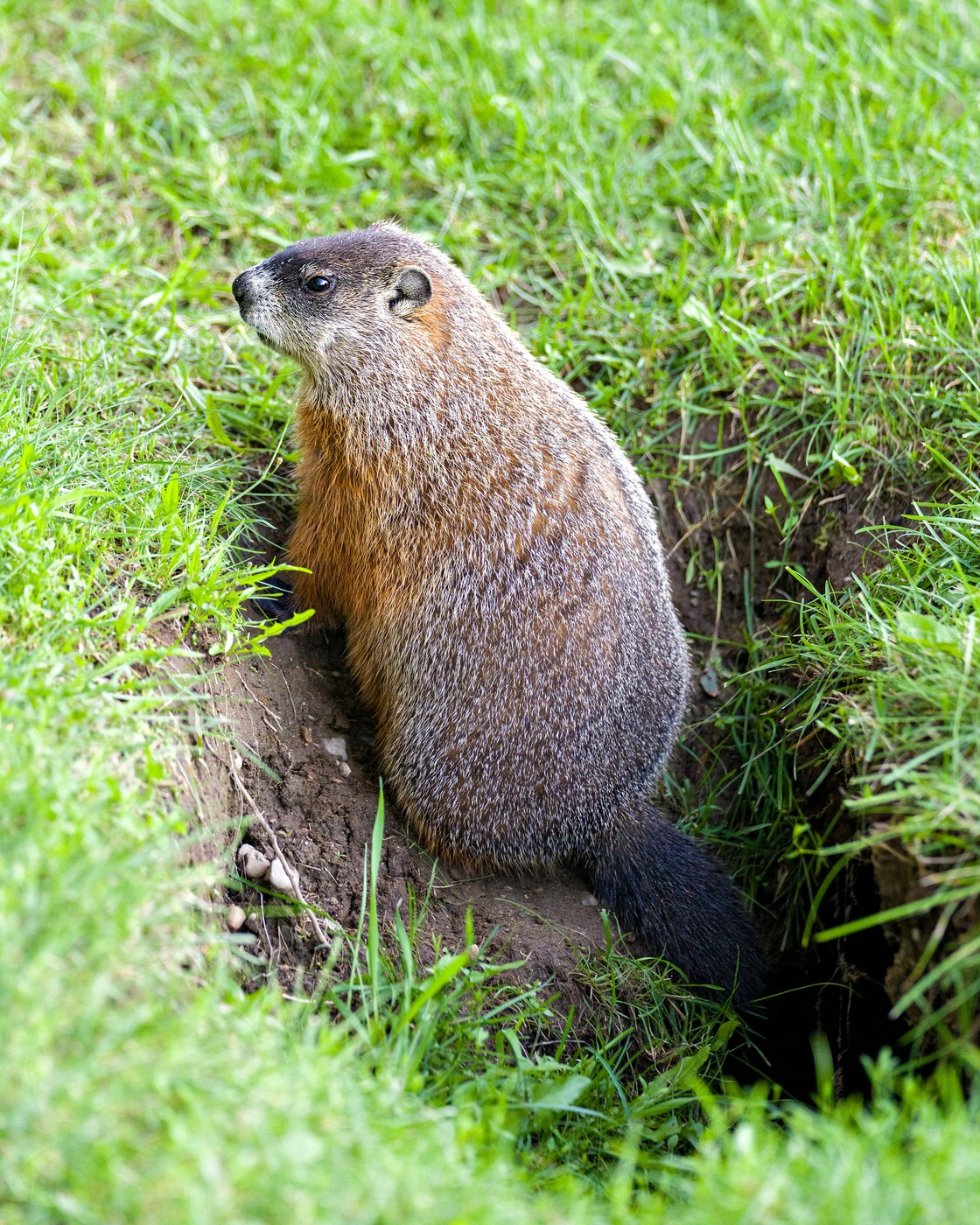
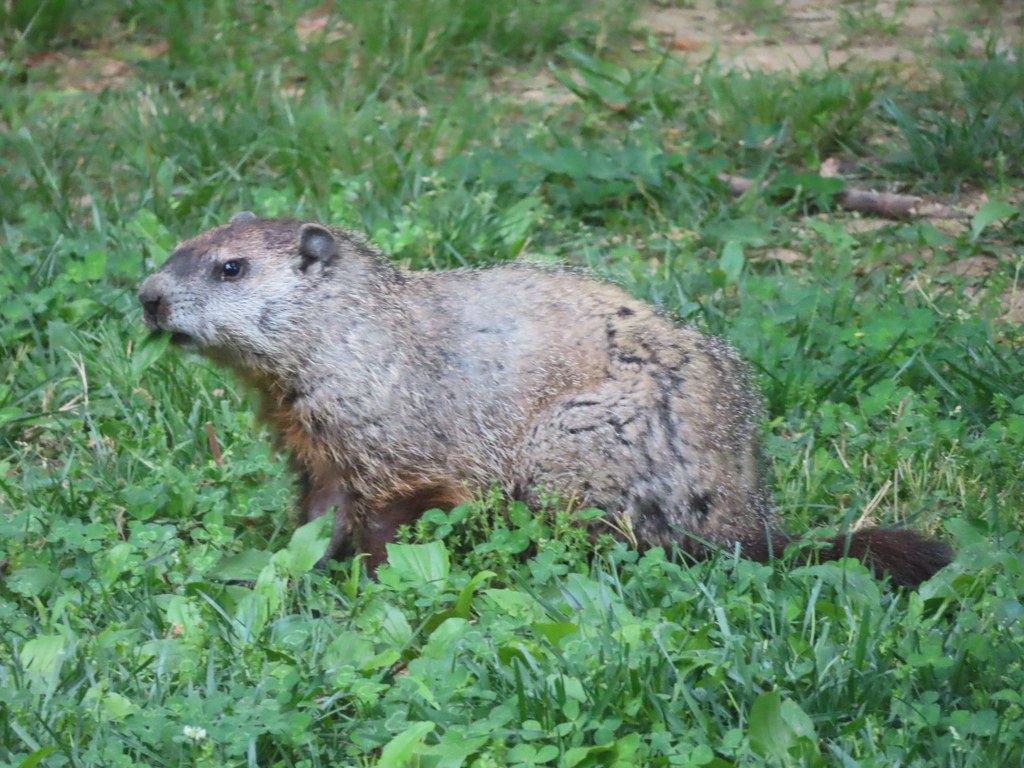
Color is grizzled gray-brown to yellow-brown or reddish-brown, with a frosted look. White-tipped guard hairs across the body create the frosting. Feet and tail run dark brown to black, and there is white fur around the nose.
The build is unmistakable
That holds once you know what to look for. Heavy-bodied, short broad head, short thick legs, long curved digging claws, and a densely furred tail running about one fifth to one third of the animal's total length.
The whistle is identifiable
The whistle is a specific, identifiable sound rather than a vague noise. A loud shrill alarm whistle, followed by a lower "phew" and then a rapid "tchuck, tchuck" warble. That full sequence is distinctive enough to confirm the animal without ever seeing it.
Daytime activity identifies it
Daytime activity is a genuine identifying sign. Groundhogs are diurnal, most active in early morning and late afternoon. An animal working a yard in broad daylight is a very different suspect list from one heard at night.
No common look-alike in these four regions
Nothing else in the Midwest, Northeast, Southeast, or Alaska is regularly confused with a groundhog, which is unusual among mammals.
Signs of Infestation
Burrow entrances, two or three
Burrow entrances 8 to 12 inches across, usually two or three of them connected by tunnel. A mound of excavated dirt sits at the main entrance and doubles as a lookout perch. The secondary entrances are deliberately concealed, so counting one hole and assuming one exit is the common mistake.
The risk is underneath
The real property risk is what is underneath, not what is inside. Unlike raccoons or squirrels, groundhogs do not get into a structure. They burrow under it. A den running beneath a foundation, a pool deck, or a sidewalk undermines it over time, and farmers have documented tractor tires sinking into collapsed tunnel systems hidden under fields.
Garden damage, underestimated
Garden and crop damage on a scale most people underestimate. A groundhog eats up to 1.5 pounds of vegetation a day during the growing season, gaining 11.5 to 20 grams daily as it builds fat for hibernation. Clover, alfalfa, grasses, and legumes come first in spring, then berries, corn, tomatoes, and orchard fruit as the season runs on.
Gnawed bark that mimics raccoon
Gnawed bark and broken limbs on fruit or ornamental trees, which can look like raccoon damage. That resemblance is real, so it is worth locating a burrow before assuming which animal is responsible.
Livestock injury from a hidden hole
Livestock injury from a foot going into an unseen burrow hole. On working land this is the sign that costs the most, and it is a different problem entirely from a chewed vegetable garden.
Equipment sunk into a collapsed tunnel
Sunken and damaged farm equipment where tunnels have collapsed under a field. Same mechanism as the foundation risk, applied to ground that gets driven over.
Prevention and When to Call a Pro
Fencing, with two working specs
Fencing is the realistic homeowner tool, and two sourced specifications both work. The first: 3 to 4 feet tall in heavy wire or hardware cloth, buried 12 inches deep with another 12 inches bent outward in an L shape at the bottom to stop tunneling underneath, and the top 12 inches left unattached or bent outward at 45 degrees so a climbing animal cannot get purchase. The second: a 3-foot fence with an 18-inch skirt buried at least 2 inches down and a 9 to 12 inch overhang. The dimensions differ, but both are solving the same two problems, digging under and climbing over, so either specification works.
Electric fencing wire heights
Electric fencing has a specific, sourced wire-height spec. A single strand about 4 inches off the ground plus a second strand at 8 inches deters groundhogs effectively, run off a grounded charger with stakes every 3 to 5 feet and insulators at each height.
Never seal an active burrow
Confirm it is empty first, and never evict during hibernation or breeding season. This is the counterintuitive one. A groundhog sealed in will either die in place or dig its way back out, and the escape route is often more expensive than the original burrow. Hibernation runs roughly late October or November through February or March, later into April or May in Alaska, and dependent young may be in a nest chamber from spring through midsummer. The recommendation is explicit: use a professional for eviction rather than sealing a hole yourself.
Repellents are weak
The published guidance says so plainly. Predator urine or dried blood around a perimeter, or capsicum, garlic, or mustard extracts applied directly to plants, work as behavioral deterrents at best. Once a groundhog already treats a garden as a known food source, a repellent is unlikely to change its mind. No repellent is registered specifically for this species beyond general predator-scent products.
If you trap, specs and law
If you trap, the specifications and the legality both matter. Cage or box traps run roughly 10 by 10 by 24 inches up to 10 by 12 by 32 inches, baited with cabbage, lettuce, apple slices, or carrots, replenished daily, set near a burrow entrance with logs arranged to funnel the animal toward the opening. Body-gripping and foothold traps are documented as den-entrance sets, but their legality swings hard by state. Ohio permits body-gripping traps seasonally with a jaw-spread limit and placement rules. New Jersey bans lethal traps and steel-jawed leghold traps outright except for licensed trappers working water-associated furbearers.
Gas cartridges are not DIY
Burrow gas cartridges and aluminum phosphide are real control methods and they are not a do-it-yourself project. Aluminum phosphide requires Restricted Use Pesticide applicator training and cannot be used within 100 feet of an occupied building. These methods exist and they are professional-only, and the technique is not worth attempting yourself, because the failure modes are not the kind you recover from.
Ohio shows the permissive baseline
Ohio shows how permissive the baseline really is. Open, year-round hunting season. Anyone may remove a nuisance groundhog from private property, though only state-certified operators may charge a fee for it. Live-trapped animals may be relocated with landowner permission, released on site, or humanely killed. Body-gripping traps are allowed March 1 through September 30 with a 7-inch maximum jaw spread, set within 3 feet of the burrow and enclosed to keep non-target animals out.
North Carolina draws a line
North Carolina draws a real line between hunting and trapping. Groundhog is nongame there, with no closed season and no bag limit for hunting, but trapping specifically requires a state trapping license during the regulated trapping season. Same animal, same state, two different sets of rules depending on the method.
New Jersey is the big exception
New Jersey is the one big legal exception, and the reason behind it is a health finding rather than paperwork. New Jersey classifies groundhog as a rabies vector species. As a direct consequence, relocating a live-trapped animal off site is strongly discouraged. Where on-site release is not practical, relocation is capped at 5 miles from the capture site, inside the same township, and requires landowner permission. New Jersey's hunting season runs March through September with no bag limit, plus a second bow and shotgun season October through February, with rifles barred on wildlife management areas and state parks, forests, and recreation areas.
Massachusetts agrees separately
Massachusetts lands on the same classification independently, which is what makes this a regional pattern rather than a one-state quirk. Massachusetts groups woodchuck with raccoon, skunk, and bat as rabies vector species. Any bare-handed contact there, not only a bite, is treated as a potential rabies exposure requiring the animal to be euthanized for testing. Two Northeast states arriving at the same classification, while the Midwest and Southeast do not, is a real legal split worth knowing before you pick up a trap.
The rabies finding behind both
Groundhogs are not a national rabies reservoir. Rodents and lagomorphs generally are not, and no federal listing treats them as one. But a peer-reviewed study co-authored with federal health researchers, covering 2011 through 2020, found groundhogs accounted for over 90 percent of all documented rabies cases among rodents and lagomorphs nationally, with 368 positives out of 9,084 animals tested, a 4.1 percent positivity rate. That is close to the 5.9 percent rate in bats and far above nearly every other rodent tested, most of which had zero confirmed cases. The mechanism is not groundhog-to-groundhog spread. It is cross-species transmission from raccoon bites during competition over a burrow. Cases cluster in the Northeast and mid-Atlantic where the raccoon rabies variant predominates, peak in July, and are virtually absent January through March, which tracks hibernation exactly. And the number that keeps this in proportion: no human rabies death has ever been attributed to a rodent or lagomorph exposure in the United States. Handle a groundhog with real caution, especially in the Northeast. Do not treat it as a crisis.
Two other documented diseases
Two other diseases are documented, and one of them is not a homeowner risk at all. Tularemia is documented in groundhogs and is a reason to avoid handling. Woodchuck hepatitis virus is documented too, but it is a research fact rather than a health warning: the virus causes a liver disease progression close enough to human hepatitis B that groundhogs are the best available non-human model for it, and groundhog-based research has directly informed hepatitis B treatment development. Ticks and fleas are the ordinary wildlife parasite load.
A cornered one is different
A healthy groundhog wants nothing to do with you, and a cornered one is a different animal. Groundhogs bluff charge when cornered and will bite anything that gets too close. That is normal defensive behavior rather than a sign of illness, and it is a good reason to keep distance rather than a reason to panic.
Call for a burrow under concrete
Call a professional for any burrow under a foundation, pool deck, sidewalk, or near farm equipment and livestock areas. That is the threshold where undermined ground stops being cosmetic and starts being structural.
Call before a winter eviction
Call before attempting eviction or burrow sealing during hibernation or the breeding and kit-rearing window. An animal sealed in dies in place or digs out through new damage, and getting the timing wrong is the single most common way a do-it-yourself fix makes the problem worse.
Call after any bite or scratch
Call after any bare-handed contact, bite, or scratch, and treat that as urgent in the Northeast specifically. Under New Jersey's and Massachusetts's rabies vector species rules, the animal will likely need to be captured and tested rather than simply observed, and that is a call to make immediately rather than the next morning.
Call before traps or gas
Call before any removal that would involve a body-gripping trap, a foothold trap, a gas cartridge, or a pesticide. Legality and permit requirements vary sharply from state to state on all four. Route the question to a state wildlife agency or a licensed nuisance wildlife control operator instead of guessing at the local rule.
Frequently Asked Questions
Is a groundhog the same thing as a woodchuck?
Yes. Groundhog and woodchuck are two common names for the same species, Marmota monax, both traceable to an Algonquian word that the sources do not fully agree on. Whistlepig and land beaver are older regional nicknames for the same animal. Land beaver describes the digging only. Groundhogs do not fell trees or dam water the way beavers do.
Do groundhogs carry rabies?
Groundhogs are not a national rabies reservoir species, and rodents and lagomorphs generally are not either. But a study co-authored with federal health researchers found groundhogs account for over 90 percent of documented rabies cases among rodents and lagomorphs nationally, at a 4.1 percent positivity rate among animals tested, close to the rate in bats. The infections come almost entirely from bites taken while defending a burrow against a rabid raccoon rather than from spread between groundhogs. New Jersey and Massachusetts both formally classify groundhog as a rabies vector species as a result, so any bare-handed contact in those states is treated as a potential exposure. Worth real caution, especially in the Northeast. Worth keeping in proportion too: no human rabies death in the United States has ever been attributed to a rodent or lagomorph exposure.
Can a groundhog actually damage my house?
Not the way raccoons or squirrels do by getting inside. Groundhogs burrow under structures instead. A den running beneath a foundation, a pool deck, or a sidewalk undermines it over time, and tunnel systems reach 30 feet long and 4 to 5 feet deep. Farmers have documented tractor tires sinking into collapsed groundhog tunnels hidden under fields, which is the same mechanism working on ground that gets driven over.
Can I trap and relocate a nuisance groundhog myself?
It depends heavily on the state, more than most people expect. Ohio allows live-trap relocation with landowner permission and runs an open year-round hunting season. North Carolina treats groundhog as nongame with no closed season for hunting, but requires a state trapping license to trap one. New Jersey specifically discourages off-site relocation because groundhog is classified there as a rabies vector species, capping any move at 5 miles from the capture site and inside the same township. Confirm your own state's current rule before you set a trap.
How long do groundhogs hibernate?
It depends on how far north you are, and groundhogs are true hibernators rather than light sleepers like bears. Body temperature and all bodily functions drop for months, and the animal plugs its own tunnel with dirt, vegetation, and feces before going under. Across the mid-Atlantic and Midwest that runs from roughly late October or November into late February or March. North Carolina sees a shorter window, November into February. In Alaska the winter is long enough that animals do not emerge to breed until April or May.
Are groundhogs found in Alaska?
Yes. Groundhog is native to east-central Alaska and the Yukon Territory, one of three marmot species resident in the state, with its own dedicated species profile and range map from the Alaska Department of Fish and Game. This is established native range, not a stray or an introduced population, and the colder climate is why the breeding and hibernation calendar there runs later than anywhere else in its range.
Sources
- Woodchucks, Woodchuck Biology, Woodchuck Damage Identification, and Woodchuck Damage Prevention and Control Methods Internet Center for Wildlife Damage Management (University of Nebraska-Lincoln / USDA APHIS Wildlife Services)
- Ecology and Management of the Groundhog (Marmota monax), Bulletin E361 Rutgers Cooperative Extension, New Jersey Agricultural Experiment Station
- Groundhog (Woodchuck) Wildlife Profile: range expansion mapping, nongame classification, and the trapping license requirement North Carolina Wildlife Resources Commission
- Woodchuck (Marmota monax) Species Profile: Alaska native range, Interior river-valley loess denning, and the later breeding calendar Alaska Department of Fish and Game
- Nuisance Species: Groundhogs, including hunting season, removal rules, and body-gripping trap restrictions Ohio Department of Natural Resources
- Rabies in Rodents and Lagomorphs in the USA, 2011-20, Journal of Wildlife Disease 59(4): 734-742 Centers for Disease Control and Prevention
- Rabies Vector Species: the Massachusetts classification grouping woodchuck with raccoon, skunk, and bat Tufts Wildlife Clinic, Cummings School of Veterinary Medicine at Tufts University
Image Credits
- Image: Adobe Stock, licensed.
- Image: Ken Clark via iNaturalist. CC BY 4.0.
License.