Seasonal Timeline
Arizona coral snake is most active on warm nights, especially during and immediately after summer monsoon rains from July through August. It shifts to cooler mornings and evenings in spring and fall, and spends the coldest months underground and largely inactive.
Arizona coral snake is most active on warm nights, especially during and immediately after summer monsoon rains from July through August.…
This species lays eggs rather than giving live birth, and egg-laying is concentrated in the summer monsoon season, typically July and August, in underground burrows or beneath surface debris where moisture is retained. Outside of that window, the clearest driver of surface activity is heat and moisture: warm, humid nights bring this snake up to hunt, and it is especially likely to be seen moving across the surface during and right after a monsoon downpour. Cooler spring and fall mornings and evenings are the next most likely time to encounter one, and the coldest months see it retreat underground almost entirely.
No source publishes region-by-region seasonality for this species, so treat this timing as a general Southwest pattern rather than a state-by-state breakdown.
Where They're Found
Arizona coral snake is found in central and southern Arizona and the extreme southwestern corner of New Mexico, with its range continuing south into Sinaloa, Mexico. Both U.S. states in its documented range fall within the Southwest region, and no published record places this species anywhere near Alaska or Hawaii, so neither is included here. This is a warm-desert specialist through and through, with no evidence of range expansion beyond the Southwest.
Habitat is arid and semiarid desert country: rocky upland desert, thornscrub, desert-scrub, woodland, grassland, and farmland edges, from sea level up to roughly 5,800 feet. It is considered abundant specifically in rocky upland desert within Arizona, and it spends the great majority of its life underground or tucked beneath rocks, loose soil, and surface debris rather than moving in the open. Surface activity increases noticeably during and right after rain.
Unlike a rodent-hunting snake, this species is not drawn to structures, woodpiles, or crawl spaces for food. Its diet is almost entirely other small snakes and lizards, so a sighting is not a reliable sign of a rodent problem. It more plausibly points to a healthy local population of small reptiles nearby.
Related Pests
Life Cycle
This species spends the overwhelming majority of its life out of sight. Eggs are laid and incubate underground, hatchlings emerge already independent, and adults are fossorial by nature, meaning they live most of their lives below the surface rather than moving in the open. That is the real reason this snake is genuinely rare to encounter across a range where it is not actually uncommon: it is not avoiding people specifically, it simply lives underground. The clearest window for an above-ground encounter is a warm night during or right after summer monsoon rain, when both adults and the season's new hatchlings are more likely to be moving across the surface.

Eggs
Hatchling2
Adult
Identification
The black head and full encirclement
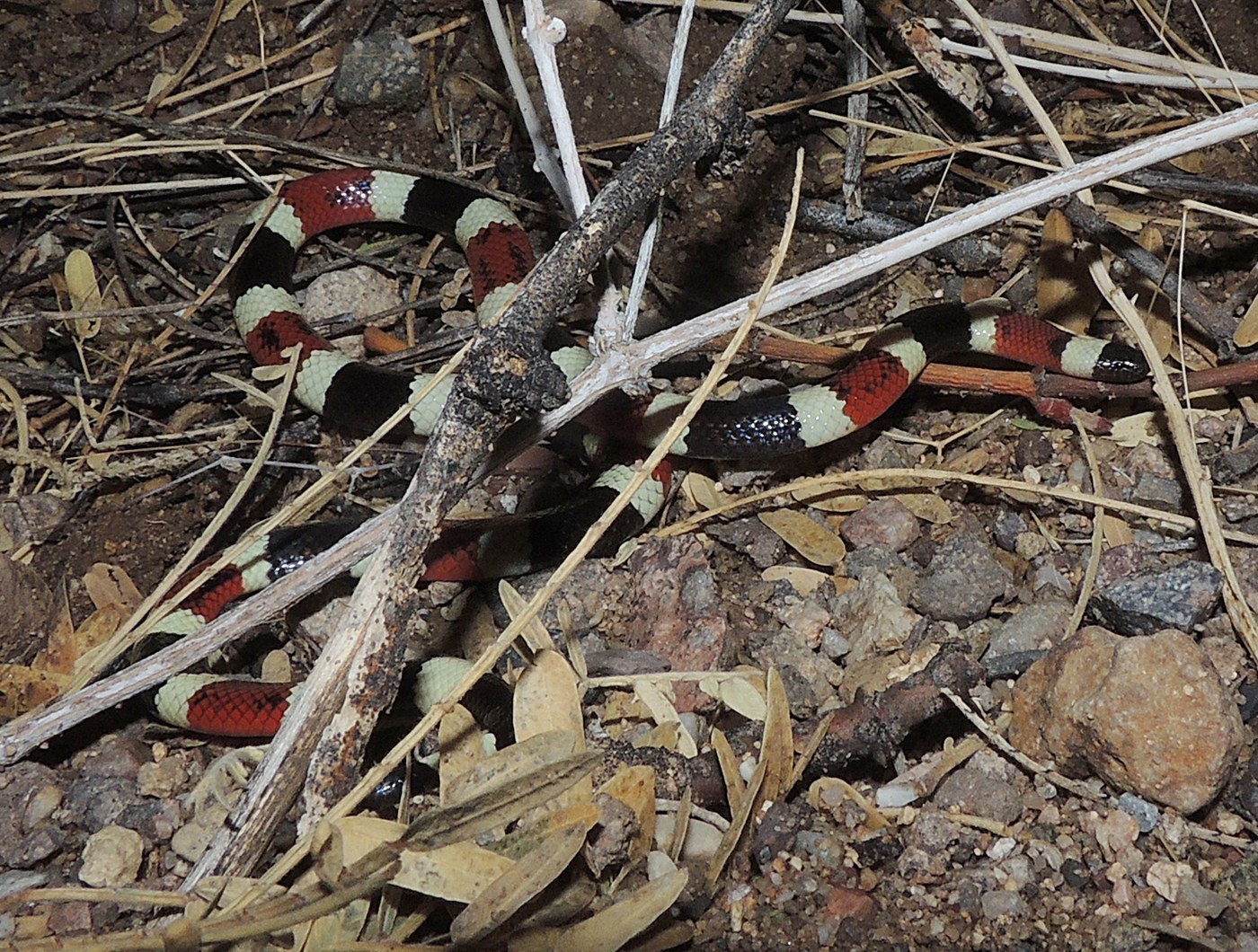
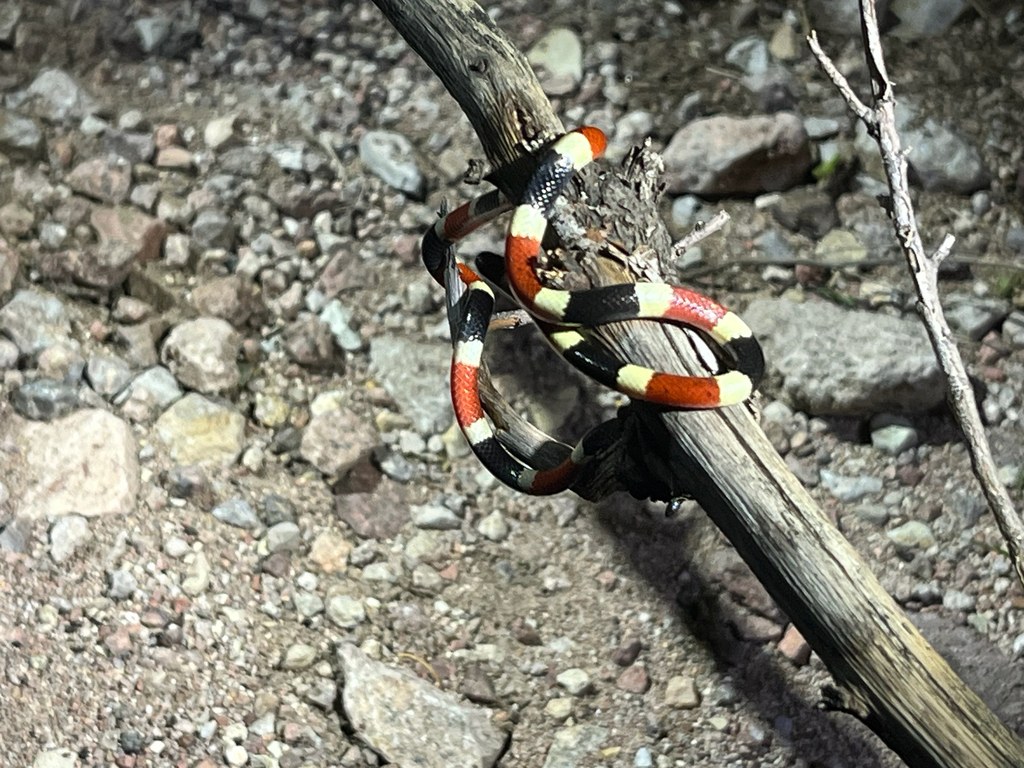
The tell is the solid black head and full body encirclement, not the color combination alone. Broad red and black rings, separated by narrower white or, less often, yellow rings, completely encircle the body and continue onto the belly, fading paler toward the underside. The head is solid black from the snout back past the eyes, not just a black nose, and the tail's final rings are black and white/yellow only, without red.
The red-touch-yellow rhyme is weaker here
The classic "red touch yellow" rhyme is meaningfully less reliable in this region, so do not treat it as settled fact. The Arizona-Sonora Desert Museum states plainly that the standard rhyme does not always hold here, because several harmless desert snakes can show red bands touching yellow or white bands too. The more reliable check is the black head running past the eyes, combined with color bands that wrap all the way around the body onto the belly. A second independent identification source used by licensed Arizona snake-removal professionals confirms the same point.
Build and head shape
They separate it from the desert's pit vipers immediately. Smooth scales and a blunt but otherwise unremarkable head shape, in contrast to the broader, triangular heads and vertical pupils of the region's rattlesnakes. The fangs are small and fixed at the front of the jaw rather than long, hollow, and hinged.
Size
Adults typically run 13 to 21 inches, occasionally up to 24 inches, and are notably slender, thinner-bodied than either Texas or Eastern coral snake.
Commonly confused with
Western shovel-nosed snake and Sonoran shovel-nosed snake, both similarly banded but with a light-colored snout instead of a solid black head; the Sonoran shovel-nosed snake also shows fewer than 21 black body bands. Long-nosed snake is a second frequent look-alike, distinguished by bands that stop at the belly line rather than wrapping fully around the body, a snout that often carries light flecks rather than solid black, and hatchlings that can lack red coloration entirely. Variable ground snake is a third mimic in this region, true to its name showing a highly variable banding pattern rather than one consistent look.
Signs of Infestation
No structural damage
This species leaves no structural damage, since it is a wild reptile with a reptile-and-lizard diet, not a structural pest. There is no droppings pattern and no gnaw marks to work from. There is one smell, and it is defensive rather than a sign of residence: a cornered Arizona coral snake forces gas from its cloaca, and the odor is foul enough that people sometimes register it before they spot the animal. The sign is the snake itself.
The band pattern is the visual sign
The visual sign is the full band pattern with a solid black head. Red, white or yellow, and black rings completely encircling the body, seen moving across open ground, tucked under a rock or piece of debris, or crossing a path on a warm or rainy night.
No rattle, but a defensive sound
No rattle, but a distinctive defensive sound is possible. When cornered, this species can produce an audible "cloacal pop," a forcibly expelled burst of gas used as a startle display, sometimes accompanied by a genuinely foul smell that can be noticed before the snake itself is spotted.
A sighting is not a rodent signal
A sighting is not the same rodent-problem signal a rodent-eating snake sighting can be. Because this species eats almost exclusively other small snakes and lizards, finding one is more likely a sign of a healthy local reptile population than of a rodent issue on the property.
Prevention and When to Call a Pro
Never handle or capture one
Never handle or attempt to capture one. Handling is the primary documented driver of coral snakebites generally. This species' small size and colorful pattern can make it seem lower-risk to pick up than it actually is, and that assumption is exactly the mistake that leads to a bite.
Identify it from a distance
If you find one, identify it from a distance rather than up close. Use the black-head-and-full-body-banding check described above, or treat any snake you cannot confidently identify as potentially venomous and leave it alone.
Clear the foundation line
Keep rock piles, woodpiles, and yard debris away from the immediate foundation, and use a tool rather than a bare hand when checking under rocks or boards. This species favors exactly that kind of rocky desert ground cover, and surface activity increases noticeably after rain, so a post-monsoon yard check is a reasonable habit in its range.
No rodent-control angle here
There is no rodent-control angle to this species' prevention advice. Because it hunts other snakes and lizards rather than rodents, it is not drawn to structures or food sources the way a rodent-eating snake would be, so general ground-cover and debris management is close to the full extent of useful exclusion advice here.
A bite is a medical emergency
If someone is bitten, treat it as a medical emergency regardless of how mild it looks. Keep the person calm and still, remove rings, watches, and tight clothing from the bitten limb before swelling starts, and immobilize the limb. Call 911 or the Arizona Poison and Drug Information Center at 1-800-222-1222 and get to an emergency department immediately. Do not cut the wound, do not attempt to suck out venom, do not apply a tourniquet, and do not apply ice. These folk remedies are rejected for every venomous snakebite.
Milder, and still an emergency
The bite-severity picture for this species is genuinely milder than Texas or Eastern coral snake, but that does not change the emergency-room advice above. A national clinical review of coral snakebite outcomes found Arizona cases ran to minor effects or less, in clear contrast to the more serious profile documented for the larger Texas and Eastern species. That is population-level clinical data, not a guarantee for any individual bite, so every suspected bite still needs the same emergency evaluation and observation period used for any coral snake bite in the United States.
Antivenin supply is limited
Antivenin supply is the same limited situation as with every other US coral snake. The only FDA-approved treatment for North American coral snake bites has not been actively manufactured since 2003, with the FDA periodically extending the shelf life of existing stock rather than letting it run out. Given this species' typically milder documented outcomes, many bites may not require antivenin at all, but that determination belongs to emergency physicians working with a regional poison center, not to guesswork at home.
Killing or capturing one in Arizona
Arizona regulates native reptile handling under state hunting-license rules and Game and Fish Commission orders, and specific bag limits, seasons, and area closures can and do change. Any specific bag limit needs local verification against the current rules rather than a figure that could be out of date. Check current Arizona Game and Fish Department regulations before assuming a particular action is allowed, and remember that the behavior most likely to cause a bite, picking the snake up, is the same behavior a legal question would be raised about in the first place. Leaving it alone answers both questions at once.
When a Bite Is an Emergency, Who to Call
Call 911 or the Arizona Poison and Drug Information Center immediately for any bite from a snake matching this pattern, or from any snake you cannot positively identify as non-venomous, and go to an emergency department rather than waiting to see if symptoms develop. Call a licensed pest control company or wildlife control operator for a snake found inside a structure, or one that keeps turning up on a property where a homeowner is not comfortable identifying or handling it, and confirm the company holds whatever permit or license Arizona currently requires for native reptile handling.
Frequently Asked Questions
Does the "red touch yellow, kill a fellow" rhyme work in Arizona?
Not reliably. The Arizona-Sonora Desert Museum states the rhyme doesn't always hold in this region, because several harmless local snakes, including the shovel-nosed snakes and the long-nosed snake, can show red bands touching yellow or white bands too. A solid black head running back past the eyes, plus color bands that fully encircle the body onto the belly, is a more reliable check than the rhyme alone.
How do I tell an Arizona coral snake from a shovel-nosed snake?
Check the snout color. The shovel-nosed snakes have a light-colored snout, while the Arizona coral snake's head is solid black back past the eyes. The Sonoran shovel-nosed snake specifically also shows fewer than 21 black body bands, another point of difference from a true coral snake.
How dangerous is an Arizona coral snake bite?
Genuinely less dangerous than a Texas or Eastern coral snake bite, based on real clinical case data, not just this species' smaller size. Bites are rare to begin with, and a national clinical outcomes review found Arizona coral snake bite cases ran to minor effects or less, in contrast to the more serious profile documented for the larger Texas and Eastern species. Any suspected bite should still go to an emergency department immediately, since this is population-level data, not a guarantee for any one bite.
What does an Arizona coral snake eat?
Mostly other small snakes, including threadsnakes, groundsnakes, and black-headed snakes, plus occasional small lizards. Because it hunts other reptiles rather than rodents, finding one on a property is not a sign of a rodent problem, it more likely points to a healthy population of small reptiles nearby.
Is it legal to kill or capture an Arizona coral snake on my property?
Arizona regulates native reptile handling under state hunting-license rules and Game and Fish Commission orders, and the specific limits and seasons can change, so this isn't something to assume from a general description. Check current Arizona Game and Fish Department regulations, or call a licensed wildlife control operator, rather than attempting to handle a venomous snake yourself.
Sources
- Sonoran Coral Snake (Micruroides euryxanthus) Arizona-Sonora Desert Museum
- Reproduction in the western coral snake, Micruroides euryxanthus Great Basin Naturalist / Brigham Young University ScholarsArchive
- Micruroides euryxanthus (Sonoran Coralsnake) species account Arizona Wildlife Conservation Strategy, Arizona Game and Fish Department
- Western Shovel-nosed Snake (Chionactis occipitalis) Reptiles and Amphibians of Arizona
- Sonoran Coralsnake (Micruroides euryxanthus) Reptiles and Amphibians of Arizona
- Coral Snake Toxicity National Center for Biotechnology Information (NIH), StatPearls
- Snake Eyes: Coral Snake Neurotoxicity Associated With Ocular Absorption of Venom and Successful Treatment With Exotic Antivenom Journal of Emergency Medicine (ScienceDirect)
- Abstracts of the Coral Snake Antivenom Conference, January 28, 2009 Journal of Medical Toxicology, American Academy of Clinical Toxicology, hosted by University of New Mexico Health Sciences Center
- Arizona State and Federally Protected Species Southwestern Center for Herpetological Research
- Are coral snakes poisonous? Poison Control (National Capital Poison Center)