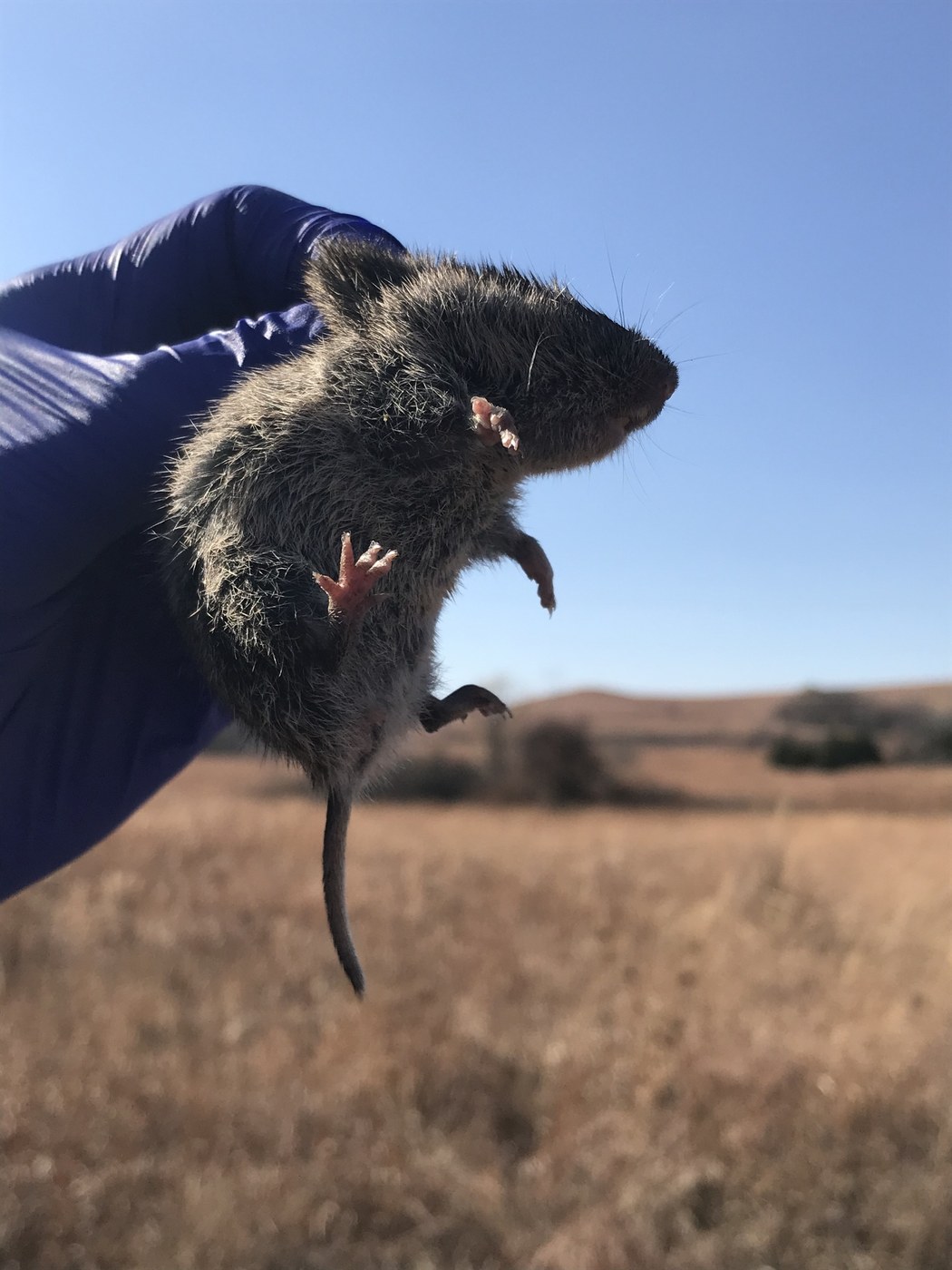
Seasonal Timeline
Prairie voles are active day and night, year-round, with no hibernation. This region's damage pattern is a spring peak and a fall peak with a real midsummer lull in between, which is the opposite shape from the snow-cover-and-snowmelt pattern that drives vole damage farther north. Winters here are mild enough that there is no reliable snow layer for voles to work under and no single dramatic reveal at snowmelt.
Prairie voles are active day and night, year-round, with no hibernation. This region's damage pattern is a spring peak and a fall peak with…
This spring-and-fall shape with a midsummer gap is not a guess, and it is not the northern pattern with the dates nudged. Field ecologists studying a prairie vole population at the University of Kansas Nelson Environmental Study Area near Lawrence deliberately ran their trapping in May and June rather than July and August, and they gave two reasons in print: the Kansas population experiences a lull in reproduction during midsummer, and the breeding season begins roughly one month earlier in Kansas than in Indiana. Two things to be precise about there. Those researchers measured breeding, not how visible runway damage is in a lawn, so this is convergent evidence on a related measure rather than a direct confirmation of the damage calendar. But it is peer-reviewed evidence that this region's prairie voles genuinely run on a spring-early, midsummer-slack, fall-again rhythm, which is the same shape the damage pattern takes and the opposite of the northern one.
The practical consequence is that the northern advice does not transfer. Pages written for the Northeast and the northern Midwest are built around snow: voles tunnel unseen under it all winter and the homeowner discovers a lawn full of matted trails in one shocking week at snowmelt. There is no such week here. Damage in this region accumulates in view, at ground level, across two visible seasons, which means it can be caught early rather than diagnosed after the fact.
Where They're Found
Prairie vole is an entirely outdoor, ground-level animal. Kansas State University's own homeowner publication states plainly that voles do not commonly invade homes and should not be confused with the house mouse. Look at lawns, garden beds, ornamental plantings, orchard floors, the base of young trees and shrubs, and agricultural field edges.
Kansas is the one part of this region where prairie vole is straightforwardly common. K-State treats voles as occurring throughout the state, and the Lawrence-area population has been studied continuously for decades. Measured densities there ran about 44 adult voles per hectare in one study year and about 27 in the next, which sat at the lower end of the range recorded at a comparison site in Indiana over the same project.
Oklahoma is patchy. The Oklahoma Biological Survey's state mammal checklist lists prairie vole as rare, concentrated in the northern part of the state and especially north-central Oklahoma. Separately, a well-documented relict population persists in the southwest, in the Wichita Mountains on Fort Sill and the adjacent national wildlife refuge, where it was first confirmed from the pellets of hawks and later described as locally common inside those hills but rarely encountered elsewhere in southern Oklahoma. A 1990 capture at a west-central Oklahoma range research station was described as sitting near the leading edge of the species' southwestern limit in the state, on ungrazed upland mixed-grass and short-grass prairie of buffalo grass, blue and sideoats grama, and little bluestem.
Texas is the part most often overstated, so here is the actual record. Texas Tech University's Natural Science Research Laboratory places prairie vole in Texas only in Hardin County in the southeast and in Armstrong, Hansford, Lipscomb, and Lubbock counties in the northern Panhandle, and gives the state population status as rare. The Hardin County animal is a single specimen taken in 1902, representing a relict coastal-prairie subspecies that is now extinct. The Panhandle animals belong to a different subspecies and may represent the species pushing into Texas rather than retreating; a single Lubbock County capture is noted as either a southward expansion or a human translocation, carried in on transported hay or livestock feed. A federal species account ranks the species critically imperiled in Texas and presumed extirpated in Louisiana.
Drought is what actually sets the southern edge of this species, not cold. Prairie vole withdrew northward out of most of Texas as the Holocene climate turned arid, leaving fossil evidence as far south as the Edwards Plateau and the Gulf Coast. A southwestern Kansas population described in 1943 was found restricted to a few remaining bogs and meadows, surviving both agricultural pressure and a recent drought, and a later reanalysis proposed that the original stock there was extirpated by drought outright. That is the ecological force shaping this animal in this region, and it has no counterpart on a Midwest page.
One ranking disagreement, stated rather than smoothed over. A federal species account lists prairie vole as secure in Oklahoma, while the Oklahoma Biological Survey's own state checklist calls it rare there. These are not strictly contradictory, since a conservation rank measures extinction risk rather than local abundance, but a reader who finds both should know the two sit oddly together.
Life Cycle
The pair bond is real, it is unusual among mammals, and it is not what most people picture when they hear it. Prairie vole is one of a small handful of socially monogamous mammals and has become the standard laboratory model for the neurobiology of attachment, which is why these numbers are unusually well studied for a small rodent. What the field record actually shows: adults sort into two tactics. Roughly 60 to 75 percent become residents, holding a territory with an opposite-sex partner. The other 20 to 35 percent are wanderers, living alone, defending nothing, and intruding on other animals' territories.
Social monogamy is not sexual exclusivity, and the pairs are not lifelong in the way the phrase suggests. A four-year field study of 281 breeding units found 50 percent were monogamous pairs, 27 percent were a single reproductive female with no resident male, and 23 percent held more than one resident adult. Monogamous pairs stayed together an average of 42 days, and 78 percent of those pairings ended because one or both animals died, not because they separated. Given a wild life expectancy often under two months, that is closer to for-life than it sounds, but the mechanism is mortality rather than devotion.
The comparison species in all of that research is the meadow vole, which does not form mating-induced partner preference or selective aggression and shows no comparable long-term male-female association in trapping data. That contrast is the reason a prairie-vole-only page reads differently from a page covering the two species together.
A documented disagreement about this region's animals, stated rather than resolved. One field study comparing free-living populations in Kansas and Indiana concluded that more prairie voles were both socially and genetically monogamous in the Kansas population. Earlier work points the other way: a 1957 study reported polygyny in the more arid habitat of eastern Kansas, and later laboratory comparisons found Kansas-derived animals showed less alloparental care as juveniles and less paternal care as adult males than Illinois-derived animals, with Kansas males also reported as larger-ranging, more aggressive, and more sexually dimorphic. The two bodies of work are not directly comparable, since one is free-living Kansas against Indiana and the other is laboratory-housed Kansas stock against Illinois stock. The honest summary is that prairie vole social organization varies measurably between populations, that this region's animals sit on one side of a documented difference from Midwest animals, and that the direction of that difference is not settled.

Newborn
Weanling/Juvenile
Bonded Pair
Adult2
Signs of Activity
Identification
The tail against the hind foot
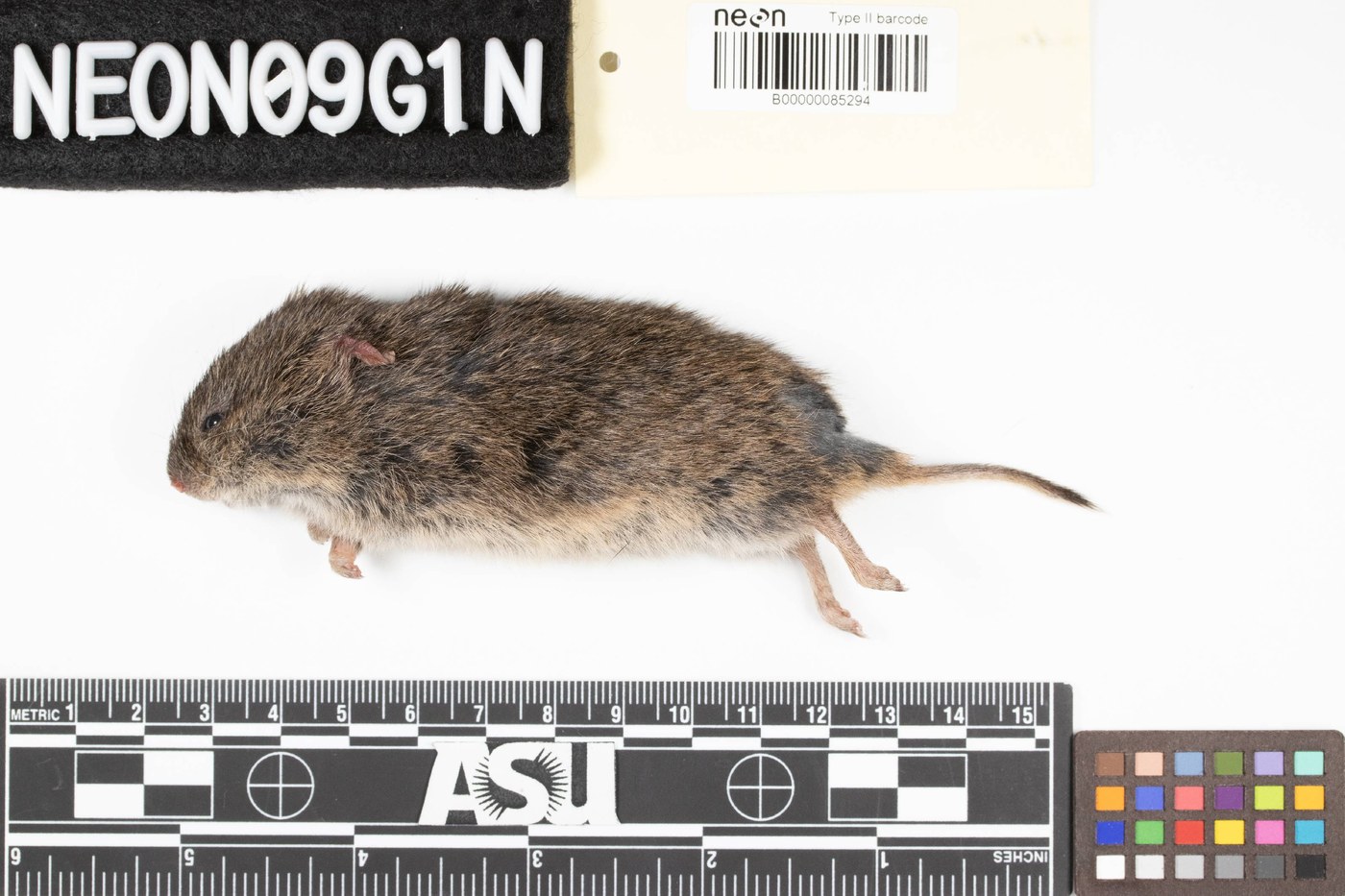
Tail shorter than twice the length of the hind foot. That is Texas Tech's own diagnostic phrasing and it is the fastest measurable tell. Texas specimens average 146 millimeters total length, about 5.75 inches, with a 34 millimeter tail, about 1.3 inches, and a 20 millimeter hind foot, at 30 to 50 grams. K-State gives Kansas prairie voles at 5.5 to 7 inches total length.
Grizzled above, golden below
Grizzled grayish-brown above, yellowish to golden below, tail darker on top than underneath. Stocky build, short legs, short ears, small eyes, blunt snout. Texas Tech describes Texas animals more simply as a dark brownish or blackish vole.
Five plantar tubercles, not six
Five plantar tubercles on the sole of the hind foot, against six in the rest of the genus. This is a specimen-in-hand character rather than a yard character, but it is a genuine species-level diagnostic. Prairie vole also carries six mammae, two inguinal pairs and one pectoral pair, rather than the eight typical of related rodents.
Commonly confused with the house mouse
K-State states it directly: house mice are smaller than voles, have large ears, and carry a 3 to 4 inch tail. A prairie vole's tail is about 1.3 inches. House mice also nest indoors, while prairie voles live entirely outdoors on surface runways.
The woodland or pine vole
Commonly confused with the woodland or pine vole, which is the more likely vole across eastern and southern Oklahoma. The Oklahoma Biological Survey's state checklist lists woodland vole as common in the eastern and southern parts of the state while prairie vole is listed as rare. The practical difference is depth: woodland voles run deeper tunnel systems, so K-State notes that trapping them requires excavating down to the run, while prairie voles are taken on surface runways with no digging at all.
Moles, and the fixes do not transfer
Commonly confused with moles, and the fix for one does nothing for the other. Moles push up raised ridge tunnels and mounds of soil. Voles leave worn, matted-down paths across the surface. Oklahoma State University Extension separates the parallel mole and pocket gopher confusion the same way, by tunnel and mound shape rather than by sighting the animal.
Rabbits, for bark damage
Commonly confused with rabbits, for bark damage specifically, and this one matters more here than up north. K-State gives the tell: vole girdling sits at ground level and shows paired grooves from small chisel-like teeth, while rabbit girdling starts several inches above the soil surface and leaves much larger grooves. In a region without dependable snow cover, vole girdling stays at ground level rather than climbing to a snow line, so height is a reliable separator here.
Signs of Infestation
Matted runways to small holes
Matted surface runways at ground level leading to entrance holes about one and a half inches across. A single colony's runway network can cover as much as a quarter acre, connecting several den openings.
Droppings you can identify
Droppings that are actually identifiable, which is unusual. K-State describes vole feces as brown or green, shaped like wheat grains, and frequently left in small piles alongside grass clippings at the base of large clumps of grass. That is a checkable sign a homeowner can confirm without seeing the animal.
Paired grooves in girdled bark
Girdled bark at ground level showing paired grooves from chisel-like teeth. Girdling all the way around a trunk will kill the tree, which is why K-State treats any indication of aboveground damage as reason to start a control program rather than to wait and watch.
Under landscape fabric and mulch
Large numbers of voles under landscape fabric and mulch piles. K-State names this specifically for plantings near ornamentals and woody vegetation. Lifting a corner of the fabric is often a faster diagnostic than walking the lawn.
Clipped grass stems and cached food
In late summer and fall voles store seeds, tubers, bulbs, and rhizomes, so small caches near burrow openings are a seasonal sign that lines up with this region's fall activity peak.
No distinctive sound or smell
No distinctive sound and no distinctive smell. No characteristic vocalization or odor is documented for this species as something a homeowner would notice.
Prevention and When to Call a Pro
Habitat modification first
It is the only step that lasts. Mow regularly, reduce competing vegetation, clear brush and dead branch piles, remove unused garden crops, and clear fallen fruit off orchard floors. Anything that removes vegetative cover makes the site unsuitable. K-State's own framing is worth repeating: damage prevention is much more beneficial than population control after the damage has already happened.
A 4-foot clear circle
Keep a 4-foot diameter vegetation-free circle around the base of young trees and vines. That is K-State's figure for this region, and it is twice the 2-foot clearance northern extension services recommend. Wider is the local answer.
Pull mulch back, check the fabric
Pull mulch back and check under landscape fabric. Sawdust and wood-chip mulch is good horticultural practice and excellent vole habitat at the same time. K-State names mulch piles and landscape fabric near ornamentals as places voles concentrate in numbers.
Tree guards for a snowless region
Tree guards, sized for a region without snow. Cylinders of quarter-inch or smaller hardware cloth, buried at least 6 inches so voles cannot tunnel underneath, with about 12 inches standing above ground. Northern guidance calls for 12 to 24 inches specifically to clear snow depth, and that reason does not apply across most of this region, so 12 inches above grade is the working figure here. K-State also says plainly that exclusion is not always practical and will not protect the plant in every situation.
Snap traps, in real numbers
Snap traps, set correctly and in real numbers. An ordinary snap-type mousetrap baited with a small piece of apple or a peanut butter and oatmeal ball, with a shingle bent into an arched roof over it so the spring arm clears. For prairie vole, set traps at right angles to the surface runway or back to back within the run, with no excavation needed at all, because this species travels the surface. Ten traps is K-State's stated minimum for a yard or small garden. Wear plastic or rubber gloves when handling dead animals, which K-State recommends specifically to reduce the chance of disease transfer.
Rodenticides are not a home tool
Rodenticides are mostly not a homeowner tool here. About 28 products are registered for vole control in Kansas across repellents, toxicants, and fumigants, and most are restricted-use products requiring applicator training and a permit to buy or use. Anticoagulants including chlorophacinone, warfarin, and diphacinone need multiple feedings over as much as five days and are generally safer around non-target animals; warfarin products are not restricted-use. Zinc phosphide at 2 percent is an acute toxicant for quick knockdown, applied one teaspoon by hand around each active burrow or runway, allowed to fall through grass to the ground surface, never onto bare ground and never in piles, and not applied when rain is forecast within 48 hours. Fumigants are not recommended for lawns and landscapes at all.
Repellents rate poorly
The local source says so. Capsaicin-type hot sauce repellents are registered for ornamentals but not for gardens or plants intended for human consumption. K-State rates them expensive, short-term at best, washed off by precipitation, and least effective in winter when food is scarce and voles are least choosy.
On disease, this region differs
On disease risk, this region is genuinely different, and the qualifier matters as much as the fact. Tularemia is a real south-central concern: CDC's national surveillance for 2011 through 2022 found that Arkansas, Kansas, Missouri, and Oklahoma together accounted for 50 percent of all reported US cases, with 78 percent of patients reporting symptom onset between May and September, and CDC states separately that tularemia is most common in the south-central United States. What none of those sources says is that voles drive it. The documented human exposure routes are tick and deer fly bites, handling infected animals, inhaling contaminated aerosols, and contaminated water, not walking across a lawn with runways in it. The practical takeaway is ordinary caution around any dead or visibly sick rodent in this part of the country, plus the gloves K-State already recommends.
Call when girdling rings a tree
Call a professional when girdling has already ringed or is actively threatening a valued tree. K-State's threshold is blunt: any indication of aboveground girdling damage is cause for instituting a control program, because a complete girdle kills the plant and there is no undoing it afterward.
Call for a restricted-use product
Call a professional when the job needs a restricted-use product. Most of the products registered for voles in this region require training and a permit, which puts a real bait program beyond a homeowner regardless of willingness. Kansas routes homeowners to licensed damage control operators by county through its state wildlife agency, and Texas routes wildlife damage questions through Texas Wildlife Services and county extension offices.
Call when damage keeps returning
Call a professional when damage keeps returning season after season. If mowing, mulch pullback, and clearing have all been done and runways still reappear each spring and fall, or if the population has surged past what ten-plus traps in a small yard can handle, area-wide integrated work is the next step rather than more traps.
Frequently Asked Questions
Do prairie voles really mate for life?
Close, with a real qualifier. Prairie vole is one of the very few socially monogamous mammals: pairs build the nest together, share a territory, raise young with the male present, guard the bond by turning aggressive toward strangers but not the partner, and are repeatedly live-trapped together in and out of breeding season. But social monogamy is not sexual exclusivity, and only about 60 to 75 percent of adults hold a pair territory at all, with 20 to 35 percent living as unattached wanderers. In one four-year field study, half of breeding units were monogamous pairs, those pairs lasted an average of 42 days, and 78 percent of them ended because one or both animals died rather than because they split up.
Are prairie voles common in Texas?
No. Texas Tech University's Natural Science Research Laboratory records the species in Texas only from Hardin County in the southeast and from Armstrong, Hansford, Lipscomb, and Lubbock counties in the northern Panhandle, and lists its Texas status as rare. The Hardin County record is a single specimen taken in 1902, of a subspecies that is now extinct. A federal species account ranks prairie vole critically imperiled in Texas. If you have runway damage in a lawn across most of Texas, the animal is probably something else.
Is that vole damage or rabbit damage on my young tree?
Check the height and the grooves. Vole girdling sits at ground level and shows paired grooves left by small chisel-like teeth. Rabbit girdling starts several inches above the soil surface and the grooves are much larger. Rabbits also clip branches with clean angled cuts, which voles do not do.
Why does my lawn damage show up in spring and fall but not in midsummer?
That is the documented regional pattern rather than a coincidence. Researchers studying a Kansas prairie vole population scheduled their fieldwork for May and June specifically because the population goes through a reproductive lull in midsummer, and because the breeding season there starts about a month earlier than it does in Indiana. Spring and fall growth periods are also when runway damage is most visible in turf.
Do I need to worry about disease from voles in my yard?
Routine yard contact is low risk, but this is the part of the country where tularemia actually occurs. CDC found that Arkansas, Kansas, Missouri, and Oklahoma together accounted for 50 percent of all US tularemia cases reported from 2011 through 2022. The typical human exposure routes are tick and deer fly bites, handling infected animals, inhaling contaminated aerosols, and contaminated water, none of which describes walking on a lawn. K-State's own instruction is to wear plastic or rubber gloves when handling dead voles.
Why do voles keep coming back to my mulched beds?
Because wood-chip and sawdust mulch is ideal vole habitat even while it is doing the plants good. K-State notes voles are sometimes found in large numbers under landscape fabric and mulch piles near ornamentals and woody vegetation. The fix is a 4-foot diameter vegetation-free circle at the base of young trees and vines, and pulling mulch back rather than piling it against trunks.
Everything I read says vole damage appears after the snow melts, but we barely get snow. Is that even the same animal?
It can be, but most of that advice was written for the Northeast and the northern Midwest, where voles tunnel unseen under snow all winter and a lawn full of matted trails appears in one week at snowmelt. Without a reliable snow layer, the damage here accumulates in view at ground level across two visible seasons, spring and fall, with a midsummer slack period. It also means girdling on a young trunk stays at ground level rather than climbing to a snow line, and that tree guards can be sized for the animal's reach, about 12 inches above grade, rather than for snow depth.
Sources
- Vole Control in Lawns and Landscapes (MF2975): colony structure, quarter-acre runway networks, mulch and landscape fabric habitat, 4-foot vegetation-free circle, hardware cloth spec, trapping method and ten-trap minimum, glove precaution, the 28 registered Kansas products, anticoagulant and zinc phosphide specifics, and the drought-stress consequence K-State Research and Extension, Kansas State University (Charles D. Lee, March 2011)
- Voles, Damage Identification: entrance hole diameter, wheat-grain-shaped droppings in small piles, paired tooth grooves in girdling at ground level, and the rabbit-versus-vole girdling height distinction K-State Extension Wildlife Management, Kansas State University
- Voles: statewide Kansas occurrence, general description, the under-two-months life expectancy and 16-month maximum, and referral to licensed damage control operators by county K-State Extension Wildlife Management, Kansas State University
- Voles: Kansas prairie vole size range of 5.5 to 7 inches and grayish-brown coloring K-State Research and Extension, Johnson County
- Species account of the Prairie Vole (Microtus ochrogaster), The Mammals of Texas Online Edition: Texas county-level distribution, rare state status, the extinct Hardin County subspecies, the Lubbock County translocation note, tail-to-hind-foot diagnostic, average measurements, nest dimensions, litter size, and year-round breeding Natural Science Research Laboratory, Museum of Texas Tech University
- Natural History of a Relictual Population of the Prairie Vole, Microtus ochrogaster, in Southwestern Oklahoma, Occasional Papers No. 129: the Fort Sill and Wichita Mountains relict population, discovery from raptor pellets, pelage description, five plantar tubercles, and six mammae The Museum, Texas Tech University (Larry L. Choate, 1989)
- Historical zoogeography and taxonomic status of the prairie vole (Microtus ochrogaster) from the southern plains of Texas and Oklahoma: Holocene northward retreat under increasing aridity, the 1943 southwestern Kansas drought-survivor population, and the local abundance picture in southern Oklahoma Occasional Papers, Museum of Texas Tech University (Stangl, Goetze and Spradling, 2004)
- Checklist of Oklahoma Mammals: prairie vole listed as rare in the northern and especially north-central part of the state, with woodland vole listed as common in the eastern and southern parts Oklahoma Biological Survey, University of Oklahoma (Priscilla Crawford)
- Frequently Asked Questions for Wildlife Damage and Disease: the mound-and-tunnel method of separating burrowing mammals by their damage rather than by sighting the animal Oklahoma State University Extension
- Notes on Mammals from the Klemme Range Research Station, west-central Oklahoma: the 1990 prairie vole capture on ungrazed upland mixed-grass and short-grass prairie near the species' southwestern limit in the state Proceedings of the Oklahoma Academy of Science, Oklahoma State University
- Prairie vole (Microtus ochrogaster) species account: state conservation ranks including secure in Oklahoma, apparently secure in Arkansas, critically imperiled in Texas, and presumed extirpated in Louisiana USDA Forest Service Research and Development
- Intraspecific variability in the social and genetic mating systems of prairie voles, Microtus ochrogaster, Animal Behaviour: the Kansas and Indiana field comparison, measured population densities, the earlier Kansas breeding season, the midsummer reproductive lull, and the finding of greater social and genetic monogamy in the Kansas population Streatfeild, Mabry, Keane, Crist and Solomon, 2011
- Alternative Mating Tactics in Socially Monogamous Prairie Voles, Microtus ochrogaster, Frontiers in Ecology and Evolution 7:7: resident and wanderer tactics in natural Kansas and Indiana populations, and the stated reason for scheduling Kansas fieldwork a month earlier Shuster, Willen, Keane and Solomon, 2019
- Variation, plasticity, and alternative mating tactics: Revisiting what we know about the socially monogamous prairie vole, Advances in the Study of Behavior: the 60 to 75 percent residency and 20 to 35 percent wandering figures, year-round pair bonds and territoriality, and the documented between-population differences involving Kansas and Illinois animals Madrid, Parker and colleagues, 2020, hosted by Stanford University School of Medicine
- Social organization in free-living prairie voles, Microtus ochrogaster, Behavioral Ecology and Sociobiology 18(4):275-282: 281 breeding units monitored over four years, 50 percent monogamous, the 42-day average pair duration, and 78 percent of pairs ending in the death of one or both members Getz and Hofmann, 1986
- The mating system of the prairie vole, Microtus ochrogaster: Field and laboratory evidence for pair-bonding, Behavioral Ecology and Sociobiology 8:189-194: repeated joint captures of pairs across breeding and non-breeding seasons, selective aggression toward strangers, and the absence of comparable long-term associations in meadow vole data Getz, Carter and Gavish, 1981
- The Ties That Bond: Neurochemistry of Attachment in Voles: prairie vole as the standard model for social monogamy, biparental care, mate-guarding through selective aggression, and the meadow vole and montane vole contrast National Institutes of Health, National Library of Medicine (PubMed Central)
- Tularemia, United States, 2011 to 2022, MMWR: Arkansas 18 percent, Kansas 11 percent, Missouri 11 percent and Oklahoma 10 percent together accounting for 50 percent of all reported US cases, 78 percent of onsets between May and September, and the documented human exposure routes Centers for Disease Control and Prevention
- Tularemia Data and Statistics: the statement that tularemia is most common in the south-central United States Centers for Disease Control and Prevention
- Tularemia cases increase in the USA from 2011 through 2019: independent state ranking of Arkansas, Missouri, Oklahoma and Kansas, and identification of the American dog tick and lone star tick as the principal central-US tularemia vectors National Institutes of Health, National Library of Medicine (PubMed Central)
- Microtus ochrogaster, Taxonomic Serial No. 180312: order Rodentia, family Cricetidae, subfamily Arvicolinae, and the subgenus placement recorded as Pedomys Integrated Taxonomic Information System (ITIS)
- Texas Wildlife Services: the state route for wildlife damage management questions in Texas Texas A&M AgriLife Extension Service