Seasonal Timeline
Cold-weather months bring the heaviest indoor pressure almost everywhere this species lives, as outdoor populations move into basements, crawl spaces, and sewer systems seeking shelter and food. The window shifts earlier or later, and runs milder or sharper, by region and climate. Hawaii is the exception: no cold season means no seasonal shift at all.
Cold-weather months bring the heaviest indoor pressure almost everywhere this species lives, as outdoor populations move into basements…
Urban centers with dense, older housing stock and connected sewer systems (large cities in the Midwest and Northeast especially) see year-round baseline pressure on top of the cold-weather peak. Alaska is not a typical seasonal residential market for this species; see Where They're Found below for why.
Where They're Found
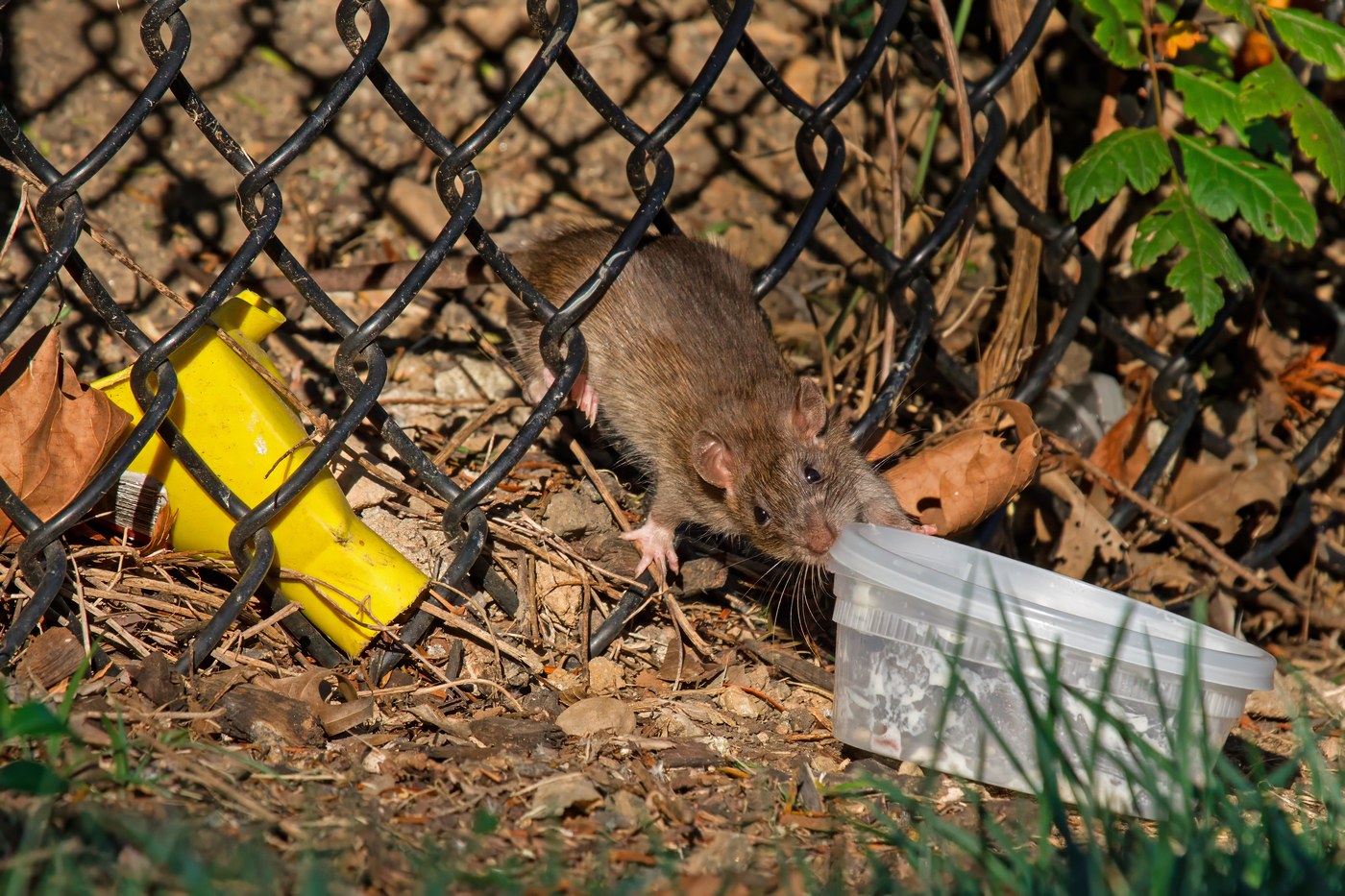
Norway rats show up most often along building foundations, in burrows dug in the yard, and around sewers, docks, and any structure with ground-level clutter or stored goods. Indoors, they occupy basements and ground floors far more often than upper levels or attics, since burrowing and staying low is their pattern, not climbing.
University extension and wildlife management sources confirm that the Norway rat, Rattus norvegicus, is established throughout the 48 contiguous United States, as well as in Hawaii and parts of Alaska. In Hawaii, Norway rats occur across all major islands, predominantly occupying lowlands, agricultural zones, and urban infrastructure, though the species is generally secondary to the roof rat there.
Alaska is a real but genuinely different story, worth understanding rather than lumping in with the rest of the country. Norway rats are established in a dozen or so coastal and island communities: the Aleutian ports of Dutch Harbor, Adak, and Atka, the Southeast Alaska communities of Juneau, Sitka, Wrangell, and Craig, the community of Nome, and areas near Kodiak Island. They are documented on 21 large Alaska islands and likely more small ones. They are not established in Anchorage, the Mat-Su Valley, the Kenai Peninsula, or the state's interior; a past sighting at the Fairbanks landfill did not persist into an established population. Anchorage in particular may be the largest rat-free port in the Northern Hemisphere, a status the city and the Port of Alaska actively protect through cargo inspection and monitoring rather than taking for granted. On the ecological side, invasive rats have devastated seabird colonies on Alaska's outer islands; a landmark 2008 eradication returned Rat Island (renamed Hawadax Island) to a documented, multi-year recovery of native birds, and federal wildlife managers have proposed (not yet started, as of this writing) a similar eradication effort on four more Aleutian islands.
Life Cycle
The range matters more than a single number here. Sources put Norway rat litters at 4 to 6 per year, with one giving a slightly wider 3 to 6, and litter size at 2 to 14 young averaging 7 to 8, with one source giving a narrower 6 to 12. Either range lands in the same place: a single female can wean 20 or more offspring in a year, which is why a burrow found early is a far smaller job than one found late.

Pup
Juvenile
Adult2
Norway Rat vs. Roof Rat
Identification
Five tells, in order of reliability
The five tells that separate a Norway rat from a roof rat, in order of reliability. These two species are constantly confused, and every tell below runs in the opposite direction for a roof rat.
One: body build
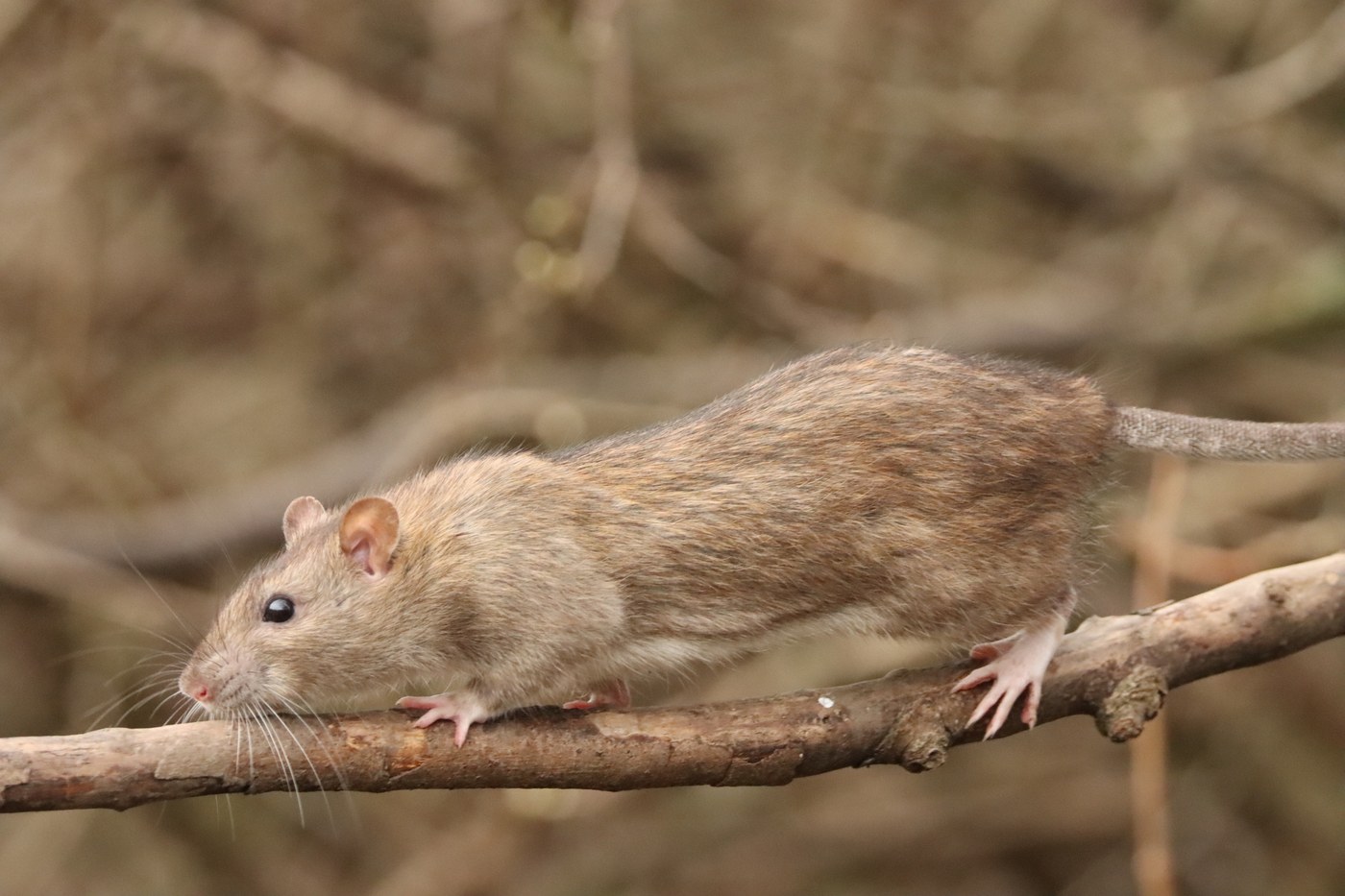
1. Body build. Large, robust, and thick-bodied. This is the bigger and chunkier of the two commensal rat species overall.
Two: the muzzle
2. Muzzle. Blunt and rounded, not pointed.
Three: the ears
3. Ears. Small, pink, and naked. Folded forward over the head, they do not reach the eyes.
Four: the eyes
4. Eyes. Smaller than a roof rat's, relative to head size. This specific point comes from a single extension diagram rather than several independent sources, so treat it as a secondary tell, not the deciding one.
Five: the tail, the best tell
5. Tail, the single most reliable tell. Shorter than the combined length of the head and body. Pulled forward over the back, it reaches only to the middle of the skull, and it is dark above, pale below, scaly, and essentially hairless. When in doubt on a trapped animal, measure the tail against the body.
Behavior confirms the shape
Norway rats are burrowers that live at or below ground level: foundations, yard burrows, crawl spaces, and sewers. If a nest turns up underground, it is almost always a Norway rat. Norway rats are also the stronger swimmers of the two species, which explains reports of a rat coming up through a toilet or drain. A roof rat is the far better climber and nests above ground, in attics, wall voids, or dense vegetation. The two species cannot interbreed, and it is rare to find both living in the same structure at once.
Color is not reliable alone
Color is not a reliable tell on its own. Sources describe Norway rats as light brown above, gray with a white underside, or brown-to-red-gray above with a white-gray belly, depending on the individual animal. Lean on the shape and behavior tells above rather than coat color.
Confused with a mouse instead of a roof rat?
A very young Norway rat is often mistaken for an adult mouse. Young rats have large heads and feet in proportion to their bodies, while adult mice do not. Gnaw marks are another tell: rats leave marks about 1/6 inch wide, versus a mouse's finer marks around 1/12 inch.
Pack rats have furry tails
In the Southwest, pack rats and woodrats get thrown into the same conversation, but they have furry tails. Both Norway and roof rats have scaly, mostly hairless tails.
Signs of Infestation
Burrows along foundations
Woodpiles and gardens work the same way. Entrance holes typically run 2 to 3 inches in diameter. Undermined slabs or foundations are a sign the burrowing has been going on for a while.
Droppings and gnaw marks
Droppings turn up near food storage and prep areas or around pet food containers. Gnaw marks run about 1/6 inch wide, wider than a mouse's.
Nests in clutter and woodpiles
Nests behind boxes, in cluttered garages, or in woodpiles, plus smudge or grease marks where oily fur repeatedly brushes beams, rafters, pipes, and walls, and runways worn smooth by repeated travel.
Fresh digging
Fresh digging under sheds or doghouses, or burrows starting under compost piles or garbage cans.
Sounds after dark
Gnawing, climbing, and clawing inside walls, plus squeaks and fighting noises, since activity peaks at night. Noises from the attic or a drop ceiling usually mean the infestation has grown enough to move upward.
A detectable smell
It shows in a poorly ventilated space.
Gnawed wiring is a fire risk
It is not just a nuisance. Norway rats gnaw soft metals, plastic, wood, and electrical wiring, and rodent gnawing on wiring is a believed cause of some fires of unknown origin.
Prevention and When to Call a Pro
Seal every quarter-inch opening
Seal every opening larger than 1/4 inch with rat-resistant materials. This is the exclusion standard for Norway rats specifically. Separately, check door thresholds: young rats and even adults can squeeze under a door with only a 1/2-inch gap, so a tight seal under 1/4 inch does not automatically cover doors.
Use the right material
18-gauge, 1/2-inch mesh galvanized expanded metal, or 16-gauge, 1/2-inch mesh galvanized wire cloth, for vent grills. 19-gauge, 1/2-inch mesh galvanized wire cloth for ground-level windows. Never lightweight chicken wire, which rats pass through easily. Cover rooftop plumbing vent pipes over 2 inches in diameter with screens.
Burrow prevention is the extra step
Burrow prevention is the step roof rat advice skips. Concrete poured along a foundation helps prevent burrowing underneath it. A gravel barrier at least 1 inch in diameter, laid at least 2 feet wide and 6 inches deep along the foundation, also discourages digging.
Clear the ground-level habitat
Thin dense, ground-level vegetation. Store firewood, lumber, and other stacked goods at least 18 inches off the ground with at least 2 feet of clearance from walls.
Cut off food and water
Store pet food and bulk food in rodent-proof metal or glass containers, since galvanized steel resists gnawing far better than plastic. Feed pets only what they finish in one sitting. Keep garbage in tightly covered metal cans, ideally elevated at least 18 inches, and clean up pet waste, since rats will eat it.
Two things that do not work
Ultrasonic or high-frequency frightening devices, since rats quickly get used to repeated sound. And odor or taste repellents, none of which are registered as effective long-term solutions.
When to Call a Pest Control Professional
Burrowing that has started to undermine a foundation or slab is not something a homeowner can assess or fix without excavation-level work. Professional-grade rodenticides are also more effective and more tightly regulated than retail products, with some formulations restricted to licensed applicators, though exact rules vary by state and should not be assumed universal. A population is considered heavy once it reaches around 40 Norway rats sharing a territory, and with litters compounding at 4 to 6 per year, active burrows or droppings across more than one area of a property are a reasonable trigger for a professional inspection rather than DIY trapping alone. Handling droppings or nesting material without protection is also a real exposure route for disease, since urine is the main transmission path for more than one of the illnesses rats can carry, which is one more reason to bring in a professional for anything beyond a small, contained problem.
Frequently Asked Questions
How can I tell if I have Norway rats or roof rats?
Check the tail against the body. A Norway rat's tail is shorter than its head and body combined, with a blunt muzzle and small ears that do not reach the eyes when folded forward. A roof rat's tail is longer than its head and body, with a pointed muzzle and large ears that do reach the eyes. The tail comparison is the single most reliable tell of the two.
Do Norway rats climb, or do they stay on the ground?
They stay low. Norway rats are burrowers that live at or below ground level, in foundations, yard burrows, crawl spaces, and sewers. Roof rats are the far better climbers of the two species and prefer to nest above ground, in attics or wall voids.
Why do I keep finding holes in my yard near the foundation?
Those are likely Norway rat burrows. Entrances typically run 2 to 3 inches in diameter and show up along foundations, under woodpiles or rubbish, and around gardens.
Can rats really come up through a toilet or drain?
Yes. Rats can enter a structure by gnawing, climbing, jumping, or swimming through sewers and coming up through toilets or broken drains, and Norway rats are the stronger swimmers of the two commensal species.
Do rats carry rabies?
No. Commensal rats, Norway and roof rats alike, do not carry or transmit rabies, unlike some wild mammals such as raccoons, skunks, foxes, and bats. Plague is also worth putting in perspective: it is a disease rats can theoretically carry, but it is very rarely found in commensal rodent species in the United States, so it should not be weighed the same as more common risks.
What diseases do Norway rats actually spread?
The primary vector risks backed by public health literature include leptospirosis, rat-bite fever, salmonellosis, murine typhus, and trichinosis. Norway rats are also the natural worldwide host for Seoul virus, an Old World hantavirus transmitted via aerosolized urine, feces, or saliva. In humans, Seoul virus causes Hemorrhagic Fever with Renal Syndrome (HFRS), a condition distinct from Hantavirus Pulmonary Syndrome (HPS), which is transmitted by deer mice rather than rats.
I've only seen one rat. How big is the actual problem likely to be?
Bigger than one animal, almost always. Norway rats produce roughly 4 to 6 litters a year (one source says 3 to 6), with 2 to 14 young per litter and an average of 7 to 8. A single female can wean 20 or more offspring in a year, and a heavy population is considered to start around 40 rats sharing one territory.
Sources
- Pest Notes: Rats UC Statewide IPM Program, UC ANR Publication 74106
- Norway Rats (species overview and subpages) Internet Center for Wildlife Damage Management (University of Nebraska-Lincoln / USDA APHIS Wildlife Services)
- Managing Rats & Mice, Publication L-1916 Texas A&M AgriLife Extension Service
- About Leptospirosis Centers for Disease Control and Prevention
- About Rat-Bite Fever (RBF) Centers for Disease Control and Prevention
- Hantavirus, Veterinary Guidance for Seoul Virus Centers for Disease Control and Prevention
- Rats in Alaska: Keeping Anchorage Rat Free Alaska Department of Fish and Game
- Rat Eradication on Four Aleutian Islands EIS U.S. Fish and Wildlife Service