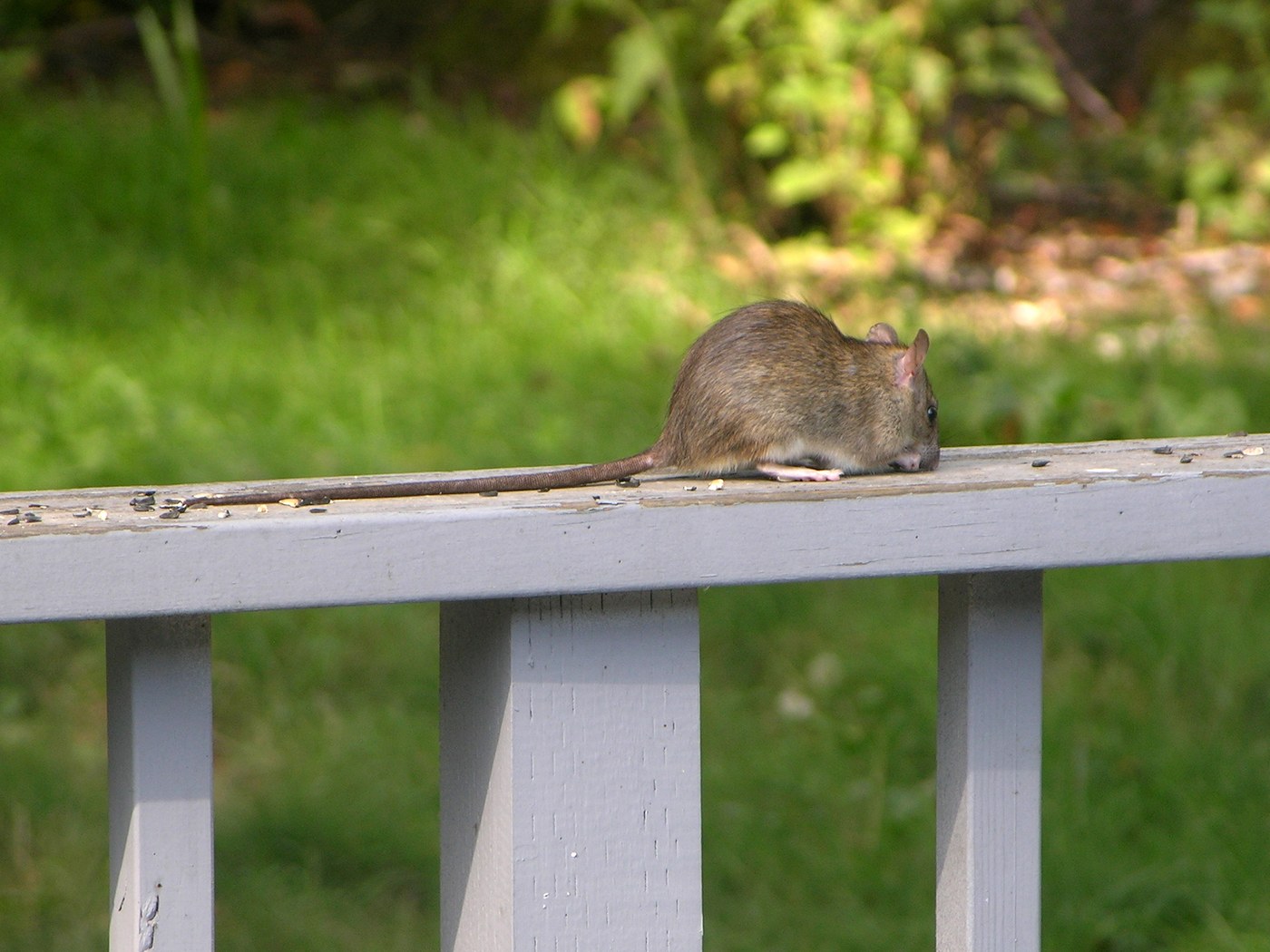
Seasonal Timeline
Warm, humid, or irrigated climates keep roof rats active year round with little seasonal break. Cooler climates see a real fall-to-winter indoor push, October through February, as outdoor populations move inside seeking shelter.
Warm, humid, or irrigated climates keep roof rats active year round with little seasonal break. Cooler climates see a real fall-to-winter…
The October-to-February indoor push describes when roof rats are most noticeable inside a house in cooler climates, not necessarily when they breed. In California, the Southwest, the Gulf Coast, and Hawaii, mild or irrigated conditions keep roof rats active with little seasonal break at all. The Northeast population is real but the smallest and slowest-growing of all these regions, concentrated in older port-city housing stock (Boston, New York) rather than spread broadly.
Where They're Found
Roof rats are established well beyond their South Central and Southeast core. California carries one of the largest roof rat populations of any region, competing directly with Norway rat across most of the state's urban and suburban areas, supported by mild climate, citrus and avocado agriculture, and dense ornamental landscaping. The Southwest holds a genuinely counterintuitive population: roof rats persist in irrigated, heavily landscaped desert suburbs (citrus, palms, dense hedges) that mimic the humid conditions this species needs, despite the arid climate surrounding them. The Pacific Northwest's naturally mild, wet climate supports an established population without needing irrigation at all. The Northeast has the smallest and slowest-growing population of these regions, limited mostly to older port-city housing stock in places like Boston and New York, and running well behind Norway rat there.
Hawaii and Alaska are confirmed too, and look very different from each other and from the mainland. Hawaii carries a fully established, statewide population across all major islands, a genuine agricultural and conservation problem, not a minor one: roof rats cause an estimated 5 to 10 percent of the annual macadamia crop loss and prey on the seeds and fruit of critically endangered native plants as well as the eggs and nestlings of endemic forest birds and seabirds.
Alaska's roof rat presence is real but narrow, not statewide, and much smaller than its Norway rat presence. State wildlife sources document confirmed roof rats only on Shemya Island, an isolated outer Aleutian island where a World War II-era shipping introduction is the documented origin, and near Kodiak Island. That is a far smaller footprint than the dozen-plus coastal communities and roughly 21 islands where Norway rats specifically are established in Alaska; the two species should not be assumed to share the same Alaska range just because both are called "rats." Roof rats are not established in Anchorage, the Mat-Su Valley, the Kenai Peninsula, or Alaska's interior.
Research also points to the range expanding into drier inland pockets beyond the irrigated Southwest suburbs, including a Phoenix, Arizona population first identified in 2001. Midwest and Mountain West sit outside the range: the species' climbing, warmth-and-humidity-dependent biology does not fit those colder, drier interiors the way it fits the regions where it is established.
Life Cycle
Litter size is where the sources disagree. Two university extension sources put it at 5 to 8 pups per litter. A third, non-university source cites a much wider range of 6 to 20. The university figures are the better supported ones.

Gestation
Pup
Juvenile
Adult2
Identification
Length, and the tail is longer
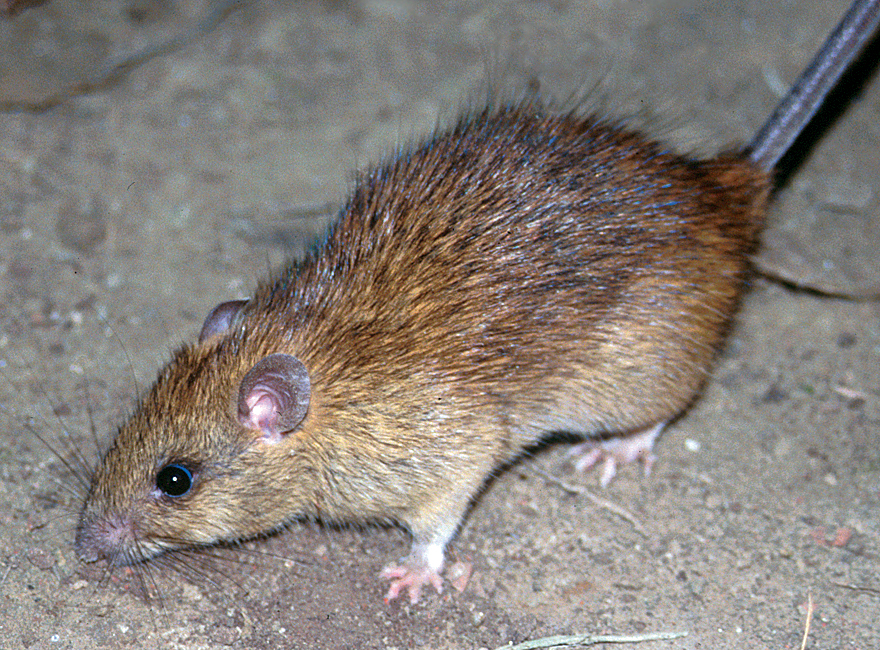
Roof rats run 13 to 18 inches total including the tail, with the tail alone longer than the head and body combined, a small, sleek, agile build, a pointed muzzle, and ears large enough to reach the eyes when folded forward. Black or brown on the back, often with black guard hairs mixed in, and gray to white underneath. Adults weigh 5 to 10 ounces.
The Norway rat matters most
The Norway rat is the look-alike that matters most, and the differences track together rather than any single feature. Roof rats are smaller, sleeker, and better climbers, with a pointed muzzle, larger eyes and ears relative to body size, and a tail longer than the head and body combined. Norway rats are larger and stockier, with a blunt muzzle, smaller eyes and ears, and a tail shorter than the head and body. Where the two species share a building, roof rats take the upper floors and attic while Norway rats stay at ground level and in basements.
Pack rats and cotton rats
Pack rats and woodrats have furry tails, unlike the scaly, nearly hairless tail of a roof rat. Cotton rats run smaller overall, with a tail shorter than the head and body combined, the opposite of a roof rat's proportions.
Signs of Infestation
Smudge and grease marks up high
Look along rafters and beams. This is a useful tell against Norway rats, whose marks run along the floor and foundation instead.
Droppings
Black, banana-shaped, and pointed at the ends, about 1/4 to 1/2 inch long.
Narrow gnaw marks
Gnaw marks around 1/6 inch wide, larger and coarser than a mouse's finer gnawing.
Citrus hollowed on the tree
Hollowed-out citrus still hanging on the tree. Roof rats will chew a small hole in a piece of fruit and hollow the whole thing out, leaving the rind on the branch. It is a distinctive, easy-to-point-to sign for anyone with a citrus tree nearby.
Nighttime noise overhead
Scurrying, scratching, or running sounds from the attic or a drop ceiling, most noticeable after dark when the house is quiet. Both university sources point to this as the first thing homeowners actually notice.
Traveling along wires at dusk
Roof rats seen traveling along overhead utility wires or fence tops at dusk is itself a visible sign of activity nearby.
Prevention and When to Call a Pro
Trim limbs 6 feet off the roof
Trim tree limbs back within 6 feet of the roofline. That distance is what stops a roof rat from using an overhanging branch to reach the roof, a soffit vent, or an attic gap.
Keep canopies 2 feet apart
Keep tree and shrub canopies pruned 2 feet or more apart from each other and from the building, so a rat cannot travel tree to tree or tree to structure without touching the ground.
Rat guards above jump height
Install rat guards above jump height, not at ground level. Sheet-metal cylinders 18 to 24 inches wide, placed at least 4 feet above the ground and above anything nearby a rat could climb to bypass them, since roof rats can jump more than 3 feet vertically. Place these on trees, poles, and any other vertical route to the roof.
Thin the climbing vegetation
Remove or thin climbing vegetation on the building itself. Ivy, star jasmine, and honeysuckle growing up a fence or wall give a roof rat an aerial route straight into an attic or soffit.
Seal the roofline, not just the base
Seal roofline and attic entry points, not just the foundation. Cover attic and foundation vents with wire mesh, screen the tops of rooftop plumbing vent pipes, and repair damaged screens under the eaves and on roof or attic vents. Exclusion for this species has to extend above ground level, not stop at the foundation the way Norway rat exclusion can.
Seal gaps sized for a climber
Seal gaps sized for a climbing rat. Sources do not fully agree on the exact number, one gives 1/4 inch, another 1/2 inch, a third says roof rats can squeeze through openings up to 3/4 inch, but the practical rule that holds across all of them is to seal anything a quarter inch or larger and check the roofline and attic vents as carefully as the foundation.
Utility wires need a pro
If roof rats are seen traveling on overhead utility wires into the structure, that entry pathway generally needs a pest professional or the utility company, since it is off the property and not something a homeowner can seal.
Sanitation is secondary here
General sanitation still matters but is secondary to exclusion for this species. Secure garbage in rodent-proof containers, harvest fruit and nuts promptly and pick up fallen fruit, remove pet food and bird-feeder access, and eliminate standing water, since roof rats need a water source and are drawn to it in hot, dry weather.
When to Call a Pest Control Professional
Repeated nighttime noise in the attic or ceiling void, not just a single sighting, is the threshold worth acting on. Any gnawed wiring found in the attic should trigger an urgent call given the documented fire and gas-line risk, and any rats seen using overhead utility wires to reach the structure should go straight to a professional or the utility company rather than a DIY fix.
Frequently Asked Questions
What's the difference between a roof rat and a Norway rat?
Roof rats are smaller, sleeker climbers with a tail longer than their head and body combined, a pointed muzzle, and large ears that reach their eyes when folded forward. Norway rats are larger, stockier ground-burrowers with a blunt muzzle, smaller ears, and a tail shorter than their head and body.
Why do I hear scratching or scurrying in my attic at night?
Nighttime attic noise is one of the first and most common signs of a roof rat infestation, since the species nests and travels overhead rather than at ground level.
Do roof rats carry rabies?
The available research points to no. Commensal rats, unlike wild raccoons, skunks, foxes, and bats, are not documented as rabies carriers or transmitters. That said, that rests on a single source, so treat it as the current best answer rather than settled fact.
What diseases can roof rats spread to people?
Leptospirosis, salmonellosis and other foodborne pathogens, and rat-bite fever are documented by more than one university extension source. Roof rats also carry a historical association with plague, which is well known globally, but current university sources describe plague as now rare in commensal rat populations like roof rats and Norway rats, with wild ground squirrels and similar animals being the more common present-day reservoir.
How do roof rats get into a house?
Primarily through elevated routes: overhanging tree limbs, utility lines, roof vents, soffits, and gaps where pipes or wires enter near the roofline. Roof rats are excellent climbers that prefer to travel and enter above ground level, unlike the ground-level entry points typical of Norway rats.
Sources
- Pest Notes: Rats UC Statewide IPM Program, UC ANR Publication 74106
- Roof Rat Control around Homes and Other Structures University of Arizona Cooperative Extension, Publication AZ1280
- How Plague Spreads Centers for Disease Control and Prevention
- Rats in Alaska: Keeping Anchorage Rat Free Alaska Department of Fish and Game