Seasonal Timeline
There is no season. Hawaii's climate gives mongoose no dormancy period, so the animals are active and breeding through the year. The cycle that matters is the daily one: mongoose is diurnal, hunting through daylight hours and denning up at night, which is the opposite of nearly every other mammal pest homeowners deal with.
There is no season. Hawaii's climate gives mongoose no dormancy period, so the animals are active and breeding through the year. The cycle…
Mongoose in Hawaii has no season, and that is the operating condition. There is no swarm window, no emergence, no overwintering period. Nothing about the year forces a pause, so a coop that is vulnerable in February is just as vulnerable in August, and an exclusion job left half finished does not get a quiet stretch to sit in.
What replaces the calendar is the clock, and the clock is inverted from what people expect. Mongoose is diurnal. It hunts in daylight and dens at night. That single behavioral fact drives almost everything that follows. It is why the animal is the rare wildlife pest most homeowners actually see rather than infer from droppings and damage. It is why traps set for a nocturnal animal are set at the wrong hours. And it is the reason usually given for why the 1883 introduction failed as rat control, though most published accounts dispute that explanation and credit the mongoose as an effective cane-field ratter.
Where They're Found
In the United States, mongoose is a Hawaii problem and nowhere else. No source places the small Indian mongoose anywhere in Alaska, which is unsurprising: the species' introduced range worldwide is overwhelmingly tropical and subtropical islands, and it has never been documented as introduced to a cold-climate part of the United States. Puerto Rico, a United States territory rather than a state, does carry a large introduced mongoose population.
Within Hawaii the distribution is genuinely uneven, and the unevenness changes what you should do. Established, breeding populations exist on four islands: Hawaii Island, Oahu, Maui, and Molokai. Two islands, Kauai and Lanai, have no established breeding population. Both have had hitchhiking individuals intercepted in cargo, at harbors, and at airports over the years, and both are the subject of active state prevention work rather than routine control. Kauai in particular has been the focus of a decades-long effort to keep the species out, and the Kauai Invasive Species Committee reports a total of five live mongoose captured on the island as of its most recent capture in April 2023, each one through a rapid multi-agency trap response.
The reason Kauai stayed clear is close to an accident. A planned introduction to Kauai was aborted, reportedly because of an incident during unloading, which is why the island never received the founding animals the others did. What began as chance is now deliberate policy, and it has a measurable conservation payoff described in the identification and prevention sections below.
On the islands where mongoose is established, it uses a wide range of habitat: rock piles, dense vegetation, lava tubes and rock crevices, agricultural field edges, and burrows it digs or takes over. It occurs from sea level to roughly 2,400 meters, about 7,900 feet, with an older and disputed claim of higher ground, and from wet rainforest to dry leeward country. On a residential property, the working habitat is rock walls, thick landscaping, woodpiles, and the brushy edges of a yard.
This is not a structure-invading animal. Mongoose does not nest in an attic, chew through a soffit, or get into wall voids the way a rat or a raccoon does. The work is all in the yard, the coop, the garden, and the property edge, not in sealing a house.
Life Cycle
The life cycle is what turned a failed pest-control experiment into a permanent one. A gestation of about 49 days, litters of 1 to 4, more than one litter a year where conditions allow, and sexual maturity inside twelve months add up to a population that refills itself continuously in a climate with no dormancy period. That is why the four islands where mongoose established have never gotten it back out, and why the state's entire strategy on Kauai and Lanai is built around stopping the first breeding pair rather than managing an established population later.
Two figures are genuinely unavailable. No source gives a litters-per-year count or a wild lifespan drawn from Hawaii's own mongoose population specifically. The reproductive numbers come from a worldwide review of the species published through the University of Hawaii, which is a strong source but not Hawaii field data, and no dependable wild longevity figure was found at all. No number is given for either gap.

Young
Juvenile
Adult
Identification
A weasel shape moving in daylight
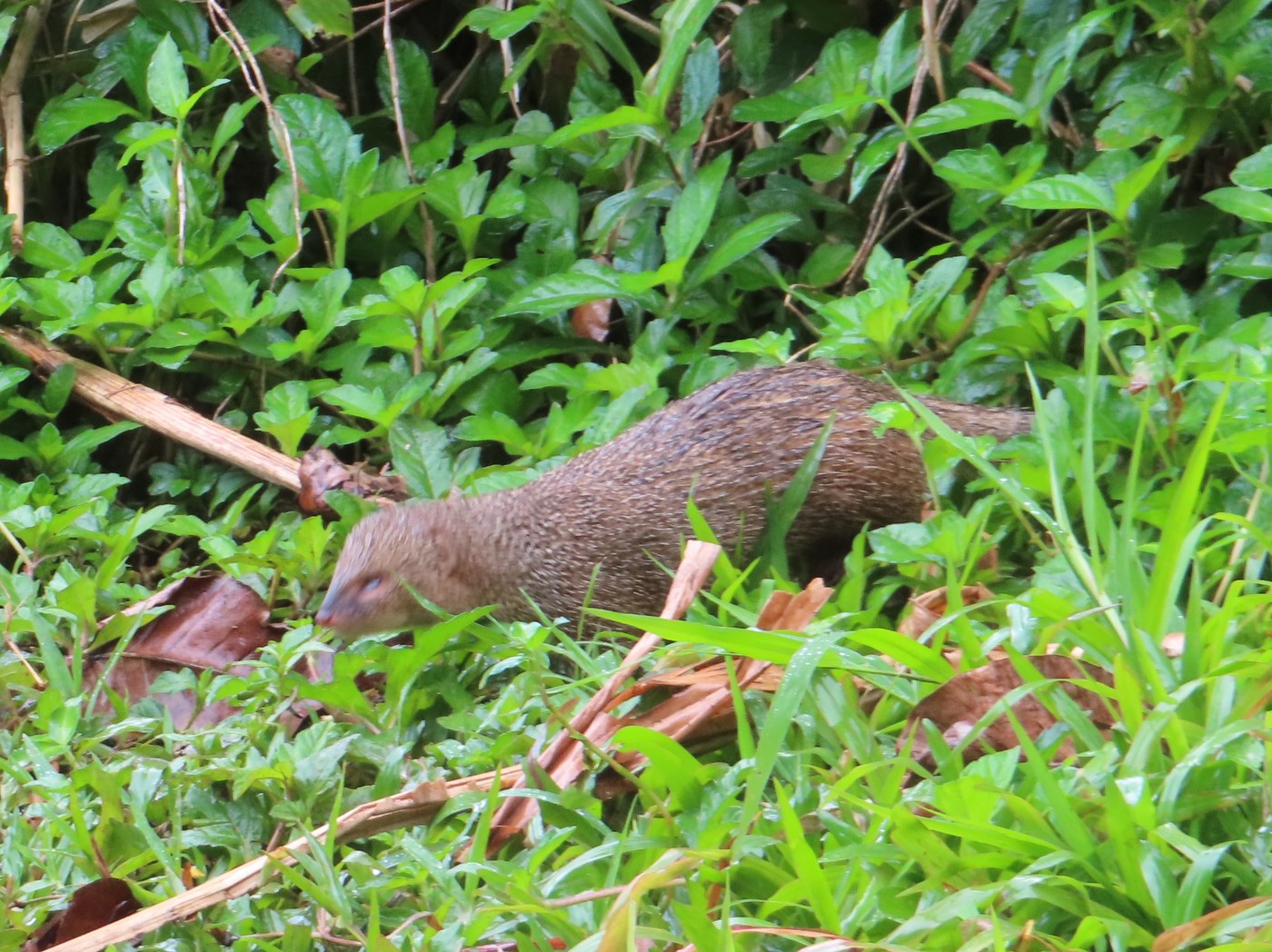
A brown, weasel-shaped animal moving in broad daylight is the identification. Mongoose is diurnal, which sets it apart from almost every other mammal pest a homeowner deals with. Adults run roughly 0.7 to 2 pounds and about 20 to 26 inches in total length, with a long slender body, short legs, a pointed nose, small rounded ears, and a long bushy tail that makes up around 40 percent of the animal. Fur is short, light brown to grizzled brown-gray.
A rat, and the tail settles it
The look-alike is a rat, not a weasel, and the tail settles it. The Kauai Invasive Species Committee calls this confusion out directly, because both animals scurry with a similar low, cat-like movement. A rat has a hairless, naked tail and is noticeably smaller overall. A mongoose has a full, bushy tail nearly as long as its body. No weasel species is established in Hawaii, so the practical mix-up in the islands is specifically with rats.
The serious part is not the property
The most serious thing about this animal is not what it does to a property. Mongoose is a documented predator of at least eight federally listed endangered Hawaiian birds, per a peer-reviewed worldwide review published through the University of Hawaii: the nene or Hawaiian goose, the alala or Hawaiian crow, the koloa or Hawaiian duck, the Hawaiian coot, the Hawaiian stilt, the Hawaiian gallinule, the Hawaiian petrel, and Newell's shearwater. Those birds evolved without any mammalian predator and have no defensive behavior against one.
A federal regulatory finding agrees
The federal government reached the same conclusion in a regulatory finding, which is a stronger form of evidence. In its 2019 final rule reclassifying the nene from endangered to threatened, the U.S. Fish and Wildlife Service stated that predation by mongoose is a serious threat to nene, and that mongoose prey on both goslings and adults. The same rule names the near-absence of mongoose on Kauai as a major reason nene have recovered better there than on islands where the species is established. That is about as direct a demonstration of this animal's effect as conservation biology produces.
Rabies, stated precisely
Getting it wrong in either direction is a real problem. The small Indian mongoose is a documented rabies reservoir and vector in parts of its introduced range, most notably Puerto Rico and several Caribbean islands, where studies have found roughly 40 percent of sampled animals had been exposed and mongoose account for more than 75 percent of reported animal rabies cases. Hawaii's mongoose population is a different situation entirely. Hawaii is the only rabies-free state in the United States and has no rabies in any species, a status the state maintains through a strict animal quarantine and testing program. So the accurate statement is not that mongoose do not carry rabies, and not that Hawaii's mongoose might. It is that the species is a genuine rabies vector elsewhere, and that Hawaii's own animals pose no rabies risk because there is no rabies in Hawaii to carry.
Leptospirosis and murine typhus
Both are the real disease concerns in Hawaii, confirmed by more than one source. Mongoose are documented hosts of leptospirosis in Hawaii specifically, per peer-reviewed work cited in a USDA Wildlife Services report hosted by the state. The Maui Invasive Species Committee independently states that mongoose carry leptospirosis and murine typhus, and notes that murine typhus can pass to a person bitten by a flea that has fed on an infected mongoose. Both risks are real and worth respecting. Both sit well below the endangered-bird predation problem in overall significance.
Naming, in case you run into a different one
This animal is usually called Herpestes javanicus, sometimes Herpestes auropunctatus, and current state invasive species program pages increasingly use Urva auropunctata after a taxonomic split. Small Asian mongoose and Javan mongoose refer to the same animal. In Hawaii, everyday usage is simply mongoose.
Signs of Infestation
You see it
That is the most common sign, and it is unusual for a wildlife page. Because mongoose hunts by day, most encounters are a direct sighting: a low brown animal darting across a road, along a rock wall, through landscaping, or across a yard in full daylight.
A raided chicken coop
Missing eggs, dead poultry, or both. This is the most commonly reported homeowner-level mongoose complaint in Hawaii, and it is usually what turns a wildlife curiosity into a pest problem someone wants solved.
Ground nests with missing eggs
Disturbed ground nests with missing eggs or chicks. On properties near native bird habitat, this is the sign that carries the real weight, for the reasons in the identification section above.
Digging in gardens and crops
Garden and crop damage from digging and foraging. Mongoose will take garden crops and produce, and it scavenges human food scraps, unsecured trash, and pet food left outdoors.
No odor or sound cue
Do not go looking for an odor cue or a distinctive sound. No source describes a characteristic smell or a call that homeowners commonly notice for this species. Sightings and damage are the detection methods, and pretending otherwise sends people hunting for evidence that is not there.
Dens in rock walls and crevices
Watch for burrows and dens in rock piles, rock walls, dense vegetation, and lava crevices. Mongoose dig their own burrows and take over existing ones, so a den entrance in landscaping stone or a brushy corner of the property is worth checking even without a sighting.
Prevention and When to Call a Pro
It depends on which island
What to do depends on which island you are standing on, and for this species the split runs the opposite way from what most people assume. Two islands, Kauai and Lanai, have no established mongoose population, and a sighting on either one should be reported immediately. Four islands, Oahu, Maui, Molokai, and Hawaii Island, already have established populations, and on those four reporting a sighting is not necessary and control is something a property owner may simply do. Read the next two items in that light and use the one that matches your island.
On Kauai or Lanai, report it
Report it first, before anything else. Call 643-PEST at 808-643-7378 or file at 643pest.org. These two islands are active state early-detection and rapid-response targets, and the response is real rather than nominal. After a single mongoose sighting at Nawiliwili Harbor on Kauai in May 2023, the Hawaii Department of Agriculture and Biosecurity, the Kauai Invasive Species Committee, and the Hawaii Department of Health Vector Control Branch deployed 43 traps in one week. Do not attempt to trap and keep or relocate the animal yourself on these islands. A coordinated multi-agency response is built to catch exactly this, and self-handling risks losing the animal or the sighting.
Elsewhere, traps are allowed
On Oahu, Maui, Molokai, or Hawaii Island: reporting is not necessary, and small animal traps can be used for control. The Maui Invasive Species Committee states this plainly in both directions: it is not necessary to report sightings on Maui, Molokai, Oahu, or Hawaii Island, and small animal traps can be used for control where the species is established. There is no eradication response to feed on those islands, because the population is already established. A homeowner dealing with a nuisance animal there does not need a special permit to trap it.
Secure the coop
That is where most of the damage happens. Mongoose-proof poultry housing means small-gauge wire mesh, sealed at ground level and buried, not just wrapped around the sides. A coop that keeps out a dog will not keep out an animal built to get into burrows and rock crevices. Raided coops and predated poultry and eggs are the most frequent homeowner complaint on this species in Hawaii, and a properly built coop removes the reason the animal keeps coming back.
Take away the easy food
Otherwise the trapping never ends. Mongoose is an opportunistic feeder that will use whatever is available. Do not leave pet food outdoors, keep trash secured, and pick up fallen fruit. A property that offers a reliable meal will keep producing mongoose no matter how many individual animals get removed.
Exclusion fencing works
It works at both ends of the scale. Fencing designed to exclude mongoose along with cats, dogs, and pigs has been used successfully around sensitive nesting areas at Hawaii Volcanoes National Park and other conservation sites. The same principle, small-mesh fencing sealed at ground level, applies at residential scale for anyone protecting poultry, garden beds, or a yard where ground-nesting birds are present. If the fence has a gap at the soil line, it is not a mongoose fence.
What the law actually restricts
Understand what the law actually restricts, because it is not what people expect. Mongoose was one of the very first species listed as injurious wildlife under the federal Lacey Act of 1900, which makes it illegal to import, export, acquire, or transport in the United States or any US territory. Hawaii separately classifies it as Injurious Wildlife under state administrative rules, making it illegal to introduce, transport, keep, or breed a mongoose without a permit from the Hawaii Department of Agriculture, and no such permits are issued at all for Kauai County or the island of Lanai. All of that legal weight falls on introducing, moving, keeping, or breeding the animal. None of it stops a homeowner on an established island from removing a nuisance mongoose already on their own property.
Who to Call, and When
Call for repeated coop raids or continuing garden damage after the basics are done, meaning a properly sealed coop and food sources removed. On the four islands where mongoose is established there is no permit obstacle and no protected-species question, so what a licensed nuisance wildlife control operator brings is coverage, technique, and follow-through rather than legal access. Call for a property near native ground-nesting bird habitat, where the stakes go beyond your own yard. And on Kauai or Lanai, make the 643-PEST report before anything else, because response there is a funded state program rather than a service to buy.
Frequently Asked Questions
Why were mongoose brought to Hawaii in the first place?
Sugarcane planters on Hawaii Island imported them, reportedly from Jamaica, in 1883 to control rats that were damaging cane fields. The animals spread quickly across Oahu, Molokai, Maui, and Hawaii Island, from sea level to elevations as high as 7,000 feet. A planned introduction to Kauai was aborted, reportedly because of an incident during unloading, which is the reason that island stayed mongoose-free.
Did the mongoose actually control the rats?
No. The explanation usually given is a straightforward mismatch that was apparently not considered in 1883. Mongoose hunts by day. The rats in Hawaiian cane fields, both Norway rats and roof rats, are primarily active at night. The two species were rarely out at the same time, so they seldom encountered each other, and mongoose did little to reduce rat numbers. The peer-reviewed record is blunt about the outcome: rat damage in cane did not drop meaningfully after the introduction, and contemporary accounts from other cane-growing islands with mongoose reported crop losses to rats continuing at 25 percent or higher. There is even evidence the mongoose changed rat behavior rather than rat numbers, pushing them toward tree-nesting, since roof rats became comparatively more common than ground-nesting Norway rats specifically on islands where mongoose was present. Some later accounts credit whatever real reduction in cane losses did occur to unrelated changes in farming practice rather than to the mongoose. What the mongoose did do, having no rats available during its own working hours, was turn its hunting pressure onto Hawaii's ground-nesting native birds, reptiles, and invertebrates. One caveat belongs with all of that: the peer-reviewed review that records the day-night mismatch also notes that most published accounts dispute it and credit the mongoose as an excellent cane-field ratter, eventually made obsolete by improved rat poisoning.
Do mongoose in Hawaii carry rabies?
No, and the precise reason matters. The small Indian mongoose is a documented rabies reservoir and vector in other parts of its introduced range, particularly Puerto Rico and several Caribbean islands, where sampling has found roughly 40 percent exposure and mongoose account for more than 75 percent of reported animal rabies cases. That is a real public-health problem in those places. It is not a Hawaii problem, because rabies has never become established in Hawaii. Hawaii is the only rabies-free state in the United States, with no rabies in any species, maintained through a strict animal quarantine and testing program for animals entering the islands. So a mongoose in Hawaii is not a rabies risk, not because mongoose are safe animals generally, but because there is no rabies in Hawaii for it to carry. The diseases that are documented in Hawaii's mongoose population are leptospirosis and murine typhus.
Is it legal to trap a mongoose on my property in Hawaii?
On Oahu, Maui, Molokai, and Hawaii Island, where mongoose is already established, small animal traps can be used for nuisance control and no special permit is required. What state and federal law restrict is something different: mongoose is federally listed as injurious wildlife under the Lacey Act of 1900, and Hawaii classifies it as Injurious Wildlife under state administrative rules, making it illegal to introduce, transport, keep, or breed one without a permit from the Hawaii Department of Agriculture. No such permits are issued for Kauai County or the island of Lanai at all. Removing a nuisance animal already present on your property on an established island is not what those rules are aimed at. Moving one, keeping one, or breeding one is.
What should I do if I see a mongoose on Kauai or Lanai?
Report it right away, to 643-PEST at 808-643-7378 or at 643pest.org, and do not try to trap and keep it or move it yourself. Neither island has an established mongoose population, and the state runs an active multi-agency rapid-response program to keep it that way. That response is not a formality. A single sighting at Nawiliwili Harbor on Kauai in May 2023 produced 43 traps deployed in one week by the state agriculture department, the Kauai Invasive Species Committee, and the Department of Health Vector Control Branch. The Kauai Invasive Species Committee reports a total of five live mongoose captured on the island as of April 2023, every one of them through this kind of coordinated response.
Do I need to report a mongoose I see on Oahu, Maui, Molokai, or Hawaii Island?
No. This is where mongoose differs from most invasive species pages you will read about Hawaii. The Maui Invasive Species Committee states directly that it is not necessary to report sightings on Maui, Molokai, Oahu, or Hawaii Island, because the population there is already established and is not the subject of an active eradication response. Reporting matters on Kauai and Lanai, where the animal is not established and a single sighting triggers a real trapping response. On the four established islands, the useful action is control on your own property: secure the coop, remove outdoor food sources, and trap if you need to.
Are mongoose really that bad for Hawaii's native birds?
Yes, and this is the most serious thing about the species, well ahead of any nuisance it causes around a house. A peer-reviewed worldwide review published through the University of Hawaii documents mongoose as a predator of at least eight federally listed endangered Hawaiian birds, including the nene or Hawaiian goose, the alala or Hawaiian crow, the koloa or Hawaiian duck, the Hawaiian coot, the Hawaiian stilt, the Hawaiian gallinule, the Hawaiian petrel, and Newell's shearwater. The U.S. Fish and Wildlife Service reached the same conclusion in its 2019 final rule reclassifying the nene from endangered to threatened, stating that predation by mongoose is a serious threat to nene and that mongoose take both goslings and adults. That same federal rule names the near-absence of mongoose on Kauai as a major reason nene have recovered better on that island than on islands where the species is established. Predator-exclusion fencing at Hawaii Volcanoes National Park and other refuges exists specifically to hold this animal, along with cats, dogs, and pigs, out of nesting areas.
How do I tell a mongoose from a rat?
Look at the tail. A mongoose has a full, bushy tail nearly as long as its body, which accounts for roughly 40 percent of its total 20 to 26 inch length. A rat has a hairless, naked tail and is noticeably smaller overall. The Kauai Invasive Species Committee flags this confusion directly, because both animals move with a similar low, cat-like scurry. Time of day helps too: mongoose hunts in daylight and dens at night, while rats are primarily nocturnal. That same difference is the explanation usually given for why the 1883 introduction failed to control rats. Weasels get mentioned as a look-alike because of the body shape, but no weasel species is established in Hawaii, so in the islands the real mix-up is with rats.
Sources
- Biology and Impacts of Pacific Island Invasive Species. 1. A Worldwide Review of Effects of the Small Indian Mongoose, Herpestes javanicus: size and description, diurnal activity, diet, reproduction including the roughly 49 day gestation and litters of 1 to 4, the diurnal-versus-nocturnal mismatch that caused the 1883 rat-control introduction to fail, the persistence of rat crop damage afterward, and predation on at least eight federally listed endangered Hawaiian birds Pacific Science, published via University of Hawaii at Manoa ScholarSpace
- Endangered and Threatened Wildlife and Plants; Reclassifying the Hawaiian Goose From Endangered to Threatened With a Section 4(d) Rule, final rule of December 19, 2019: the 1883 introduction from Jamaica for cane rat control, spread to Oahu, Molokai, Maui, and Hawaii Island from sea level to 7,000 feet, the aborted Kauai introduction, mongoose predation as a serious threat to nene goslings and adults, the near-absence of mongoose on Kauai as a reason for better nene recovery there, and predator-exclusion fencing at Hawaii Volcanoes National Park U.S. Fish and Wildlife Service, Federal Register
- Mongoose species page: identification and size, habitat range from rainforest to dryland, diet including poultry, eggs, garden crops and scavenged food scraps, leptospirosis and murine typhus transmission including the flea-bite route, the statement that reporting is not necessary on Maui, Molokai, Oahu, or Hawaii Island, and the guidance that small animal traps can be used for control on islands where the species is established Maui Invasive Species Committee
- Mongoose species page: current genus usage Urva auropunctata, the rat-versus-mongoose look-alike distinction based on the naked tail and smaller size, the island's capture history totaling five live mongoose as of April 2023, and the 643-PEST reporting line for Kauai sightings Kauai Invasive Species Committee
- Mongoose Captured on Kauai, news release NR23-08 of May 5, 2023: the Nawiliwili Harbor sighting and the multi-agency response deploying 43 traps in one week with the Kauai Invasive Species Committee and the Department of Health Vector Control Branch Hawaii Department of Agriculture and Biosecurity
- Mongoose toxicant trial final report: the federal Lacey Act injurious wildlife listing still in force, the state Injurious Wildlife classification, peer-reviewed documentation of leptospirosis in Hawaii's mongoose population, and the cited Puerto Rico rabies studies showing roughly 40 percent exposure in sampled mongoose and mongoose accounting for the majority of reported animal rabies cases there USDA APHIS Wildlife Services, hosted by the Hawaii Department of Land and Natural Resources Invasive Species Council
- The Safeguarding of Hawaii's Ecosystem and Agriculture against Invasive Species, congressional testimony: mongoose as one of the first species listed as injurious wildlife under the Lacey Act of 1900, and the first federal wildlife law enforcement officers stationed at ports specifically to intercept mongoose U.S. Fish and Wildlife Service
- Animal quarantine rules and the state's rabies-free status: Hawaii as the only rabies-free state in the United States, maintained through a strict animal quarantine and testing program for animals entering the islands Hawaii Department of Agriculture and Biosecurity
- National rabies surveillance study stating that rabies is not present in Hawaii PubMed Central, National Institutes of Health
Image Credits
- Image: Ken Clark via iNaturalist. CC BY 4.0.
License.