Seasonal Timeline
Breeding runs on a single annual cycle tied to pup rearing, not to winter cold. Mating happens in fall, pups are born in June, and the flightless pup season runs into early September.
Breeding runs on a single annual cycle tied to pup rearing, not to winter cold. Mating happens in fall, pups are born in June, and the…
One island chain, one cycle, no winter to plan around. Mating happens between September and December. Pregnancy runs from April to early June. Females give birth, typically to twins, in mid to late June, and stay with their pups through a non-volant period that runs into late August or early September, when the young bats finally become capable of flight. There is no documented hibernation season for this species. Hawaii's own wildlife agency lists whether the species uses torpor at all as an open research question, not a settled fact, so there is no established winter dormancy pattern to plan around.
The one seasonal rule that matters for homeowners is about trees, not attics. Because flightless pups roost with their mother in tree canopy through the summer, state and federal guidance directs against trimming or removing woody plants taller than 15 feet between June 1 and September 15 without checking with a wildlife biologist first. That is the practical, species-specific version of a maternity season restriction. It has nothing to do with sealing an entry point, because there is no entry point to seal.
Where They're Found
Hawaii is this species' entire range, and it is found nowhere else on Earth. It is confirmed on every main Hawaiian island, with breeding populations documented on all of them except Ni'ihau and Kaho'olawe, though it has been observed visiting Kaho'olawe as well. No source places the species outside the archipelago.
It roosts alone, in a tree, and that single fact reshapes everything else about living near one. Hawaii's Division of Forestry and Wildlife states directly that the species has not been observed using cracks in rocks or human-made structures for roosting. Instead it roosts solitarily in native and non-native trees and shrubs, typically more than 15 feet above the ground, in species as varied as 'ohi'a, hala, coconut palm, kukui, kiawe, avocado, shower trees, pukiawe, ferns, eucalyptus, and both Cook pine and Norfolk Island pine. A peer-reviewed roost selection study found bats favor taller, larger diameter trees with lower canopy cover near forest edges, likely because that positioning gives a fast escape route from ground based and low climbing predators.
Elevation range is unusually wide for an island species. Bats have been documented from sea level to the 13,678 foot summit of Mauna Loa, foraging even over high elevation lava tubes. Activity is greatest at lower elevations, below about 4,200 feet, from April through December on Hawai'i Island specifically, and warmer nighttime temperatures are linked to breeding success, which is why researchers expect key breeding habitat to cluster at lower elevations.
No confusable species, and that is a genuinely strong identification fact rather than an assumption. This is Hawaii's only native, extant, terrestrial mammal of any kind. Every other land mammal in the islands, from mongoose to rats to feral cats, arrived with people. It is also the only bat species confirmed breeding in Hawaii, so there is no look-alike species question to resolve.
Life Cycle
Twins, not a single pup, and no winter hibernation at all. Most bat species bear a single pup a year. This species typically has twins, occasionally a single pup, born in mid to late June after a September to December mating season and an April to early June pregnancy. There is also no documented hibernation season for this bat, unlike mainland bat species. Hawaii's own wildlife agency lists whether this species uses torpor at all as an open research question rather than a settled fact, so there is no established winter dormancy pattern to plan around.
The practical consequence of the twin, non-volant pup period running from June into early September is the tall tree work guidance covered in the prevention section: a flightless pup cannot escape a roost tree that gets cut down or heavily trimmed during that window.

Mating
Pregnancy
Pup
Non-volant Juvenile
Adult
Signs of Activity
Identification
There is nothing else to confuse it with
There is no other bat, and no other native land mammal, to confuse this with. This is Hawaii's only extant native terrestrial mammal of any kind. Every other land mammal present in the islands, from mongoose to rats to feral cats and pigs, arrived with people. It is also the only bat species confirmed breeding in the state, so unlike mainland bats, there is no realistic look-alike species question a homeowner or professional needs to resolve. Some sources note that mainland hoary bats may occasionally occur in Hawaii as non-breeding visitors, but that is disputed in the published literature rather than a settled second resident population.
Size and markings, up close
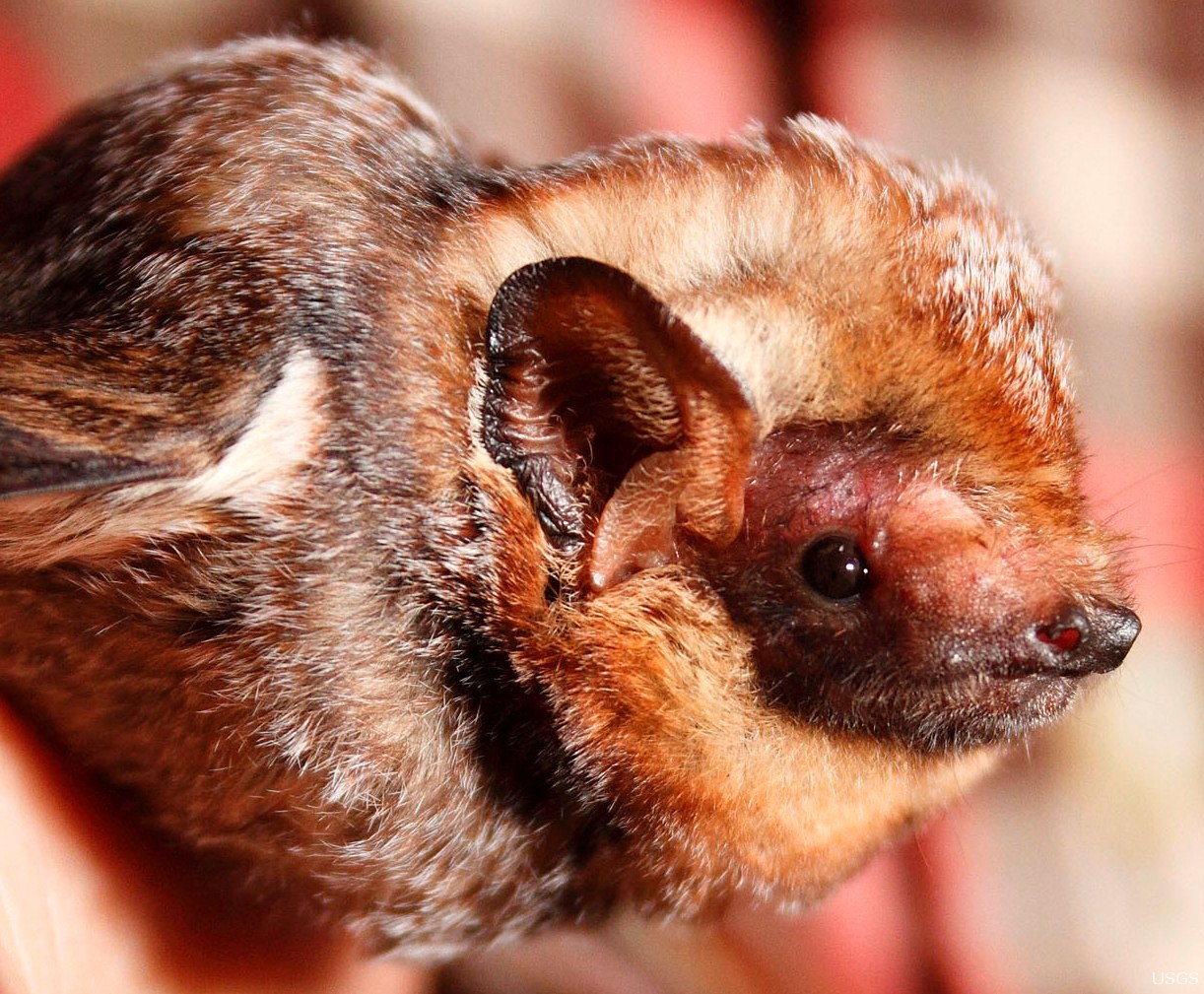
Size and markings, for the rare case someone gets a close look. Wingspan runs roughly 10.5 to 13.5 inches, about a foot, with a forearm of 50 to 57 millimeters. Weight is reported two ways by two reliable sources: 14 to 18 grams per Bat Conservation International, or a wider 20 to 38 gram range per the U.S. Fish and Wildlife Service. Females run larger than males. Fur is brown and gray, with individual hairs frosted white at the tips, the source of the hoary name. A distinctive yellowish brown collar sits under the chin, ears are yellowish and edged in black, and white patches mark the shoulders and wrists.
Two color populations
They are tied to two separate arrivals from the mainland. Hawaii's wildlife agency documents this directly: genetic dating suggests one colonization event roughly 10,000 years ago and a second roughly 600 years ago. The older population tends to run chestnut brown with less white frosting, while the more recently arrived population is more strongly frosted, closer in appearance to mainland hoary bats. This is a real, citable detail most general bat content does not carry.
Solitary and tree roosting
Not colonial and structural. The species roosts alone during the day, with the one exception of a mother roosting together with her dependent pups. It hunts at night by echolocation, with calls centered around 30 kilohertz, described as higher pitched and more variable than mainland hoary bat calls, over a very wide elevation range running from sea level to the 13,678 foot summit of Mauna Loa.
Signs of Infestation
Almost nothing to find at a house
Realistically, almost nothing to find around a house. This species does not roost in buildings, so it produces none of the guano accumulation, urine staining, rub marks, or attic noise that confirm a mainland bat colony. Hawaii's wildlife agency states the species is not documented roosting in human-made structures.
An actual sighting is the realistic sign
A bat seen in fast, erratic flight at dusk, most often near tree canopy, forest edges, or areas with concentrated flying insects, is the most likely way anyone notices this species. It is genuinely difficult to spot even for researchers, who rely on bat detectors that record echolocation calls above human hearing rather than visual sightings to survey for the species.
A grounded or injured bat, rarely
Because pups are flightless for weeks after birth and adults occasionally collide with structures or wind turbines, a bat found on the ground beneath a tall tree is the other realistic way a homeowner might encounter this species directly. That situation is covered under when to call a professional below, not under any home remedy.
Prevention and When to Call a Pro
Leave it alone, that is the answer
Do not remove, relocate, trap, or exclude this bat. Leaving it alone is the complete, correct answer. This is a federally and state endangered species. No DIY handling, capture, or exclusion of any kind is appropriate at any time. If you believe a bat is on your property, the entire practical answer is to leave the animal alone and, if it needs help, call the agency listed below.
Not a structural pest
This species is not a structural pest, so there is no building to exclude it from. Unlike mainland bats, there are no attic entries to seal, no one way doors to install, and no gap sealing checklist to follow, because Hawaii's own wildlife agency does not document this species roosting in a home, garage, or other structure. If you are dealing with an actual structural bat problem in Hawaii, you are very likely dealing with something other than this species, and professional wildlife assistance can confirm what you actually have before any work is planned.
The seasonal rule is about trees
The one real seasonal rule concerns tall trees, not buildings. Because non-volant pups roost with their mother in tree canopy from birth in mid to late June through late August or early September, state and federal guidance directs against trimming or removing woody plants taller than 15 feet during that window without first consulting a wildlife biologist. A pup too young to fly cannot escape a roost tree that is cut down or heavily trimmed during that period. If tall tree work on your property cannot wait outside that window, contact Hawaii's Division of Forestry and Wildlife or the U.S. Fish and Wildlife Service's Pacific Islands office first.
Rabies is not a concern here
Rabies is not a documented concern here, and that is worth stating precisely rather than defaulting to generic bat caution. The Centers for Disease Control and Prevention states directly that rabid bats are found in every U.S. state except Hawaii, and Hawaii's veterinary and public health community independently confirms the state is the nation's only rabies free state, maintained through its animal quarantine program. Ordinary common sense against handling any wild animal bare-handed still applies, but the specific rabies-exposure warning that applies to mainland bats does not carry over to this species, because the documented rabies risk it is based on does not exist in Hawaii.
If you find a grounded bat
What to do if you find a grounded or injured bat. Do not handle it. Contact Hawaii's Division of Forestry and Wildlife for guidance rather than attempting home rehabilitation, transport, or release yourself, since this is a protected species under both state and federal law.
Frequently Asked Questions
Is the Hawaiian hoary bat still an endangered species?
Yes. It has been federally listed as endangered since 1970. In 2021 federal officials announced they were considering a proposal to reclassify it as threatened, and a separate 2023 to 2024 sequence of paperwork briefly changed and then restored its official scientific name, but neither event changed its legal status. It remains endangered under both federal and Hawaii state law today.
Will I find a Hawaiian hoary bat roosting in my attic or garage?
Almost certainly not. Unlike mainland bat species, this bat is solitary and roosts alone in tree foliage, not in buildings. Hawaii's own wildlife agency states it is not documented roosting in a human-made structure of any kind.
Do I need to worry about rabies if I see a bat in Hawaii?
No documented rabies risk exists. The CDC states rabid bats are found in every U.S. state except Hawaii, which is maintained as the nation's only rabies free state through its animal quarantine program. Ordinary caution against handling any wild animal still applies, but the rabies-specific warning that applies to bats elsewhere in the country does not apply here.
Can I trim or remove a tall tree on my property if bats might be roosting in it?
Time it carefully. State and federal guidance directs against trimming or removing woody plants taller than 15 feet between June 1 and September 15, when flightless pups may be roosting in the canopy with their mother and cannot escape if the tree is disturbed. Outside that window, or if the work cannot wait, check with Hawaii's Division of Forestry and Wildlife or the U.S. Fish and Wildlife Service first.
What should I do if I find an injured or grounded bat in Hawaii?
Do not handle it yourself. This is an endangered, protected species under both state and federal law. Contact Hawaii's Division of Forestry and Wildlife for guidance, either the statewide line or the downed wildlife contact for your island, rather than attempting to help the animal on your own.
Sources
- Endangered and Threatened Wildlife and Plants; Technical Corrections for 62 Wildlife and Plant Species; Hawaiian Hoary Bat; Correction (confirms current listing: Lasiurus cinereus semotus, Endangered, listed 10/13/1970, wherever found) U.S. Fish and Wildlife Service, Federal Register
- Species Profile for Hawaiian hoary bat (Lasiurus cinereus semotus) U.S. Fish and Wildlife Service, Environmental Conservation Online System
- 'Ope'ape'a, the Hawaiian Hoary Bat: life cycle, roost habitat, tree-trimming guidance, state endangered listing Hawaii Department of Land and Natural Resources, Division of Forestry and Wildlife
- 'Ope'ape'a or Hawaiian hoary bat, 2025 State Wildlife Action Plan Terrestrial Mammal fact sheet Hawaii Department of Land and Natural Resources
- Multi-scale assessment of roost selection by 'ope'ape'a, the Hawaiian hoary bat (Lasiurus semotus) PLOS One, peer-reviewed
- Rabies in the United States: Protecting Public Health (rabid bats found in all U.S. states except Hawaii) Centers for Disease Control and Prevention
- Hawaiian Hoary Bat species data sheet Bat Conservation International
- Contact Us, Division of Forestry and Wildlife (downed and injured wildlife contacts) Hawaii Department of Land and Natural Resources
Image Credits
- Image: Frank Bonaccorso, USGS via Wikimedia Commons. Public domain.
License.