Seasonal Timeline
Active through the warm season, mating in spring from April into June and giving birth to live young rather than laying eggs, with litters arriving late summer into early fall, typically August and September. It overwinters in bank burrows, crayfish burrows, rock ledges, levees, and old stumps, and Virginia records note individuals basking on unusually warm winter days.
Active through the warm season, mating in spring from April into June and giving birth to live young rather than laying eggs, with litters…
The daily schedule shifts with the calendar. This snake is active both day and night, and several state sources note a swing toward more nocturnal activity through the hottest stretch of summer, with daytime basking more typical in the cooler shoulder months. Long-term Virginia data shows active snakes running noticeably cooler in body temperature, roughly 13 to 24.6 degrees Celsius across March through October, than snakes resting under boards and rocks in summer at 26 to 31.6 degrees. The practical reading is the same one that applies to most watersnakes: a midday sighting is most likely in spring and fall, and a midsummer encounter is as likely at dusk or after dark.
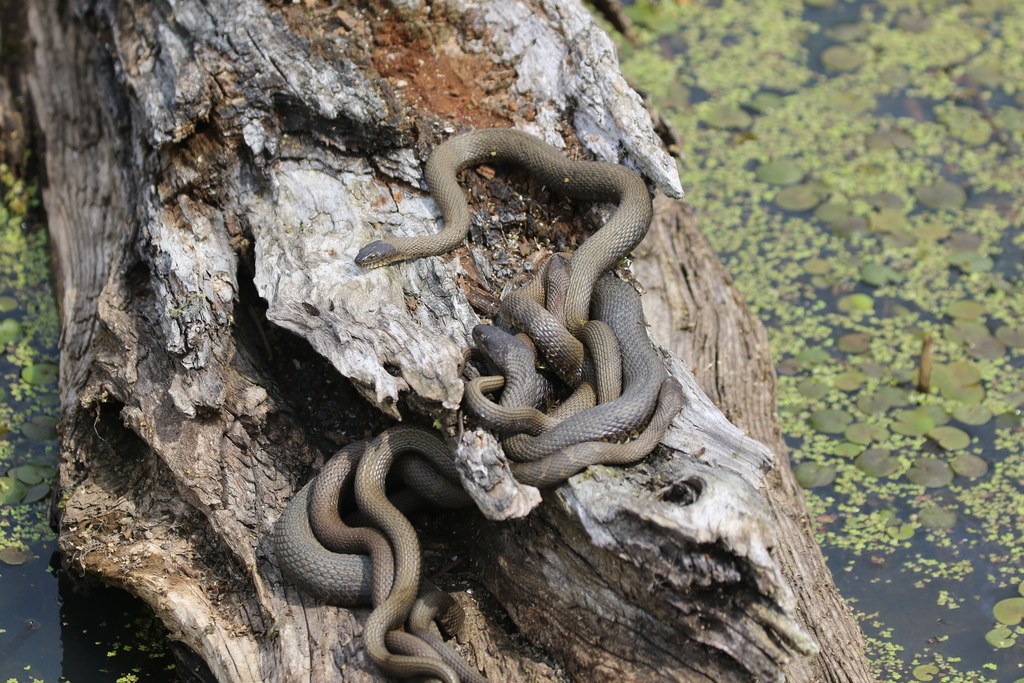
Spring and fall are also the only times this otherwise solitary snake is social. Animal Diversity Web describes individuals sunning themselves in heaps, knots, and snarls at shared basking sites after overwintering, which is exactly the sight that makes a property owner think a pond has been overrun. One breeding cycle follows per year, and by August and September newborns roughly 6 to 10 inches long are working the same bank edges, ditches, and dock pilings the adults have used all summer.
Where They're Found
This snake ranges widely across the eastern and central United States, through the Midwest, the Northeast, the Southeast, and the South Central states. In the Midwest, Missouri's Department of Conservation states its two subspecies occur statewide, the Illinois Natural History Survey documents it statewide in Illinois with both subspecies present, and Wisconsin's Department of Natural Resources profiles it directly. The University of Michigan's Animal Diversity Web places the species from Nebraska and Kansas east through the Great Lakes region, and California's own state wildlife agency describes the same native boundary independently, which puts Kansas and Nebraska inside the range as well. Indiana, Iowa, North Dakota, and South Dakota sit inside that same contiguous range description rather than being separately confirmed state by state, so treat those four as inside the range but not individually verified.
In the Northeast, the northern watersnake appears in New York's Department of Environmental Conservation State Wildlife Action Plan reptile documentation, Pennsylvania's fish and boat agency describes it as found throughout that state, and Maine carries a documented, disjunct population studied specifically for its habitat and climate limits. The remaining northeastern states sit within that broadly cited range without a state-by-state confirmation.
In the Southeast, the Virginia Herpetological Society documents verified records in 95 counties and 18 cities statewide. North Carolina's Wildlife Resources Commission places it in the salt marshes of the Outer Banks as well as the Coastal Plain, the Piedmont, and the mountains. The University of Georgia's Savannah River Ecology Laboratory reports it restricted to the Piedmont and mountains in Georgia and South Carolina. Alabama's Department of Conservation and Natural Resources calls the midland form common statewide except the southernmost Coastal Plain, and the most frequently encountered water snake in the northern two thirds of the state. Florida's population is real but narrow: the Florida Museum of Natural History confirms the midland form only in the western Panhandle, with verified records limited to Escambia, Holmes, Okaloosa, Santa Rosa, and Walton counties. Mississippi appears only in a secondary source, so its record stays unconfirmed.
In the South Central region, Tennessee's Wildlife Resources Agency states this is the most common watersnake in Tennessee and that it occurs statewide, adding that it is frequently killed by people who mistake it for a cottonmouth or copperhead. The University of Kentucky states it occurs throughout Kentucky. The Arkansas Herpetological Atlas documents 903 records across 59 of Arkansas' 75 counties, common in the Interior Highlands and patchier in the South Central Plains and Mississippi Alluvial Plain. Oklahoma's wildlife department describes it as commonly seen in state waterways, though on lighter sourcing than a full field guide entry. No state agency or comparable source confirms Louisiana or Texas.
California, Alaska and Hawaii sit outside the native range. California has a real, established, breeding population, and California's own Department of Fish and Wildlife runs an active invasive species profile for it, confirming reproduction in Kaseberg Creek in Roseville, Placer County since 2007 with a second breeding site found in 2014, while stating the species does not naturally occur west of the Rocky Mountains. That is an introduction, not native range. Alaska and Hawaii have no population at all, native or introduced, and no range description places the species outside the eastern and central continental United States and southern Ontario.
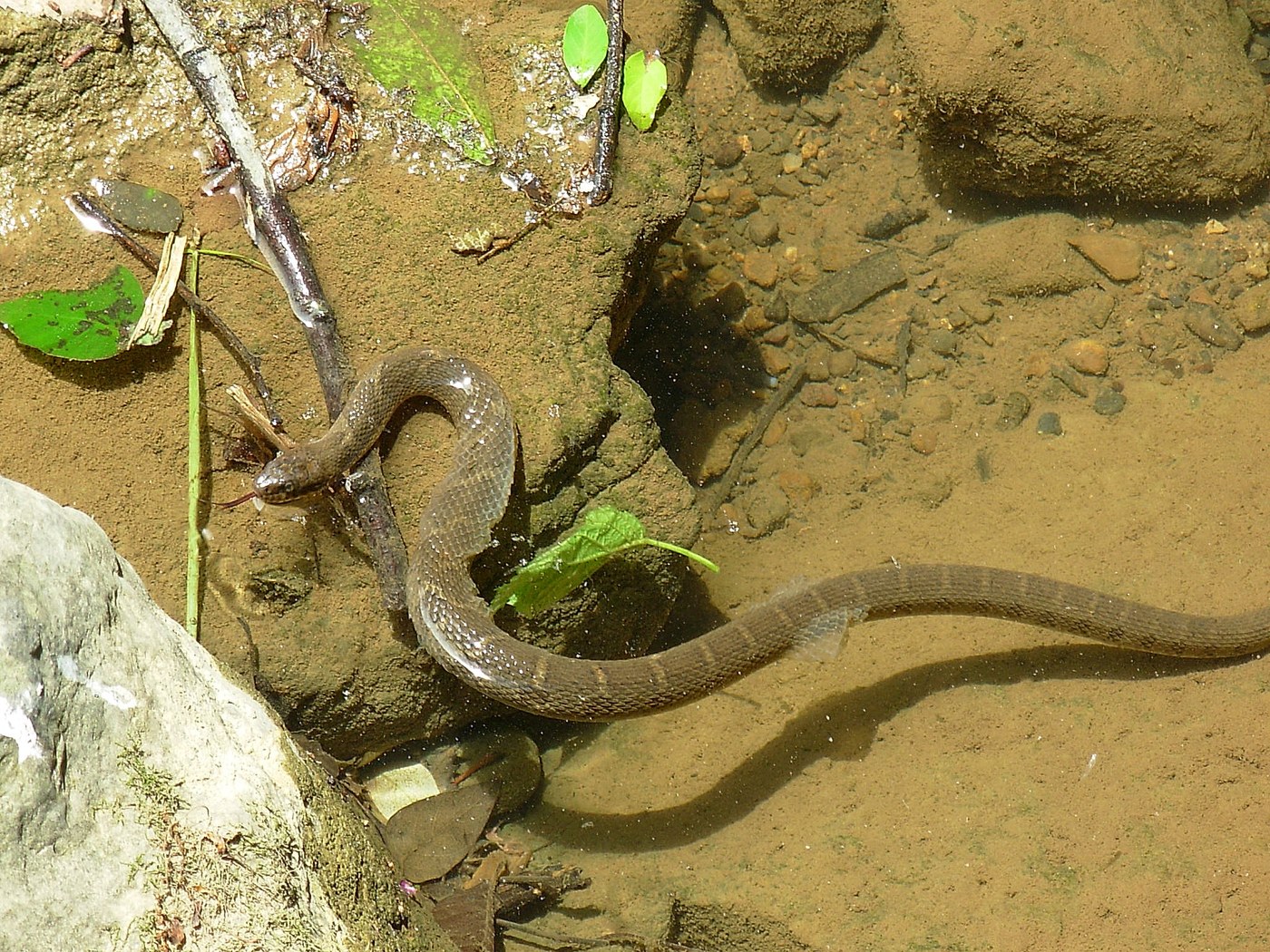
On a specific property, expect it anywhere there is water. Tennessee's Wildlife Resources Agency calls it a habitat generalist found in every type of water body, and the species is documented in rivers, lakes, ponds, streams, sloughs, marshes, bogs, swamps, roadside ditches, drainage impoundments, temporary pools, and low-salinity brackish tidal marshes. It basks on logs, rocks, docks, and branches overhanging water, and hides under flat rocks, boards, and logs near the shoreline. It never enters a building. The realistic complaint is a snake in a pool, on a dock, in a ditch, or in a damp yard corner next to water.
Related Pests
Life Cycle
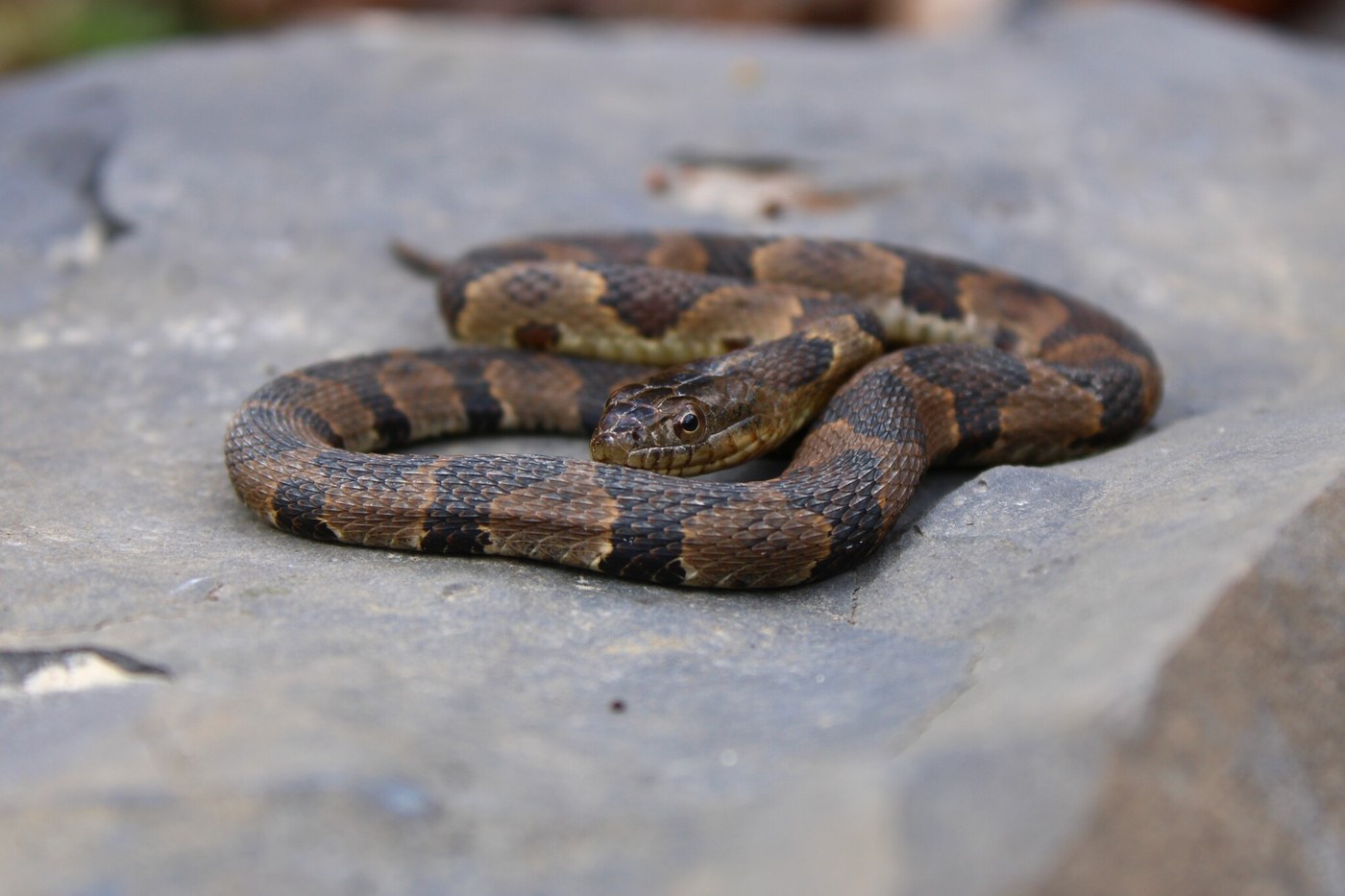
The pattern that identifies this snake is the pattern it loses. A young or freshly wet northern watersnake wears readable dark crossbands close together near the head that break into alternating square blotches down the back and sides, sometimes described as a checkerboard past the front third of the body. Older individuals darken toward solid brown or black, and a dry old adult can read as a plain dark animal at the water's edge. That is the appearance that keeps getting called a cottonmouth. When pattern stops working, the pupil shape, the missing facial pit, and the belly half-moons are what remain.
Mating/courtship2

Gestation
Neonate/birth3
Juvenile
Adult
Identification
There is no venom here
That is not a hedge. The northern watersnake, also called the common watersnake, is completely non-venomous. There is no venom risk, no disease-vector risk, and no allergen risk from this snake. Everything below is about telling it apart from snakes that do carry venom.
Pupils and pit rule out cottonmouth
Check the pupils and look for a facial pit. This is the cleanest cottonmouth ruling available. A watersnake has round pupils and no heat-sensing pit. A cottonmouth has vertically elliptical, cat-like pupils and a facial pit sitting between the nostril and the eye. Copperhead, named as a second source of confusion by Tennessee's Wildlife Resources Agency and the Illinois Natural History Survey, fails the same two checks. No watersnake of any kind has a facial pit.
Watch what the dark markings do
Follow them along the body. On this species, dark crossbands run close together near the head and then break up around midbody into alternating square or rectangular blotches down the back and sides. A cottonmouth's broad crossbands run the full length of the body without breaking into blotches. That change partway down the body is the single most useful pattern tell available from a distance.
The belly, given a clean view
Look at the belly if you get a clean view of one. The belly is cream, yellow, or white, marked with reddish, orange, or black half-moon shaped spots. Cottonmouths lack those belly markings entirely. Within the genus, the Virginia Herpetological Society uses the same detail to separate this species from the plain-bellied watersnake, which as an adult has a uniformly brown back and a plain red belly, and from the brown watersnake, whose blotches run the entire body length rather than starting as bands and breaking later.
Head shape and build, used carefully
This is a heavy-bodied snake with strongly keeled, rough-textured scales, a divided anal plate, and a head only slightly wider than the neck. A cottonmouth has a large, angular head distinctly wider than its neck. Heft alone proves nothing. A big, thick-bodied snake at a pond edge alarms people, and size says nothing at all about whether an animal is dangerous.
Size runs wider than most people expect
Adults typically measure 24 to 55 inches, with most state agencies giving a 24 to 42 inch working range and Virginia's herpetological society recording a 55.3 inch maximum. Newborns are roughly 6.2 to 10 inches. Color is highly variable, running gray, tan, brown, or reddish-brown and darkening toward solid brown or black in older animals, so treat color as supporting detail rather than as the deciding factor.
Names do not change the animal
Subspecies and alternate names do not change the animal. Four subspecies are recognized, and the two most homeowners meet differ mainly in marking count: the nominate northern form runs more than 30 crossbands and blotches, and the midland form fewer than 30, per both the Illinois Natural History Survey and Tennessee's Wildlife Resources Agency. The same snake is called common watersnake by most state agencies, midland watersnake across much of Tennessee, Alabama, southern Illinois, southeastern Missouri, the Florida Panhandle, and parts of Arkansas and Georgia, and Lake Erie watersnake on the Lake Erie islands. Older regional vernacular includes moccasin, mud moccasin, water adder, and water viper, none of which points to a venomous animal.
Signs of Infestation
Nothing structural to find
There is nothing structural to find, because this is not a structural pest. No published account describes this species entering a building. It does not chew, gnaw wiring, burrow into a foundation, or den in living space. There is no droppings pattern, no entry hole, and no gnaw damage to look for. The sign is the snake, and the only question worth answering is whether it was identified correctly.
The same snakes do reuse a spot
If it looks like the same snakes keep using the same spot, that is because they do. A peer-reviewed 20-year study published in Ecology and Evolution followed 13,800 individually marked Lake Erie watersnakes, an island subspecies of this same species, across 14 sites. Of the snakes recaptured, 99.4 percent turned up back at their original study site rather than somewhere new. A separate study of mainland northern watersnakes along an urban stream found snakes returning to previously used locations 56 percent of the time when they moved at all, with females showing significantly stronger site fidelity than males. These animals are not wandering through. They come back to the log, the rock ledge, or the dock piling that works.
Local density can be extreme
Local density can be genuinely extreme, and that is a real finding rather than an impression. The same 20-year island study measured that population averaging 520 adults per kilometer of shoreline, roughly 260 per hectare. That figure describes an island population under study conditions, not a typical backyard pond, but it establishes the ceiling: when habitat, prey, and basking structure all line up in one place, this species stacks up in numbers most people would find hard to believe. It is also why a spring or fall sighting of several snakes together at one bank is normal behavior at a good site, not an infestation spreading.
Basking, and groups are seasonal
Basking is the sighting, and groups are seasonal. The ordinary encounter is a heavy-bodied snake stretched out on a bank, dock, rock, or branch overhanging water. Animal Diversity Web notes the species is solitary through most of the active season and social only in fall and spring around overwintering, when individuals can be found sunning themselves in heaps, knots, and snarls at shared sites. Shed skins under bankside cover or along the water's edge indicate a snake using the area, not an infestation.
A real smell sign, unusually
There is a real smell sign here, which is unusual for a snake. Handled or captured, this species releases a foul-smelling musk from paired glands at the base of the tail, often along with feces, documented independently by Wisconsin's Department of Natural Resources, Missouri's Department of Conservation, and Tennessee's Wildlife Resources Agency. If you can smell it, someone has already picked up the snake, which is the part of the encounter worth preventing.
Repeats say something about the water
Repeat sightings usually say something about the water, not about a problem. This snake eats fish, frogs, toads, tadpoles, and salamanders, and also takes crayfish, large insects, leeches, other snakes, turtles, birds, and small mammals. Missouri's Department of Conservation notes it cannot catch healthy game fish, only diseased, dying, or injured ones, and that it readily scavenges cleaned-fish carcasses discarded by anglers. It is not a constrictor. Prey is seized in the jaws and swallowed alive. A pond that keeps producing watersnake sightings is a pond that holds plenty of prey.
No sound sign is worth acting on
No distinctive sound-based sign has been documented for this species. An undisturbed watersnake is silent, and nothing you hear at a pond edge identifies which snake you are dealing with.
Prevention and When to Call a Pro
Leave it alone
Nearly the whole risk disappears. The Florida Museum of Natural History's account of the midland form describes this species as not aggressive, avoiding people and pets, with virtually all bites occurring only when the snake is intentionally molested. A watersnake given room to leave will take it. Distance is the entire strategy.
Do not handle or corner it
Do not handle, corner, or try to capture it, and understand why. The Virginia Herpetological Society states this species almost always bites repeatedly when captured, especially adults, with teeth adapted for holding struggling fish that can inflict a minor wound. Missouri's Department of Conservation states it will bite viciously and smear a foul-smelling musk if captured. There is no venom, so a bite is a wound rather than an envenomation, but it is a real wound, and it happens almost exclusively to people who reached for the animal.
Never identify one by handling
Never settle the identification by handling the snake. Telling a watersnake from a venomous look-alike in the field is a documented failure point even in states where no venomous look-alike lives. Wisconsin's Department of Natural Resources says cottonmouths do not occur anywhere near Wisconsin and that this snake is mistaken for one and killed anyway. The Illinois Natural History Survey documents the same killing hundreds of miles north of where cottonmouths actually live. Ohio's wildlife agency states cottonmouth does not occur in Ohio at all. Uncertainty is not a reason to be careful with your hands. It is a reason to keep them out of it.
There is no exclusion work
The snake was never trying to get in. This species does not respond to sealed entry points the way a rodent or an insect does. What it responds to is water that holds fish and amphibians. Reducing easy basking structure right at a pond or pool edge, meaning piled debris and low branches hanging directly over the water, can make one specific spot less attractive without touching the water feature itself.
It came on its own
A snake in the pool, on the dock, or in a wet yard corner came on its own. It arrived chasing prey or looking for a place to bask, not because the property has an infestation. The safest response is the same every time: give it room and let it leave, or call a wildlife control professional. Do not attempt removal by hand.
Check your state rule first
Check your own state's rules before doing anything to this snake. The University of Georgia's Savannah River Ecology Laboratory states this species is protected throughout the state of Georgia, and Georgia's Department of Natural Resources confirms the same statewide protection for native non-venomous snakes on its own public snake-safety page. That is one real state example, not a national rule. Separately, the Lake Erie watersnake subspecies was once federally listed as Threatened under the Endangered Species Act before being recovered and delisted in 2011, while the species as a whole carries no comparable federal status. No other state publishes a reporting requirement, bag limit, trapping season, or possession permit specific to this species. Rules on trapping, handling, and relocating native wildlife vary by state and change over time, so verify the current rule where you live before assuming any example applies to you.
When to Call a Wildlife Control Operator
Call a licensed nuisance wildlife control operator or your state wildlife agency for any snake near water you cannot confidently rule out as a cottonmouth or copperhead, and for a confidently identified watersnake repeatedly basking at a pool, dock, or other high-traffic waterfront spot where an accidental encounter is likely. A licensed operator is the safer default over a do-it-yourself trap, both because trapping and relocation may be regulated where you are and because the identification question gets answered by someone qualified to answer it. Clean and watch any bite as you would any other puncture wound, and get medical care if it shows increasing redness, swelling, warmth, or pus instead of healing. If there is any chance at all the snake was venomous, treat the bite as an emergency and call 911 rather than waiting to settle the identification.
Frequently Asked Questions
Is a northern watersnake dangerous?
No. It carries no venom and poses no disease risk. It will bite defensively and readily if it is handled or cornered, and the bite can draw blood, because the teeth are adapted for holding struggling fish. The Virginia Herpetological Society describes adults as almost always biting repeatedly when captured, and Missouri's Department of Conservation says the same in blunter terms. That is a wound, not an envenomation, and it is not medically dangerous. The Florida Museum of Natural History describes the species as not aggressive, avoiding people and pets, with virtually all bites occurring only when the snake is deliberately bothered.
How can I tell a northern watersnake from a cottonmouth?
Look at the head and the eye. A cottonmouth has a heat-sensing pit between the eye and the nostril, vertically elliptical cat-like pupils, and a large angular head distinctly wider than the neck. A watersnake has round pupils, no facial pit, and a head only slightly wider than its neck. There is a second tell on the body: a cottonmouth's broad crossbands run the full length of the animal, while this species' crossbands break up around midbody into alternating square blotches. The belly settles it too, since a watersnake carries reddish, orange, or black half-moon spots that a cottonmouth does not have.
I don't have cottonmouths where I live. Why does everyone say this is a cottonmouth?
Because the misidentification happens whether or not a cottonmouth lives anywhere nearby. Wisconsin's Department of Natural Resources states that cottonmouths do not occur anywhere near Wisconsin and that this snake is mistaken for one and killed anyway. Ohio's wildlife agency states that cottonmouth does not occur in Ohio at all. The Illinois Natural History Survey documents residents killing this species hundreds of miles north of where cottonmouths actually live. The University of Kentucky notes cottonmouths are confined to western Kentucky while this snake occurs statewide. The fear tracks the silhouette of a dark, thick-bodied snake near water, not the venomous snake's range.
Why are there so many watersnakes in one spot along my pond or shoreline?
Because this species returns to the same basking sites rather than wandering. A peer-reviewed 20-year study of 13,800 marked Lake Erie watersnakes, an island subspecies of this same species, found 99.4 percent of recaptured snakes back at their original site, and measured that population averaging 520 adults per kilometer of shoreline. Those island numbers are not what a typical backyard pond holds, but the behavior transfers: a spot with good basking structure, cover, and prey gets used again and again by the same animals. In spring and fall you may also see several sunning together in a heap near an overwintering site, which is normal seasonal behavior rather than a spreading problem.
Are northern watersnakes protected?
It depends on the state. Georgia protects all native non-venomous snakes by state law, including this species, confirmed both by Georgia's Department of Natural Resources and by the University of Georgia's Savannah River Ecology Laboratory. The Lake Erie watersnake subspecies was also once federally listed as Threatened before being recovered and delisted in 2011. No other state publishes a specific protection, bag limit, trapping season, or permit requirement for this species. Check your own state and local rules before trapping or relocating any native snake, and route anything you are unsure about to a licensed nuisance wildlife control operator.
Sources
- Northern Watersnake species account: range restricted to Piedmont and mountains in Georgia and South Carolina, identification, and statewide Georgia protection University of Georgia Savannah River Ecology Laboratory Herpetology Program
- Kentucky Snake Identification, Common or Northern Watersnake: statewide Kentucky range, litter size averaging 20 to 30, and cottonmouth confined to western Kentucky University of Kentucky Department of Forestry and Natural Resources, Martin-Gatton College of Agriculture, Food and Environment
- INHS Herpetology Collection, Nerodia sipedon: statewide Illinois range, crossband counts by subspecies, juveniles patterned as adults, and killings hundreds of miles north of cottonmouth range Illinois Natural History Survey, University of Illinois
- Common Watersnake species profile: coloration, belly half-moons, musk, and the statement that cottonmouths do not occur anywhere near Wisconsin Wisconsin Department of Natural Resources
- Field Guide, Northern Watersnake and Midland Watersnake: statewide Missouri range, litter size 6 to 99 averaging 27, maturity, overwintering sites, diet, and defensive biting with musk Missouri Department of Conservation
- Northern Watersnake species page: most common watersnake in Tennessee occurring statewide, habitat generalist, crossband counts, and killing over cottonmouth and copperhead confusion Tennessee Wildlife Resources Agency
- Northern Watersnake species profile: Outer Banks salt marshes, Coastal Plain, Piedmont, and mountains of North Carolina North Carolina Wildlife Resources Commission
- Outdoor Alabama, Midland Water Snake: common statewide except the southernmost Coastal Plain, and the most frequently encountered water snake in the northern two thirds of Alabama Alabama Department of Conservation and Natural Resources
- California's Invaders, Northern Watersnake: native range description, and an established introduced breeding population in Kaseberg Creek, Placer County California Department of Fish and Wildlife
- Nerodia sipedon, Northern Water Snake: courtship behavior, litter size 4 to 99, maturity ages, captive lifespan, diet, and social basking in heaps, knots, and snarls Animal Diversity Web, University of Michigan Museum of Zoology
- Sunning themselves in heaps, knots, and snarls: the extraordinary abundance and demography of island watersnakes, Ecology and Evolution 8(15):7500-7521, a 20-year mark-recapture study of 13,800 Lake Erie watersnakes reporting 520 adults per kilometer of shoreline and 99.4 percent site fidelity King, R.B., Stanford, K.M., et al., via PubMed Central, U.S. National Library of Medicine
- Northern Watersnake species account: verified records in 95 counties and 18 cities, record length of 55.3 inches, mating dates, body temperature data, and defensive biting Virginia Herpetological Society
- Florida Snake ID Guide, Midland Watersnake: western Panhandle range limited to five counties, juveniles colored as adults, and the species described as not aggressive with virtually all bites occurring when intentionally molested Florida Museum of Natural History, University of Florida
- Nerodia sipedon pleuralis, Midland Watersnake: 903 Arkansas records across 59 of 75 counties, common in the Interior Highlands Herps of Arkansas, Arkansas Herpetological Atlas
- What To Do When You See A Snake: Georgia's native non-venomous species are protected by state law Georgia Department of Natural Resources