Seasonal Timeline
Both species are active through the warm season, mating in spring around April and May and giving birth to live young rather than laying eggs. Banded watersnake litters typically arrive July through September, and brown watersnake litters arrive from late summer into early fall. Missouri's state wildlife agency documents the broad-banded watersnake overwintering in mammal burrows, under rock ledges, and beneath tree stumps or logs, sometimes well away from water.
Both species are active through the warm season, mating in spring around April and May and giving birth to live young rather than laying…
The daily schedule differs between the two, and it shifts with the calendar. Banded watersnake is active both day and night, foraging in the shallows and basking on logs and branches over water. Brown watersnake moves with the season: the Florida Museum of Natural History describes it as diurnal in spring and fall, then more nocturnal through the hottest stretch of summer, and Missouri's Department of Conservation reports the same seasonal swing for the broad-banded watersnake. The practical reading is that a daytime sighting is most likely in the cooler shoulder months, and a midsummer sighting is as likely to happen at dusk or after dark.
Breeding puts a bump in the late-season encounter rate. Males gather around a female and compete to court her in spring, and one litter follows per year. By July, and running into early fall, newborn watersnakes under roughly 10 inches long are working the same pond edges, ditches, and river banks the adults have used all summer, during the weeks people are still fishing, mowing, and boating.
Where They're Found
The two species overlap heavily in the Southeast, and only one of them ranges west and north of it. In the Southeast, both are present. The University of Georgia's Savannah River Ecology Laboratory places banded watersnake along the Coastal Plain from southwest Alabama to North Carolina, present throughout Georgia and South Carolina except the mountainous northwestern corners, and it is found throughout mainland Florida except the Keys. The same source places brown watersnake along the Coastal Plain and Piedmont from southern Virginia south through all of Florida, also throughout Georgia and South Carolina except those same mountain corners. Mississippi turns up in secondary range lists for banded watersnake's westernmost subspecies, but no state agency or university source confirms it, so treat Mississippi as an unconfirmed lead rather than a documented state.
West and north of the Southeast, it is banded watersnake alone. Its broad-banded subspecies is documented across the full South Central region, one state-level or university source at a time: Oklahoma's Department of Wildlife Conservation profiles it directly in the state field guide, the Arkansas Herpetological Atlas documents it as a resident species, Louisiana's Department of Wildlife and Fisheries calls it common to abundant, Tennessee's Wildlife Resources Agency names it as a similar in-state species on its own northern watersnake page, the University of Kentucky's snake identification resource confines it to extreme western Kentucky, and the City of Sugar Land, Texas describes it living throughout the eastern and southeastern regions of that state. In the Midwest, Missouri's Department of Conservation places it mainly in the Mississippi Alluvial Basin of southeastern Missouri, common within the wetland habitat that remains there. Brown watersnake does not follow it into either region. The Savannah River Ecology Laboratory states that brown watersnake is replaced by the diamondback watersnake west of eastern Alabama, which keeps it out of the Midwest entirely. Alaska and Hawaii have no population of either species, and every range description found confines both to the southeastern and south-central continental United States. An introduced, non-native banded watersnake population was documented in the Los Angeles suburbs of California, where more than 300 were removed by a dedicated task force in 2009. That is an introduction, not native range.
On a specific property, habitat splits along diet. Banded watersnake will use nearly any fresh water: ponds, lakes, rivers, streams, swamps, wetlands, marshes, roadside ditches, and, per Missouri's own field guide, drainage ditches and yards that get watered regularly, because regular watering draws the frogs and toads it eats. Brown watersnake is pickier. It feeds almost entirely on fish, especially small catfish, so it stays with flowing water and permanent water bodies that hold a stable fish population: rivers, canals, blackwater cypress creeks, and large reservoirs. The Savannah River Ecology Laboratory notes that it moves less over land than banded watersnake and is seldom seen far from the water's edge. Neither species enters a building. The realistic indoor complaint is a snake in a pool, on a dock, in a boat, or in a low wet corner of a yard next to water.
Life Cycle
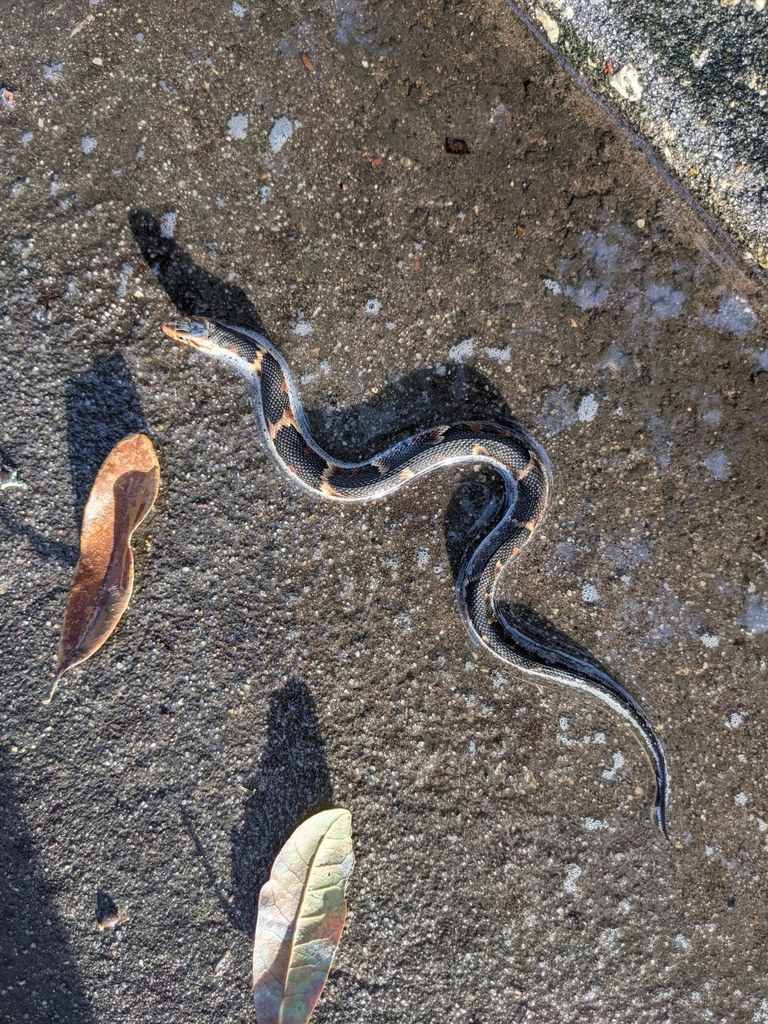
The banded watersnake gets harder to identify as it ages, and the brown watersnake does not. A young banded watersnake wears sharp, well-separated crossbands that are easy to read and easy to rule against a cottonmouth. Those bands fade. Old individuals darken until the pattern is faint or gone and the snake reads as a plain dark animal at the water's edge, which is the exact appearance that keeps getting called a cottonmouth. Brown watersnake takes the opposite path, carrying adult coloring from birth, so its checkerboard blotches stay readable for life. When pattern stops working on an old banded watersnake, the pupil and facial pit check below is what remains.

Mating/courtship
Gestation
Neonate/birth
Juvenile2
Adult
Identification
Neither species has venom
That is not a hedge. Banded watersnake and brown watersnake are both completely non-venomous. There is no venom risk, no disease-vector risk, and no allergen risk from either one. Everything below is about telling them apart from a snake that does carry venom, and from each other.
Pupils and pit rule out cottonmouth
Check the pupils and look for a facial pit. This is the cleanest cottonmouth ruling available. A watersnake has round pupils. A cottonmouth has vertically elliptical, cat-like pupils. A cottonmouth also has a heat-sensing facial pit sitting between the nostril and the eye, and no watersnake has one. There is a second half to the same check that works from a safer angle: viewed from directly above, a cottonmouth's eyes cannot be seen at all, while a watersnake's round eyes stay visible from a top-down view. Both tells come from the Florida Museum of Natural History's identification guide, and neither requires getting close enough to judge how triangular a head looks.
Crossbands or checkerboard
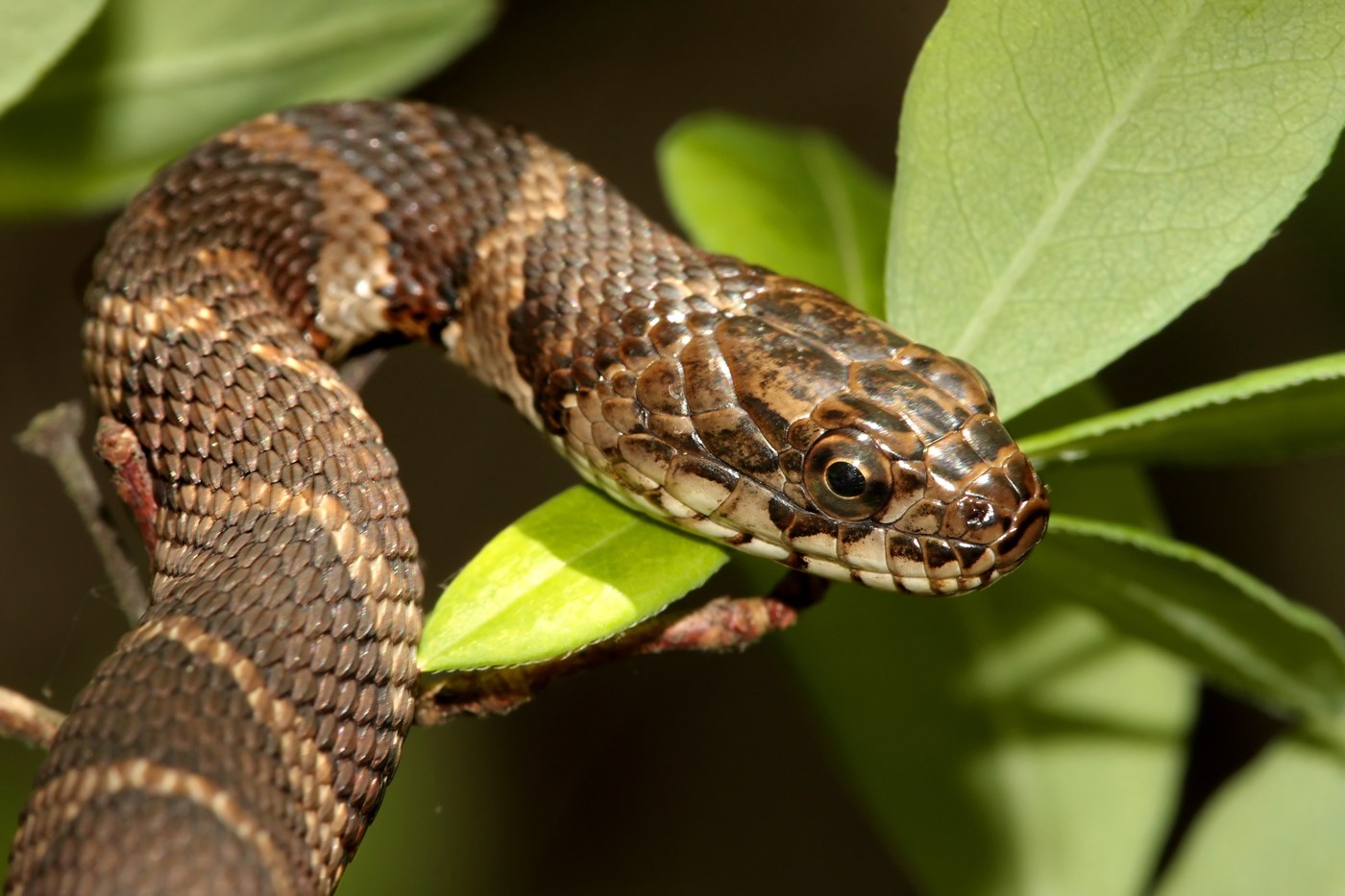
Crossbands mean banded. Squarish blotches in a checkerboard mean brown. This is the tell that separates the two species from each other, and it is the wording Florida's own state wildlife agency uses. Banded watersnake carries true crossbands, broad across the back and narrowing down the sides, sometimes breaking into blotches toward the tail. Brown watersnake carries large, squarish dark blotches running the full length of the body in three parallel rows, one down the spine and two alternating along the sides, which reads as a checkerboard rather than as banding.
Brown watersnake has a narrow head
The eyes sit high and forward. The Savannah River Ecology Laboratory describes its head as visibly narrower than that of other watersnakes in its region, with the eyes placed high on the head and close to the tip of the nose. The Florida Museum of Natural History separately describes that head as large and distinct from the neck, with round pupils. Between the head shape and the blotch pattern, brown watersnake is the more distinctive of the two once you know what to look at.
Color is a weak tell alone
Color is variable enough that it is a weak tell on its own. Banded watersnake runs light brown, reddish, gray, yellow, tan, or nearly black, with dark crossbands that may be brown, black, or red and are often black-bordered, plus a dark stripe running from the eye to the corner of the jaw. Brown watersnake runs light tan through light or dark brown, with a light belly marked by brown splotches and black crescent or half-moon shapes. Use pattern shape and pupil shape first, and treat color as supporting detail.
Size proves nothing about venom
Size separates them at the top end but proves nothing about venom. Brown watersnake is the larger species, roughly 30 to 60 inches for adults with records above 69 inches, which makes it one of the largest watersnakes in North America. Banded watersnake typically runs 22 to 48 inches, with a record of 62.5 inches. Females of both species are larger and heavier-bodied than males. A big, thick-bodied snake at the water's edge alarms people, and heft says nothing at all about whether an animal is dangerous.
Shared genus traits, several names
Both share the genus traits, and both answer to several names. Banded and brown watersnakes both have strongly keeled, rough-textured scales and a divided anal plate, typical of the genus Nerodia. Banded watersnake is also called southern watersnake and, for its Florida subspecies, Florida watersnake, while the form found across Missouri, Oklahoma, Arkansas, Louisiana, Kentucky, and west Texas is called broad-banded watersnake. Brown watersnake appears as both brown watersnake and brown water snake. None of these names points to a different animal, and none of them changes the fact that the snake has no venom.
Signs of Infestation
Nothing structural to find
There is nothing structural to find, because neither species is a structural pest. No published account describes either snake entering a building. They do not chew, gnaw wiring, burrow into a foundation, or den in living space. There is no droppings pattern, no entry hole, and no gnaw damage to look for. The sign is the snake, and the only question worth answering is whether it was identified correctly.
With brown watersnake, look up
This is a proficient climber, documented basking on branches and snags as high as 20 feet above the water. That habit produces the single most alarming thing either species does. Startled by an approaching boat, a basking brown watersnake drops straight down to escape into the water, and sometimes lands in the boat instead. It is a documented behavior recorded by the Savannah River Ecology Laboratory, the Florida Museum of Natural History, and a North Carolina herpetology reference independently. The snake is not attacking the boat. It is falling into it.
For the banded one, watch wet ground
With banded watersnake, look at wet ground and at the irrigation. Missouri's Department of Conservation specifically notes broad-banded watersnakes turning up in drainage ditches and in yards that are watered regularly, because the watering draws the frogs and toads the snake follows. A snake at a pond, lake, stream, swamp, marsh, or roadside ditch edge, coiled on a bank or a log, is the ordinary sighting.
A real smell sign, unusually
There is a real smell sign here, which is unusual for a snake page. Handled or captured, both species release a foul-smelling musk from paired glands at the base of the tail, often smeared on the handler along with feces. Missouri's Department of Conservation and the Savannah River Ecology Laboratory document it independently. If you can smell it, someone has already picked up the snake, which is the part of the encounter worth preventing.
A buzz identifies nothing
A buzzing sound in leaf litter identifies nothing. Cornered banded watersnakes, both juveniles and adults, rapidly vibrate the tail tip against leaf litter and produce an audible buzz, per the Florida Museum of Natural History. Plenty of harmless snakes do the same thing, and this species has no rattle. Treat the sound as a snake that is frightened, not as evidence of which species it is.
Shed skins at the water's edge
They are a routine sign. Shed skins under bankside cover or along the water's edge are common to both species and indicate a snake using the area, not an infestation. Repeat sightings at a pond or river usually mean the water holds plenty of fish, frogs, and crayfish, which is an observation about the habitat rather than a pest problem.
Prevention and When to Call a Pro
Leave it alone
Nearly the whole risk disappears. The Florida Museum of Natural History frames both species as not aggressive, avoiding people and pets, with virtually all bites happening only when the snake is intentionally molested. A watersnake given room to leave will take it. Distance is the entire strategy.
Do not handle or corner either one
Do not handle, corner, or try to capture either species, and understand why. Missouri's Department of Conservation states that the broad-banded watersnake will bite viciously and smear foul-smelling musk if captured, and calls the genus pugnacious when cornered. The Savannah River Ecology Laboratory states that brown watersnakes do not hesitate to strike if cornered and can inflict a painful bite. Neither snake has venom, so the bite is a wound rather than a poisoning, but it is a real, painful wound. It is also entirely avoidable, since it happens almost exclusively to people who reached for the animal.
Manage the water and its edges
Manage the water and what gathers around it. Watersnakes follow prey to water, and the prey follows the moisture. Reducing standing water, emptying birdbaths that sit full, and cutting unnecessary routine irrigation near a natural water feature removes some of the draw for the frogs and toads banded watersnake eats, and therefore some of the draw for the snake. There is no snake-specific exclusion work to do on the building itself, which follows from an animal that was never trying to get inside.
It came on its own
A snake in the pool, on the dock, or in the boat came on its own. It arrived chasing prey or looking for a place to bask, not because the property has an infestation. In a boat under overhanging branches, it may simply have fallen in. The safest response in every one of those cases is the same: give it room and let it leave on its own, or call a wildlife control professional. Do not attempt removal by hand.
Never identify one by handling
Never make the call by handling the snake. Correctly separating a watersnake from a venomous cottonmouth in the field is a documented failure point even among people specifically trying to get it right, which is why the Florida Museum of Natural History reports that many watersnakes are killed every year by residents who make the mistake, and why the Savannah River Ecology Laboratory says the same ignorance leads to the needless killing of many watersnakes annually. Uncertainty is not a reason to be careful with your hands. It is a reason to keep them out of it.
Check your state rule first
Check your own state's rules before doing anything to either snake. Georgia's Department of Natural Resources states on its own public snake-safety page that Georgia's native non-venomous species are protected by state law, with fines and possible jail time for violations. That covers both species, since both are native and non-venomous in Georgia, and the Savannah River Ecology Laboratory confirms the same protection independently in its species accounts. Florida's Fish and Wildlife Conservation Commission lists both species as native, and neither is threatened or endangered there. Those are two real state examples, not a national rule. No reporting requirement, bag limit, trapping season, or possession permit specific to either species was found for any other state. Rules on trapping, handling, and relocating native wildlife vary by state and change over time, so verify the current rule where you live before assuming either example applies to you.
When to Call a Wildlife Control Operator
Call a licensed nuisance wildlife control operator or your state wildlife agency for any snake near water you cannot confidently rule out as a cottonmouth, and for a confidently identified watersnake repeatedly basking at a pool, dock, or other high-traffic waterfront spot where an accidental encounter is likely. A licensed operator is the safer default over a do-it-yourself trap, both because trapping and relocation may be regulated where you are and because the identification question gets answered by someone qualified to answer it. Clean and watch any bite as you would any other puncture wound, and get medical care if it starts showing increasing redness, swelling, warmth, or pus instead of healing. If there is any chance at all the snake was venomous, treat the bite as an emergency and call 911 rather than waiting to settle the identification.
Frequently Asked Questions
Is a watersnake dangerous?
No. Banded watersnake and brown watersnake are both completely non-venomous, and neither carries a disease risk. Both will bite defensively if they are handled or cornered, and the bite is genuinely painful, but it is a wound rather than an envenomation. The Florida Museum of Natural History describes both species as not aggressive, avoiding people and pets, with virtually all bites occurring only when the snake is deliberately bothered.
How can I tell a watersnake from a cottonmouth?
Look at the eye. A watersnake has round pupils and no facial pit. A cottonmouth has vertically elliptical, cat-like pupils and a heat-sensing pit sitting between the nostril and the eye. From directly above, a cottonmouth's eyes cannot be seen at all, while a watersnake's round eyes stay visible from a top-down view, which is the version of this check you can run from a safe distance. Both tells come from the Florida Museum of Natural History's snake identification guide.
How do I tell a banded watersnake from a brown watersnake?
By the shape of the dark markings. Banded watersnake shows true crossbands, wide across the back and narrower down the sides. Brown watersnake shows large squarish blotches running the full length of the body in three rows, which reads as a checkerboard rather than as banding. That is the exact comparison Florida's state wildlife agency uses. Brown watersnake also has a noticeably narrower head with the eyes set high and close to the snout, and it is the larger of the two.
Why did a snake fall into my boat?
Because it was basking above you. Brown watersnakes climb well and bask on branches and snags overhanging rivers, canals, and reservoirs, documented as high as 20 feet above the water. Startled by an approaching boat, the snake drops straight down to escape into the water, and sometimes lands in the boat instead. The Savannah River Ecology Laboratory, the Florida Museum of Natural History, and a North Carolina herpetology reference all document the behavior. It is an escape, not an attack. Give the snake room and it will leave on its own.
Are watersnakes protected?
It depends on the state. Georgia's Department of Natural Resources states that Georgia's native non-venomous species are protected by state law, with fines and possible jail time for violations, and both of these species qualify. Florida lists both as native and neither as threatened or endangered. No specific protection, bag limit, or permit requirement was found for either species elsewhere. Check your own state and local rules before trapping or relocating any native snake, and route anything you are unsure about to a licensed nuisance wildlife control operator.
Which regions do these two snakes actually cover?
They do not cover the same ground. Both species are present across the Southeast. Banded watersnake alone extends into the South Central states, where its broad-banded form is documented in Texas, Oklahoma, Arkansas, Louisiana, Tennessee, and western Kentucky, and into the Midwest in the Mississippi Alluvial Basin of southeastern Missouri. Brown watersnake stays out of both of those regions. The Savannah River Ecology Laboratory notes that it is replaced by the diamondback watersnake west of eastern Alabama. Neither species occurs in Alaska or Hawaii.
Sources
- Water Snakes species profile: banded and brown watersnakes covered together, crossbands versus squarish blotches, cottonmouth confusion, and native species status Florida Fish and Wildlife Conservation Commission
- Florida Snake ID Guide, Southern Watersnake: size, coloration and darkening with age, round pupils and absent facial pit, litter size, tail buzzing, and defensive temperament Florida Museum of Natural History, University of Florida
- Florida Snake ID Guide, Brown Watersnake: head shape and round pupils, seasonal activity shift, litter size, arboreal basking, and cottonmouth misidentification Florida Museum of Natural History, University of Florida
- Banded Watersnake species account: Coastal Plain range, size, coloration, litter size, musk, and Georgia protected status University of Georgia Savannah River Ecology Laboratory Herpetology Program
- Brown Watersnake species account: narrow head with high-set eyes, fish diet and permanent water, arboreal basking, defensive biting, range limit west of eastern Alabama, and Georgia protection University of Georgia Savannah River Ecology Laboratory Herpetology Program
- Field Guide, Broad-Banded Watersnake: southeastern Missouri range, size, maturity, overwintering sites, yards watered regularly, defensive biting and musk Missouri Department of Conservation
- Field Guide, Broad-banded Watersnake: Oklahoma range and species account Oklahoma Department of Wildlife Conservation
- Kentucky Snake Identification, Broad-banded Watersnake: extreme western Kentucky range University of Kentucky Department of Forestry and Natural Resources, Martin-Gatton College of Agriculture, Food and Environment
- Snake Species Field Guide, Southern Watersnake: Louisiana occurrence of the broad-banded subspecies, described as common to abundant Louisiana Department of Wildlife and Fisheries
- Northern Watersnake species page, naming Broad-banded Watersnake as a similar Tennessee species Tennessee Wildlife Resources Agency
- Nerodia fasciata confluens, Broad-banded Watersnake: Arkansas resident species records Herps of Arkansas, Arkansas Herpetological Atlas
- Brown Water Snake: independent corroboration of arboreal basking and dropping into passing boats Herps of North Carolina
- What To Do When You See A Snake: Georgia's native non-venomous species are protected by state law Georgia Department of Natural Resources
- Laws Related to Native Wildlife: penalties for taking protected native species Georgia Department of Natural Resources Law Enforcement Division
Image Credits
- Image: Adobe Stock, licensed.
- Image: Ainsley via iNaturalist. CC BY 4.0.
License.