Seasonal Timeline
Diamondback watersnake is active from roughly late March or April through October across its range, then overwinters in beaver lodges, muskrat and crayfish burrows, mud bottoms, rock ledges, and riprap along stabilized banks. Mating occurs in spring, and live young arrive from August into October.
Diamondback watersnake is active from roughly late March or April through October across its range, then overwinters in beaver lodges…
Sources disagree on when this snake is awake, and the disagreement is worth stating rather than smoothing over. Alabama's wildlife agency calls the species diurnal outright. Missouri's and Illinois's agencies describe it as active by day in spring and fall but shifting to night through the hottest part of summer. A Florida Museum identification guide reports the same seasonal shift with the emphasis reversed, calling the species typically nocturnal but more day-active in spring and fall. The practical reading is that the snake is seasonally variable: expect daytime basking in the cooler months and more night activity in midsummer, with Alabama's blanket daytime framing noted as the one outlier.
The breeding calendar is simpler and it puts a bump in the late season. Mating happens in spring, Illinois pinning it to late April or May, and the young are born live rather than hatched from eggs, arriving from August into October. That means newborns roughly 9 to 13 inches long, carrying the brightest, sharpest version of the diamond pattern the species ever shows, are moving along the same pond, lake, and reservoir margins the adults have basked on all summer, during the weeks people are still fishing, mowing, and working near the water.
Where They're Found
This species is documented across a considerably wider range than it is usually credited with. State wildlife agencies and university herpetology programs confirm it in every South Central state: Texas, Oklahoma, Arkansas, Louisiana, Tennessee, and Kentucky. It reaches well into the Midwest, with Illinois's Department of Natural Resources describing it as common in the southern third of that state, the Indiana Herp Atlas calling it locally abundant in the southwestern lowlands along the lower Wabash and Ohio Rivers, and Missouri's Department of Conservation documenting it in the Bootheel, the Mississippi River floodplain, and the state's northwestern quarter while noting its absence from the Ozarks. In Kansas, validated records are essentially confined to the Spring River drainage in the extreme southeast corner, which the state's own herpetofaunal atlas flags directly as a correction to the common assumption that the snake occurs broadly statewide. In the Southeast, Alabama's wildlife agency describes it as fairly common to common in the western Coastal Plain, extending east along the Tennessee and Tallapoosa river drainages to Macon County. Mississippi is reported as well, though on a weaker source than the government and university citations behind the other states, so treat Mississippi as a report rather than a confirmation. The range covers three regions: South Central, Midwest, and Southeast.
Range is not uniform inside those regions, and one eastern boundary deserves stating. The University of Georgia's Savannah River Ecology Laboratory places diamondback watersnake west of eastern Alabama, and identifies brown watersnake, not this species, as the Nerodia found throughout Georgia and South Carolina. General secondary range lists disagree and include Georgia. The specific university herpetology source is the one to follow over the general list, so read the Southeast presence as the western Coastal Plain and the Tennessee and Tallapoosa drainages rather than the whole region. Alaska and Hawaii have no population of this species. Every published range description confines it to the central and southeastern continental United States and adjacent northern Mexico. A single introduced population was documented at a reservoir in Contra Costa County, California, first seen in the late 1980s and later controlled, which is an introduction rather than an established native range and is not a basis for adding California here.
On a specific property, the habitat is water, not structure. Rivers, lakes, ponds, marshes, swamps, streams, canals, ditches, oxbow lakes, sloughs, and cypress swamps all appear on the habitat lists these agencies publish, in nearly identical terms. Illinois's Department of Natural Resources names reservoirs among this species' aquatic habitats directly. No Texas agency source uses that specific word, so read reservoir habitat as a documented range-wide preference rather than a Texas-specific finding. Wherever the water is, the snake will be at its edge, coiled on a branch, log, stump, or riprap over the surface, dropping in when someone gets close.
Life Cycle
This snake gets harder to tell from a cottonmouth as it ages, not easier. A newborn diamondback watersnake wears the sharpest, brightest version of the chain-like diamond pattern it will ever have, and that pattern is the single most useful mark for ruling out cottonmouth. It fades. Large, old adults darken until the pattern is obscured, and the cottonmouth follows the identical trajectory: bright banded juveniles fading toward nearly uniform dark adults. Two heavy-bodied, dark, water-loving snakes converging on the same muddy appearance in old age is a fair summary of why this misidentification is so persistent, and why head shape and behavior have to carry the call when pattern no longer can.

Mating
Gestation
Neonate
Juvenile
Adult
Identification
The chain-like pattern
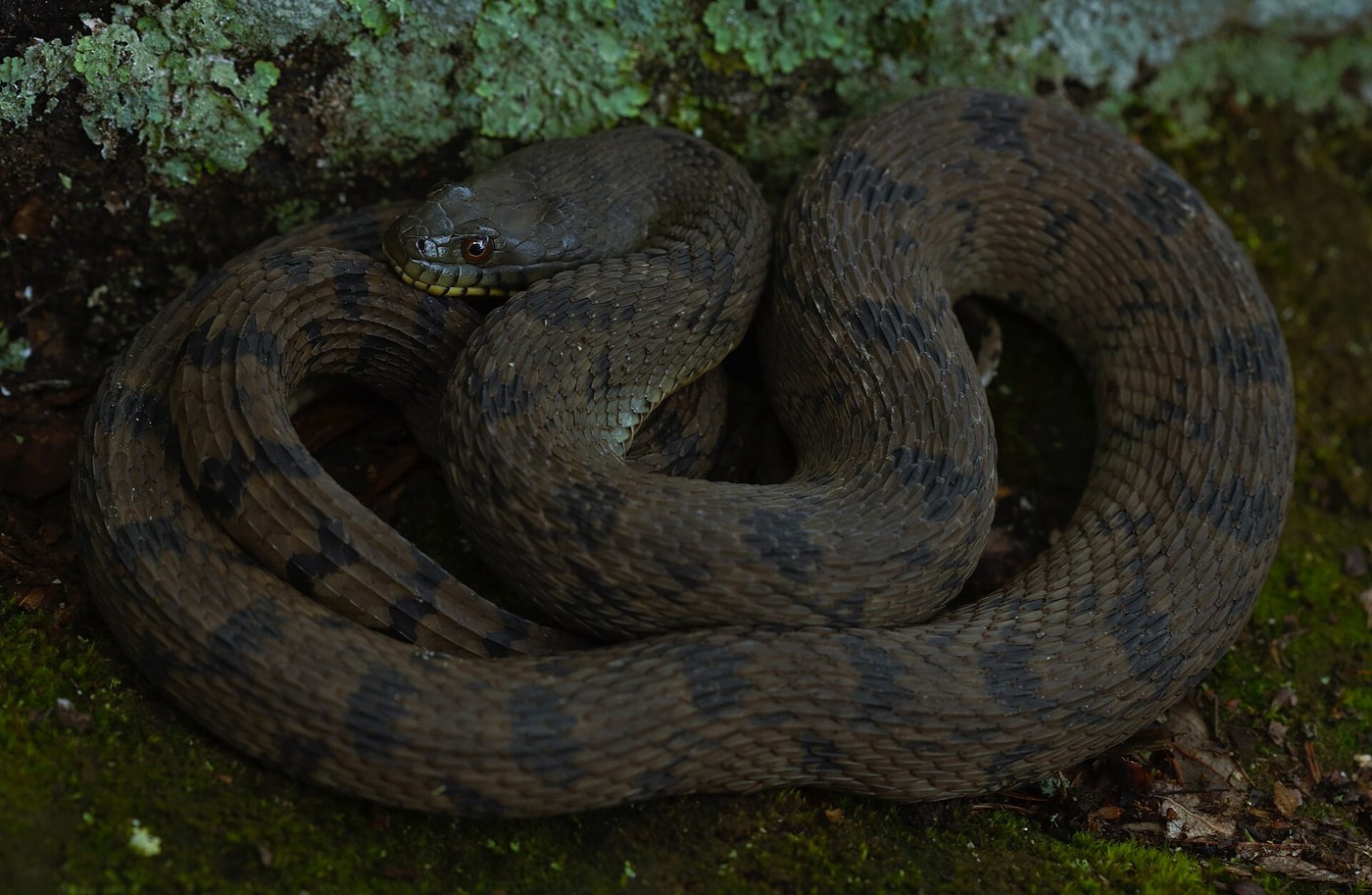
It is the whole reason this species keeps getting called a cottonmouth. Background color runs brown, olive, gray, yellowish, or a dirty yellow, overlaid with dark blotches that link into a chain or diamond pattern down the back. Illinois, Missouri, Tennessee, and Kentucky sources describe it in nearly identical terms. Tennessee's wildlife agency states the comparison directly: cottonmouths are dark brown or black without the chain-like pattern on the back. If you can read a chain of diamonds, you are not looking at a cottonmouth.
Check the head against the neck
A diamondback watersnake's head is only slightly wider than its neck. A cottonmouth's head is markedly wider, blocky and triangular. A Texas Parks and Wildlife state park page makes this exact comparison for watersnakes in a Texas context, and the same tell reads from the cottonmouth's side as well. One honest caveat travels with it: a threatened watersnake flattens its own head into a more triangular shape, which blurs the difference at exactly the moment you would most like it to be clear.
The belly, if you get a safe look
The belly is worth a look if you get a safe one. Yellow, sometimes closer to off-white, marked with dark brown or black half-moon spots that are heaviest toward the belly edges and toward the tail, per Illinois's own description. The dorsal scales are heavily keeled, meaning rough-textured rather than smooth, and the anal plate is divided.
A mark on adult males
Adult males carry a mark almost nobody looks for. Small raised bumps, called papillae, sit on the underside of an adult male's chin, confirmed independently by Tennessee's wildlife agency and the University of Kentucky's snake identification resource. They serve a purpose in courtship. A claim circulates that this trait is unique among all snakes in the United States. No government or university source confirms it, so treat it as unverified rather than as fact.
Behavior is a bad basis for guessing
Behavior is a genuinely bad basis for guessing venomous. Alabama's and Missouri's wildlife agencies describe this nonvenomous species as extremely aggressive when cornered, biting hard and repeatedly, and smearing a foul-smelling musk when captured. A Florida Museum guide frames the same conduct differently, calling the species not aggressive and describing biting as a last-resort defense, while still confirming it bites readily when grabbed or pinned. Both framings agree on the outcome. Meanwhile the cottonmouth is reluctant to strike, more likely to gape or leave. Aggression, in this pairing, points the wrong way.
Names vary by source
Names and taxonomy vary by source, and none of it changes what the snake is. Diamondback watersnake, diamond-backed watersnake, and diamond-backed water snake all refer to Nerodia rhombifer, with state agencies split roughly evenly on spelling. Northern diamond-backed watersnake is the name Indiana's and Oklahoma's resources use for the most widespread form. Sources also disagree on whether the snake belongs to family Colubridae in subfamily Natricinae or to a separate family Natricidae, and on whether it has three subspecies or none, with Indiana's and Illinois's own sources stating that no subspecies are currently recognized. These are real disagreements between classification schemes, and there is no winner to pick.
Do not use size alone
This is a large, heavy snake, roughly 30 to 48 inches for typical adults with credible reports of much larger individuals, and it is the largest watersnake in some of the states it occupies. Heavy build is part of why it reads as dangerous to people who encounter it. Weight and length say nothing at all about venom.
Signs of Infestation
Nothing structural to look for
There is nothing structural to look for, because this species is not a structural pest. No published source describes a diamondback watersnake entering a building. It does not chew, gnaw wiring, burrow into a foundation, or den in living space. There is no droppings pattern, no entry hole, and no gnaw damage to find. The sign is the snake, and the only real question is whether it was identified correctly.
Look at the water and at what overhangs it
The realistic sighting is a snake coiled on a branch, log, stump, or riprap above the surface of a pond, lake, reservoir, river, ditch, or slough, dropping into the water as someone approaches. Missouri and Illinois both note that riprap placed to stabilize lake and reservoir banks and levees makes excellent basking and hiding habitat. A property with permanent or semi-permanent water is the context. Woodpiles and foundation gaps are not.
A real smell sign, unusually
There is a real smell sign here, which is unusual for a snake. Handled or threatened, this species releases a genuinely foul-smelling musk from glands at the base of the tail, documented independently by Alabama, Illinois, Missouri, and Oklahoma sources. Combined with a flattened head, hissing, and a snake that bites rather than flees, the musk is part of a defensive package worth recognizing so it is not mistaken for aggression from a venomous animal.
Hissing identifies nothing on its own
A defensive diamondback watersnake flattens its head or body and hisses. Plenty of harmless snakes do the same when startled. Treat the sound as a signal that a snake is frightened, not as evidence of which species it is.
Repeats point at the fish
Repeat sightings point at the fish, not at an infestation. This is a heavy-bodied fish specialist, taking slow-moving fish, minnows, frogs, toads, tadpoles, salamanders, and crayfish, and it scavenges carrion readily. It forages actively underwater with the mouth open and also ambushes from branches above the surface. A pond or reservoir margin producing regular snake sightings is usually a water body holding plenty of prey, which is an observation about the habitat rather than a pest problem.
Winter absence is not removal
The species overwinters in beaver lodges, muskrat and crayfish burrows, mud bottoms, rock ledges, and riprap, and Illinois and Oklahoma sources report large numbers sheltering communally. A water feature that produced sightings all summer and goes quiet in December has not been cleared of snakes. The snakes are under the bank.
Prevention and When to Call a Pro
Leave it alone
Nearly the entire risk evaporates when you do. Multiple state wildlife agencies frame this species' presence as ecologically useful, keeping fish and amphibian populations in balance, rather than as a problem needing a solution. Tennessee's and Illinois's agencies both state plainly that the snake is needlessly killed by people who mistake it for a cottonmouth, and secondary sources note that mistaken fear, not predators or disease, is the main real-world threat to the species. Distance is the whole strategy.
Never handle one you cannot name
Never handle, move, or kill a snake you cannot confidently name. Uncertainty is not a reason to be careful with your hands. It is a reason to keep them out of it. Given how routinely the harmless species in this pairing is the one that actually bites, and given the misidentification runs constantly in both directions, killing on sight in this range removes far more beneficial nonvenomous snakes than it does actual hazards, and it puts a hand inside striking range of an animal that would otherwise have dropped into the water and left.
Manage the water's edge
That is where the habitat is. Clearing brush piles, low overhanging vegetation, and loose bank debris from pond, lake, and reservoir margins removes the basking and ambush cover this species prefers. There is no snake-specific exclusion work to do on the building itself, which follows from the animal never having tried to get inside. Sealing a foundation does not address a snake that lives in the water.
If you are bitten
Clean the wound and watch it. This snake has no venom, and published sources say so without qualification. The bite is still a real injury: hard, repeated, and painful, delivered by sharp teeth built to hold slippery fish. A regional wildlife research program source states directly that while the bite is nonvenomous, it can carry nasty bacteria, which is why the wound needs cleaning. Alabama's wildlife biologist describes the result as relatively harmless apart from scratches and the possibility of infection. Clean it, then keep an eye on it.
Check your state rule first
Check your own state's rules before doing anything to this snake. Tennessee's wildlife agency states directly on its own species page that it is not a protected species there. Texas treats it as native nongame wildlife, meaning no special protection, but the state's general reptile-take rules still apply: a hunting license is generally required to take reptiles from land, and recreational non-lethal capture along public roadway rights-of-way requires a Reptile and Amphibian Endorsement. Texas also runs a separate permit system for non-native venomous snakes and constrictors, which does not apply here at all, since this is a native, nonvenomous species. No published source gives a reporting requirement, bag limit, or closed season specific to this species in any of these states. Those are two real state examples, not a national rule. Rules on trapping, handling, and relocating native wildlife vary by state and change over time, so verify the current rule where you are before assuming either example covers you.
When to Call a Wildlife Control Operator
Call a licensed nuisance wildlife control operator or your state wildlife agency for any snake near water you cannot confidently separate from a cottonmouth, and for a confidently identified diamondback watersnake denning or repeatedly basking near an occupied structure, dock, pool, or other high-traffic waterfront spot where accidental encounters are likely. A licensed operator is the safer default over a DIY trap purchase. Seek medical care for any bite that starts showing signs of infection, meaning increasing redness, swelling, warmth, or pus, rather than healing like an ordinary puncture wound. And if there is any chance the snake was venomous, treat the bite as an emergency and call 911 rather than waiting to settle the identification question.
Frequently Asked Questions
Is a diamondback watersnake the same thing as a water moccasin or cottonmouth?
No. Nerodia rhombifer is a completely nonvenomous species, and it is one of the snakes most often mistaken for the venomous cottonmouth because it is dark, heavy-bodied, water-loving, and patterned. State wildlife agencies in Tennessee, Illinois, and Alabama each independently identify this as one of the most common snake-identification errors in its range. The most useful single tell is the pattern itself: Tennessee's agency notes that cottonmouths are dark brown or black without the chain-like pattern on the back.
If it is harmless, why does it bite so much?
This is the counterintuitive part. Alabama's and Missouri's wildlife agencies describe this nonvenomous species as one of the more defensively aggressive North American watersnakes, biting hard and repeatedly if it is cornered or picked up, and smearing a foul musk while it does. A Florida Museum guide frames the same conduct as strictly last-resort defense rather than aggression, but agrees it bites readily when grabbed. Meanwhile the venomous cottonmouth is documented as reluctant to strike. The harmless look-alike is frequently the one that bites.
Is a diamondback watersnake bite dangerous?
Not in venom terms, because there is no venom. The real risk is a hard, repeated, painful bite from teeth adapted to grip slippery fish, plus a documented bacterial infection risk if the wound is not cleaned. A regional wildlife research program source states it plainly: the bite is nonvenomous but can carry nasty bacteria, so clean it. Watch for increasing redness, swelling, warmth, or pus, and get medical care if any of that develops.
Where are diamondback watersnakes found?
Considerably more widely than most people assume. State wildlife agencies and university herpetology programs confirm the species across the entire South Central United States, meaning Texas, Oklahoma, Arkansas, Louisiana, Tennessee, and Kentucky, well into the Midwest in Illinois, Indiana, Missouri, and southeastern Kansas, and into Alabama in the Southeast, with Mississippi reported on a weaker source. It favors rivers, lakes, ponds, marshes, and reservoirs, and it is one of the most abundant snakes anywhere it occurs. It does not occur in Alaska or Hawaii.
How big does one get?
Big, which is part of why it alarms people. Typical adults run roughly 30 to 48 inches, though Alabama and a Florida Museum guide put the usual range higher at 3 to 5 feet, and state agency sources record rare individuals to 69 inches. Kansas documents a 55.5-inch maximum for that state. It is one of the largest watersnakes in North America, and the largest watersnake species in both Missouri and Indiana according to those states' own wildlife agencies. Size and heavy build say nothing about venom.
Can I legally kill or trap a diamondback watersnake on my property?
It depends on your state, and killing on sight is discouraged in any case given how often the species is misidentified. Tennessee's wildlife agency states directly that it is not a protected species there. Texas treats it as native nongame wildlife with no special protection, but general reptile-take licensing rules still apply, including a hunting license to take reptiles from land and a Reptile and Amphibian Endorsement for non-lethal roadside capture. Confirm your own state's current rule before assuming either example applies, and route anything you are unsure about to a licensed nuisance wildlife control operator instead of handling it yourself.
Sources
- Diamond-backed Water Snake: size, coloration, diet, defensive biting, birth window, litter size, and conservation status Alabama Division of Wildlife and Freshwater Fisheries (Outdoor Alabama)
- Diamond-backed Watersnake: identification against cottonmouth, chin papillae, courtship, litter size, and Tennessee protected status Tennessee Wildlife Resources Agency
- Diamond-backed watersnake: aquatic habitats including reservoirs, belly markings, mating dates, neonate size, and overwintering sites Illinois Department of Natural Resources
- Diamond-backed Watersnake: Illinois range, size, litter size, and subspecies status Illinois Natural History Survey, Prairie Research Institute
- Northern Diamond-Backed Watersnake: Missouri's largest watersnake, range, defensive biting and musk, riprap habitat, and seasonal activity Missouri Department of Conservation
- Kentucky Snake Identification, Diamond-backed Watersnake: western Kentucky range, chin papillae, catfish in the diet, and litter size University of Kentucky Department of Forestry and Natural Resources, Martin-Gatton College of Agriculture, Food and Environment
- Northern Diamond-backed Watersnake: Oklahoma range, neonate size, basking and communal overwintering behavior, defensive musk Oklahoma Department of Wildlife Conservation
- Florida Snake ID Guide, Diamond-backed Watersnake: size range, activity pattern, litter size, and defensive temperament Florida Museum of Natural History, University of Florida
- Diamond-Backed Watersnake: Indiana range along the lower Wabash and Ohio Rivers, largest watersnake in the state, subspecies status Indiana Herp Atlas
- Diamond-backed Watersnake: Kansas validated records and documented state maximum length Kansas Herpetofaunal Atlas, Fort Hays State University
- South Texas Natives: Diamondback water snake, nonvenomous bite and bacterial infection risk Caesar Kleberg Wildlife Research Institute, via San Antonio River Authority
- Nongame, Exotic, Endangered, Threatened and Protected Species: Texas native nongame framework and reptile take rules Texas Parks and Wildlife Department
- Brown Watersnake: the Georgia and South Carolina range finding that places diamondback watersnake west of eastern Alabama University of Georgia Savannah River Ecology Laboratory Herpetology Program
- Hunter Education Online Course, Snakes: Texas snake identification context Texas Parks and Wildlife Department
Image Credits
- Image: Peter Paplanus, St. Louis, Missouri, via Wikimedia Commons. CC BY 2.0.
License.