Seasonal Timeline
Active every month of the year with no hibernation, day and night. The reproductive season runs roughly May through September, though Alaska's own wildlife notebook puts the start in late winter. The damage calendar is the opposite of the breeding calendar: feeding on roots, bark, and garden plants happens under the snow all winter and only becomes visible at snowmelt, which is why the useful time to act is before freeze-up rather than after breakup.
Active every month of the year with no hibernation, day and night. The reproductive season runs roughly May through September, though…
Region-specific peak and shoulder windows have not been pinned down for this species. Treat the windows above as the documented calendar rather than a fixed set of dates.
Two Alaska Department of Fish and Game sources give different breeding windows. The department's species profile says young are born May through September. Its own Wildlife Notebook says red-backed voles start breeding in late winter and continue until August. A fifty-year monitoring record from the Yukon boreal forest describes the species as breeding only in summer. None of these is obviously wrong, and the likeliest reading is that the start of the season shifts with latitude and snowmelt.
The winter body-mass pattern is worth knowing because it is the reverse of what most people expect. A peer-reviewed Interior Alaska study measured winter body mass 30 percent below summer mass in males and more than 50 percent below in females, with the loss coming mostly from lean tissue rather than fat. Total body fat stays low all year and peaks in spring for males and early summer for females, tracking breeding rather than winter. This animal does not fatten up for an Alaskan winter. It shrinks, cutting its absolute energy demand, and goes into the cold smaller than it was in July.
Where They're Found
The northern red-backed vole is an Alaska animal. That is its entire United States range. No record places it in any lower 48 state, and it is confirmed absent from Hawaii, which has no boreal or tundra habitat and no vole fauna of any kind.
Inside Alaska the range is close to statewide, and the state's own agency describes it precisely. Northern red-backed voles occur throughout most of Alaska. They are found across the Arctic Slope and are especially common in the Brooks Range and along the sides of major river valleys. On the mainland they run from the Malaspina Glacier at least as far north as Norton Sound on the Bering Sea coast and northward to Utqiagvik, extensively through central Alaska and out the Alaska Peninsula. They occur on Unimak and St. Lawrence islands. They are absent from Kodiak and Nunivak islands, and in Southeast they occur only along the northern mainland east and south of LeConte Bay. Across most of Southeast their place is taken by a close relative, Gapper's red-backed vole, which is a different species.
Northern red-backed vole and meadow vole both live in Alaska, but not the same Alaska. Meadow vole in Alaska is confined to Interior and Southcentral west to Bristol Bay, absent from the Alaska Peninsula and Kodiak. Red-backed vole covers nearly the whole state including all the ground meadow vole never reaches. Where the two do overlap, the state's own Wildlife Notebook supplies the mechanism rather than leaving it to guesswork: meadow voles may inhibit red-backed voles from colonizing grassland habitats during the breeding season. Meadow vole holds the grass. Red-backed vole holds the forest, the taiga, and the tundra edge.
On the ground, look at trees and moss rather than at lawn. The stated habitat preference is dry tundra and alpine, plus damp forest floor in northern spruce forests and taiga, and the department describes this animal as living in more forested habitats with a broader diet than its grass-eating relatives. A university museum account puts the highest densities in overgrown talus slopes and in stands of dwarf willow, alder, and dwarf birch. Alaska voles as a group occupy every habitat in the state except bare rock and glaciers.
In winter it is under the snow but not down in the grass. Alaska Department of Fish and Game reporting describes red-backed voles nesting in groups of 6 to 12 at the bases of trees or under fallen trees, above ground but beneath the snowpack, with those winter groups predominantly female and holding few males. That is a different position in the snowpack, and a different social arrangement, from the ground-level runway networks meadow voles work through grass and thatch all winter.
The indoor picture is the part most people get wrong. Voles as a group very rarely enter houses. Red-backed voles are the documented exception: the state's wildlife notebook says they are quite common in cabins and camps, and University of Alaska Fairbanks Cooperative Extension says the same, naming fishing camps and unused cabins specifically. This is a seasonal-structure animal, not a heated-house animal, and the exclusion work belongs on the closing-up checklist.
Life Cycle
The reproductive strategy is slower than a meadow vole's, and that is a real difference rather than a rounding error. Meadow vole females can be breeding at three to five weeks old, which is what makes that species capable of a population eruption inside one season. Red-backed voles mature in two to four months, and only about one female in five from the year's first litter breeds during the summer she was born. The state's own profile says the species can breed up to four times a year but probably averages two litters. Gestation runs 17 to 21 days depending on the account, with weaning at roughly two weeks.
How much these populations swing is genuinely contested. Fifty years of monitoring in the Yukon boreal forest found consistent 3 to 4 year cycles, with peak densities averaging 8.3 per hectare before 2000 and 18.5 per hectare after, and an average autumn-to-spring decline of 76 percent across 48 years. A 30-year mark-recapture record from Denali National Park found cycling on a 2 to 4 year period, linked to white spruce seed mast and hurt by late snowfall combined with cold. Against that, a peer-reviewed review reports that neither of the two long-running Alaskan studies it examined found evidence of a 3 to 5 year cycle at all, attributing that to chronically poor overwinter survival. Alaska Department of Fish and Game's own species profile describes only irregular fluctuations in Interior Alaska and large year-to-year variation in the Copper River Basin, and asserts no cycle.
One figure sits outside all of that. An Alaska Department of Fish and Game popular article describes vole booms every 4 to 5 years reaching 50 to 100 times normal levels. That is the same agency whose own species profile declines to claim a cycle, and it is far above the measured per-hectare peaks in the long-term records. Treat 2 to 4 year cycling as the supported figure where cycling occurs at all, and the 50 to 100 times statement as an outlier you may encounter.
Winter mortality is the number that explains the whole life history. A comparative study of this species in low-Arctic taiga and tundra measured winter mortality of 55 to 75 percent in taiga against 90 to 95 percent in tundra, and never detected breeding under the snow across four years. The tundra population offsets those losses with larger litters and a much higher rate of young-of-year maturation. An animal that loses most of its population every winter and rarely reaches its first birthday is not built to be managed the way a long-lived pest is.

Newborn Pup
Weanling
Adult
Red-Backed vs. Meadow Vole
Winter Nest and Signs
Identification
The red back cannot be faked
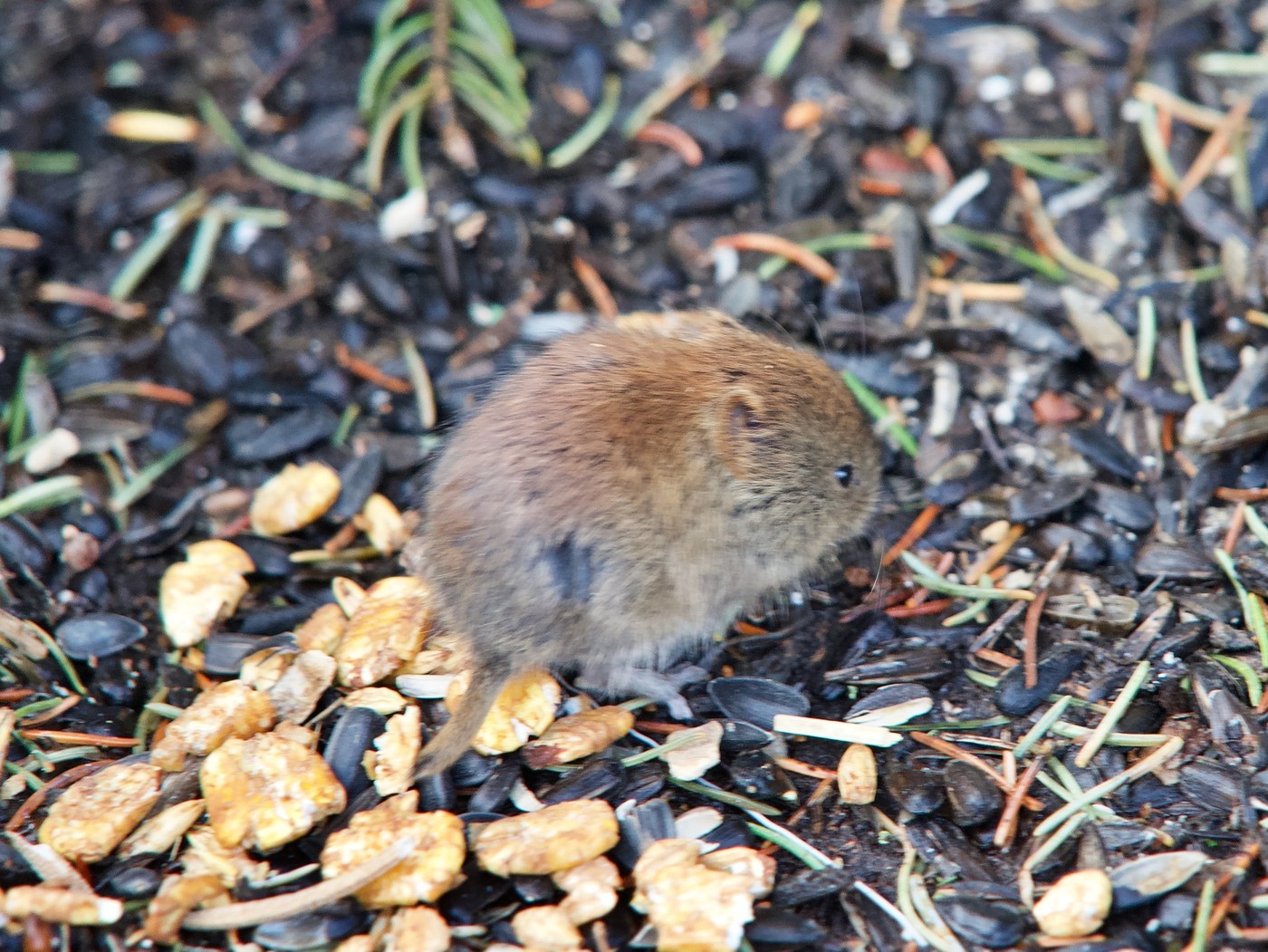
The red back is the field mark, and it is the one meadow vole cannot fake. Northern red-backed voles have a rusty-reddish band running the length of the back over grayish underparts. A university museum account describes it specifically as a rusty-reddish dorsal stripe whose intensity varies with season, geography, and subspecies. Alaska's own wildlife notebook puts the contrast in one line: the red-backed voles have red-colored backs, while the state's Microtus voles are brown or gray. Meadow vole is dark chestnut-brown to blackish above with no red anywhere.
The rest is standard vole
Everything else about the body is standard vole, so do not try to identify it on build alone. Stocky body, short legs, very small ears partially hidden under fur, a short blunt snout, a short smooth tail about a third of body length, and dense underfur beneath longer guard hairs. That description fits every vole in Alaska. Only the back separates them.
Size and weight
Size runs 130 to 158 mm, roughly 5 to 6 inches, at 6 to 42 grams. That weight span is a whole-population range including juveniles rather than a typical adult. A long-term field study describes the species as a 20 to 25 gram rodent and a museum account gives about 30 grams, which is the realistic adult figure. Alaska's pesticide applicator manual rounds all state voles to three to six inches with short ears and short tails.
It does not build runways
That is an identification fact as much as a behavior one. Alaska Department of Fish and Game states it twice, on the species profile and in the wildlife notebook: red-backed voles do not build runways but will use those built by Microtus voles if they share the same area. If you are standing in forest or tundra edge with no grass trail network in sight, that does not rule out voles. It points at this one.
Against meadow vole
In Alaska the two genuinely overlap in Interior and Southcentral, and the state's notebook notes meadow voles may inhibit red-backed voles from colonizing grassland during the breeding season.
Against Gapper's red-backed vole
Northern red-backed vole is absent from Southeast Alaska. Gapper's occurs on the Southeast mainland and some adjacent islands, but not on Admiralty, Baranof, or Chichagof. If you are in Southeast and it has a red back, it is probably the other species.
Against a mouse or shrew, in a cabin
Against a mouse or a shrew, which is the comparison that matters in a cabin. University of Alaska Fairbanks Cooperative Extension publishes a three-way table. Mouse: large ears for its body size, a ridged nearly hairless tail, a slightly pointed snout, a delicate body, mostly active at night. Shrew: small ears, a narrow pointed snout, pointed teeth with dark tips, dense fur of uniform color. Vole: very small ears partially hidden under fur, a short smooth tail about a third of body length, a short snout, a stocky body on short legs, active day and night.
Against a lemming
The state gives the quick tell. Lemmings have stubby tails. Voles have tiny but present tails.
It climbs
It climbs, which almost no vole guidance accounts for. University of Alaska Fairbanks Cooperative Extension's horticulture agent for the Tanana District notes that the northern red-backed vole can climb trees, and raises that directly as a reason to doubt whether a standard trunk guard height is enough for this species. No equivalent climbing statement appears in published meadow vole guidance.
A note on the scientific name
You may meet both. Alaska Department of Fish and Game titles its species profile Myodes rutilus. Current field literature, including a 2024 fifty-year monitoring paper and a Denali National Park thesis, uses Clethrionomys rutilus. Clethrionomys is also the older name that Myodes displaced, so this is a reversion rather than a new proposal. Both names refer to the same animal. There is a second, smaller mismatch worth knowing: Alaska's agency pages still place the state's voles in the family Muridae, while current sources place red-backed voles in Cricetidae, subfamily Arvicolinae.
Signs of Infestation
Start with what you will not find
The worn surface runway network through grass and thatch, the sign that headlines almost every vole guide, is a Microtus sign. Red-backed voles do not dig them. Where you do see them in Alaska, this species borrowed them. In pure red-backed vole ground, forest floor and tundra edge, there may be no trail network at all, and its absence is not evidence there are no voles.
A nest exposed by melting snow
A nest at the base of a tree or under a fallen log, exposed by melting snow. Alaska Department of Fish and Game reporting describes winter nests holding 6 to 12 animals, sitting on the ground surface but beneath the snowpack rather than tunneled into soil, and skewed heavily female. That is the most distinctive physical sign this species leaves and it shows up all at once at breakup.
Inch-wide tunnels after snowmelt
Tunnels with roughly one-inch openings, and winding trails of packed vegetation right after snowmelt. Alaska's pesticide applicator manual describes the state's voles tunneling under the snow through winter and lining those tunnels with vegetation, with the packed trails visible on bare ground as soon as the snow goes.
Tunnelling through flower beds
Tunneling through vegetable and flower beds, and feeding on plant roots. This is the garden-scale damage, and it happens underground and under snow rather than in view.
Trees girdled at the soil line
Trees girdled just above the soil line, or roots destroyed outright. Note the height. Alaska's own guidance puts the girdling just above the soil line, which is lower and different from the snow-line girdling documented for meadow vole. Because this species climbs, do not assume the damage stops at any particular height either.
The animal inside an outbuilding
The animal itself, inside a cabin, fish camp, or unused outbuilding. For most voles that would be an oddity. For this one it is normal, documented independently by the state wildlife agency and by university extension, and it is often the first sign a property owner gets.
No useful sound and no useful smell
No audible or olfactory cue is documented that reliably identifies this species. Go on the nest, the tunnels, the root damage, and the red back.
Prevention and When to Call a Pro
Alaska discourages rodenticide
Alaska's own environmental agency discourages rodenticide for voles, and the reason is worth reading rather than skipping. Its rodent control manual states that many rodenticides list voles as a target species and can be effective, but that voles are a main food source for hawks, owls, foxes, wolves, martens, weasels, and shrews, and that due to the likelihood of secondary poisoning, use of rodenticides for voles is not encouraged. This is a stronger position than the usual last-resort framing, it comes from the state, and it makes sense here: the department of fish and game describes this species' single greatest value to Alaskans as being the prey base for the predators people come to see.
If bait is used anyway
Know what it actually requires. Many anticoagulant baits do not work unless voles feed on them for at least five days. Some products must be placed 100 feet or more from structures. Some are restricted-use and require a certified applicator. And in Alaska, anyone applying pesticides to property other than their own must be certified by the state environmental agency regardless of the product.
Trunk guards, with a caveat
The caveat is one this species earns. The state spec is quarter-inch mesh hardware cloth wrapped around the lower trunk and buried 6 inches below the soil surface. Research cited by university extension gives 6 inches deep and at least 10 inches above the soil line. But the same extension agent notes that the northern red-backed vole can climb trees and questions whether that barrier is reliable for this species. Install the guard, and do not treat it as a complete answer the way it would be for a ground-bound meadow vole.
The Alaska trap method
It is specific and it works better than setting traps in the open. Excavate a small part of a tunnel, place a mousetrap baited with peanut butter inside the tunnel, and cover the opening with boards. For a pet-heavy property, extension recommends setting a sturdy snap trap near a burrow entrance and covering both with an overturned 5-gallon bucket weighted with a rock. Multi-catch live traps can take as many as 15 voles at a time. Wear gloves when handling any trapped vole, because of the parasites voles carry.
Clear the right cover
Clear cover, but clear the right cover. Mowing and eliminating thatch is the standard state advice, and it targets grass, which is meadow vole ground. For a red-backed vole working forest floor or the brushy edge around a cabin, the equivalent step is pulling dense ground cover, brush, woody debris, and fallen limbs back from the structure and from planting beds, rather than cutting a lawn shorter.
Most repellents do not work
Extension has the tested list. Castor oil applied full strength repelled captive voles effectively, but dilutions of 0.65 percent and 16 percent did not. Almond, garlic, and spearmint oils were ineffective. Capsaicin at 0.5 percent was ineffective. Products registered in Alaska with repellent properties contain castor oil, fir needle oil, and coyote and fox urine. Repellents cannot be applied to food crops unless the label specifically allows it.
Seal the cabin at closing-up
Seal the cabin, not the house, and do it at closing-up time. Because this is the vole that turns up in cabins, fish camps, and unused outbuildings, the exclusion checklist that matters is structural. Fill any opening greater than a quarter inch, using steel wool mixed with caulking compound and smoothed so it cannot be pulled back out. Seal foundation cracks and water pipe and vent openings with concrete or metal. Check that windows, doors, thresholds, door sweeps, and garage seals fit snugly. Re-inspect for new openings. Store any food left on site in glass, metal, or heavy plastic with tight-fitting lids.
On disease, mostly about dogs
On disease, the honest answer is narrow, real, and mostly about dogs. Northern red-backed vole is a documented intermediate host for the tapeworm Echinococcus multilocularis in Alaska. People do not catch it from the vole. Humans are accidental hosts who become infected by ingesting eggs shed in the feces of an infected fox or dog, so the actions that matter are deworming dogs, keeping dogs from hunting and eating rodents, washing hands, and washing produce. The federal disease agency reports the parasite as endemic in Alaska, with a mean infection rate of 77 percent across 1,579 arctic foxes examined and 12 percent in dogs necropsied on St. Lawrence Island, but records only 54 human cases statewide from 1947 to 1986, none from 1986 to 2010, and roughly 5 possible cases from 2010 to 2014. A ten-year program of monthly dog deworming in one St. Lawrence Island village cut larval prevalence in local voles by an average 83 percent, which is the clearest evidence available that the dog is the controllable link.
A parasite risk, from one source
Alaska Department of Fish and Game's wildlife notebook says the state's voles carry the protozoan Giardia, which may infect humans. No second independent source publishes that specific claim. Treat it as documented by the state rather than settled, and let it reinforce the gloves rule rather than drive anything else.
Hantavirus is not documented
Hantavirus has not been documented in this species. No published account records hantavirus in northern red-backed vole. That is an absence of evidence rather than a clean bill of health, and ordinary caution around any wild rodent, its nest, or its droppings still applies.
About as unrestricted as it gets
Legally, this is about as unrestricted as a wild mammal gets in Alaska. The state department of fish and game states plainly that voles are unclassified game in Alaska with no closed season and no bag limit, and notes only that in limited areas they may become an agricultural pest when numbers are high. There is no permit, no season, and no species-specific restriction. The species is ranked secure globally and least concern internationally, and the state records no conservation threats to any of Alaska's seven vole species at present. The one real legal constraint is the pesticide certification rule above, which is about the product rather than the animal.
Call if rodenticide is on the table
Call a professional when rodenticide is on the table at all. Between the state's own discouragement on secondary-poisoning grounds, the restricted-use status of some products, and the certification requirement for applying to property you do not own, that decision has effectively moved out of homeowner territory.
Call for repeat garden damage
Call when garden or root damage keeps coming back after trunk guards and trapping. That is a particularly reasonable trigger here, because the standard trunk guard spec is explicitly questioned for a vole that climbs.
Call when reopening a cabin
Call when a seasonal cabin, fish camp, or outbuilding is being reopened and shows established occupation, chewed contents, or nesting. That is this species' documented indoor scenario, and the fix is a structural exclusion job rather than a trap line.
Call a vet if dogs eat voles
Call a veterinarian, not a pest company, if dogs at a rural property regularly hunt and eat voles. Routine deworming is the actual control point in the tapeworm cycle described above, and it is a veterinary conversation.
Call before freeze-up
Make the call before freeze-up, not after breakup. Everything this animal does to a property happens under the snow and stays invisible until it is finished. By the time the tunnels, the packed trails, and the girdled trunks appear at snowmelt, the damage is already done.
Frequently Asked Questions
What is the difference between a red-backed vole and a meadow vole?
The back. A northern red-backed vole has a rusty-reddish band running down its back over gray underparts. A meadow vole is uniformly brown to blackish above with no red at all. They are also different genera, Myodes rutilus against Microtus pennsylvanicus, and they live differently in Alaska: red-backed voles hold forest, taiga, and tundra-edge ground while meadow voles hold grass. Alaska's own wildlife notebook adds the mechanism, noting that meadow voles may keep red-backed voles out of grassland during the breeding season.
Why can I not find any vole trails in my yard even though something is eating my plants?
Because this species does not make them. Alaska Department of Fish and Game states twice that red-backed voles do not build runways and will simply use trails built by meadow voles where the two share ground. The worn grass runway network that identifies a meadow vole is not this animal's sign, and its absence does not mean you do not have voles. Look instead for tunnels with roughly one-inch openings, packed vegetation trails right after snowmelt, root damage, and a nest at the base of a tree.
Do voles get into cabins in Alaska?
Red-backed voles specifically, yes. Alaska Department of Fish and Game says voles venture into houses very rarely but that red-backed voles are quite common in cabins and camps, and University of Alaska Fairbanks Cooperative Extension says the same, naming fishing camps and unused cabins. The fix is structural and belongs on the closing-up checklist: fill every opening greater than a quarter inch with steel wool mixed into caulking compound, seal foundation cracks and pipe and vent openings with concrete or metal, and check that doors, thresholds, and sweeps fit snugly.
Why did damage appear in my garden that I never saw happen?
It happened under the snow. These voles do not hibernate and stay active day and night all winter, tunneling under the snowpack and lining the tunnels with vegetation. A Fairbanks study of the forest floor found that these animals abandon surface activity entirely once snow cover reaches about 15 to 20 cm deep. The tunnels, the packed vegetation trails, and any girdling at the soil line all become visible at once when the snow melts, months after the feeding actually happened.
Should I put out rodenticide for voles in Alaska?
The state says no, not as a first move. Alaska's Department of Environmental Conservation notes that many rodenticides list voles as a target and can work, but that voles are a main food source for hawks, owls, foxes, wolves, martens, weasels, and shrews, and that due to the likelihood of secondary poisoning, use of rodenticides for voles is not encouraged. Trapping in an excavated tunnel with peanut butter bait, plus clearing cover and sealing structures, is the recommended route.
Do red-backed voles carry anything that can make people sick?
They are a documented intermediate host for the tapeworm Echinococcus multilocularis in Alaska, but people do not catch it from the vole itself. Humans are accidental hosts infected by ingesting eggs shed in the feces of an infected fox or dog, so the real precautions are deworming dogs, keeping dogs from eating rodents, washing hands, and washing produce. The disease is rare in people: the federal disease agency records 54 Alaska cases from 1947 to 1986 and none from 1986 to 2010. Alaska's wildlife agency separately notes that voles can carry Giardia, a claim that rests on that one source. Wear gloves when handling any trapped vole.
Do vole numbers really explode some years?
They swing hard, but the sources genuinely disagree on whether it is a true cycle. Fifty years of monitoring in the Yukon boreal forest found consistent 3 to 4 year cycles with autumn-to-spring declines averaging 76 percent, and a 30-year Denali National Park record found a 2 to 4 year period. Against that, Alaska Department of Fish and Game's own species profile describes only irregular fluctuations in Interior Alaska, and a peer-reviewed review found that neither of two long-running Alaskan studies showed evidence of a multi-year cycle at all. A popular article from the same state agency claims booms every 4 to 5 years at 50 to 100 times normal levels, which is well outside every measured figure and should be treated as an outlier.
Is it legal to trap voles on my property in Alaska?
Yes. Alaska Department of Fish and Game classifies voles as unclassified game with no closed season and no bag limit. The legal constraint that does exist is about pesticides rather than the animal: applying pesticides to property other than your own, or using any restricted-use product anywhere, requires certification from the Alaska Department of Environmental Conservation.
Sources
- Northern Red-backed Vole (Myodes rutilus) Species Profile: size and weight, reddish back over grayish underparts, litter size 4 to 9 averaging 6, gestation 17 to 19 days, weaning, maturity, omnivorous diet, predators, statewide Alaska range, and the unclassified game status Alaska Department of Fish and Game
- Northern Red-backed Vole (Myodes rutilus) Management: voles are unclassified game in Alaska with no closed season or bag limit Alaska Department of Fish and Game
- Voles, Alaska Wildlife Notebook Series: the two-genus color contrast, per-species Alaska ranges including Gapper's red-backed vole and meadow vole, the competitive exclusion statement, litter range 2 to 11, late-winter breeding start, the cabins and camps statement, and the Giardia note Alaska Department of Fish and Game
- Alaska Limited Vertebrate Pest Control for Rodents Manual, Category Seventeen B, January 2020: under-snow tunneling and post-snowmelt trails, one-inch tunnel openings, girdling just above the soil line, quarter-inch hardware cloth buried 6 inches, the peanut butter tunnel trap method, the secondary poisoning rationale for discouraging rodenticides, and applicator certification requirements Alaska Department of Environmental Conservation, Pesticide Control Program
- So You Have Mice, Now What? publication PMC-00200: the mouse, shrew, and vole comparison table, the statement that voles may be found in fishing camps and unused cabins, and the quarter-inch structural exclusion checklist University of Alaska Fairbanks Cooperative Extension Service
- Don't let voles get the best of your garden, Cooperative Extension column by Julie Riley, Tanana District horticulture agent: the statement that northern red-backed voles can climb trees and that this undercuts trunk guard reliability, tested repellent results, the 5-gallon bucket trap method, multi-catch trap capacity, the five-day anticoagulant feeding requirement, and the gloves handling caution University of Alaska Fairbanks Cooperative Extension Service
- Voles in Alaska: Small but Mighty Important, Alaska Fish and Wildlife News: winter nests of 6 to 12 animals at tree bases and fallen logs above ground but beneath the snow, female-skewed winter groups, the seasonal diet split, the lemming tail comparison, and the 4 to 5 year, 50 to 100 times boom figure disclosed here as an outlier Alaska Department of Fish and Game
- Myodes rutilus (northern red-backed vole): the rusty-reddish dorsal stripe and its seasonal and geographic variation, Cricetidae placement, adult mass, highest densities in talus and dwarf willow, alder and birch stands, and food caching Animal Diversity Web, University of Michigan Museum of Zoology
- Long-term monitoring of cycles in Clethrionomys rutilus in the Yukon boreal forest, Integrative Zoology 19:27-36 (2024): fifty-year record, consistent 3 to 4 year cycles, peak densities 8.3 per hectare before 2000 and 18.5 after, 76 percent average autumn to spring decline over 48 years, 20 to 25 gram body mass, and current use of the name Clethrionomys rutilus University of British Columbia, University of Toronto Scarborough and Yukon University
- Seasonal drivers of amplitude patterns in a population of red-backed voles (Clethrionomys rutilus): 30-year Denali National Park mark-recapture record, 2 to 4 year cycling, white spruce seed mast linkage, and the negative effect of late snowfall combined with cold University of Alaska Fairbanks, ScholarWorks
- Population limitation of the northern red-backed vole in the boreal forests of northern Canada, Journal of Animal Ecology 75:1269-1284 (2006): neither Alaskan study reviewed found evidence of a 3 to 5 year cycle, attributed to chronically poor overwinter survival, plus Fairbanks-area density figures University of Toronto Scarborough and University of British Columbia
- Comparative demography of Clethrionomys rutilus in taiga and tundra in the low Arctic, Canadian Journal of Zoology 57:2106-2120 (1979): winter mortality 55 to 75 percent in taiga against 90 to 95 percent in tundra, and subnivean breeding never detected across four years Canadian Journal of Zoology, Canadian Science Publishing
- Seasonal Changes in Body Mass, Composition, and Organs of Northern Red-Backed Voles in Interior Alaska, Journal of Mammalogy 80(2) (1999): winter body mass 30 percent lower in males and more than 50 percent lower in females than summer, loss driven by lean tissue, and body fat peaking in spring or early summer rather than before winter Journal of Mammalogy, American Society of Mammalogists
- Observations on the Bioclimate of Some Taiga Mammals, Arctic 10(3) (1957): Fairbanks thermistor study of the moss-covered forest floor, the winter thermal stability of the under-snow layer, and the abandonment of surface activity once snow cover reaches 15 to 20 cm Arctic, Arctic Institute of North America, University of Calgary
- Echinococcus spp. Tapeworms in North America, Emerging Infectious Diseases 24(2) (2018): Alaska endemicity, 77 percent mean infection across 1,579 arctic foxes, 10 to 80 percent prevalence in prey animals, 12 percent in St. Lawrence Island dogs, human infection via accidental ingestion of eggs from canid feces rather than from rodents, and Alaska human case counts of 54 during 1947 to 1986 and none during 1986 to 2010 Centers for Disease Control and Prevention
- Echinococcus multilocularis in North America: the great unknown, Parasite 21:73 (2014): names northern red-backed vole among the northern tundra zone arvicoline intermediate hosts sustaining the arctic fox cycle Parasite, EDP Sciences
- A programme to reduce the risk of infection by Echinococcus multilocularis: the use of praziquantel to control the cestode in a village in the hyperendemic region of Alaska, Annals of Tropical Medicine and Parasitology 84(3) (1990): a ten-year dog deworming trial that cut larval prevalence in village voles by an average 83 percent National Institutes of Health, National Library of Medicine (PubMed)
Image Credits
- Image: Donald Hampton via iNaturalist. CC BY-SA 4.0. Resized, so this version is offered under the same license.
License.