Seasonal Timeline
Eastern ratsnake is active from spring through fall, with mating in late spring, roughly April through June depending on latitude, and eggs laid in summer. It dens through the cooler months and is primarily nocturnal in warm weather, shifting to daytime activity when temperatures are cooler.
Eastern ratsnake is active from spring through fall, with mating in late spring, roughly April through June depending on latitude, and eggs…
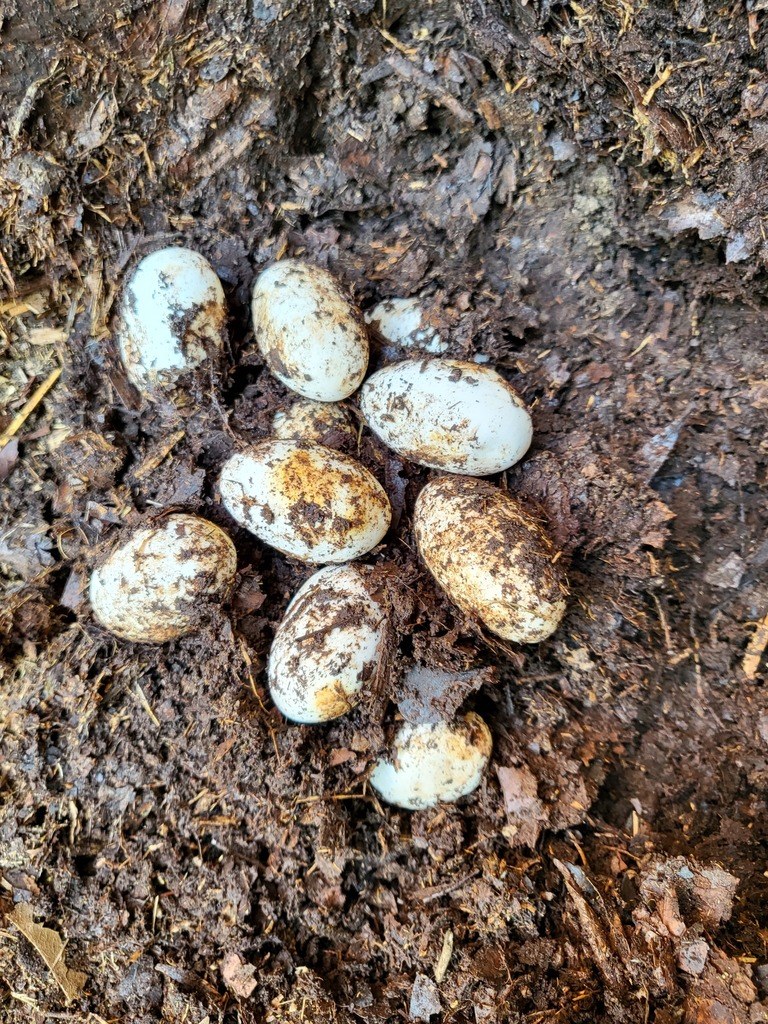
The calendar puts two different snakes in front of homeowners at two different times of year. Spring is when adults are most conspicuous, moving to mate and basking in the open on cool mornings, and this is when males engage in ritual combat with one another for access to females. Summer is the egg season. Females lay in moist, sheltered places such as rotting logs, leaf litter, sawdust piles, and decaying vegetation, and incubation runs roughly five to ten weeks depending on the source and the summer, with Ohio sources citing 65 to 70 days and National Wildlife Federation citing five to seven weeks.
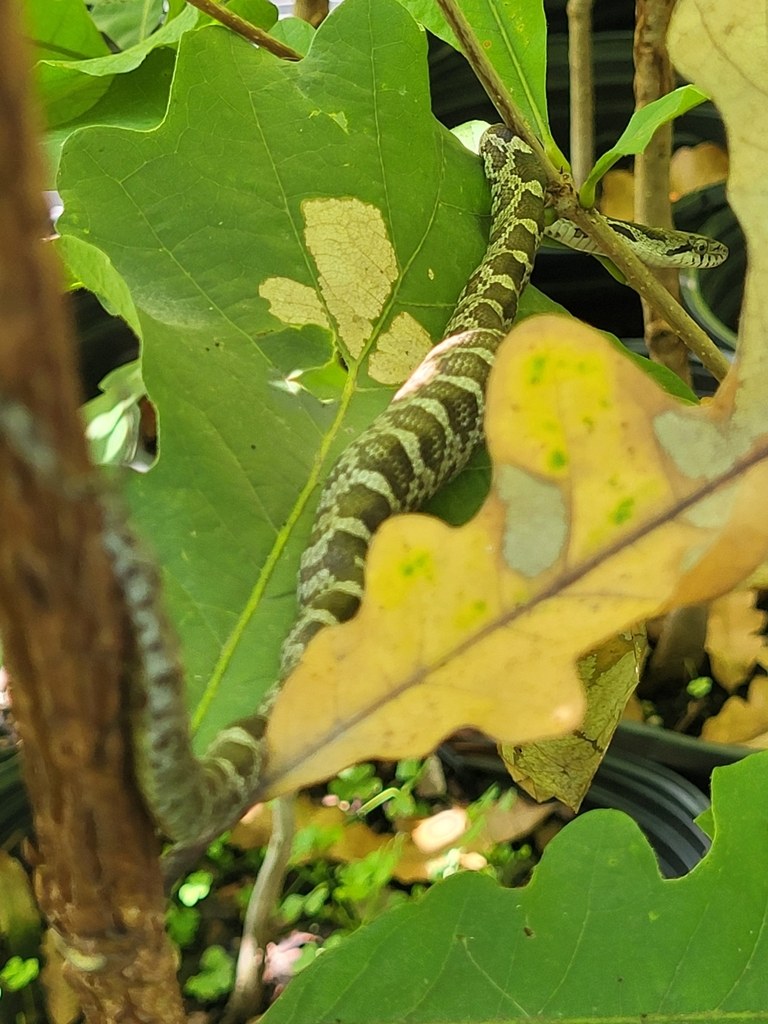
Late summer and early fall is when the smallest, most frequently misidentified version of this species appears. Hatchlings emerge at roughly 11 to 16 inches already wearing the bold juvenile pattern of dark saddle blotches on a gray or light tan background, and one source reports that they may stay near the nest site for as long as two years. That timing matters, because a small gray blotched snake in a mulch bed in September is exactly the encounter that generates a copperhead call. Activity in warm months skews nocturnal, so a daytime sighting is more likely in spring and fall than in the heat of midsummer.
Where They're Found
The species occupies three regions: Southeast, Northeast, and Midwest. Range inside each region is narrower than the region itself, and the specific states worth naming are the ones the sources actually confirm. In the Southeast, a curated taxonomic distribution places the species in Virginia, where the type locality sits on the summit of the Blue Ridge, along with North Carolina, South Carolina, Georgia east of the Chattahoochee River, and Florida east of the Apalachicola River, and Florida Museum of Natural History covers the species for both peninsular Florida and the Panhandle. In the Northeast, National Wildlife Federation describes the range as running from Connecticut to South Carolina, and the same curated distribution adds southeastern New York, western Vermont, Pennsylvania, and Maryland. New Jersey and Delaware sit inside that confirmed Vermont-to-Maryland band though no published source breaks them out separately. In the Midwest, the confirmation rests on Ohio: the curated distribution says the range runs north to Ohio, the City of Montgomery, Ohio calls its local population the largest snake species in the Cincinnati area under this exact scientific name, and Ohio's own snake identification resource, which cites the state Division of Wildlife, says the species occurs throughout most of the state.
Two exclusions are deliberate and worth stating, because the colloquial names this species shares with its close relatives make its range look bigger than it is. Alabama and Mississippi are not included: Alabama's own state wildlife agency files the names black rat snake and chicken snake under a different species, the gray ratsnake, and no published source places this species in either state. Indiana, Illinois, Michigan, and the rest of the Midwest are likewise not included, for the same reason, since Indiana's Department of Natural Resources also assigns those colloquial names to the gray ratsnake. The South Central states are excluded outright. No published source places this species in Tennessee, Kentucky, Arkansas, Louisiana, Oklahoma, or Texas, and Tennessee and Kentucky fall inside the documented range of that sibling species instead. If you are in one of those states and someone calls the black snake in your barn a chicken snake, they are probably right about the name and looking at a close relative rather than this species. Alaska and Hawaii have no population. Every distribution source confines this species and its relatives to the eastern and central continental United States and adjacent southern Ontario.
On a specific property, the habitat list is forest and farmland and the seam between them: wooded lots, rocky hillsides with large trees, old field edges, and forested suburbs where woods and farmland intermix. The snake turns up under rocks, logs, and loose bark, inside tree cavities and knotholes, in palm fronds in the South, and, more often than homeowners expect, in the rafters of a barn. Structures enter the picture because prey does. Barns, chicken coops, sheds, crawl spaces, and attics all appear in state and municipal accounts of where this species is found, and in every case the snake is there hunting rodents, birds, or eggs rather than seeking shelter for its own sake.
Life Cycle
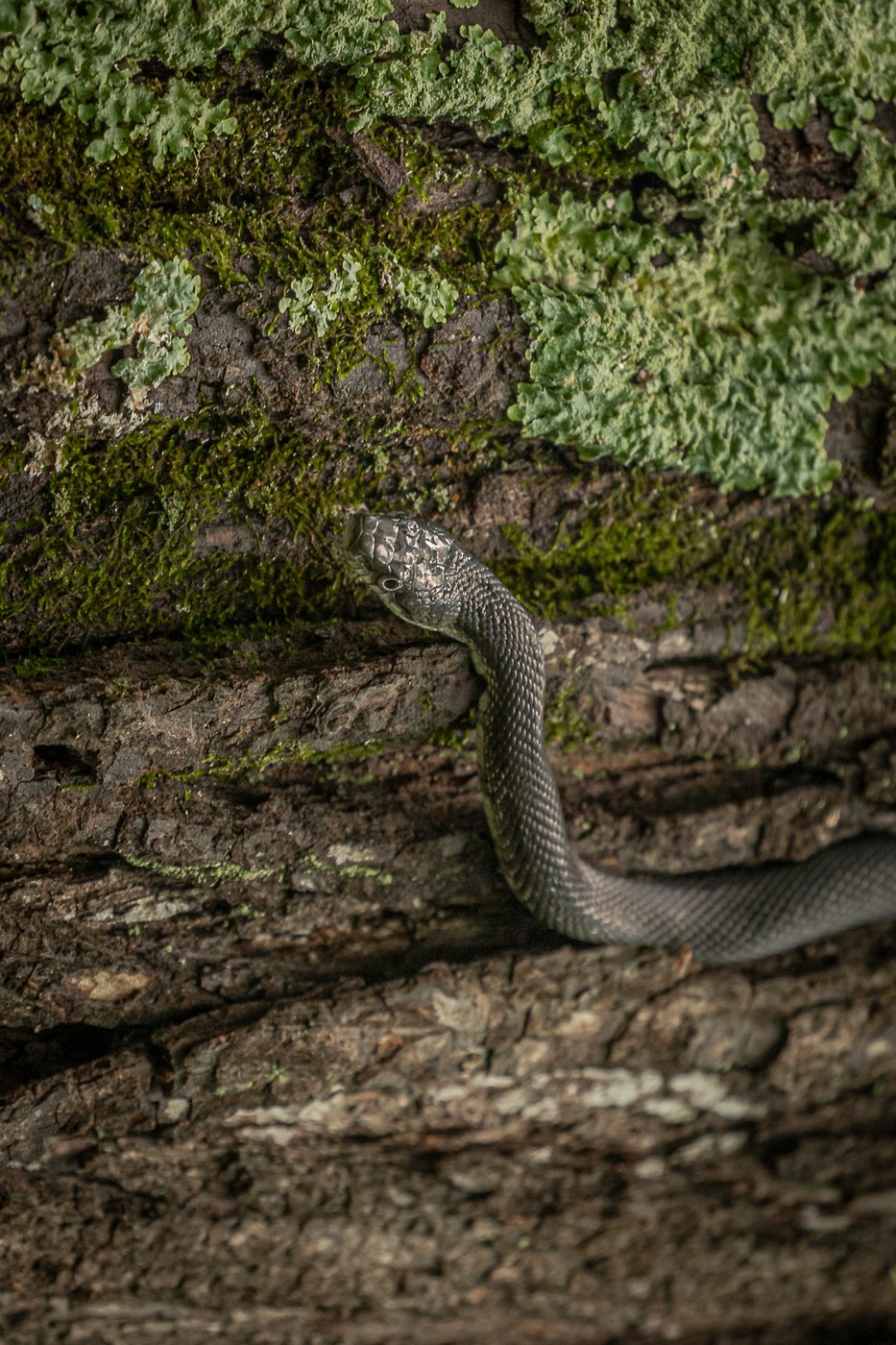
This is one of very few snakes on this list whose juveniles and adults look like two unrelated species. A hatchling and a young juvenile are gray with bold dark saddle blotches. A mature adult through most of the range is solid glossy black, sometimes with only faint traces of that old blotch pattern still showing through, and sometimes with white skin visible between the scales after a large meal. The pattern does not shift a little with age. It disappears. That is why copperhead confusion with this snake is almost entirely a juvenile problem: once the snake darkens, nobody mistakes a solid black snake for a banded copperhead, and the risk of a wrong call drops sharply.

Mating
Eggs2
Hatchling3
Juvenile
Adult
Identification
Age changes the answer
Establish that first. Adults through the northern part of the range and the Florida Panhandle are solid glossy black on top, with a white chin and throat and a belly checkered in white and dark. Juveniles are gray or light tan with bold dark gray or brown saddle-shaped blotches. In peninsular Florida, adults can be yellow, orange, tan, or gray with four dark lengthwise stripes, which is the same species in a different color form rather than a different snake.
The copperhead question, both ways
If you found a gray snake with dark blotches, this is the copperhead question, and it runs in both directions. Virginia's herpetological society states that juveniles start out gray with darker gray or brown saddles and are still often misidentified as eastern copperhead, and the confusion runs from the other side too, since a state extension service names immature black rat snakes among the species most often mistaken for copperhead. The reliable tells: a copperhead's crossbands form a true hourglass or dumbbell, narrow across the center of the back and wide along the sides, against a coppery-tan background, and a copperhead has vertical elliptical pupils and a heat-sensing pit between the eye and the nostril. A juvenile ratsnake has irregular blotchy saddles rather than hourglasses, against a gray background, with round pupils and no heat pit.
Build and scales, if you can look
Build and scales are worth a look if you get a safe one. The University of Georgia's herpetology program describes the body cross-section as loaf-shaped rather than round, which is a genuine field tell for this species and its close relatives. The head is wider than the neck, the scales are weakly keeled, meaning neither smooth nor strongly ridged, and the anal plate is divided.
Size narrows it, no more
Size alone will not identify it, but it will narrow the field. Most adults are 42 to 72 inches, and Virginia's herpetological society calls this the only snake in that state reaching six feet or more, with a state record of 79.8 inches and a species record of 101 inches. A genuinely long, slender, solid black snake in the eastern United States is far more likely to be this species than anything venomous. Color alone never clears a snake, though. A black-phase timber rattlesnake reads as nearly solid black except at close range, and an old cottonmouth darkens the same way.
A buzzing tail is not a rattlesnake
A buzzing sound in the leaves does not mean a rattlesnake. Cornered, this species will typically coil, vibrate its tail rapidly against leaf litter or dry ground to produce a buzz that mimics a rattle, and may strike. Indiana's Department of Natural Resources says the vibration is convincing enough that the snakes get mistaken for rattlesnakes, and multiple Virginia-area sources describe the same behavior independently. The snake has no rattle. The sound is the tail against dry debris.
Shared names, unsettled taxonomy
The names are shared, and the taxonomy is genuinely unsettled, and neither changes what the snake is. Black snake, black rat snake, and chicken snake all get applied to this species and to its two closest relatives, the gray ratsnake and the western ratsnake, so the name alone does not confirm the species. Pilot snake and pilot black snake are older Virginia folk names for the same animal. On the science side, a 2001 molecular study split the old black rat snake into three species, which is the arrangement Florida Museum of Natural History, National Wildlife Federation, and most state wildlife agencies still use. A more recent 2021 revision would reassign the name and move Eastern Ratsnake to a narrower Atlantic coastal population, and it remains disputed and not adopted by those sources.
An unverified comparison
Noted rather than repeated as fact. Juvenile timber rattlesnake is also gray with dark saddle blotches before it darkens, so the same blotched-gray confusion is plausible in that direction too, and the heat pit, pupil shape, and eventually the rattle itself would be the tells. No published state source makes that comparison directly, so it is reasoned from each species' separately documented juvenile coloring rather than sourced, and it should be treated as unconfirmed rather than as a settled second look-alike.
Signs of Infestation
No structural damage to find
There is no structural damage to find, because this species does not cause any. It does not chew wiring, insulation, or wood, and it does not burrow or build a destructive nest. There is no gnaw pattern, no droppings trail, and no structural repair to plan for. Any concern here is about presence and access, not damage, and saying that plainly is more useful than leaving it implied.
A shed skin near an entry point
It is the most common physical sign. Look for a long, translucent, patterned tube of skin near a gap, a rafter, a woodpile, or the base of a wall. Because this species grows large, the shed is often long enough to be startling on its own.
The snake, and where you find it
The snake itself, and where you actually find it, is the real sign. Coiled in a barn rafter, in an attic space, in a wall void near an exterior gap, under a woodpile, or in a garden shed. This is a climber, so the sighting is frequently well above ground level, which is exactly where most homeowners are not looking for a snake.
Missing eggs in a poultry house
In a poultry structure, missing eggs and dead chicks are a sign worth reading carefully. Florida Museum of Natural History documents this species eating chicken eggs and chicks, which is where the name chicken snake comes from. Eggs disappearing or chicks turning up dead with no obvious mammal predator sign, no digging, no scattered feathers, and no chewed entry, points toward a snake rather than a raccoon or an opossum.
A dry buzz, once you know it
A dry buzzing sound is audible and identifiable once you know it. A startled ratsnake vibrating its tail against leaf litter, dry grass, or a wood floor produces a genuine buzz that is distinct from an insect once you have heard it. It sounds alarming and means the snake is frightened.
An odor sign, unusually
There is an odor sign here, which is unusual on a snake page. National Wildlife Federation documents this species releasing a foul-smelling musk when it feels threatened, describing the musk as imitating the taste of a poison, so it works as a chemical deterrent rather than just an unpleasant smell. A strong musky odor in a shed or coop after something disturbed the snake is a real sign that one was there.
Prevention and When to Call a Pro
It is eating your rodents
Start with the part that sets this snake apart: it is eating your rodents. Florida Museum of Natural History states plainly that eastern ratsnakes are extremely beneficial to people because they prey heavily on species considered pests, and that they feed voraciously on rodents. Ohio's identification resource, citing the state Division of Wildlife, calls the species one of the most beneficial reptiles for people in Ohio specifically because it pursues rats and mice, and adds a detail worth knowing: because these snakes live a long time and hold a territory, a farmer may see the same snake around the same buildings for years. Alabama's state wildlife agency documents the same rodent-control role for the closely related gray ratsnake. Absent a specific entry-point or poultry concern, the guidance from most state wildlife agencies is to leave a resident ratsnake where it is rather than remove it reflexively.
Address the food source
Not just the snake, because prey is why it is there. This species is following rodents and birds, not looking for shelter. Reducing rodent activity around a structure, which means sealing food sources, clearing harborage and clutter, and doing the usual rodent exclusion work, removes the reason the snake showed up. That is a far more durable fix than removing one snake and waiting for the next one to follow the same mice in.
Seal high, not just low
Gaps smaller than you think a large snake can use still count. Two state and municipal sources describe this species as an excellent climber that uses its scales and body muscles to work up narrow crevices in bark and ascends trees and building rafters in search of birds, eggs, and mice, sometimes nesting high in tree cavities. Combine that with a body that compresses through surprisingly small openings and the exclusion work moves up the building: roof eaves, soffit vents, chimney flashing, gable and attic vents, and any place a tree branch or vine touches the roofline or siding and hands the snake a route in. Trim those contact points back. Ground-level gaps still matter. This species simply adds a second route above them.
Poultry needs its own pass
Poultry structures need their own pass. Because this species is documented entering coops specifically for eggs and chicks, screen a coop with hardware cloth at a gauge small enough to block a snake, and close every seam, including where the roof meets the walls and around nest box access panels. A gap that keeps out a raccoon will not necessarily keep out a snake that climbs.
Check your state rule first
Check your own state's rules before trapping, moving, or handling this snake, because they genuinely differ. In Virginia, snakes are nongame wildlife and it is generally unlawful to take, possess, import, export, buy, sell, or liberate a wild animal without a permit, though a specific nuisance-species exception covers animals committing or about to commit depredation on agricultural or other property, or concentrated in a way that constitutes a health hazard. A published summary of Virginia's nongame regulations uses a blacksnake as its own worked example of that exception, and the state wildlife agency's permit overview confirms the same permit framework for reptiles outside it. Ohio works differently: the state Department of Natural Resources runs a noncommercial wild animal propagation program that lets an Ohio resident possess up to four individuals of a native reptile or amphibian species taken from the wild per year, requires a permit for residents over 18, and states that native wildlife taken from the wild in Ohio may not be bought, offered for sale, sold, traded, or bartered. Those are two real state examples, not a national rule. No reporting requirement, bag limit, or closed season for this species was found in Florida, South Carolina, or North Carolina. Rules vary by state and change over time, so verify the current rule where you are, and a licensed nuisance wildlife control operator is the safer default over a do-it-yourself trap purchase.
If you are bitten
Clean it and watch it. This species has no venom, and its bite is not documented as medically serious beyond ordinary wound care. A bite can still break skin and draw blood if the snake is cornered or handled, and a Virginia species profile states directly that nonvenomous bites can get infected and should be cleaned thoroughly with an antiseptic. Clean the wound, then keep an eye on it for increasing redness, swelling, warmth, or pus.
When to Call a Wildlife Control Operator
Call a licensed nuisance wildlife control operator if the snake has taken up residence inside a living space rather than a barn, shed, or coop, or if entries into a poultry structure keep happening after you have sealed the obvious gaps. Call as well if you cannot confidently tell an adult from a copperhead, or a blotched gray juvenile from a copperhead, and do not want to get close enough to be sure. Identification uncertainty is by itself a good reason to bring in a professional rather than attempt a do-it-yourself catch and release. And if there is any chance a bite came from a venomous snake, treat it as an emergency and call 911 rather than waiting to settle the identification question.
Frequently Asked Questions
Is a black rat snake the same thing as a black snake?
Sometimes, but the name is not reliable. Black snake is a colloquial name used for this species, and it is also used for several unrelated harmless species, including the North American racer, and for this species' two closest relatives, the gray ratsnake and the western ratsnake. Chicken snake and black rat snake are shared across those relatives too. If someone tells you there is a black snake in the barn, that narrows the field but does not identify the species.
Why do people call it a chicken snake?
Because it climbs well enough to get into a poultry coop and will eat chicken eggs and chicks when it finds them. Florida Museum of Natural History documents that behavior directly. It is not the snake's main diet. Rodents, wild birds and their eggs, lizards, frogs, and the occasional bat make up the normal menu, and the rodent half of that list is why the species is called a ratsnake in the first place.
Are eastern ratsnakes dangerous?
No. They are nonvenomous and not aggressive by nature. Cornered or handled, one may coil and vibrate its tail against leaf litter to produce a buzz that sounds like a rattlesnake despite having no rattle, release a foul-smelling musk, or bite in self-defense. The bite carries no venom. Clean it with an antiseptic anyway, since a Virginia species profile notes that nonvenomous bites can get infected.
I found a gray snake with dark blotches. Is it a copperhead?
Possibly, but a juvenile eastern ratsnake wears a very similar blotched gray pattern before it darkens with age, and the two species get confused for each other in both directions. Look at the pattern shape and the head. A copperhead's crossbands form a true hourglass, narrow at the center of the back and wide along the sides, and a copperhead has vertical elliptical pupils and a heat-sensing pit between the eye and the nostril. A juvenile ratsnake has irregular blotchy saddles, round pupils, and no heat pit. If you cannot tell from a safe distance, treat it as venomous and call someone.
Should I remove a rat snake I find on my property?
Usually not. This species actively controls rodent populations around homes, barns, and farms, and both Florida Museum of Natural History and Ohio's own snake identification resource describe it as genuinely beneficial for exactly that reason. Most state wildlife agencies' guidance is to leave a resident ratsnake alone unless it is repeatedly entering a living space or a poultry structure. Removing it also tends to be temporary, since the rodents that attracted it are still there.
How did it get into my attic?
It climbed. A municipal source in Ohio states that rat snakes are excellent climbers that use their scales and body muscles to work up narrow crevices in tree bark, and Alabama's state wildlife agency describes them ascending trees and building rafters after birds, eggs, and mice. A branch or vine touching the roofline is a ramp, and a gap at a soffit vent, eave, or chimney flashing is a door. That combination, plus a body that squeezes through openings smaller than the snake's length suggests, is how a large snake ends up above a ceiling.
Sources
- Florida Snake ID Guide, Eastern Ratsnake: size, regional color forms, juvenile pattern, diet, clutch size, and the species' benefit to people Florida Museum of Natural History, University of Florida
- Eastern Ratsnake species profile: Virginia size records, vernacular names, juvenile-versus-copperhead misidentification, and nonvenomous bite care Virginia Herpetological Society
- Pantherophis alleghaniensis: curated taxonomic distribution and synonymy, including the Virginia type locality and the range north to Ohio The Reptile Database
- Eastern Rat Snake, Wildlife Guide: Connecticut-to-South-Carolina range, incubation window, and defensive musk release National Wildlife Federation
- Rat Snake species account: loaf-shaped body cross-section, weakly keeled scales, and divided anal plate Savannah River Ecology Laboratory Herpetology Program, University of Georgia
- Rat Snake, Black: Ohio statewide occurrence, clutch and incubation figures, 20-year lifespan, and the species' rodent-control benefit Ohio Public Library Information Network, citing the Ohio Department of Natural Resources Division of Wildlife
- Eastern Black Rat Snake (Pantherophis alleghaniensis): Cincinnati-area population, climbing ability, and clutch size City of Montgomery, Ohio
- Gray Ratsnake species page: shared colloquial names, climbing into building rafters, juvenile diet, and the rodent-control role of the sibling species Alabama Division of Wildlife and Freshwater Fisheries (Outdoor Alabama)
- Gray Ratsnake species page: shared colloquial names, ritual male combat, tail-vibration mimicry of a rattlesnake, and occurrence in barn rafters Indiana Department of Natural Resources, Division of Fish and Wildlife
- Overview: Collecting, Exhibiting, and Releasing Wildlife, the Virginia permit framework for taking native reptiles Virginia Department of Wildlife Resources
- Wild Animal Propagation, Noncommercial: Ohio's four-animal native reptile possession limit, permit requirement, and prohibition on sale of wild-taken native wildlife Ohio Department of Natural Resources
- Central ratsnake Species Status Assessment, State Wildlife Action Plan 2025: the disputed 2021 taxonomic reassignment of this species' clade New York State Department of Environmental Conservation
Image Credits
- Image: Adobe Stock, licensed.
- Image: Curtis Burke via iNaturalist. CC BY 4.0.
License. - Image: Brandon McCracken via iNaturalist. CC BY 4.0.