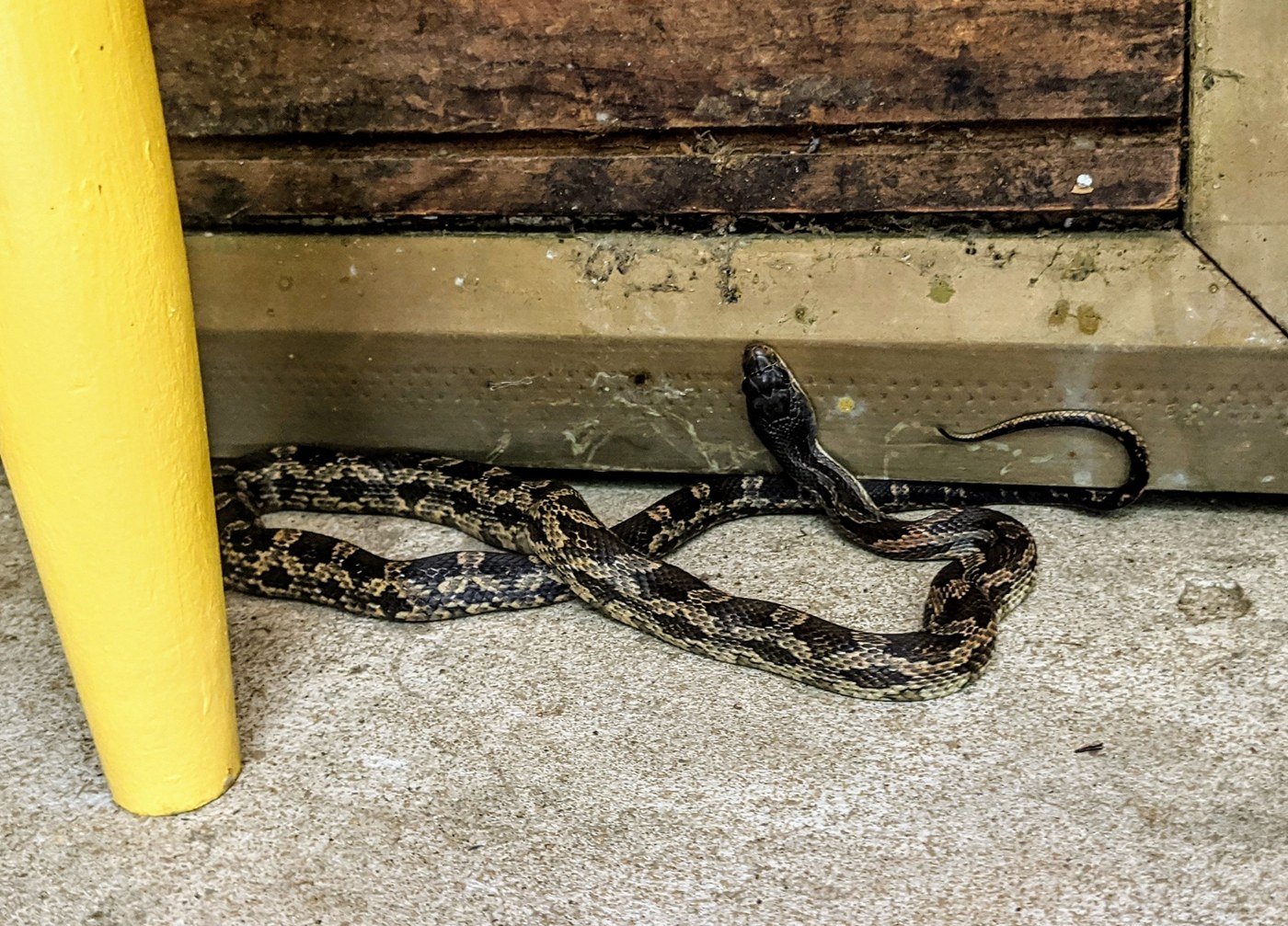
Seasonal Timeline
Texas rat snake is active through the warm months, mates in spring, lays eggs in early summer, and brumates in dens through winter. It hunts by day in cooler weather and shifts toward evening and night activity through the hottest part of a Texas summer.
Texas rat snake is active through the warm months, mates in spring, lays eggs in early summer, and brumates in dens through winter. It…
The activity clock flips twice a year, and it changes when people actually see this snake. In spring and fall, when daytime temperatures are moderate, the species is largely diurnal, which is when most homeowner sightings happen. Through the hot core of a Texas summer it shifts toward crepuscular and nocturnal foraging, so the snake is still working, just not while anyone is outside to notice.
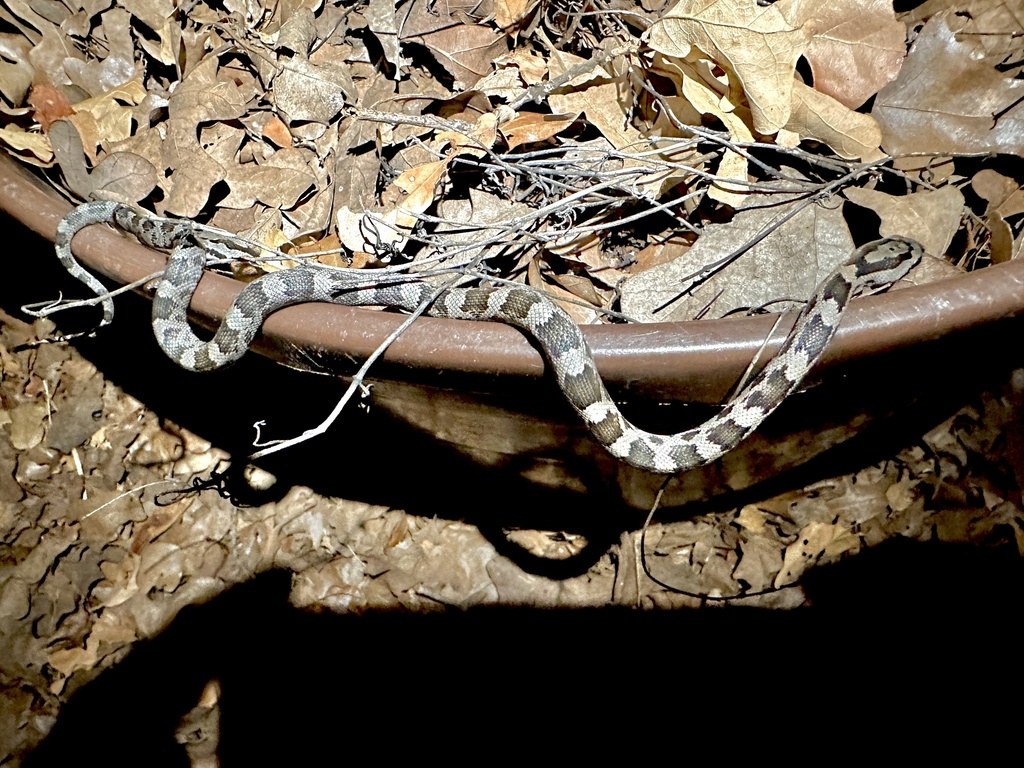
Two things put this species in front of people at predictable times. Spring is when adult males move to find and compete for females, which is the season for a large snake crossing open ground in daylight. Late summer and early fall is when hatchlings arrive, and a hatchling is under 15 inches, gray with brown blotches, and looks nothing like the black or tan adult it will become. A small blotched snake in a mulch bed in September is a very different-looking animal from the six-foot climber in the barn rafters, and both are the same species.
Where They're Found
Across the South Central region, the range is narrower than the region itself. Every source gives the same short state list beyond Texas: Louisiana, Arkansas, and Oklahoma. Tennessee and Kentucky fall outside this snake's documented range, and no source places the Texas rat snake color form in either state. Within Texas, Texas Parks & Wildlife Magazine describes the species across the eastern two-thirds of the state, and it does especially well where habitat types meet, at the seams between the Edwards Plateau, the Blackland Prairie, the East Texas woodlands, and the Post Oak Savannah.
One boundary is worth stating plainly, because it is easy to get wrong. The broader species this snake belongs to, Pantherophis obsoletus, ranges considerably farther north than those four states, reaching southeastern Iowa, Missouri, eastern Kansas, and southeastern Nebraska. The name Texas rat snake, and the color form it describes, does not travel that far. Every source that specifically describes the Texas rat snake rather than the species as a whole confines it to Texas, Oklahoma, Arkansas, and Louisiana, and that narrower reading is the one to trust. Alaska and Hawaii have no population. The entire documented range sits in a warm-temperate and subtropical band with no overlap with either state, and no snake of this genus is native to either.
On a specific property, this is a snake of forests, wooded river bottoms, rocky hillsides, and flat farmland, and it shows up around buildings because that is where the food is. It is an excellent climber and a strong swimmer, and it spends real time in trees. Barns, chicken coops, sheds, attics, and occasionally the inside of a house, including window blinds and kitchens, all appear in accounts of where the species has been found. In every case the snake is following rodents or bird nests rather than looking for shelter of its own.
Life Cycle
Color is the least reliable identification tool on this species, and that is unusual enough to say out loud. Most snakes can be identified by color. This one cannot. A Texas rat snake can be solid black, brown to black with orange or red tinges, or yellow to tan with brown and olive-green blotches, and which one you get depends largely on where in the state you are. On top of that regional variation, naturally occurring color morphs are a documented, heritable feature of this population rather than rare curiosities, including albino, leucistic, hypomelanistic, and xanthic forms. The leucistic form is an autosomal recessive trait first characterized in 1985 and now regularly captive-bred, and a 2021 peer-reviewed study sequenced the Texas rat snake genome specifically to characterize it. Practically, this means build, head shape, pupil shape, and behavior have to carry the identification, because color will not.

Egg
Hatchling
Juvenile2
Adult
Identification
Start with what it is not
The rattlesnake mix-up here is real and it works on two senses at once. Texas Parks & Wildlife Magazine states directly that this species hisses, strikes and vibrates its tail like a rattlesnake when cornered, and separately that its markings, a dark gray head with olive-brown splotches on a yellowish-tan body, get mistaken for a rattlesnake's, with its large size adding to the effect. A Central Texas identification guide independently reports the same misidentification. The reliable tells: a Texas rat snake has round pupils and no heat-sensing pits between eye and nostril, while a rattlesnake has vertical pupils and pits. There is no rattle at the tail tip, because the sound is the tail buzzing against dry leaves or debris. And the body is slender and evenly tapered rather than thick with a sharply triangular head.
Do not lead with color
Color will not settle it, so do not lead with color. The species runs from solid black, through brown to black with orange or red tinges, which is the classic Texas rat snake look, to yellow or tan with irregular brown to olive-green blotching. Southern populations tend more yellow, northern populations darker. Naturally occurring albino, leucistic, hypomelanistic, and xanthic morphs are documented as a heritable feature of this population as well. The belly is typically solid gray or white. If someone tells you the snake was too dark or too light to be a Texas rat snake, that reasoning does not hold for this species.
The belly gives away the climber
The underside is flattened rather than rounded in cross-section, with belly scales that project outward at the edges. Those edges work like cleats, which is how a snake this size gets up a tree trunk, a masonry wall, or a cliff face. It is also why an attic or a barn rafter is a realistic place to find one, and why exclusion work on this species has to move up off the ground.
A solid gray head, with a caveat
A solid gray head is reported as a field mark, and it is worth knowing with a caveat attached. One general reference states that among rat snakes, this is the only one with a solid gray head, which would be genuinely useful given how variable the body color is. That specific claim traces to a single general-reference source rather than to a state agency or university program, so treat it as a helpful hint rather than a confirmed diagnostic. Texas Parks & Wildlife Magazine does independently describe the classic look as a dark gray head with olive-brown splotches against a yellowish-tan body.
Size narrows the field without settling it
Typical adults run 3.5 to 6 feet, with records past 7 feet. In its range, a very long, slender, strong-climbing snake is far more likely to be this species than anything venomous. Length says nothing about venom, and a big snake reads as dangerous to most people whether or not it is.
The names travel further than it does
The names travel further than the species does. Chicken snake is the most common local name, earned by raiding coops and eating eggs, and the animal also gets lumped in with black snake and rat snake generally, neither of which identifies a species. On the science side, Texas rat snake is a color form and former subspecies name within Pantherophis obsoletus rather than a separately classified species of its own, and current treatments differ on whether any subspecies in that group should be recognized at all. The working convention every Texas source uses is to call the snake a Texas rat snake and get on with it, but the taxonomy behind that name is not settled.
Signs of Infestation
No structural damage to look for
There is no structural damage to look for, because this species does not cause any. It does not chew wiring, gnaw wood, tunnel into a foundation, or build a destructive nest. There is no gnaw pattern and no repair to plan for. With this snake, everything comes down to presence and access, not damage.
Look higher than you expect
The sighting itself is the main sign, and it is usually higher up than people look. Realistic places to find one: climbing a tree, fence, or exterior wall, coiled in a chicken coop or barn, in an attic, or occasionally inside a house, including behind window blinds or in a kitchen. A snake found at eye level or above is entirely consistent with this species, which is not true of most snakes in its range.
Shed skins in structural voids
Shed skins in outbuildings and structural voids. A long, translucent, patterned tube of skin in a barn, shed, attic, or wall void says a snake has been using the space, not just passing through it. Given the size this species reaches, the shed is often long enough to be startling on its own.
A buzz with no rattlesnake
A buzzing rattle sound with no rattlesnake attached. Cornered, the snake hisses loudly and vibrates its tail rapidly against dry leaves or debris, and the result genuinely sounds like a rattle. Texas Parks & Wildlife Magazine names this behavior directly. Treat the sound as a frightened snake rather than as proof of which species made it, and back away either way until you can identify it safely.
A smell sign, unusually
There is a smell sign here, which is unusual for a snake. Picked up or handled, this species sprays a strong, foul musk from glands near the base of the tail as a last-resort defense. A sharp musky odor in a coop or shed after something disturbed the snake is a real sign one was there.
Missing eggs in a poultry house
In a poultry structure, missing eggs are the sign to read carefully. The name chicken snake exists for a reason, and Texas Parks & Wildlife Magazine's own feature on the species centers on a homeowner finding one with its mouth around a whole chicken egg. Eggs disappearing with no digging, no scattered feathers, and no chewed entry point argues for a snake rather than a raccoon or an opossum.
Prevention and When to Call a Pro
The honest tradeoff
Start with the honest tradeoff, because this species is genuinely doing two things at once. Rodents, meaning rats, mice, and voles, are its primary prey, and sources covering the species in Texas describe it as a significant controller of rat and mouse populations around homes, barns, and farms. Those particular accounts come from regional wildlife-guide and reptile-reference sources rather than from a state agency, so read the benefit as well reported rather than as an agency finding. The same appetite and the same climbing ability are why it raids coops for eggs and nestlings. Both halves are true, and a decision about one snake should account for both rather than picking whichever framing is convenient.
Work on the rodents
Not just the snake. The snake is here because the food is here. Standard rodent exclusion and sanitation around structures, sealing food sources, clearing clutter and shelter, and cutting off access to feed, removes the reason a snake showed up in the first place. That is a far more durable fix than removing one snake and waiting for the next one to follow the same mice in.
Coops need cloth up high too
Coops and hutches need hardware cloth, and they need it up high too. Chicken wire is not a snake barrier. A snake of this size and strength can pass through it, and a proficient climber can reach an opening well above the ground. Screen poultry and rabbit structures with hardware cloth at a gauge small enough to block a snake, and close every seam, including where the roof meets the walls and around nest box access panels. Seal gaps at ground level and at the roofline both, because sealing only the bottom of a coop leaves the route this species actually prefers wide open.
Move the shelter away
That means away from the building. Firewood piles, brush piles, and dense ground cover against a foundation are exactly the shelter sites this species uses near structures. Pull them back from the walls. Trim tree limbs and vines that touch the roofline or siding as well, since a branch against a wall is a ramp for a snake that climbs this well.
Check your state rule first
Check your own state's current rules before you trap, collect, move, or sell one, because they differ inside this region. This is the part that catches people out, and the rules genuinely are not the same across the four states this snake occupies. In Texas, the state's own nongame wildlife regulations require a valid hunting license to collect non-venomous, non-game snakes from the wild, and a separate nongame collection or dealer permit for commercial sale, trade, or barter of wild-collected animals. A homeowner dealing with one nuisance snake is a different situation from commercial collection, but that license and permit threshold is real. Oklahoma's wildlife agency requires a hunting or fishing license simply to take or kill a nongame snake at all. Louisiana handles nuisance relocation through its own fishing-license-based permitting, a mechanism reported on a secondary compilation rather than read off the state agency directly, so treat it as a pointer to check rather than as a rule to rely on. Those are examples of how much the answer varies, not a rule you can carry across a state line. Rules change, so verify the current one where you are, and a licensed nuisance wildlife control operator is the safer default over a do-it-yourself trap purchase or a relocation drive.
If you are bitten
Clean it and watch it. There is no venom involved. Texas Parks & Wildlife Magazine says bites from this species typically heal in a day or two, which puts it in the category of a minor puncture or scratch rather than a medically serious injury. A reptile-keeping reference describes the same defensive biting in captivity. Clean the wound thoroughly anyway, then watch it for increasing redness, swelling, warmth, or pus, the same as any other break in the skin.
When to Call a Wildlife Control Operator
Call a licensed nuisance wildlife control operator when the snake has taken up residence inside living space or a structural void rather than passing through, when entries into a coop keep happening after the obvious gaps are sealed, or when a question comes up about collecting, selling, or relocating that runs into the state permitting above. Call as well if you cannot confidently separate the snake from a venomous species on sight. On this species that is not a minor concern, because the tail buzz and the head markings are a convincing rattlesnake impression at exactly the moment you are trying to decide. Identification uncertainty is by itself a good reason to bring in a professional rather than attempt a do-it-yourself catch and release. And if there is any chance a bite came from a venomous snake, treat it as an emergency and call 911 rather than waiting to settle the identification question.
Frequently Asked Questions
Is a Texas rat snake dangerous?
No. It is non-venomous. It will bite defensively if it is cornered or handled, and it is more willing to stand its ground than most harmless snakes, but Texas Parks & Wildlife Magazine describes the resulting bite as typically healing in a day or two. Clean the wound and keep an eye on it for signs of infection, the same as any other break in the skin.
Why does a Texas rat snake shake its tail and hiss like a rattlesnake if it isn't one?
It is a bluff, and a good one. Cornered, the snake hisses, vibrates its tail rapidly against dry leaves or debris to produce a rattle-like buzz, and may strike. Texas Parks & Wildlife Magazine describes exactly this behavior. There is no rattle on the tail and no venom behind the strike. Look for round pupils and the absence of heat-sensing pits between the eye and the nostril, and back off until you are sure either way.
Why is my Texas rat snake black instead of the tan and brown color I expected?
Because color is the least consistent thing about this species. The range runs from solid black, through brown to black with orange or red tinges, to yellow or tan with brown and olive-green blotches, with southern populations tending lighter and northern populations darker. On top of that, naturally occurring albino, leucistic, hypomelanistic, and xanthic morphs are documented as a heritable feature of this population, with the leucistic form characterized in a 2021 peer-reviewed genome study. Identify by build, pupil shape, and behavior rather than by color.
Do Texas rat snakes actually help with rodent control?
Yes, and that is worth weighing before removing one. Rats, mice, and voles are its primary prey, and sources covering the species describe it as a significant controller of rodent populations around homes, barns, and farms. The same snake will also take chicken eggs and nestlings from an unprotected coop, which is where the name chicken snake comes from. Both things are true at once, so the fix is usually to protect the coop rather than to remove the snake.
Why do people call it a chicken snake?
Because it climbs well enough to reach a coop and will eat eggs and nestlings when it finds them. Texas Parks & Wildlife Magazine's own feature on the species opens with a homeowner finding one with its mouth around a whole chicken egg. It is not the snake's main diet, which is mostly rodents, but it is the behavior that generates most of the calls.
Can I legally trap or relocate a Texas rat snake myself?
It depends on your state and your situation, and the answer genuinely changes across this snake's four-state range. Texas requires a hunting license to collect non-game snakes from the wild and a separate permit for commercial sale or trade. Oklahoma requires a hunting or fishing license just to take or kill a nongame snake. Louisiana runs nuisance relocation through its own fishing-license-based permitting. Those are examples rather than a single rule, they change over time, so verify the current rule where you are before doing anything, and route anything you are unsure about to a licensed nuisance wildlife control operator.
Sources
- Rat Snake: Agility and an Appetite. Size, classic coloring, climbing belly scales, the rattlesnake mimicry and misidentification, defensive behavior, coop and egg predation, and bite severity Texas Parks & Wildlife Magazine, Texas Parks and Wildlife Department
- Nongame, Exotic, Endangered, Threatened & Protected Species: the hunting license requirement to collect non-game snakes and the separate nongame permit for commercial sale Texas Parks and Wildlife Department
- Wildlife & Fisheries, Non-Game Species: the commercial-use permit requirement and the general Texas nongame framework Texas A&M AgriLife Extension Service
- Reptile & Amphibian Regulations: the Oklahoma hunting or fishing license requirement to take or kill a nongame snake Oklahoma Department of Wildlife Conservation
- Pantherophis obsoletus species account: activity pattern, defensive threat sequence and musk, diet and constriction, hatchling size, age at maturity, lifespan, and species-wide range Animal Diversity Web, University of Michigan Museum of Zoology
- Pantherophis obsoletus, Eastern Rat Snake: egg-laying timeline, incubation window, and the second-clutch note BioKIDS, University of Michigan
- Characterization of the Leucistic Texas Rat Snake Pantherophis obsoletus, 2021: the genome study documenting leucistic, albino, hypomelanistic, and xanthic color morphs as heritable traits Frontiers in Ecology and Evolution (peer-reviewed)
Image Credits
- Image: P.G.Th❤️mas via iNaturalist. CC BY 4.0.
License. - Image: Joshua via iNaturalist. CC BY 4.0.