Seasonal Timeline
Northern pocket gophers are active year-round, day and night, with no true hibernation. Mound-building activity peaks twice, once in spring as breeding gets underway and again in fall, with a burst of juvenile dispersal in between, typically in June.
Northern pocket gophers are active year-round, day and night, with no true hibernation. Mound-building activity peaks twice, once in spring…
There is no closed season for this animal. Unlike a groundhog, it does not seal itself in and sleep through winter. It slows briefly during the hardest summer heat and coldest winter stretches but never truly goes dormant, and it will tunnel through snowpack rather than wait it out.
Where They're Found
The northern pocket gopher has the greatest range of any pocket gopher species in North America, running on both sides of the continental divide from mid-Manitoba, Canada in the north to New Mexico in the south, as far west as the eastern Cascades and northern Sierra Nevada, and as far east as the Dakota Plains. Within that range it is the most common pocket gopher species in Colorado's mountain rangelands and forests, and Montana State University Extension documents the same damage pattern for Montana ranchland and turf. Wyoming and Idaho fall within the species' broader Rocky Mountain corridor range.
Soil, not climate, is what limits this animal. It needs light-textured, well-drained ground that allows gas exchange in and out of a tunnel. Continuously wet soil is unsuitable and shallow soil is prone to cave-ins, though the species does turn up in compacted clay and shallow rocky ground where it has to. Elevation is not a real barrier. It is found from about 3,000 feet to above 12,000 feet, and is most common between roughly 4,000 and 9,000 feet, in mountain meadows, tundra edges, valley grasslands, sagebrush steppe, farm fields, and ordinary residential turf. The species is not found in Alaska or Hawaii. Its documented range, and the federal habitat model built for it, are both scoped to the continental United States and southern Canada, and no published source places any population in either state.
Where its range overlaps Botta's pocket gopher, in parts of southern Colorado, the two species can be genuinely difficult to tell apart on looks alone, since both share the same small-clawed, smooth-incisor Thomomys body plan. Elsewhere in the Mountain West, the animal a homeowner is more likely to confuse this one with is a burrowing ground squirrel, not a mole. True moles are not established through most of the interior Mountain West, and a ground squirrel gives itself away by sitting openly at its own unplugged burrow entrance, which a pocket gopher almost never does.
Life Cycle
One litter a year is the standard figure for this species specifically. Broader wildlife-damage literature covering the pocket gopher genus as a whole sometimes describes two litters a year with a smaller brood size in parts of the group's overall range, but that is a genus-wide pattern drawn from other pocket gopher species, not a documented finding for the northern pocket gopher itself, so the two are worth keeping separate.

Pup
Juvenile
Adult
Identification
Start with the mound
You will almost never see the animal, so start with the mound. A pocket gopher spends nearly its whole life underground and surfaces only briefly, typically within about one body length of a tunnel opening. Identification in the field starts with the mound shape.
Size and build
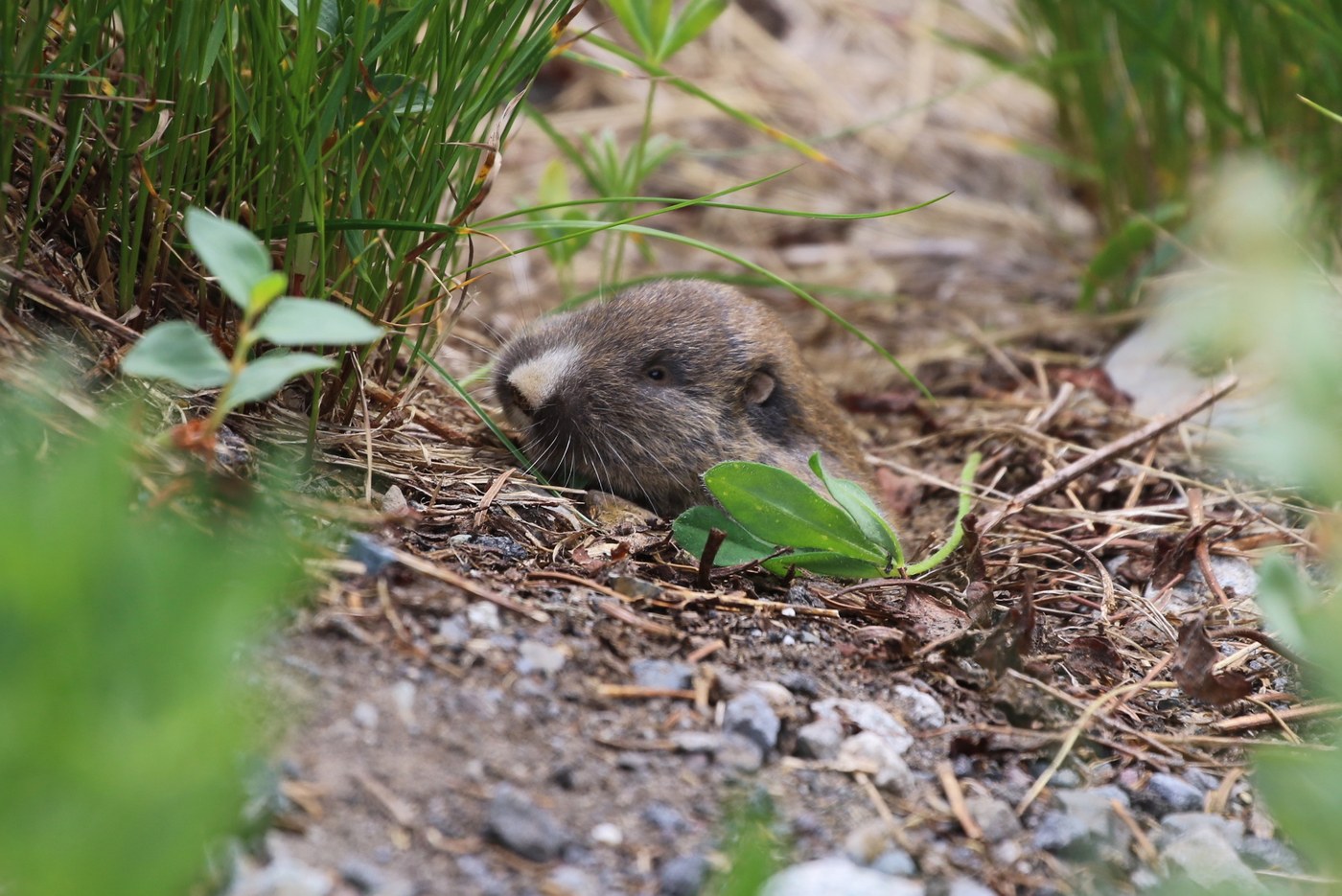
About 6½ to 10 inches long, not counting a short, sparsely-haired tail of roughly 1.5 to 3 inches. Males run larger than females. The body is built for one job: powerful forequarters, large-clawed front paws for digging, small ears and eyes, sensitive facial whiskers for navigating in the dark, and a tail the animal uses as a guide when it backs up through a tunnel.
The namesake cheek pouches
The cheek pouches are the family's namesake feature. External, fur-lined pouches sit on each side of the face and open outward. They are carrying bags for food, not part of the mouth, and the animal does not chew in them.
Color is a soft clue at best
Fur runs grayish-brown to brown to yellowish-brown and generally matches local soil color, but the northern pocket gopher is most often described as dark-colored with a whitish chin and belly. That matters, because it is one of the only things separating this species from Botta's pocket gopher.
Botta's, where they overlap
Botta's pocket gopher is the real look-alike, where the two overlap. In parts of southern Colorado where northern and Botta's pocket gopher ranges meet, university extension guidance says the two are often difficult to tell apart on physical grounds alone. The northern pocket gopher tends to run dark with a whitish chin and belly, while Botta's pocket gopher is often reddish-brown with a blackish chin and reddish belly, but coat color tracks soil color and is not fully reliable on its own.
Ground squirrels are the usual mix-up
Ground squirrels are the more common mix-up across most of the Mountain West. True moles are not established through most of the interior Mountain West, so the animal people actually confuse this one with day to day is a burrowing ground squirrel. The tell is behavior as much as looks: a ground squirrel is commonly seen sitting right at its own open, unplugged burrow hole in daylight, something a pocket gopher essentially never does.
Active year round, and all day
There is no quiet season and no time of day that rules this animal out. Pocket gophers are active year-round and around the clock. Fresh mounds appearing in the dead of winter, or overnight, are entirely normal.
Signs of Infestation
Fresh mounds, and their shape
Fresh soil mounds are the primary sign, and the shape is the tell. A pocket gopher mound is fan-shaped or crescent-shaped from above, roughly 12 to 18 inches wide and 4 to 6 inches high, with the entrance hole set off to one side and usually plugged with soil. A mole mound, by contrast, is round and volcano-shaped in profile with the plug centered, because a mole pushes soil straight up while a pocket gopher approaches the surface at roughly a 45-degree angle. One animal typically builds one to three mounds a day, so a yard full of mounds does not necessarily mean more than one gopher.
Snow casts in spring
In snow country, this species tunnels through snowpack and lines the tunnel with soil. When the snow melts, those soil-lined tunnels collapse into visible ropes and casts of dirt lying on top of the ground, a distinctive spring sign in Mountain West climates.
Girdled or clipped stems at ground level
Trees and shrubs get stripped or clipped right at the soil line, and under snow cover the damage can extend several inches up a stem, higher than most people think to check.
Plants wilting or vanishing
Plants wilting, dying, or disappearing entirely. Gophers eat roots and fleshy plant parts as they tunnel and will pull an entire small plant down into the tunnel from below rather than grazing it from above. A seedling that vanishes overnight without a trace above ground is a signature sign.
Damaged irrigation lines and buried cable
Tunnels running through the same soil layer as buried utility lines and drip or sprinkler irrigation put both in the path of gnawing and digging.
No distinctive sound or smell
Pocket gophers are rarely seen or heard, and the only documented vocalization is a squeal when caught in a trap or by a predator. No odor-based sign specific to this species is documented.
Prevention and When to Call a Pro
Not protected, and low risk
Pocket gophers are not protected in the Mountain West, and this is a low public health risk animal. No published source ties the northern pocket gopher to rabies or any other disease-transmission risk, and university extension guidance for both Colorado and Montana states plainly that pocket gophers are not protected by state or federal law. The realistic hazard with hands-on control is a bite from the animal's large incisors, which is why gloves are the standing advice during any direct handling.
Exclusion, with real dimensions
Exclusion works underground, and the dimensions are specific. Bury 1/4 to 1/2 inch mesh hardware cloth at least 18 inches deep around valued ornamental trees, shrubs, or garden beds, and leave 6 inches of fencing standing above ground. In shallow soil, keep the fence at least 2 feet from plant roots to avoid injuring them during installation. Cylindrical plastic mesh tubes placed over an entire seedling, root ball included, meaningfully cut damage to new plantings. This method is effective but expensive and labor-intensive at any real scale.
Protect buried lines and pipe
Protect buried utility lines and irrigation pipe specifically. Enclose cable and irrigation lines in lead, PVC, or other conduit thicker than 2.1 inches in diameter. Thinner soft-metal conduit is readily chewed through.
Trapping is the best home method
Trapping is the most reliable homeowner-level method. Body-gripping traps, sold under names like Macabee and Victor, or an open-pan trap design, are the standard tools. Locate the main tunnel by probing 12 to 18 inches from the plug side of a fresh mound, or set a trap directly in the shallower lateral tunnel branching off it. Favor recently built mounds, which are taller, darker, and less compacted than old, flattened, sun-bleached ones. Use enough traps for every fresh mound, check them at least once every 24 to 48 hours, and move any trap that has not caught anything in that window. Trapping works best in spring and fall, when mound-building peaks.
On ranch ground, change habitat
On ranch, pasture, or hay ground, larger-scale habitat changes help. Rotating alfalfa to annual grain crops removes the large underground roots that sustain gophers, grain buffer strips around a hay field slow reinvasion, multi-rooted alfalfa varieties tolerate feeding damage better than single-taproot varieties, and flood irrigation on properly leveled ground can suppress a population outright by fouling the gas exchange and the animal's fur and claws. None of these apply to an ordinary residential yard, but they are the standard toolkit at acreage scale.
What does not work
This is worth stating plainly, so you do not spend money finding out. No repellent product or frightening device, including noise-makers, vibration stakes, or ultrasonic devices, has held up in university research trials against pocket gophers. Fumigation with smoke or gas cartridges is generally ineffective, because the animal senses the gas and plugs the tunnel section before it takes effect. Shooting is impractical, since the animal is almost never seen above ground. Gasoline, propane, or vehicle-exhaust fumigation are not recommended by university extension guidance because of real explosion and toxic-fume hazards.
Rodenticides carry restrictions
Rodenticides exist but carry real restrictions that vary by state. Colorado's registered active ingredients for pocket gopher control include strychnine, zinc phosphide, chlorophacinone, and diphacinone, all of which must be placed underground directly into the tunnel system, never left on the surface. Because label registrations and legal products change over time and differ by state, confirm the current legal options with your own state's extension service or department of agriculture before buying anything, rather than assuming one state's list applies everywhere in the region.
When to Call a Pest Control Professional
Bring in a licensed pest or wildlife control operator once mound activity is established and spreading across a large area after real trapping effort has failed, once tunneling threatens a ditch bank, earthen dam, pond, or other water-control structure, which is the most expensive damage category this animal produces, or when the control method under consideration calls for a Restricted Use Pesticide or burrow-builder equipment rather than a homeowner trap set.
Frequently Asked Questions
How can I tell a northern pocket gopher from Botta's pocket gopher?
It's genuinely difficult by looks alone, since both share the same smooth-incisor, small-clawed body plan. The best color clue is that the northern pocket gopher tends to run dark-colored with a whitish chin and belly, while Botta's pocket gopher is often reddish-brown with a blackish chin and reddish belly, though coat color varies by local soil and is not fully reliable on its own.
Is it legal to trap or remove a pocket gopher in Colorado or Montana?
Yes. Pocket gophers are not protected by state or federal law in either state, though it is still worth checking current rules with your state wildlife agency before starting any control program, since regulations can change.
How do I tell a gopher mound from a mole mound or a ground squirrel hole?
Shape and behavior both give it away. A gopher mound is fan-shaped or crescent-shaped with the plugged entrance off to one side, while a mole mound is round and volcano-shaped with the plug centered. A ground squirrel, unlike either burrowing animal, is commonly seen sitting right at its own open, unplugged burrow entrance during the day.
Will a pocket gopher get into my house or damage my foundation?
No. This is an entirely outdoor, burrowing species that spends nearly its whole life below ground in turf, garden beds, and open land. Pocket gophers are not documented entering attics, walls, or crawl spaces.
Do pocket gophers hibernate in the winter?
No. They stay active underground year-round, digging through and beneath snowpack rather than going dormant, though activity does slow briefly during the coldest and hottest stretches of the year.
Sources
- Pocket Gophers Internet Center for Wildlife Damage Management (University of Nebraska-Lincoln / USDA APHIS Wildlife Services)
- Thomomys talpoides (northern pocket gopher) Animal Diversity Web, University of Michigan Museum of Zoology
- Managing pocket gophers in Colorado Colorado State University Cooperative Extension
- Non-Chemical Pocket Gopher Control Montana State University Extension, Animal and Range Sciences
- Northern Pocket Gopher (Thomomys talpoides) species profile U.S. Fish & Wildlife Service
- Northern Pocket Gopher (Thomomys talpoides) mNPGOx_CONUS_2001v1 Habitat Map U.S. Geological Survey
Image Credits
- Image: Henggang Cui via iNaturalist. CC0 1.0.
License.