Seasonal Timeline
Western painted turtles become active in mid-spring, when water temperature reaches roughly 15 degrees C, and stay active into late September or October. The behavior that actually brings them into contact with people is the overland nesting walk by adult females, concentrated from late May through early July with June as the core month.
Western painted turtles become active in mid-spring, when water temperature reaches roughly 15 degrees C, and stay active into late…
The one date range a homeowner needs is late May through early July. That is when adult females leave the water and travel overland to nest, and it is the reason a turtle turns up on a lawn, a driveway, a trail, a levee, or a gravel shoulder. Oregon's own guidance puts nest sites usually within about 325 feet of occupied water, and the Canadian status report for this subspecies records females nesting up to 150 meters out. She is not lost and she is not sick.
The nesting itself is quick and easy to miss. The whole process generally takes about an hour, usually at dawn, dusk, or late afternoon. She digs a flask-shaped cavity about four inches deep using only her hind feet, lays, refills it, and packs the soil down with her hind limbs. Once she leaves, a completed nest reads as a small patch of disturbed dirt and nothing more. Females frequently abandon a first attempt: at one British Columbia site only 20 percent of nesting attempts were completed in the first location chosen, because of poor substrate or interference.
The part of the calendar nobody expects is the winter, and it splits by age. Adults and juveniles spend it dormant on the muddy bottom of the pond, under ice, not breathing. Hatchlings do something entirely different. They hatch in late summer or early fall and then stay inside the nest chamber underground, only about three to five inches below the surface, all the way through winter, emerging the following spring. That means an unremarkable patch of sunny open ground near a pond can hold a live cohort of turtles from July until April, invisible from above. Tilling, regrading, or running machinery over that ground in autumn or winter destroys them.
Incubation length here is a Pacific Northwest figure, not a borrowed one. The Canadian status report cites regional work putting incubation at 72 to 104 days in the Pacific Northwest, against an average of about 76 days across nests generally.
Where They're Found
This turtle's Pacific Northwest range crosses just two states, and they treat the same animal very differently.
Oregon holds a narrow sliver of range and protects it hard. The western painted turtle is confined to the northern part of the state: north-central and northeastern Oregon, primarily the Columbia River Basin, plus the northern Willamette River Basin, with most known populations north of Salem, though animals have been documented as far south as Eugene. Oregon's wildlife agency lists it as a Conservation Strategy Species in the Blue Mountains, Coast Range, Columbia Plateau, East Cascades, West Cascades, and Willamette Valley ecoregions, and notes that in the three Cascades and Plateau ecoregions it occurs only along the Columbia River itself. It is one of only two turtle species native to Oregon, the other being the western pond turtle.
Washington has it nearly everywhere and gives it no special status at all. Washington's wildlife agency documents the painted turtle in all of the state's ecoregions, with most occurrences at lower elevations of eastern Washington, the Columbia Gorge, and the Puget Trough. The state's conservation status for it is apparently secure, the species appears common, and the agency says no specific conservation actions seem needed at this time.
The Puget Sound population is probably not native. Washington's own species page states the turtle was likely introduced to the Puget Sound region, based on relatively recent records from 1958 through 1967 associated with urban areas, though it is now well distributed there. The same agency's broader amphibian and reptile overview adds that while the painted turtle appears common in Washington, identifying where native populations actually occur is useful, which is a state agency saying plainly that it does not yet know which of its own populations are original. West of the Cascades the species also runs into a hard habitat limit: the agency notes it uses shrub-steppe, grassland, and forest terrestrial habitat but cannot survive in western Washington's wet, cool forest.
The wrong turtle often gets credited with this one's conservation story. Washington's genuinely imperiled native turtle is the northwestern pond turtle, a different species, which fell to two Columbia River Gorge populations totaling under 200 animals in the 1990s and has since recovered to roughly six populations and about 800 turtles. That is not this animal. And in California, painted turtles are introduced, not native, so there is no safe general claim that this is the West Coast's native pond turtle.
Beyond the Pacific Northwest. The painted turtle is the most widespread native freshwater turtle in North America, running coast to coast, and the western subspecies alone occupies the largest share of that range, from western Ontario to British Columbia and south into the central United States.
Alaska and Hawaii both have no population. No source places western painted turtle in Alaska in any capacity, native or introduced; the subspecies' northern limit is described as southern British Columbia, the southern prairies, and southwestern Ontario, with expansion limited by how short the active season gets and how cold egg incubation runs. No source places it in Hawaii either. Its entire described distribution is continental North America.
On the ground, three features define the habitat, and only one of them is water. The turtle needs marshy ponds, small lakes, sloughs, canals, or slow off-channel river reaches with muddy bottoms and abundant aquatic vegetation. It needs sunny basking structure, meaning logs, rocks, or vegetation hummocks. And it needs open, sparsely vegetated, well-drained ground with southern exposure and little tree canopy, within roughly 325 feet of the water, to nest in. Take away any one of the three and the population fails even if the pond itself is untouched. Oregon's guidance is explicit that wetland protection alone does not cover the upland nesting ground, and that this is one of the main reasons the species is in trouble there.
Life Cycle
How the hatchlings survive winter underground is a genuine, unresolved argument between two research groups, and both sides are worth knowing. One body of work, from Kenneth Storey's laboratory, shows hatchling painted turtles surviving actual freezing of roughly half their body water: at least 24 hours at minus 4 degrees C with 53.4 percent of body water frozen, and as long as 11 days at minus 2.5 degrees C with 50.2 percent frozen. Canadian sources restate that as tolerance down to about minus 10 or minus 11 degrees C in the nest.
A second body of work, from Gary and Mary Packard's laboratory, reaches the opposite conclusion about what happens in the field. In artificial nests, half of hatchlings survived exposure between minus 8 and minus 9 degrees C, and some to near minus 11, while remaining unfrozen and supercooled. Every animal in those tests that was actually inoculated by ice from the surrounding soil died. That group's position is that freeze tolerance plays at most a minor role in nature and that supercooling is the real strategy.
What both sides agree on is the part that changes what a property owner should do. The turtles are in shallow ground all winter, and the physical character of the soil around them is a dominant predictor of whether they live. In a controlled comparison of Indiana and Nebraska nests, soil moisture and the ice-forming particles present in the soil mattered more than which population the turtles came from. So the meaningful protective act is not doing anything to the turtles. It is leaving the sunny patch of open ground near the pond undisturbed from July until spring.
One honest limit on all of those numbers. Every subzero figure above comes from populations in Ontario, Nebraska, Indiana, northern Illinois, or New Jersey, at the continental and northern edge of the range. No Pacific Northwest overwintering study for this species was found, and nest soil at minus 8 degrees C is a continental-interior condition that most of western Oregon and western Washington simply will not produce. What transfers to this region is the timing and the location, hatchlings underground in a shallow nest from late summer until spring, not the specific temperature thresholds.
One more number worth carrying. Populations of this species run on adult longevity, not on reproductive output. Roughly 0.9 percent of eggs produce an adult, but an adult then survives at better than 98 percent per year for decades. Removing one 30-year-old female from a pond costs that population more than a raccoon eating every nest on the bank.

Mating
Nesting Migration and Egg-Laying
Eggs and Incubation
Hatchling in the Nest
Juvenile
Adult
Identification
The underside is the identification
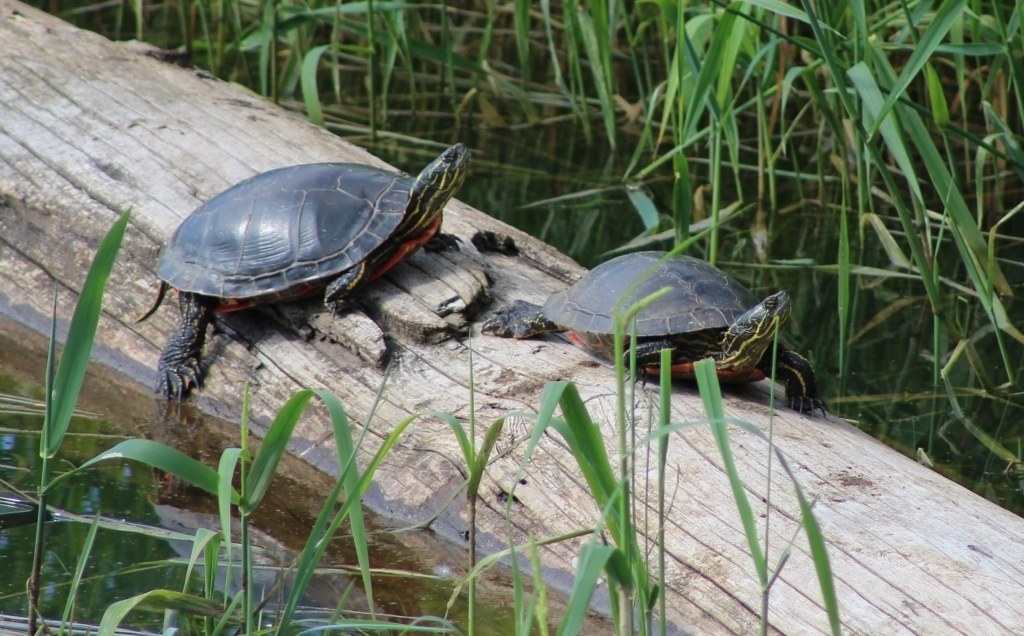
It is what the name is about. The plastron is bright red to orange carrying a large dark, irregular central figure that in this subspecies spreads along the shell seams in a reticulated pattern. Oregon's own species account notes that every individual's plastron pattern is unique. The upper shell is smooth, relatively flat, and dark green to brown to black, with bright red or orange markings along the marginal scutes at the shell edge.
Yellow striping on dark skin
Bright yellow striping on black or olive skin. Head, neck, legs, and tail all carry contrasting yellow stripes. Combined with the red shell edging, no other turtle in the Pacific Northwest looks like this.
The sexes differ genuinely
Size, and the sexes are genuinely different animals. Females reach about 10 inches of carapace length and males about 6. Published maximums for the subspecies run to about 25.5 to 26 cm, and this is the largest of the three painted turtle subspecies. Hatchlings are roughly an inch long. Males also carry conspicuously elongated front claws used in courtship and longer, thicker tails; females have short thin tails.
Group basking is an identifier
Group basking in the open is a behavioral identifier, not just a habit. Painted turtles bask several times a day through the active season and compete for the best sunny perches, which is why they end up lined up or stacked on a single log rather than spread across several. If a pond has turtles visible on a log in the sun, that alone rules out the snapping turtle, which North Carolina's wildlife agency states directly is more aquatic than most turtles and rarely basks.
A beak detail almost no other page carries
Painted turtles have two small tooth-like projections at the front of the upper beak, called bicuspid tomiodonts, which separate them from the other freshwater turtles they share water with.
Red-eared slider, the usual mistake
Look-alike 1, red-eared slider (Trachemys scripta elegans), the most common mistake in this region. This is the released pet turtle and it is now widespread in Pacific Northwest ponds. The tell is the head, not the shell: a slider carries a broad red or orange patch immediately behind each eye, which a painted turtle never has, and its plastron is yellow with dark smudges rather than red or orange with a reticulated central figure. Getting this one right matters legally, because Oregon classifies the red-eared slider as prohibited nonnative wildlife while treating the painted turtle as protected.
Western pond turtle, Oregon's other
Look-alike 2, western pond turtle (Actinemys marmorata), Oregon's other native turtle. The two co-occur in northwestern Oregon. The pond turtle is a drab animal: olive to dark brown with dark flecking or reticulation, no red or orange anywhere on it, and no bright yellow striping. Any red or orange on the shell edge or the underside rules the pond turtle out immediately. This is the identification to be most careful with, because the northwestern pond turtle is the genuinely imperiled turtle of the Pacific Northwest.
Snapping turtle changes what you do
Look-alike 3, common snapping turtle (Chelydra serpentina), which is not similar but is the one that changes what you should do. A snapping turtle has a disproportionately large head it cannot withdraw into its shell, a small cross-shaped plastron that leaves the limbs and much of the underside exposed, and a long tail roughly as long as its carapace carrying a saw-toothed row of pointed scales. None of that describes a painted turtle. The action split is sharp: a painted turtle gets left alone, while a snapping turtle in Washington is a prohibited invasive species the state wants reported and one that can bite hard on land. It has its own full page here.
Signs of Infestation
Several basking, sliding off at once
Several turtles basking together on a log, rock, dock, or bank in full sun, sliding into the water at once when you approach. This is the normal, healthy sign of a resident population and it is not evidence of a problem. Dark smooth shells with red or orange edging and bright yellow head stripes are the confirmation.
An adult crossing ground in June
An adult crossing a lawn, driveway, trail, levee, or gravel shoulder between late May and early July, moving steadily in one direction. That is a nesting female. She will be within roughly 325 feet of water and she is going somewhere specific.
Disturbed soil in a sunny spot
A small patch of freshly disturbed, packed-down soil in a sunny, sparsely vegetated spot near the water. The cavity underneath is only about four inches deep and refilled, so a completed nest is easy to walk past. The version people actually notice is a predated nest, dug open by a raccoon, skunk, or coyote with eggshell scattered around it.
A turtle stuck in a pool
A turtle in a swimming pool that cannot get out. Pools trap wildlife that falls in and cannot climb a vertical wall. This is the specific complaint that puts this species on a pest control call sheet at all, and it is a rescue rather than a control problem.
No sound and no smell
No source describes any characteristic noise or odor for this species. Every sign of it is visual.
What you will not find is damage
No source attributes structural damage, burrowing under anything, landscape destruction, or crop loss to the western painted turtle. If something on the property is actually damaged, the turtle is not the cause and something else needs looking at.
Prevention and When to Call a Pro
Check the state rule first
Start here: check the current rule with the state wildlife agency before doing anything to a turtle. Turtle law in the Pacific Northwest is species-specific, differs between Oregon and Washington, and changes. A licensed nuisance wildlife control operator or a call to the state agency is the correct default, not a trap purchase. The specifics below are cited as of the research date and should be verified locally rather than assumed still current.
Let a walking turtle walk
A turtle walking across your yard in June should be left to walk. Oregon's wildlife agency states it plainly: if you see a turtle on land, the best thing to do is let it continue on its path, and do not try to return it to water. If it is on a road or a trail and you can safely intervene, move it to the far side pointed in the same direction it was already heading. Carrying it back to the pond it just left only means it starts the trip over.
Do not collect or move it
Do not collect it, keep it, or move it somewhere else. In Oregon the western painted turtle is named by binomial in the state's protected wildlife rule, is listed as Sensitive-Critical on the State Sensitive Species List, and is categorized as protected nongame wildlife, making it unlawful to take, catch, hold, or possess one dead or alive. The state agency's own wording is that both native turtles are protected by state law and it is illegal to take them from the wild or keep them as pets. In Washington the conservation status is the opposite, apparently secure with no designation, but the operative rule is still restrictive: the state's wildlife agency states it is unlawful to take from the wild or import, hold, possess, offer for sale, sell, or release all turtle species without the proper license.
Protect the dry ground too
Protect the dry ground, not just the pond. Oregon's best management guidance is explicit that the open upland within roughly 325 feet of the water is what reproduction depends on, and that wetland protection alone does not cover it. In practice: do not till, regrade, pave, or run machinery over open sunny ground near a pond from late May until the following spring, because eggs are in it all summer and live hatchlings are in it all winter.
Cage nests instead of moving them
Where raccoon predation is a real problem at a known nest site, Oregon's own recommended action list includes using wire cages over the nest, alongside providing basking structures, keeping nesting habitat open, and controlling invasive plants and animals.
Give the pool a way out
Keep it covered too. The documented fixes for wildlife falling into pools are a commercially available escape ramp and a pool cover when the pool is not in use. To get an animal out that is already in, use a net, pool skimmer, or broom rather than reaching in. Once it is out, leave it alone nearby to recover and keep people and pets away rather than driving it to a new pond.
Wash your hands after contact
Wash your hands after any contact with a turtle, its water, or anything it touched. Federal health guidance is that any turtle can carry Salmonella in its droppings even when it looks perfectly healthy and clean, and that those germs spread readily to the animal's body, its water, and its surroundings. Turtles with shells under 4 inches are a specifically known source of human illness, which is why federal regulation prohibits selling or distributing them. Children under 5, adults 65 and older, and anyone with a weakened immune system are the higher-risk groups and should not handle one at all.
Never release a pet turtle
Never assume a pond turtle is a candidate to become a pet, either. Preventing pet turtle releases is named as a specific conservation action for this species in Oregon, and released red-eared sliders and snapping turtles are exactly the invasive competition the state names as a threat to its two native turtles.
Report rather than act
Report what you see rather than acting on it. Oregon asks the public to report turtle sightings, which helps the agency locate native populations and also find invasive turtles it may try to remove. That is a far more useful contribution than a DIY removal, and it is legal.
Call a rehabilitator for an injury
Call a licensed wildlife rehabilitator for an injured turtle, including one hit by a mower or a vehicle or pulled out of a chemically treated pool. Note exactly where it was found so it can be returned to the same place after recovery, since these animals know their home water.
Call if you cannot identify it
Call the state wildlife agency or a licensed operator before touching any turtle you cannot confidently identify. The correct action genuinely diverges by species. A painted turtle is left alone. A red-eared slider is prohibited nonnative wildlife in Oregon, though Washington classifies the pond slider only as regulated and currently makes no recommendation to remove them from its waters. A snapping turtle is a prohibited invasive in Washington at the family level, and it is the one turtle in this group with real bite reach on land. Identification comes before action, not after.
Call before disturbing a nest site
Call before disturbing ground you think might hold a nest. If a nesting female was seen on a piece of ground earlier in the season and that ground now needs work, the agency or a licensed operator can advise on timing. Waiting until after spring emergence usually costs nothing and saves an entire cohort.
State-regulated - verify locally
Frequently Asked Questions
There is a turtle walking across my yard, what should I do?
In late May through early July it is almost certainly a female looking for somewhere to lay eggs, and the right answer is to leave her alone. Oregon's wildlife agency advises letting a turtle on land continue on its path and specifically not returning it to water. If it is on a road and you can safely help, put it on the far side pointed in the same direction it was already heading. She will finish and go back to the water on her own.
How do I tell a native painted turtle from a red-eared slider?
Look at the head first. A red-eared slider has a broad red or orange patch right behind each eye. A western painted turtle has yellow stripes on the head and no ear patch at all. If you can see the underside, that settles it: the painted turtle's plastron is bright red to orange with a dark reticulated figure down the middle, while a slider's is yellow with dark smudges. The distinction matters legally, since Oregon protects one and prohibits the other.
Is it legal to keep a painted turtle I found in my yard?
No. Oregon names the western painted turtle in its protected wildlife rule and its own agency states that both of the state's native turtles are protected by state law and it is illegal to take them from the wild or keep them as pets. Washington gives the species no special conservation status, but its wildlife agency still states that taking any turtle species from the wild, holding it, possessing it, or releasing it requires the proper license. Either way, the answer is no.
Will painted turtles damage my pond, eat my fish, or hurt my kids?
No documented property damage is attributed to this species. It is an omnivore that eats aquatic invertebrates, plants, carrion, and the occasional small fish or frog, and it nests in a hole about four inches deep that it fills back in itself. The one genuine health point is Salmonella: any turtle can carry it in its droppings even when it looks clean, so wash hands after any contact with the animal or its water, and keep children under 5 from handling one.
A turtle fell into my swimming pool. What now?
Get it out with a net, pool skimmer, or broom rather than reaching in, then set it down nearby and leave it alone to recover, keeping people and pets away. Do not drive it to a different pond. To stop it happening again, put a cover on the pool when it is not in use and add a commercially available wildlife escape ramp, which is the documented fix for animals that fall in and cannot climb a vertical wall.
Where do the turtles go in winter? Our pond looks empty from October on.
They are on the bottom, and the adults are doing something remarkable. Western painted turtles tolerate submergence without oxygen longer than any other four-limbed animal known, surviving more than 170 days at 3 degrees C. Published durations for this feat do vary, running roughly 3 to 4 months in one review and up to 5 months in another; the 170-day figure is the one reported specifically for the western painted turtle rather than for the species as a whole. They manage it by dropping their metabolism to roughly a tenth of its normal rate and then using their own shell and skeleton as a chemical buffer, releasing carbonates to neutralize the lactic acid and absorbing the lactate itself into the bone. The hatchlings are not in the pond at all. They are still underground in the nest, a few inches deep, waiting for spring.
Is this the same as a snapping turtle?
No, and they are not even in the same family. A snapping turtle has a huge head it cannot pull into its shell, a small cross-shaped underside that leaves the limbs exposed, and a long saw-toothed tail. It also rarely basks, so a turtle sunning itself on a log is almost never one. The difference matters: a painted turtle should be left alone, while the snapping turtle is a prohibited invasive species in Washington that the state wants reported, and it can bite hard on land. There is a separate page here covering it in full.
Sources
- Painted turtle (Chrysemys picta): Washington conservation status of apparently secure, distribution across all Washington ecoregions, the statement that the Puget Sound population was likely introduced based on 1958 to 1967 urban records, size range, description, habitat, and the inability to persist in western Washington's wet cool forest Washington Department of Fish and Wildlife
- Amphibians and reptiles of Washington: painted turtle described as common with the note that identifying where native populations actually occur is useful, the northwestern pond turtle recovery from under 200 animals in two Gorge populations to roughly 800 in six, and the list of aquatic invasive species including snapping turtle and red-eared slider Washington Department of Fish and Wildlife
- Pond slider (Trachemys scripta): red-eared slider as a subspecies of pond slider, the regulated aquatic animal classification under RCW 77.135.030, the absence of any current recommendation to remove pond sliders from Washington waters, and the WAC 220-450-030 statement that taking from the wild, holding, possessing, selling, or releasing all turtle species requires the proper license Washington Department of Fish and Wildlife
- WAC 220-450-030, Live wildlife: taking from the wild, importation, possession, transfer, and holding in captivity Washington State Legislature
- WAC 220-640-050, Prohibited level 3 species: Reptiles, Family Chelydridae, all members, snapping turtles Washington State Legislature
- Guidance for Conserving Oregon's Native Turtles including Best Management Practices, March 2015: Sensitive-Critical listing, protected nongame wildlife status under OAR 635-044 and the unlawful-to-possess language, the S2 imperiled state rank, US Forest Service and Bureau of Land Management Sensitive designation, Oregon range, nesting habitat within 325 feet of water, hatchling overwintering in the nest chamber, and the prohibited status of red-eared slider and snapping turtle under OAR 635-056 Oregon Department of Fish and Wildlife
- Western Painted Turtle, Oregon Conservation Strategy and State Wildlife Action Plan species page: description, females to 10 inches and males to 6, the unique individual plastron pattern, group basking, habitat requirements, ecoregion listings, limiting factors, and the recommended actions including nest caging and preventing pet turtle releases Oregon Department of Fish and Wildlife
- Turtles in Oregon: the two native turtle species, Conservation Strategy Species status, habitat needs including basking logs and open nesting ground, and the identification of red-eared slider and snapping turtle as invasive competitors along with bullfrog predation Oregon Department of Fish and Wildlife
- Let turtles cross the road; nesting habitat is key to their survival, 22 May 2020: the May through July nesting window, the guidance to let a turtle on land continue on its path and not return it to water, moving a turtle across a road in the direction it was headed, both native turtles being protected by state law and illegal to take or keep, and the request for public sighting reports Oregon Department of Fish and Wildlife
- OAR 635-044-0130, Protected Wildlife: unlawful to take, capture, hold, release, or possess the listed wildlife, which names western painted turtle (Chrysemys picta bellii) and western pond turtle (Actinemys marmorata) under Reptiles Oregon Secretary of State, Oregon Administrative Rules
- Conservation Assessment for the Western Painted Turtle (Chrysemys picta bellii) in Oregon: the Oregon S2 imperiled versus Washington S5 and no-special-status comparison, the G5 global rank, the transcontinental species range and the subspecies range, the narrow Oregon distribution, and the note that painted turtles are introduced in California Oregon Wildlife Institute, prepared for USDA Forest Service Region 6 and USDI Bureau of Land Management
- Western Painted Turtle (Chrysemys picta bellii) COSEWIC assessment and status report, 2012, chapters 2 and 8: subspecies description and plastral-seam mark, nesting within 150 m of water, the 10 cm flask-shaped nest and hind-foot excavation and packing behavior, the one-hour nesting process, the 20 percent first-site completion rate at Revelstoke, clutch size and egg dimensions, the 76-day average and 72 to 104 day Pacific Northwest incubation figures, the single 28 degree C pivotal temperature for sex determination, survivorship, age at maturity by latitude, and lifespan over 50 years Environment and Climate Change Canada and COSEWIC
- Western Painted Turtle species account: maximum carapace length, hatchling size, plastron and striping description, the bicuspid tomiodonts of the upper beak, male elongated front claws, clutch size, nesting window, hatchling overwintering, diet, basking, multi-wetland home ranges, and lifespan Canadian Herpetological Society
- Changes in the material properties of the shell during simulated aquatic hibernation in the anoxia-tolerant painted turtle, Journal of Experimental Biology 2018: western painted turtles tolerate anoxic submergence longer than any other tetrapod, surviving more than 170 days at 3 degrees C, with the shell and skeleton releasing calcium and magnesium carbonates while sequestering lactate and protons PubMed, peer-reviewed
- Hibernating without oxygen: physiological adaptations of the painted turtle, The Journal of Physiology 543(3), 2002: metabolic depression, shell and skeletal buffering, survival of 3 to 4 months at 3 degrees C without oxygen, circulating lactate of 150 mmol per liter or more, and 40 to 45 percent of total body lactate residing in shell and bone National Institutes of Health, National Library of Medicine (PubMed Central)
- Activation of antioxidant defenses in response to freezing in freeze-tolerant painted turtle hatchlings: hatchlings of C. p. marginata and C. p. bellii overwinter in the natal nest, survive at least 24 hours at minus 4 degrees C with 53.4 percent of body water frozen and up to 11 days at minus 2.5 degrees C with 50.2 percent frozen Cryobiology, Storey laboratory, Carleton University, peer-reviewed
- The Basis for Cold Tolerance in Hatchling Painted Turtles (Chrysemys picta), Physiological Zoology 68(1): 50 percent survival between minus 8 and minus 9 degrees C while supercooled and unfrozen, some to near minus 11, and universal mortality among animals inoculated by ice, supporting supercooling rather than freeze tolerance as the field strategy Packard and Packard, University of Chicago Press, peer-reviewed
- Characteristics of nest soil, but not geographic origin, influence cold hardiness of hatchling painted turtles: soil moisture and constituent ice nuclei as the dominant predictors of overwinter survival in a controlled Indiana and Nebraska comparison Journal of Thermal Biology via PubMed, peer-reviewed
- Salmonella Outbreak Linked to Small Turtles, August 2024, and its investigation update: any turtle can carry Salmonella in its droppings even when it looks healthy and clean, germs spread to the animal's body, its water, and its surroundings, 27 of 29 interviewed patients reporting turtle size reported a turtle under 4 inches, and the higher-risk groups of children under 5, adults 65 and older, and immunocompromised people Centers for Disease Control and Prevention
- 21 CFR 1240.62, Turtles intrastate and interstate requirements: sale, holding for sale, and public distribution of live turtles with a carapace length under 4 inches, and of viable turtle eggs, is prohibited, with narrow scientific, educational, and exhibitional exceptions U.S. Food and Drug Administration, via the electronic Code of Federal Regulations
- Wildlife in My Pool: pools trapping wildlife that cannot climb out, commercially available escape ramps and pool covers as prevention, net or pool skimmer removal, and leaving the animal alone to recover afterward Wildlife Illinois, University of Illinois Extension and Illinois Department of Natural Resources
- Injured Turtles: contact a licensed wildlife rehabilitator experienced with native turtle care, and note exactly where the turtle was found so it can be returned after recovery New Hampshire Fish and Game
- Meet Alberta's Turtle: activity beginning when water reaches about 15 degrees C, the operating body temperature driving basking, competition for premium basking sites, and winter submergence in mud at about 4 degrees C Royal Alberta Museum
- Common Snapping Turtle species page: rarely basks, in contrast to painted turtle group basking North Carolina Wildlife Resources Commission
Image Credits
- Image: 66dodge via iNaturalist. CC BY 4.0.
License.