Seasonal Timeline
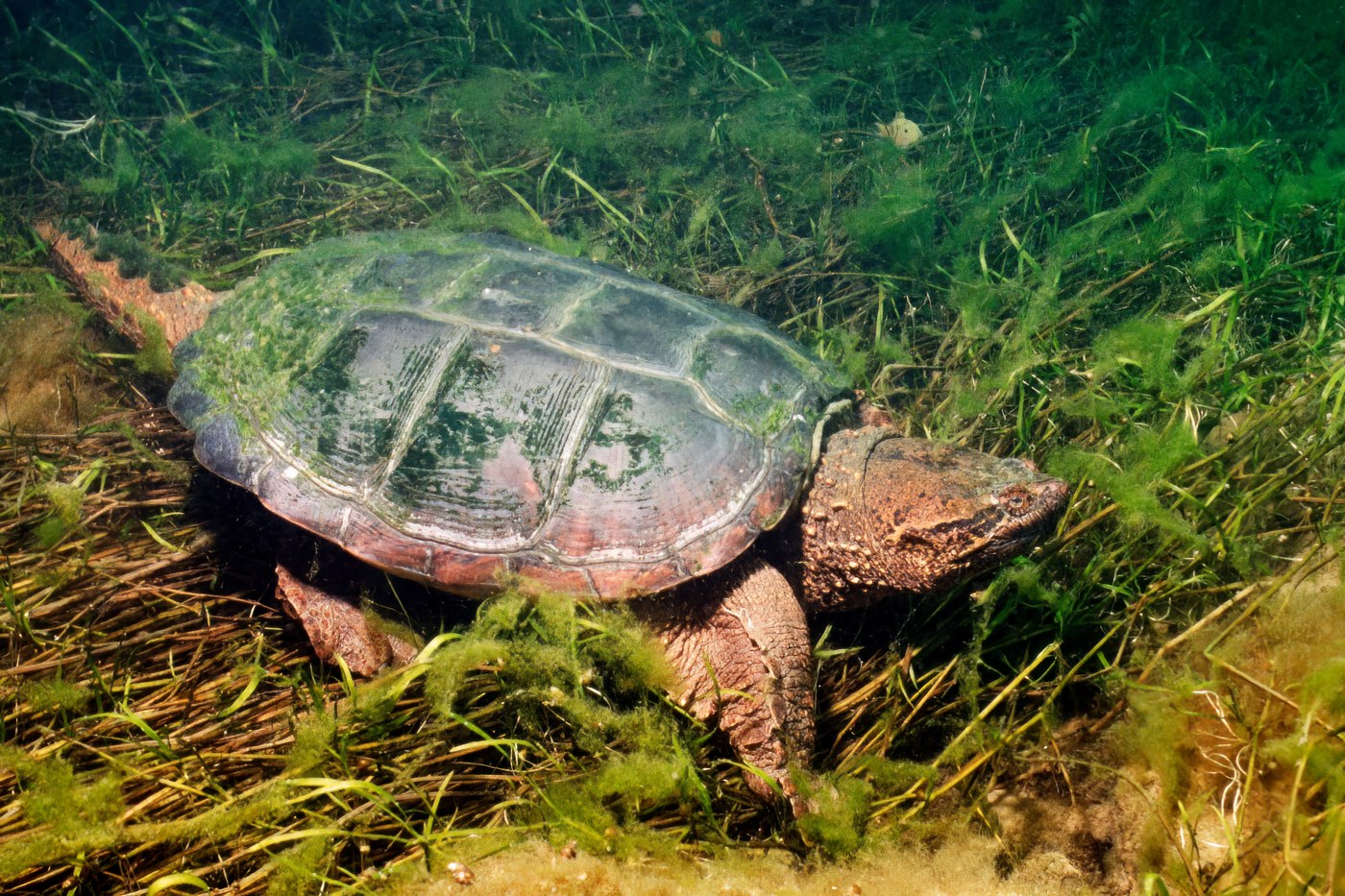
Snapping turtles are ectothermic and spend the cold months buried in bottom mud, but the behavior that actually gets noticed is the overland nesting migration, which runs from roughly late May through early July across most of the range and starts somewhat earlier at lower latitudes in the South Central and Southeast regions.
Snapping turtles are ectothermic and spend the cold months buried in bottom mud, but the behavior that actually gets noticed is the…
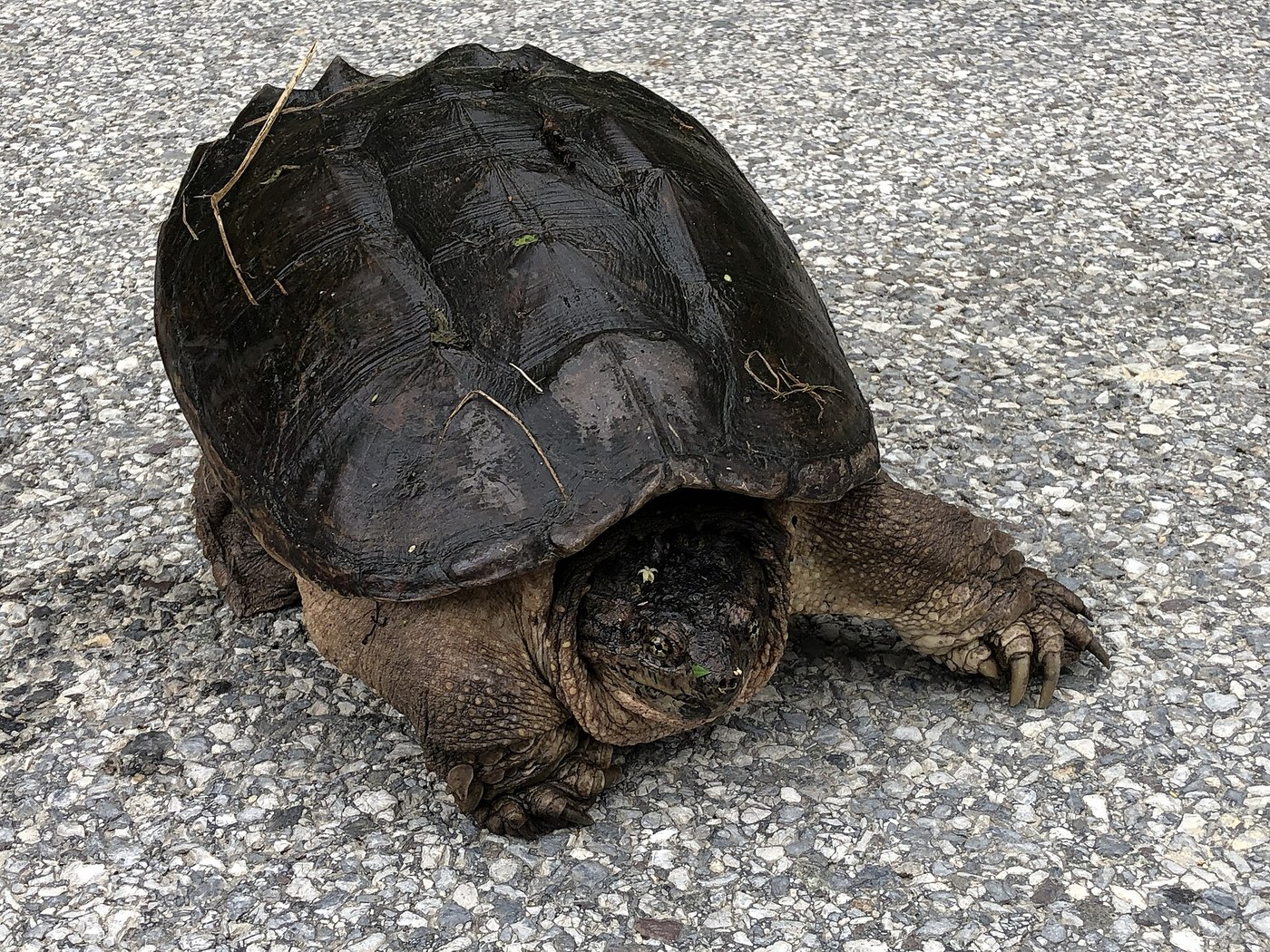
The nesting migration is the single most important seasonal fact about this species, and it explains nearly every homeowner encounter with it. Oklahoma's state wildlife agency states that females will travel nearly a mile from water in search of a nesting site, digging the egg cavity anywhere from right at the water's edge to as much as 200 yards away, in loose, sun-exposed, well-drained soil. That is why a snapping turtle shows up on a lawn, a driveway, or a freshly tilled garden bed in late spring or early summer. It is not lost, and it is not looking for a fight. Multiple state and regional wildlife sources, from Massachusetts to Minnesota to Connecticut, independently describe the same late-May-through-early-summer window for this exact behavior.
Everything else in the calendar is quieter. Mating happens in the water, generally spring into early summer, with source estimates ranging from a broad spring-through-fall window to a narrower May-through-June peak. Published sources differ on the exact window. Incubation is strongly temperature-dependent: one controlled study measured roughly 63 days at 86 degrees F versus roughly 140 days at 68 degrees F, and the broader published range across studies runs 9 to 18 weeks. In the colder parts of the species' range, hatchlings that emerge late in the season commonly overwinter inside the nest itself rather than dispersing immediately, and are notably cold-tolerant for a reptile. Adults spend the winter buried in bottom mud in a slowed, hibernation-like state called brumation, which is why a pond that was full of turtle activity in July shows none in January. Region-specific month ranges for the Mountain West, South Central, Southeast, and Pacific Northwest portions of this range have not been documented precisely enough to state, so the general pattern above is the best guide for those regions.
Where They're Found
The common snapping turtle occurs across six regions: Midwest, Mountain West, Northeast, South Central, Southeast, and Pacific Northwest. Not to be confused with the pond slider (Trachemys scripta) or the western painted turtle (Chrysemys picta bellii), which are both a completely different family, Emydidae, not Chelydridae, and are unrelated species.
Across the Midwest, Mountain West, Northeast, and South Central regions, this is core, long-established native range. The species' overall range is described as extending from southeastern Canada and Nova Scotia, southwest to the edge of the Rocky Mountains, and south through Florida, which spans most of the continent east of the Rocky Mountains. A separate range statement covers nearly all of the United States east of the Rocky Mountains, from Nova Scotia west to southern Alberta and Montana, south to New Mexico, and east to the Atlantic and Gulf coasts. A population in the Middle Rio Grande in New Mexico is believed native and has been documented there since at least the 17th century.
The Southeast is also core native range, not an edge case. The University of Georgia's Savannah River Ecology Laboratory states plainly that common snapping turtles are found throughout eastern North America, including all of South Carolina and Georgia. Peninsular Florida animals were long treated as a separate subspecies, the Florida snapping turtle (Chelydra serpentina osceola), but current taxonomy folds that name back into Chelydra serpentina, since the genetic differences turned out to be slight. County-level records confirm the species there as recently as 2024.
The Pacific Northwest is a genuinely different situation from the native regions above. This is a confirmed, established, introduced population, not a natural range extension. The U.S. Geological Survey's own Nonindigenous Aquatic Species database lists confirmed occurrences across seven separate Oregon watersheds spanning 1993 through 2024, a 30-year, multi-watershed pattern that points to a self-sustaining population rather than a handful of released pets. Washington's Department of Fish and Wildlife classifies the common snapping turtle as a Prohibited species, meaning it cannot legally be possessed, introduced, or brought into the state. Oregon news reporting, citing the state wildlife agency's own regional conservation biologist, describes the Rogue River population as actively multiplying, with the state soliciting public sighting reports. Both Oregon and Washington list only two native turtle species of their own, the western pond turtle and the western painted turtle, and both agencies describe the snapping turtle as invasive competition for those two, not as one of their own.
Alaska and Hawaii were checked specifically and both are confirmed absent. No source, native or introduced, places the common snapping turtle in Alaska in any capacity; the species' entire range and its cold-tolerant brumation behavior are described in the context of the northern Midwest and Northeast, not the far north. The USGS nonindigenous-species database, which does list introduced populations in Oregon, Montana, Idaho, Nevada, and even Guam and Puerto Rico, does not list Hawaii, and no Hawaii-specific incident turned up in a targeted search.
Inside all six regions, the habitat point that matters is the same one: permanent water. Snapping turtles live in ponds, lakes, marshes, swamps, canals, and slow-moving rivers and streams with soft, muddy bottoms, and tolerate occasional brackish water. A pond, retention basin, or slow ditch anywhere in this range that has held water for more than a season or two is a realistic place to find one, whether the population there is native or, in the Pacific Northwest specifically, introduced.
Life Cycle
Nest temperature decides sex, and the pattern runs in both directions rather than a single threshold. Peer-reviewed research found that incubation temperatures in the middle of the range, roughly 73 to 81 degrees F, tend to produce more males, while temperatures both above and below that middle band tend to produce more females. That is a genuinely unusual pattern compared to species where sex simply flips above or below one number.
Adult survival is the real reason the population holds up, not clutch size. A snapping turtle population can absorb heavy egg and hatchling losses to predators and still be stable, because a turtle that reaches adult size survives at better than a 90 percent rate year over year and can keep reproducing for decades. That is also why removing adult turtles from a pond has more effect on a population than most homeowners assume, and another reason state agencies ask that removal decisions go through them rather than being handled informally.

Mating
Nesting Migration and Egg-Laying2
Eggs and Incubation
Hatchling
Juvenile
Adult
Identification
Use the real size numbers
Adult carapace length typically runs 8 to 14 inches, with a documented record of 19.3 inches. Adult weight typically runs 10 to 35 pounds, with a documented wild-caught record of 75 pounds. Overfed captive individuals have reached as much as 86 pounds, and that figure should never be presented as a typical wild weight, since it reflects captivity, not a pond population.
Color and shell shape
The carapace ranges from tan to dark brown to nearly black and is frequently obscured by mud or algae. The head, tail, and limbs are brown, often with small black lines or spots on the head, and the plastron and undersides of the limbs are yellowish-white. The carapace carries three longitudinal keels, or ridges, that are pronounced in juveniles and largely flatten out in old adults.
Two features separate it
Two features separate this species from every other turtle in its range. First, a disproportionately large head that cannot be withdrawn into the shell. Second, a small, cross-shaped, reduced plastron that leaves the limbs and much of the underside exposed, unlike a box turtle or pond turtle, which can close up almost completely. The tail is roughly as long as the carapace and carries a saw-toothed row of large, pointed scales along its top edge, an alligator-like feature no other turtle in this range shares.
Against the alligator snapper
Commonly confused with the alligator snapping turtle (Macrochelys temminckii), a different genus within the same family. Four tells separate them reliably in an adult. Shell: the alligator snapping turtle has three distinct, pronounced rows of raised, armored plates running the full length of the carapace, giving it an almost dinosaur-like look, while the common snapping turtle's shell is comparatively smooth, with keels that flatten further with age. Eyes: the alligator snapping turtle's eyes sit on the sides of its head, while the common snapping turtle's eyes sit more toward the front and top. Feeding lure: the alligator snapping turtle has a unique worm-like fleshy tongue appendage it uses to lure fish while lying motionless with its mouth open, a structure the common snapping turtle does not have. Size: the alligator snapping turtle is dramatically larger, with males documented up to 29 inches and 249 pounds, versus the common snapping turtle's 8-to-14-inch, 10-to-35-pound typical range. One caution for younger animals: alligator snapping turtle hatchlings still have ridged shells, so shell texture alone is a weaker tell in juveniles than in full-grown adults.
Range is the fastest tell
Range is the fastest, most reliable tell, and it rules out the alligator snapping turtle almost everywhere this species occurs. The alligator snapping turtle's range is confined to the Midwest, Southeast, and Southwest, specifically Gulf of Mexico drainage systems running from Georgia and northwest Florida west to eastern Texas and north into southeast Kansas, Iowa, Illinois, and Indiana. A homeowner in the Mountain West, Northeast, or the introduced Pacific Northwest population is not looking at an alligator snapping turtle under any circumstance, since the species simply is not present there. Only in parts of the South Central and Southeast regions, near Gulf-draining river systems, can both species genuinely occur in the same watershed, which is where the shell, eye, and lure tells above actually matter.
The other one is better protected
The alligator snapping turtle also carries meaningfully stronger legal protection in several states, which is its own identification incentive. Florida lists it as a State Species of Special Concern and it is currently under federal review for Endangered Species Act listing; Louisiana and Mississippi both prohibit its collection even in states and seasons where the common snapping turtle may be taken. Getting the identification right before doing anything else is not just a biology question in those states, it is a legal one.
Signs of Infestation
An adult crossing open ground
An adult turtle crossing a lawn, driveway, garden bed, or road in late spring or early summer. This is, by a wide margin, the most likely reason a homeowner ever sees this species on land, and it is almost always a nesting female rather than a lost or aggressive animal. The migration can run nearly a mile from the water she started at, and nests turn up anywhere from right at the shoreline to roughly 200 yards inland, in loose, sun-exposed, well-drained soil.
Loose soil dug in a sunny spot
Freshly disturbed, loosely dug soil in a sunny spot near water. A sandbox, a tilled garden bed, a mulch pile, or a gravel shoulder within easy reach of a pond or ditch is realistic nesting habitat. If a nest is disturbed by a predator afterward, round, leathery-shelled eggs may be visible at the surface.
It does not bask
What this species does not typically do: bask. North Carolina's state wildlife agency states directly that this species is more aquatic than most other turtles and rarely basks, though it will often swim near the surface. A homeowner who has not seen a turtle sunning itself on a log or bank has not necessarily missed one; that is simply not how this species usually behaves, unlike many pond and box turtles.
No audible or olfactory signs
No source describes a characteristic sound or smell associated with this species that a homeowner would notice; presence is almost entirely a visual finding, tied to the nesting migration above.
Prevention and When to Call a Pro
Never pick one up
Never attempt to pick up or handle a snapping turtle directly, especially by hand or by the tail. The reduced plastron and long, flexible neck give this species real reach, and hand-handling carries genuine bite risk. If a turtle truly must be moved out of a driveway or path, Virginia's Department of Wildlife Resources describes a specific safe technique: approach from behind with a large, flat implement such as a shovel, scoop the turtle from behind, and place it into a large, sturdy container for a short move, rather than lifting it by hand.
Leave a nesting female alone
A female crossing a yard or digging in a garden bed in late spring or early summer is engaged in a brief, entirely natural behavior, not a permanent problem. State wildlife and parks sources consistently recommend giving her space and letting her finish; she typically moves on within a day.
Relocation is often illegal
Relocation is restricted or outright illegal in many states, and the rules genuinely differ from state to state, so verify locally before moving any turtle off the property where it was found. A few real, cited examples illustrate the range rather than standing in as a universal rule for every state: Virginia makes it illegal to relocate or liberate turtles under state regulation, and its wildlife agency does not send staff to remove turtles from private property. West Virginia requires a Wildlife Damage Permit to trap or kill nuisance wildlife and requires any trapped animal to be released on the same property, not moved elsewhere. New York requires a trapping license or special state license to use traps or nets to collect snapping turtles from a pond. Mississippi closes non-game turtle collection entirely from April 1 through June 30, covering the nesting season, except by special permit, and has separately stopped issuing new commercial-collection permits for this species. Washington classifies the common snapping turtle itself as a Prohibited species that cannot legally be possessed, introduced, or brought into the state at all, a notably different, invasive-species-driven rule specific to the Pacific Northwest.
A licensed operator is safer
A licensed nuisance wildlife control operator or your state wildlife agency is the safer default over do-it-yourself trapping or relocation. Rules for state-regulated species vary by state and change over time, so check with the agency directly before acting, and treat a licensed professional as the safer, correct path rather than a DIY trap purchase. Do not assume a general nuisance-wildlife license automatically covers turtles in every state; several of the citations above show turtle-specific licensing or seasonal rules layered on top of a state's general nuisance-wildlife program.
Pond owners should expect one
Pond and water-feature owners should expect an eventual encounter rather than treat one sighting as an emergency. Any permanent or semi-permanent pond, retention basin, or slow ditch in suitable habitat within the species' range will likely be found by a snapping turtle eventually. The appropriate response to an unwanted resident turtle is contacting the state wildlife agency or a licensed nuisance wildlife control operator, not DIY removal, given both the bite risk above and how widely relocation rules vary.
Who to Call, and When
Contact the state wildlife agency or a licensed nuisance wildlife control operator any time removal or relocation off the property is being considered, since DIY trapping and moving a turtle can run afoul of the state-specific rules above. Also call if a turtle is in a location posing an immediate hazard, such as a busy driveway, a pool, or anywhere children or pets have close, repeated access, and there is any uncertainty about safe handling technique. In the South Central and Southeast regions specifically, where an alligator snapping turtle can genuinely share the same watershed, do not attempt to handle either turtle if there is any doubt about which species it is; contact the state wildlife agency for identification and removal guidance instead.
State-regulated - verify locally
Frequently Asked Questions
Are snapping turtles dangerous to swimmers?
No. In the water, common snapping turtles are docile and go out of their way to avoid people. The defensive biting behavior people worry about happens only when the turtle is cornered or handled on land, not while swimming.
Can a snapping turtle really bite a finger off?
There is no documented case of a common snapping turtle biting off a human finger or toe. The one published case of a near-total finger amputation from a snapping turtle bite involved the much larger, more geographically restricted alligator snapping turtle, a different species.
Why is there a snapping turtle crossing my yard or driveway in early summer?
She is very likely a nesting female looking for loose, sunny soil to lay eggs. This overland migration can range up to nearly a mile from the water she started at and is not a sign of aggression or a lost or sick animal.
Can I just relocate a snapping turtle I do not want in my pond?
Not necessarily. Many states restrict or flatly prohibit relocating turtles, require a trapping license, or close the collection season during nesting months. Check with your state wildlife agency or a licensed nuisance wildlife control operator before moving one.
How is a common snapping turtle different from an alligator snapping turtle?
The alligator snapping turtle is much larger, has three rows of pronounced armored spikes on its shell instead of a smoother, flatter-keeled shell, has eyes on the sides of its head, and uses a worm-like tongue lure to catch fish. It also occurs in a far more limited range tied to Gulf of Mexico river drainages, while the common snapping turtle's range covers most of the eastern two-thirds of the country plus an introduced population in the Pacific Northwest.
Sources
- Common snapping turtle: taxonomy, overall native range description, and Middle Rio Grande population note Wikipedia, cross-referenced against embedded ITIS/GBIF/NatureServe identifiers
- Common Snapping Turtle (Chelydra serpentina): Southeast native-range confirmation covering all of South Carolina and Georgia Savannah River Ecology Laboratory, University of Georgia
- Snapping turtle (Chelydra serpentina): COSEWIC assessment and status report, including C. s. osceola genetic differentiation Government of Canada / COSEWIC
- Nonindigenous Aquatic Species factsheet: confirmed introduced Oregon, Montana, Idaho, Nevada, and other occurrences, 1993-2024 U.S. Geological Survey
- Common snapping turtle (Chelydra serpentina): Prohibited invasive species classification in Washington Washington Department of Fish and Wildlife
- Amphibians and reptiles of Washington: snapping turtle listed among aquatic invasive species alongside native turtles Washington Department of Fish and Wildlife
- Turtles in Oregon: native western pond turtle and western painted turtle versus non-native snapping turtle Oregon Department of Fish and Wildlife
- Common Snapping Turtle field guide entry: size, weight, distinguishing features, diet, nesting migration distance, age at maturity, adult survivorship, and wild lifespan Oklahoma Department of Wildlife Conservation
- North American Snapping Turtle field guide entry: color and physical description Missouri Department of Conservation
- Common Snapping Turtle (Chelydra serpentina) field guide entry: habitat, brackish tolerance, clutch size, and lifespan range Chesapeake Bay Program
- Alligator Snapping Turtle (Macrochelys temminckii) species page: range confined to Midwest, Southeast, and Southwest Gulf drainages, and current federal listing review status U.S. Fish and Wildlife Service
- Fish and Wildlife: Alligator Snapping Turtle range description from southern Georgia to eastern Texas and north to southeast Iowa Indiana Department of Natural Resources
- Alligator snapping turtle species profile: Florida State Species of Special Concern status Florida Fish and Wildlife Conservation Commission
- Common Snapping Turtle species page: rarely basks behavior correction, and the vegetation-heavy diet myth correction North Carolina Wildlife Resources Commission
- North American Snapping Turtle field guide entry: 1940s-era studies finding no meaningful harm to game fish or waterfowl populations Missouri Department of Conservation
- Are Snapping Turtles Dangerous?: docile-in-water behavior and defensive-only-when-cornered temperament The Orianne Society
- Bite-Force Scaling across Size Classes in the Alligator Snapping Turtle (Macrochelys temminckii) and the Common Snapping Turtle (Chelydra serpentina), Southeastern Naturalist 22(sp12) LaGrange, Kessler, Li, Morrissiey, and Merchant, 2023, peer-reviewed
- Traumatic Amputation of Finger From an Alligator Snapping Turtle Bite, Wilderness and Environmental Medicine, 2016 PubMed, peer-reviewed case report
- Embryonic temperature influences juvenile temperature choice and growth rate in snapping turtles, peer-reviewed temperature-dependent sex determination study O'Steen, S., 1998, PubMed
- Estimates of Somatic Growth Rates of Common Snapping Turtles, Herpetological Conservation and Biology 18(1): latitude-dependent growth rate and adult size study Suriyamongkol et al., peer-reviewed
- Problems with Turtles: safe removal technique using a flat implement and container, and Virginia's relocation restriction Virginia Department of Wildlife Resources
- Nuisance Wildlife in West Virginia: Wildlife Damage Permit requirement and same-property release rule West Virginia Division of Natural Resources
- New York State Reptile and Amphibian Laws: trapping license requirement to collect snapping turtles New York Turtle and Tortoise Society, citing New York State DEC
- Nuisance Wildlife Control Operator licensing: scope of taking, transporting, and releasing nuisance wildlife under state license New York State Department of Environmental Conservation
- State of the Union: personal collection limits compilation, including Mississippi's seasonal closure and permit freeze for common snapping turtle and Louisiana's alligator snapping turtle prohibition Association of Fish and Wildlife Agencies
- What to Do if You Find a Snapping Turtle: nesting migration behavior and homeowner guidance Mass Audubon
- Species Spotlight: Snapping Turtles: nesting season timing and behavior Three Rivers Park District
Image Credits
- Image: Adobe Stock, licensed.
- Image: Famartin via Wikimedia Commons. CC BY-SA 4.0. This resized copy is offered under the same license.
License.