Seasonal Timeline
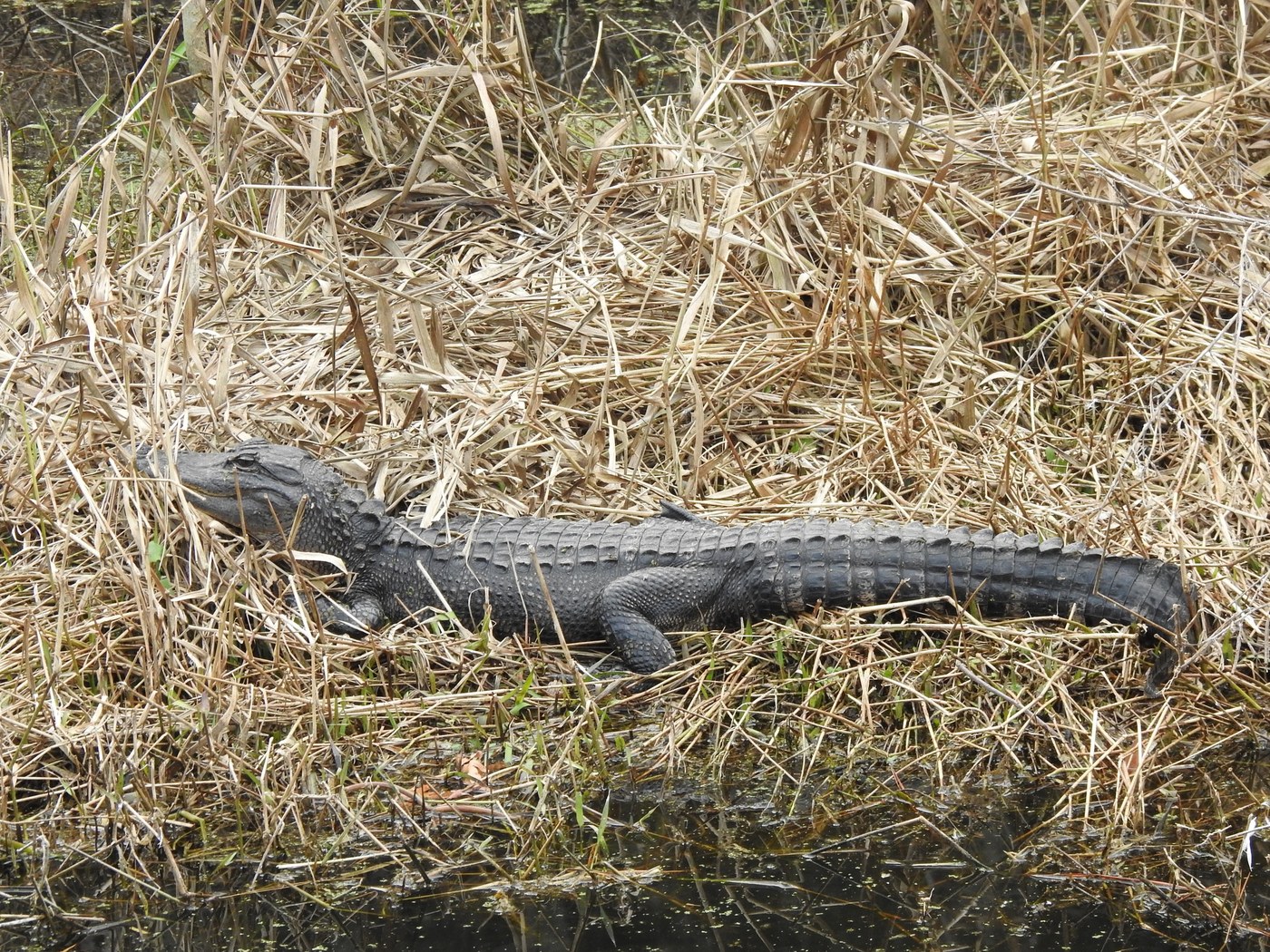
Alligators are ectothermic, so temperature runs the calendar. Florida's own wildlife agency puts peak activity between 82 and 92 degrees F, feeding stopping below roughly 70 degrees F, and dormancy below 55 degrees F. Courtship begins in early April, mating follows in spring, eggs go into the nest in late June and early July, and hatching runs from mid-August into early September.
Alligators are ectothermic, so temperature runs the calendar. Florida's own wildlife agency puts peak activity between 82 and 92 degrees F…
Nothing about this animal's year is optional. It is ectothermic, which means its activity is set by water and air temperature rather than by habit. Florida's Fish and Wildlife Conservation Commission publishes the thresholds directly: most active between 82 and 92 degrees F, feeding stops below about 70 degrees F, and the animal becomes dormant below 55 degrees F. Through much of winter it stays in a den or burrow adjacent to open water, coming out to bask during warm spells. Tennessee's wildlife agency describes the same dormancy as brumation, and notes that an alligator can survive water icing over by holding its snout above the surface before the ice closes, breathing through the opening while everything else slows down.
Courtship starts in early April. Males attract females by slapping their heads against the water surface and producing a deep rumbling bellow, and pairs swim together, touch snouts, and blow bubbles before mating. Florida's agency puts mating in May and June; UF IFAS narrows courtship and mating to mid-April through May. Both are published state and university figures, and they do not fully agree.
Nesting is the summer event that matters most to a property owner. The female builds a mound of soil, vegetation, sticks, leaves, and mud in a sheltered spot in or near water, clearing the site with her body and tail, gathering vegetation with her jaws, and digging the egg cavity with her hind legs. Eggs are deposited in one sitting, in late June or early July. Hatching follows from mid-August into early September. That whole stretch, roughly late June through early September, is when a female is most likely to hiss or charge at anything that comes near her nest, and it is the one time of year an otherwise indifferent animal becomes reliably defensive.
Where They're Found
The American alligator lives across the South Central and Southeast states. The federal range statement behind that is the U.S. Fish and Wildlife Service's own: the breeding range covers Arkansas, North Carolina, South Carolina, Georgia, Florida, Louisiana, Alabama, Mississippi, Oklahoma, and Texas. Florida's own agency describes the same span from the other direction, southeast Oklahoma and east Texas on the western side across to North Carolina and Florida in the east. The range does not fill either of those regions, so the states are worth naming individually.
In the South Central states, Louisiana and Texas are the core. Louisiana's Department of Wildlife and Fisheries has run an alligator program since 1972, starting in Cameron Parish and reaching statewide by 1981, and reports the wild population growing from under 100,000 to more than 3 million over the past 50 years, alongside nearly a million more on farms. East Texas and the Gulf coast hold an established breeding population, with fringe presence reaching up the Trinity River and along the Red River near the Oklahoma and Arkansas borders, and Texas Parks and Wildlife runs a mature permitting and nuisance-control program that only exists because the population does. Arkansas is smaller but genuinely native. The state's Game and Fish Commission documents alligators in Arkansas fauna for thousands of years, including an 1828 newspaper account of an eleven-foot animal killed at Little Rock, followed by a population crash to an all-time low by 1960 and state protection enacted in 1961, six years ahead of the federal listing. Oklahoma is real but small and tightly localized. The state's own field guide places alligators in the extreme southeast corner only, with the highest numbers in Choctaw and McCurtain counties, presence at Red Slough Wildlife Management Area, and individual animals documented at Broken Bow Lake and Eagletown. Oklahoma classifies it as a Species of Greatest Conservation Need rather than a robust game population, and nothing in the state's own material supports a statewide claim.
Two South Central states produce alligator sightings without holding an established population. Tennessee has confirmed alligator sightings, in Shelby, Fayette, and Hardin counties since 2018, a seven-foot animal recorded on video at Wolf River Wildlife Management Area, and a March 2024 catch at Norris Lake in the eastern part of the state. The Tennessee Wildlife Resources Agency's own framing is that these are alligators naturally expanding their range into Tennessee from the southern border states, and that the agency has not stocked or released any alligators in Tennessee. That is a range-expansion frontier being monitored, not an established breeding population, and possessing or releasing an alligator in Tennessee is illegal. Kentucky is a different situation entirely. The alligators that turn up there, including one found and euthanized in far-western Calloway County in August 2023 and a Harlan County case that produced criminal charges for illegal possession of a non-native animal, are escaped or illegally held pets. Kentucky's wildlife agency treats them as an illegally possessed exotic species requiring removal, not as native wildlife, and there is no wild breeding population in the state.
In the Southeast, Florida, Georgia, South Carolina, Alabama, and Mississippi all carry established populations. Florida is the center of gravity, with roughly 1.3 million alligators present in all 67 counties and in every wild area capable of supporting them. UF IFAS names Florida, southern Georgia, and Louisiana as holding the large populations. South Carolina supports an alligator farming and ranching industry, and Alabama was the first state in the country to enact protective legislation, in 1941. North Carolina is the confirmed northern limit of the current range, and it narrows further inside the state. The North Carolina Wildlife Resources Commission states it plainly: North Carolina is the northern extent of the alligator's range, and alligators generally become less common as you move from south to north along the North Carolina coast. This is a coastal animal there, not a statewide one.
Virginia and West Virginia have no alligators today, for two different reasons. Virginia has a documented historical presence and no current one. UF IFAS draws the line itself, describing a historical range that once ran from southern Virginia to the Florida Keys and west to the Rio Grande, and then describing today's range as running from the Carolinas to Texas and north to Arkansas. Virginia does not appear in the current federal ten-state breeding range list, so its presence in the state is historical only. West Virginia is a cleaner exclusion: no range source, federal, state, or university, places alligators there in either the current or the historical range, and the state has none of the coastal-plain wetland habitat the species requires. Alaska and Hawaii have no population either. No source places the American alligator in Alaska in any capacity, which is unsurprising for an animal that goes dormant below 55 degrees F, and no Hawaii-specific alligator incident or feral population turned up at all.
Inside those states, the habitat point most homeowners actually run into is the pond. Alligators occur wherever there is fresh water: lakes, ponds, rivers, marshes, swamps, and man-made canals. They tolerate brackish water and occasionally use marine environments to feed, but they have no salt glands, so salt tolerance is limited and short-lived. The part worth planning around is that stormwater retention ponds are mandatory in new Florida residential and industrial developments, and Florida's own pond-management guidance tells owners what to expect: alligators are migratory at times and will find your pond sooner or later, and their presence is of little concern unless they lose their fear of humans. A golf course pond, a retention pond, or a neighborhood lake acquiring an alligator is the normal outcome over a long enough period, not an anomaly worth panicking over.
Life Cycle
Nest temperature, not genetics, decides whether a clutch is female or male. UF IFAS gives the thresholds precisely: eggs incubating at 30 degrees C, which is 86 degrees F, or below produce females; 33 degrees C, or 91.4 degrees F, and higher produces males; and at about 32 degrees C, or 89.6 degrees F, the split runs close to 50/50. A female choosing where to build her mound is making a decision with consequences she has no other way to control.
The second number worth holding onto is how few make it. Florida's wildlife agency publishes the funnel twice with slightly different starting points, and both are legitimate. On one page it runs from an average clutch of 38 eggs down to about 5 animals reaching maturity. On the other it runs from a clutch of 35 down to an estimated 4. Either way, a clutch in the high thirties produces somewhere around four or five adult alligators, and the losses concentrate in the first year. That is also why the population math on this species is more forgiving than it looks: eggs and hatchlings absorb almost all of the mortality, and the animals that survive to adult size are hard to kill and long-lived.

Courtship and Mating
Nest and Eggs
Hatchling
Juvenile
Subadult
Adult
Identification
Use the real size numbers
The exaggerated ones make people worse at judging an actual animal. Hatchlings are 6 to 8 inches. Florida's wildlife agency defines a subadult at 4 feet. Nearly all alligators are sexually mature by about 7 feet, with females maturing as early as 6 feet, and females rarely exceed 10 feet. The U.S. Fish and Wildlife Service gives an adult range of 6 to 14 feet. Florida's state length record is 14 feet 3.5 inches and its state weight record is 1,043 pounds, both males, both documented by the agency. Twenty-foot alligators are not a thing, and an animal that genuinely looks 12 feet long is at the upper end of what any state has recorded.
Color, armor, and the tail
Adults are dark gray to almost black with a lighter underside. Juveniles carry yellow and white banding that works as camouflage and fades as they grow. The back is covered in armored bony plates, and the tail is vertically flattened, heavily muscled, and accounts for about half of total body length, which is where the propulsion comes from. Front feet have 5 toes, rear feet have 4 and are webbed. Two other details are worth knowing: the species has a 4-chambered heart, unusual among reptiles and part of why it dives so efficiently, and its eyes reflect red at night from the tapetum lucidum, which is why a flashlight swept across a pond at night finds them instantly.
Alligator versus American crocodile
American alligator versus American crocodile, using the tells the agencies actually publish. Snout: the alligator's is broad, rounded, and U-shaped, while the crocodile's is narrow, tapered, and V-shaped. Teeth: with the jaw closed, no lower teeth are visible on an alligator, while the crocodile's fourth lower-jaw tooth protrudes and stays exposed. Color: alligators are dark gray to almost black, crocodiles brownish or grayish-brown. Habitat: alligators are a freshwater animal with limited salt tolerance, while in the United States the American crocodile occurs almost exclusively in marine and brackish coastal waters of extreme southern Florida. In practical terms, an alligator seen anywhere outside the southern tip of Florida is an alligator.
The crocodile's own status matters
The crocodile is genuinely at risk in its own right, and that matters for how the alligator is regulated. The American crocodile carries its own Endangered Species Act listing on its own conservation merits, having been reclassified from endangered to threatened. UF IFAS notes it is far less abundant than the alligator and more secretive, which is why nearly every human conflict in Florida involves an alligator rather than a crocodile. That real, independently at-risk species is the reason the recovered alligator is still federally regulated. The two facts are directly connected.
One more look-alike, much less common
The spectacled caiman, Caiman crocodilus, is established in parts of south Florida, presumably from released pets. It belongs to the same family as the alligator rather than to the crocodiles, and it is smaller than an American alligator. It is a real identification possibility in south Florida and essentially nowhere else in the alligator's U.S. range.
Signs of Infestation
A gator hole or wallow at the water's edge
Alligators dig and wallow to create depressions that hold water through dry periods. In the Everglades these are often the only standing water available in the dry season, which makes them critical habitat for fish and other wildlife and makes the alligator a recognized keystone species. On a residential pond or canal, a dug depression at the bank is a straightforward sign that an alligator is using the water. Alligators also dig dens and burrows into stream banks, used year-round and most heavily as cold-weather refuge.
A mound nest near water in summer
The female may not be far away. A pile of soil, vegetation, sticks, leaves, and mud in a sheltered spot at or near the waterline, appearing in late June or early July, is a nest. The female builds it, guards it, and can hiss or charge at anything that approaches, including people. This is the one predictable window each year when an alligator becomes reliably defensive rather than avoidant. Do not approach a nest to confirm what it is.
Basking, and the cold-month absence
Basking in warm months, near-total absence in cold ones. Alligators haul out and bask at the water's edge during the day through the 82 to 92 degree F active window, roughly spring through fall. Below 55 degrees F they go dormant in dens and burrows next to open water, emerging only during warm winter spells. A pond that produced daily sightings in August and none in January has not lost its alligator.
Motionless at a pond edge after dark
An animal lying motionless at a pond edge at dusk or after dark. Alligators hunt primarily at dusk and through the night, lying still and waiting rather than actively pursuing. That behavior looks unsettling and is not by itself a sign of aggression. It is normal feeding behavior in the normal feeding window, which is also why dusk and after-dark hours around water carry the most avoidable risk.
Small pets going missing
This happens in waterfront yards. Prey selection is driven mostly by size relative to the alligator rather than by species, which is why UF IFAS documents far more alligator attacks on dogs than on people. A cat or a small dog disappearing from a yard that backs onto a pond, canal, or lake is a sign worth taking seriously before anything else happens.
The one behavior that changes it
The one behavior that changes the answer: an alligator that approaches a person. Louisiana and Texas both put it in nearly identical words. If you walk near the water and an alligator comes straight toward you, especially if it comes out of the water, that is a nuisance alligator and it should be reported to the state wildlife agency. In many cases these are animals that have lost their natural fear of humans, most often because someone has been feeding them, intentionally or not. Every other sign on this list describes a normal alligator. This one does not.
Prevention and When to Call a Pro
Federal status, exactly right
The federal status is the most unusual thing about this species, and it is worth getting exactly right. The American alligator was listed as endangered in 1967 under the Endangered Species Preservation Act of 1966, and that classification transferred to the Endangered Species Act effective December 28, 1973. Recovery ran state by state through the 1970s and 1980s, and by 1987 the animal no longer qualified as endangered or threatened based on its own conservation status. Rather than coming off the list, it was reclassified as threatened due to similarity of appearance throughout its range. Section 4(e) of the Act lets the Secretary of the Interior list a species that way when three conditions are met: the species so closely resembles a listed endangered or threatened species that enforcement personnel would have substantial difficulty telling them apart, that difficulty amounts to an additional threat to the listed species, and treating the unlisted species this way substantially facilitates enforcement. All three apply here. The 1987 rule's own preamble said it supports a need for continued federal controls on taking and commerce to protect the American crocodile in the United States and abroad and other endangered crocodilians in foreign countries. In practical terms today, the Service regulates harvest and the subsequent interstate and international trade in legally taken alligators, their skins, and products, under the special rule at 50 CFR 17.42, so that illegally harvested animals cannot enter commerce. Actual take is regulated by the states and tribes, not by the federal agency directly.
State rules are a separate thread
State rules on wildlife are the second legal thread, and they are separate from the federal one. Regulations on trapping, possessing, and relocating wildlife vary by state and change over time, so verify the current rule where you live with your own state wildlife agency before acting on anything, and treat a licensed professional as the safer default over a do-it-yourself trap purchase. That advice needs one correction, though, and it is specific to this animal. For most wildlife the safer default is a licensed nuisance wildlife control operator. For alligators it is not. Louisiana's general nuisance wildlife control operator program excludes alligators outright, and the three biggest alligator states route alligator calls through a separate, alligator-specific licensing program run by the state wildlife agency itself. So the safer default here is the state agency, which then dispatches or authorizes the correct licensed party. Every state in the alligator's range runs its own permitting structure on top of the federal framework, and what is legal for a licensed permittee is not legal for a property owner.
There is no DIY tier here
There is no do-it-yourself tier here at any stage, and the three biggest alligator states all run the same model. Florida's Statewide Nuisance Alligator Program dispatches contracted trappers; a resident calls the toll-free hotline at 866-FWC-GATOR, which is 866-392-4286, and if the complaint meets the qualifying criteria the agency issues a permit to a contracted trapper authorizing removal. Generally that means an alligator at least 4 feet long believed to pose a threat to people, pets, or property, though a smaller animal in a pool or a garage goes through the same hotline. Louisiana licenses Nuisance Alligator Hunters who remove more than 1,000 animals a year, and residents call the nearest regional office of the Department of Wildlife and Fisheries, with published numbers including Alexandria at 318-487-5885, Baton Rouge at 225-765-2339, and Lafayette at 337-262-2080. Texas issues Nuisance Control Permittee status only to applicants who complete a training course and pass an exam, and complaints without an active case number go to the Parks and Wildlife Department's Law Enforcement Communication Center in Austin at 512-389-4848. Louisiana makes the boundary especially clear: its general nuisance wildlife control operator program does not cover alligators at all, which are handled only through the separate licensed program. One more thing worth knowing before you call. These programs remove animals; they generally do not relocate them. Florida's agency explains why in its own words, pointing to a large stable population where removing individuals does not affect it, relocated alligators that try to return and create new hazards along the way, and the fighting that follows when a strange alligator is dropped into another one's territory.
Never feed an alligator
Understand the mechanism rather than just the rule. UF IFAS states it directly: feeding causes alligators to lose their natural fear of humans and to associate people with food, and it does not matter whether the food is marshmallows or fish guts from cleaning a catch. Normally an alligator avoids people. One that has been fed will move toward them and can become aggressive. Louisiana and Texas independently describe the same causal chain in their own guidance. In Florida, feeding or enticing an alligator is illegal, a second-degree misdemeanor punishable by up to 60 days in jail and a $500 fine. Unintentional feeding counts too, which is why fish scraps and food waste belong in a garbage can rather than at the water's edge.
What actually helps, in order
The practical homeowner measures, in order of how much they actually help. Keep children and pets away from the water's edge anywhere alligators occur, and never let a dog swim or explore in water known to hold one, because a dog's size profile is squarely inside this animal's prey range. Swim only in daylight, and not where large alligators are known or likely. Dispose of fish and food scraps in a container, not on the bank. If you are fencing a yard against them, height matters more than most people assume: alligators including juveniles are capable climbers with sharp claws and powerful tails, and adults have climbed fences to reach water, so UF IFAS recommends a fence taller than 4.5 feet. If you own or manage a retention pond, a golf course pond, or a neighborhood lake, plan on an alligator finding it eventually rather than treating the first sighting as an emergency. And one correction worth carrying: do not run zig-zag if an alligator charges you. That is folklore. Alligators rarely pursue people, they do not go far when they do charge, and a charge is most likely near a nest. Run fast and straight away from the animal.
The real numbers on bites
The exaggerated versions do more harm than good. Florida's wildlife agency has tracked alligator bites on people since 1948 and publishes the year-by-year table itself, broken into major, minor, and fatal, with the agency's own published document running through 2022. Agency data reported in June 2026 news coverage put the running totals at 500 unprovoked bites statewide and 32 confirmed fatalities through February 2026. Those totals are cumulative across roughly 78 years and they move as incidents occur, so the through-date matters. The annual reality is closer to 8 to 15 total bites in a typical recent year, not the hundreds some sources imply. The most useful finding is newer: a 2025 University of Florida study, the first of its kind to rank the human behavior preceding bites, found that in 96 percent of recorded incidents some form of human inattention or risk-taking came first. The study's own author frames the takeaway as prevention, that many bites can be avoided by paying attention to surroundings and skipping the risky behaviors, walking a small pet near water or swimming where alligators are known to be.
Who to Call, and When
For this animal, calling means something different than it does for most wildlife. There is no escalation path here, because there is no first step to escalate from. UF IFAS puts it in one sentence: you should never handle an alligator, even a small one, because alligator bites can result in serious infection and it is illegal. That covers catching one, moving one, and trying to help one, at any size. So the professional contact starts at the first genuine concern, not after a failed attempt at something else. Call your state wildlife agency when an alligator approaches you or comes out of the water toward you, when one takes up residence in a pool, garage, or yard, when an animal over 4 feet is behaving boldly around people or pets, or when you find a nest somewhere people regularly walk. A licensed state-permitted trapper is the only legal removal mechanism, and for this species that is not a recommendation. It is the only option.
State-regulated - verify locally
Frequently Asked Questions
Is it legal to feed alligators in Florida?
No. Feeding or enticing an alligator is illegal in Florida, a second-degree misdemeanor punishable by up to 60 days in jail and a $500 fine. The reason is behavioral rather than symbolic. Feeding causes alligators to lose their natural fear of people and to start associating humans with food, which is the single most-cited driver behind the animals that later have to be removed. It does not matter whether the food is marshmallows tossed from a dock or fish guts left at the water's edge after cleaning a catch. Unintentional feeding produces the same result.
Why is the American alligator still federally protected if it is no longer endangered?
Because the protection is not about the alligator. The species recovered, and by 1987 it no longer qualified as endangered or threatened based on its own conservation status. Instead of coming off the list, it was reclassified as threatened due to similarity of appearance under Section 4(e) of the Endangered Species Act, because it closely resembles the American crocodile and other listed crocodilians. Enforcement personnel working hides and products in trade cannot reliably tell them apart, so continued federal oversight of alligator harvest and commerce is what makes protection of those other species enforceable.
Can I trap or remove a nuisance alligator myself?
No. In Florida, Louisiana, and Texas alike, only a state-licensed nuisance alligator trapper or permittee dispatched or authorized by the state wildlife agency may legally remove an alligator. Residents are instructed to call the state hotline or regional office and let the agency handle it. This is not a case where a general pest control operator or a licensed nuisance wildlife control operator can step in either. Louisiana's general nuisance wildlife program explicitly excludes alligators, which are handled only through its separate licensed alligator program.
Do alligators live in Tennessee or Kentucky?
Neither state has a native, established, breeding population. Tennessee has confirmed sightings in the southwest of the state and, more recently, in the east, and the state's wildlife agency describes these as alligators naturally expanding their range northward from the southern border states, noting explicitly that it has not stocked or released any. That is an active range-expansion frontier rather than an established population. Kentucky is different. The alligators found there are escaped or illegally possessed pets, and the state removes them as an illegally held non-native animal.
How can I tell an alligator apart from an American crocodile?
Four tells, and the first two are enough on their own. An alligator has a broad, rounded, U-shaped snout with no lower teeth visible when the jaw is closed. An American crocodile has a narrower, V-shaped snout with the fourth tooth of the lower jaw protruding and visible when closed. Alligators are dark gray to almost black; crocodiles are brownish or grayish-brown. And habitat separates them almost completely, since alligators are freshwater animals found throughout the Southeast while in the United States the American crocodile occurs almost exclusively in marine and brackish coastal waters of extreme southern Florida.
Sources
- Endangered and Threatened Wildlife and Plants; Regulations Pertaining to the American Alligator U.S. Fish and Wildlife Service, Federal Register 86 FR 5113
- Alligator mississippiensis species profile: current listing status and the Federal Register history table of reclassification actions from 1975 through 1987 U.S. Fish and Wildlife Service, Environmental Conservation Online System
- Crocodylus acutus, American crocodile species profile: listing status in its own right and the snout and fourth-tooth distinctions from the American alligator U.S. Fish and Wildlife Service, Environmental Conservation Online System
- American Alligators in CITES Export Programs: retention on CITES Appendix II and the similarity-of-appearance rationale in plain language U.S. Fish and Wildlife Service
- Alligator Facts: activity temperature thresholds, courtship and nesting calendar, clutch size and incubation, the subadult and maturity size thresholds, the survival funnel, state length and weight records, mortality causes, and the 4-chambered heart and red eye-shine Florida Fish and Wildlife Conservation Commission
- American Alligator species profile: color and armor description, freshwater and brackish habitat, clutch and incubation figures, the survival funnel from a clutch of 35, and the federal threatened due to similarity of appearance status Florida Fish and Wildlife Conservation Commission
- Statewide Nuisance Alligator Program: the 866-FWC-GATOR hotline, the contracted trapper permitting process, the 4-foot nuisance threshold, and the agency's stated reasons for removing rather than relocating Florida Fish and Wildlife Conservation Commission
- Guidelines for Designing and Managing Florida Ponds for Recreation: mandatory stormwater retention ponds in new development and the guidance that alligators will find a pond sooner or later Florida Fish and Wildlife Conservation Commission
- Learn how to be alligator aware: feeding alligators is illegal and dangerous, and the second-degree misdemeanor penalty of up to 60 days in jail and a $500 fine Florida Fish and Wildlife Conservation Commission
- Alligator Bites on People in Florida: the agency's year-by-year table of major, minor, and fatal unprovoked bites from 1948 forward Florida Fish and Wildlife Conservation Commission
- Living with Alligators, WEC203/UW230: hatchling size, nest construction and hatching mechanics, temperature-dependent sex determination thresholds, diet, climbing ability and the 4.5-foot fence recommendation, the charge-response correction, the crocodile and caiman comparisons, and the statement that handling any alligator is illegal and carries infection risk University of Florida IFAS Extension, Electronic Data Information Source
- Alligator bites are preventable, study finds: the 2025 Human-Wildlife Interactions study finding human inattention or risk-taking preceded 96 percent of recorded incidents University of Florida News
- Alligator: the state alligator program since 1972, wild population growth to more than 3 million, and the licensed Nuisance Alligator Hunter program removing more than 1,000 animals a year Louisiana Department of Wildlife and Fisheries
- Nuisance Alligators: the approaching-alligator behavioral trigger, the feeding and habituation link, regional office phone numbers, and resident safety guidance on children, pets, swimming, and fish scraps Louisiana Department of Wildlife and Fisheries
- Nuisance Wildlife Control and Removal: the general nuisance wildlife control operator program and its exclusion of alligators Louisiana Department of Wildlife and Fisheries
- Alligator Permits: the Nuisance Control Permittee program, its training course and exam requirement, and the Law Enforcement Communication Center contact number Texas Parks and Wildlife Department
- If You See An Alligator: the state administrative code definition of a nuisance alligator, the approaching-alligator behavioral trigger, and the feeding and habituation link Texas Parks and Wildlife Department
- Alligator mississippiensis conservation status: rapid recovery under protective legislation, populations stable or increasing across most of the range, and the similarity-of-appearance federal listing NatureServe Explorer
- Arkansas Alligator History: the native Arkansas population, the 1828 Little Rock account, the 1960 population low, state protection enacted in 1961, and the similarity-of-appearance listing explained in the state's own words Arkansas Game and Fish Commission
- Alligators in Tennessee: confirmed sightings by county, the agency statement that alligators are naturally expanding their range and have not been stocked or released, brumation behavior, and the illegality of possessing or releasing alligators in the state Tennessee Wildlife Resources Agency
- Alligator, American: North Carolina as the northern extent of the species' range and the decline in abundance moving north along the coast North Carolina Wildlife Resources Commission
Image Credits
- Image: sudomir via GBIF. CC BY 4.0.