Seasonal Timeline
Surface activity runs roughly mid-March through October, with brumation, the reptile equivalent of hibernation, taking up the rest of the year. The two species peak at opposite ends of that window: Mojave tortoises are spring animals, while Sonoran tortoises in Arizona are most active during the July through September summer monsoon.
Surface activity runs roughly mid-March through October, with brumation, the reptile equivalent of hibernation, taking up the rest of the…
The two species run two different calendars, and the reason is rainfall. The Desert Tortoise Council states that both species brumate in their cover sites generally between early November and mid-March and are surface-active from mid-March through October. Inside that window, the peaks diverge. Mojave desert tortoise activity is driven by winter and spring precipitation, so it is a spring animal, with nesting running early April through mid-June and hatchlings emerging in August and September. Sonoran desert tortoise sits in country where rain arrives twice a year, and the U.S. Fish and Wildlife Service describes adults and juveniles as largely active during the summer monsoon, July through September, when new plant growth puts forage within easy reach. Gravid females are the exception, emerging earlier in April and May to feed while carrying eggs.
Three sources give three brumation windows, and they are compatible rather than contradictory. The Desert Tortoise Council gives early November to mid-March. The U.S. Fish and Wildlife Service says the Sonoran species is in shelter from about mid-November to mid-February. Arizona Game and Fish, writing for people who care for legally adopted captives, gives October through March and notes it can start as early as September and end as late as July depending on temperatures. The mechanism explains the spread: tortoises normally go under when nighttime temperatures drop below 50 degrees for several nights in a row, and that date moves with elevation and with the particular winter. Treat brumation as a range rather than a single date, because any single date would be wrong most places.
Summer heat suppresses activity as hard as winter cold does. When surface temperatures pass 120 degrees, a shelter site sits roughly 40 degrees cooler, which is why a tortoise that is out at 8 in the morning is gone by noon. Anyone who concludes tortoises have left an area because they stopped seeing them in July is usually watching the wrong hours of the day.
Where They're Found
California and the Southwest both have desert tortoises, and the honest version of the map has a river running through it.
The Colorado River is the species line, and it is the single most useful fact to know. The U.S. Fish and Wildlife Service defines the Mojave population as all tortoises north and west of the Colorado River in Arizona, Utah, Nevada, and California. Its own profile for the Sonoran species places that animal east and south of the same river, in western, central, and southern Arizona plus northwestern Sonora, Mexico, with roughly 62 percent of the range in Arizona and 38 percent in Mexico.
California is Mojave country only. The California Fish and Game Commission describes the range there as southeastern California, taking in the Mojave Desert plus portions of the Sonoran and Great Basin deserts. Habitat is alluvial fans and plains with soil that will hold a dug burrow, enough annual forage, and larger shrubs for shade and for shielding burrow entrances. Where shrub cover is thin, rainfall is low, and annual food plants come and go, tortoises occur at very low density or not at all.
Southwest is not one story, and that is the part most content gets wrong. Southern Nevada and southwestern Utah hold Mojave desert tortoise, the federally Threatened species. Most of Arizona holds Sonoran desert tortoise, which carries no federal listing. Northwestern Arizona, on the far side of the river, is Mojave country again and federally protected. The legal split runs straight through the middle of a single region, which is why it is worth naming states rather than gesturing at the Southwest as a block. New Mexico has no desert tortoise. No published range description places the species there. Both range descriptions stop well to the west of the state line.
On the ground, terrain tells you which species you have, and the shell does not. The Desert Tortoise Council puts it precisely: Mojave desert tortoise occupies desert scrub in desert valleys and on bajadas, sheltering in self-excavated burrows, caliche caves, and rock shelters, while Sonoran desert tortoise occupies desert scrub on rocky hillsides and bajadas and retreats mainly to rock shelters. The Service independently describes Sonoran habitat as the steep, rocky slopes of mountains and the incised washes draining them. Valley-floor digger against rocky-slope rock dweller is the distinction the agencies themselves use. Popular sources offer confident shell-shape tells that contradict each other, one calling the Sonoran shell flat and pear-shaped, another calling it high domed, and no authoritative source gives a clean measurable discriminator, so there is no reliable shell test to offer.
Neither species occurs in Alaska or Hawaii. This is an obligate warm-desert reptile. Every range description found for either species stays inside the southwestern United States and northwestern Mexico: the Mojave and Sonoran deserts, plus the portion of the Great Basin desert the California range reaches.
Where it actually lives is underground. Both species spend more than 95 percent of their time in cover sites. Nevada's wildlife agency notes tortoises need firm soil for a burrow to hold its shape, and that those burrows get shared with a range of other mammals, reptiles, birds, and invertebrates. A tortoise burrow is a piece of desert infrastructure, not just one animal's hole, which is a good reason not to disturb one even when it looks empty.
Life Cycle
This is a slow-motion life history, and that is exactly why the numbers matter. A Mojave female may not breed until she is 12 to 20 years old, averaging about 18.8. Generation time is estimated at roughly 25 years. She lays about six eggs per clutch, one or two clutches a year, and then walks away, because there is no parental care. Her hatchlings come out at 2 inches with shells that will not fully harden for another 5 to 7 years. Almost nothing about that schedule allows a population to absorb losses quickly.
The predation math is the part worth reading twice. Federal analysis of raven predation on this species reports that within one 4-year period, 250 juvenile desert tortoise carcasses were found beneath a single raven nest in the west Mojave. At two study plots over 6 years, 29 percent and 44 percent of tortoise deaths were probably caused by ravens, and at another location 70 percent of juvenile mortality was attributed to them. At one site between 1979 and 1988, adults rose from 54 to 82 percent of the population while juveniles fell from 27 to 12 percent, which is what a population aging out from the bottom looks like.
And the trend line for the listed species is down. Range-wide, adult Mojave desert tortoise densities declined more than 32 percent between 2004 and 2014. An estimated 336,393 adults in 2004 dropped by roughly 124,050 animals over that decade. Densities fell in every recovery unit except the Northeastern Mojave, with the Western Mojave down 49 percent and the Eastern Mojave down 33 percent from their 2004 levels. That is the context behind California moving this species from threatened to endangered rather than the other direction.

Egg
Hatchling
Juvenile
Adult
Brumation
Signs of Activity
Identification
There are two, not one
There are two desert tortoises, not one, and the split is dated and citable. In 2011, studies of tortoise genetics, morphometrics, and ecology concluded that the species complex formerly known as desert tortoise is actually two separate species. Gopherus agassizii, Mojave desert tortoise, kept the original name. Gopherus morafkai, Sonoran desert tortoise, was recognized as its own species, and federal wildlife officials adopted the new name in their 2012 candidate notice of review. A third species in the same complex, Goode's thornscrub tortoise, was later separated as well, but its range is in Mexico. Anything written before roughly 2011 calls Arizona tortoises Gopherus agassizii. That is not sloppy writing, it is superseded taxonomy, and it is worth knowing when older documents and newer ones seem to disagree.
The Colorado River is the line
Geography identifies the species, and the Colorado River is the line. North and west of the river is Mojave desert tortoise, in southeastern California, southern Nevada, southwestern Utah, and northwestern Arizona. South and east of it is Sonoran desert tortoise, in western, central, and southern Arizona and into northwestern Sonora, Mexico. There is no field mark that beats knowing which side of the river you are standing on.
Terrain is the second-best tell
It is genuinely reliable. Mojave desert tortoise lives in desert valleys and on bajadas and digs its own burrows, also using caliche caves and rock shelters. Sonoran desert tortoise lives on rocky hillsides and bajadas and shelters mainly in rock crevices and rock shelters rather than excavating. Federal descriptions of Sonoran habitat go further, naming the steep rocky slopes of mountains and the incised washes that drain them. A tortoise on an open alluvial plain and a tortoise on a boulder-strewn slope are probably two different species.
The shell shape tells you nothing dependable
Popular sources offer confident shell-shape rules and then contradict each other, one describing the Sonoran animal as flat and pear-shaped against a rounder Mojave shell, another describing the Sonoran shell as high domed and the Mojave shell as noticeably wider. Federal materials use the phrase relatively high domed for the Sonoran species. No measurable, repeatable shell-shape discriminator was found, so there is none to give.
What both clearly are
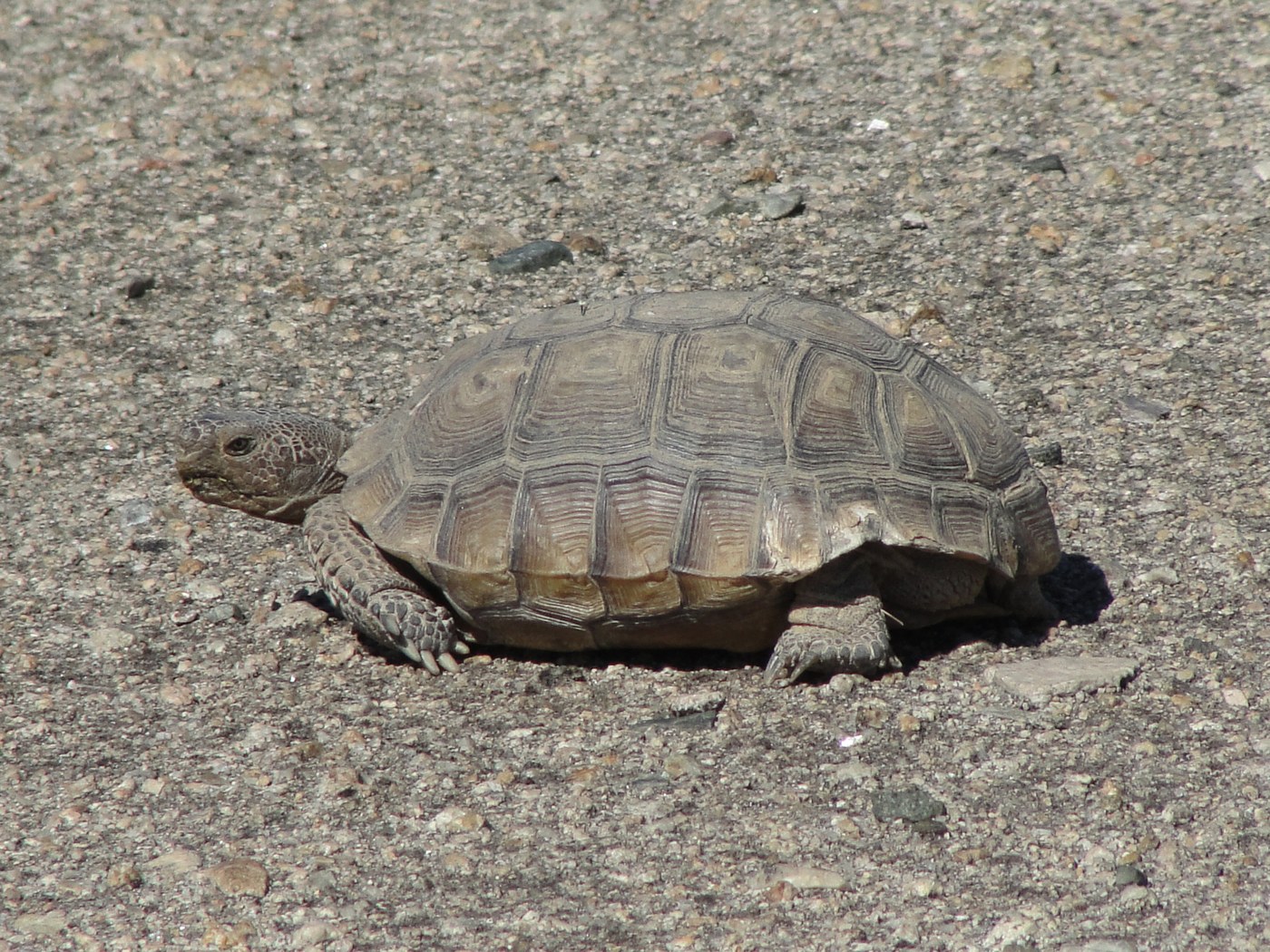
What both species clearly are: high-domed, dry-shelled, blunt-footed land animals. Brown to grayish-brown carapace with visible growth lines on each scute, a yellowish plastron underneath, front limbs flattened and heavily scaled for digging, and hind limbs described in federal materials as stocky and elephantine. A desert tortoise will never be found in water by choice, which separates it instantly from any pond turtle or slider.
Size is useless for telling the two apart
Mojave adults measure 178 millimeters to over 370 millimeters of shell length, roughly 7 to 14.5 inches. Nevada's wildlife agency gives 9 to 15 inches and 8 to 15 pounds. Federal materials give the Sonoran species 8 to 15 inches. The ranges overlap almost completely.
Wild or pet matters more than species
The most useful identification call has nothing to do with species, and everything to do with wild against pet. Nevada's wildlife agency gives a behavioral tell worth memorizing: a wild tortoise usually pulls into its shell when a person approaches, while a tortoise that does not hide, or that walks toward you looking for food, is probably somebody's escaped pet. Then check the shell for a small numbered tag, which Arizona's adoption program uses. A tortoise in a developed neighborhood, and especially one outside the animal's natural range such as northern Nevada, is most likely a lost captive rather than a wild animal. Which one you have determines which number you call, so it is worth two minutes of watching before doing anything.
Lifespan, sources kept separate
Lifespan, with the sources kept separate rather than blended. Nevada's wildlife agency gives 50 to 80 years. Clark County's desert conservation program distinguishes wild from captive, putting wild tortoises at about 50 years and captives at 80 to 100. A federal feature on the Sonoran species says they can live to be 100. Treat 50 to 80 years as the working figure for a wild animal, and the century-plus claim as applying mainly to captives, because that is how the sources actually break down.
Signs of Infestation
This is not an infestation
Desert tortoises do not enter buildings, do not nest in structures, and do not cause property damage. No published account documents any structural association at all. What follows is what a person might actually notice, and how to read it.
The animal, moving almost invisibly
The animal itself, moving slowly and almost invisibly. Arizona Game and Fish built its own spring advisory around the fact that these tortoises are difficult to spot, on roads especially. They are low, slow, and colored like the ground they walk on.
Resting in shade under a vehicle
A tortoise resting in shade under a parked vehicle. The agency lists this specifically among the situations drivers should expect. Looking under and behind a vehicle before pulling out of a driveway is real advice in tortoise country, not an abundance of caution.
Tucked into any small shaded space
A tortoise tucked under a bush, under patio furniture, or into some other small shaded space. These are the first places Arizona Game and Fish tells a tortoise keeper to search for an escaped captive, which makes them the same places a wandering tortoise turns up in a yard.
A burrow entrance names the species
A burrow entrance, and what kind tells you which species. In Mojave country, look for a dug burrow in firm soil on an alluvial fan or plain, often at the base of a shrub, or a caliche cave. In Sonoran country, look for a rock shelter on a rocky slope. Nevada's wildlife agency notes those burrows are shared with other mammals, reptiles, birds, and invertebrates, so a burrow is worth leaving alone even when it looks empty.
A numbered tag glued to the shell
That is an Arizona adoption program tortoise, and it has an owner and a record. Report it rather than adopting it yourself.
Signs the animal is sick
These change the answer from leave it alone to make a call. Arizona Game and Fish lists runny nose, bubbles from the nostrils, discharge from the eyes, lethargy, labored breathing, bulging or swollen eyelids, sunken eyes, and loss of appetite, associated with upper respiratory disease, dehydration, bladder stones, malnutrition, or parasites. A tortoise showing these is a reason to contact the state wildlife agency, not a reason to intervene yourself.
What you will not find
It is worth stating plainly. No droppings pattern in a structure, no chewing damage, no sounds in a wall or attic, no odor. No foundation or hardscape damage has been documented for this species. If something is getting into your house, it is not this.
Prevention and When to Call a Pro
There is no removal guide here
There is no removal guide for this animal, and there should not be one. Every population is either federally listed, state listed, or state protected. This animal does not enter buildings, so exclusion means fencing a yard to keep tortoises off a property, not sealing a structure. What follows is what not to do, the one narrow exception, and who to call.
Never pick one up
Never pick up, collect, or take home a wild desert tortoise. It is illegal across this entire coverage area. In California the animal is both federally Threatened and state Endangered. In Nevada it is state Threatened and belongs, by statute, to the people of the state, and Clark County states the rule bluntly: without a special permit, no one may own, touch, harm, harass, disturb, or pick up a wild desert tortoise, or disturb their burrows. In Utah, removal, harm, possession, propagation, and importation are all prohibited by rule. In Arizona, removing a Sonoran desert tortoise from the wild has been prohibited since 1988, and taking a wild one home is illegal even though the species carries no federal listing.
Handling one can kill it
Three independent wildlife agencies say so in nearly the same words. As a defense reaction, a frightened tortoise often voids its bladder. That bladder is a water reserve the animal may be depending on for over a year through drought. Federal materials call losing it a death sentence. Nevada's wildlife agency describes the same mechanism and advises against handling wild tortoises for exactly that reason. Utah's Red Cliffs Desert Reserve gives the same warning and adds that this is precisely why picking one up is illegal there. This is not a technicality. It is the reason for the law.
Never relocate a wild tortoise
The intention does not change the outcome. Arizona Game and Fish states that most desert tortoises stay in the same small area their entire lives, and that a tortoise moved somewhere new will not know where to find food and shelter and likely will die. The National Park Service pushes back on the specific well-meaning version of this mistake, driving a tortoise to a park or preserve, with a sentence worth quoting to anyone who suggests it: wild tortoises belong where you found them, and probably have a better chance of surviving in a familiar residential area than in a new, unfamiliar place.
Never release a captive
Not a pet one either, and this rule has teeth beyond the legal penalty. Arizona Game and Fish states directly that captive desert tortoises cannot be released back into the wild because they may not be able to properly seek food and can carry illnesses that could harm wild populations, and names the illness: upper respiratory disease, the tortoise cold, is one of the main reasons a tortoise cannot go back once it has been in captivity. Federal materials say released captives compete with wild animals, introduce disease, and hybridize, harming the gene pool. The National Park Service is blunter still, noting that introduced diseases are suspected of killing hundreds, perhaps thousands, of desert tortoises in California. A federal study of Sonoran desert tortoise in Mexico found 15 of 22 captive tortoises testing positive for the bacterium behind that disease while no wild tortoises tested positive at all.
The one narrow exception
It is a tortoise in immediate danger from traffic. Wildlife agencies in three states agree on the method, and Utah's reserve goes out of its way to correct the fear that helping gets you in trouble. If and only if it is safe for you: hold the animal low to the ground with both hands, carry it a short distance clear of the road in the direction it was already heading, place it in shade if you can, and then leave it and report it. Never carry it away from the site, and never take it home.
Slow down and look under the car
Tortoises are hard to see on roads and rest in the shade under parked vehicles. Checking around a vehicle before pulling away, and easing off the accelerator in tortoise habitat during the active season, is the most ordinary thing on this list and probably saves the most animals.
Stop subsidizing ravens
This is the single most substantive thing a homeowner in tortoise country can actually do for the species. Ravens are a subsidized predator, meaning their numbers are inflated by resources people provide. Federal analysis puts the increase in west Mojave raven numbers at roughly 700 percent between 1969 and 2004, and Christmas Bird Count observations across the California desert rose more than 1,600-fold from 1966 to 2006, against 5-fold for golden eagles and 57-fold for red-tailed hawks over the same period. The subsidies named are food, meaning trash, landfills, and road-killed animals; water, meaning irrigation and dust-control overspray; and elevated nest and perch structures, meaning trees, utility poles, abandoned vehicles, and signs. Reducing raven access to those human-provided resources is the first of three management categories in the peer-reviewed literature and in the federal analysis. Practically: secure your trash, fix your overspray, and do not put up new high perches next to open desert.
Do not feed a tortoise
That holds for a stray as much as a wild one. Feeding conditions a wild animal to people and, for a stray, complicates the identification and reunification process the agencies actually run.
Keep a legal captive contained
If you legally keep an adopted captive, keep it contained and keep its paperwork. Tortoises dig, and they escape poorly secured yards. Arizona Game and Fish advises securing the enclosure, keeping the adoption certificate with the shell tag number somewhere safe in case the tag falls off, and considering a microchip. Also worth knowing: it is illegal in Arizona for desert tortoises to be bred, bought, sold, or exported out of state, and the agency's own guidance says violators can and will be prosecuted.
Never let a sick one brumate
Never let a tortoise you think might be sick go into brumation. Arizona Game and Fish is explicit that doing so can intensify the health problem or kill the animal, and directs keepers to a veterinarian experienced with desert tortoises. For a wild animal showing those symptoms, the call goes to the state wildlife agency instead.
Call the state wildlife agency
A pest control or wildlife removal company is the wrong call here. No pest management professional has authority over a listed or state-protected species, and for this animal there is no service to perform. Arizona: the Tortoise Adoption Program at 844-896-5730, and sighting reports, with a photo only if it can be taken without touching the animal, to the agency's turtles project address. Southern Nevada: Tortoise Group at 702-739-7113. Northern Nevada, where the species is not native and a found tortoise is almost certainly an escaped pet: Reno Tur-Toise Club at 775-972-8532. Utah: Red Cliffs Desert Reserve at 435-301-7430, or the state's around-the-clock urban wildlife line at 435-680-1461. California: the state wildlife department, since the animal is doubly listed there.
Stop work on a construction site
Call immediately, and stop work, if a tortoise turns up on a construction, grading, or landscaping site. That is a take-liability situation under federal law and, in California, under state law as well. Permitted biologists exist for exactly this circumstance. Guessing does not.
Rehoming a legal captive
If you can no longer care for a legally held captive, route it to a sanctioned adoption facility rather than a fence line. In Arizona that means the Arizona-Sonora Desert Museum in Tucson at 520-883-3062 or the statewide adoption program at 844-896-5730. Arizona also requires captive hatchlings to be turned over to a state-sanctioned facility within 24 months of hatching.
Frequently Asked Questions
Is the desert tortoise endangered or threatened?
It depends on which species you have and which state you are in, which is why so much content on this gets it wrong. Mojave desert tortoise, found north and west of the Colorado River in southeastern California, southern Nevada, southwestern Utah, and northwestern Arizona, has been federally listed as Threatened since 1990. In California it went further: state-listed as threatened since 1989, it was uplisted to Endangered under state law with findings adopted in June 2025. Sonoran desert tortoise, found south and east of the river across most of Arizona, is not federally listed at all. Federal wildlife officials determined in February 2022 that listing was not warranted. It is still protected under Arizona state law, where removing one from the wild has been prohibited since 1988.
Can I move a desert tortoise out of my yard?
No. It is illegal, and it is likely to kill the animal. Arizona Game and Fish states that most desert tortoises spend their entire lives in the same small area, and one moved somewhere unfamiliar will not know where to find food or shelter and likely will die. The National Park Service makes the same point about the common well-meaning version of this, driving a tortoise to a park or preserve: wild tortoises belong where you found them, and stand a better chance in a familiar residential area than in unfamiliar country. Call your state wildlife agency and let them decide.
Why is it such a big deal to pick up a desert tortoise?
Because it can be fatal. A frightened tortoise frequently empties its bladder, and that bladder is a stored water supply the animal may be relying on for more than a year through drought. Federal materials call losing it a death sentence. Nevada's wildlife agency describes the same mechanism independently and advises against handling wild tortoises for that reason, and Utah's Red Cliffs Desert Reserve says plainly that this is why picking one up is illegal. Three separate agencies, one mechanism.
What if a tortoise is crossing a busy road?
That is the one exception, and agencies in three states describe it the same way. If it is safe for you, hold the tortoise low to the ground with both hands, move it a short distance clear of the road in the direction it was already heading, put it in shade if possible, then leave it and report the location. Never turn it around, never carry it away from the site, and never take it home. Utah's reserve specifically corrects the widespread fear that helping a tortoise in immediate danger gets a person in trouble. It does not.
Can I keep a desert tortoise as a pet, or let my pet one go?
You cannot take one from the wild, and you must never release a captive one. Arizona runs a legal adoption program for surrendered captives, and it is illegal there to breed, buy, sell, or export desert tortoises, with the agency noting that violators can and will be prosecuted. Releasing a captive is illegal and is a documented route for upper respiratory disease, sometimes called a tortoise cold, into wild populations with no immunity. A federal study in Mexico found 15 of 22 captive tortoises positive for the bacterium behind that disease while no wild tortoise tested positive. If you can no longer care for one, contact a state-sanctioned adoption facility.
How do I tell if the tortoise in my yard is wild or someone's pet?
Watch it before you touch anything, and do not touch it either way. Nevada's wildlife agency gives the tell: a wild tortoise usually withdraws into its shell when a person approaches, while a pet often does not, and may walk toward you expecting food. Check the shell for a small numbered tag, which Arizona's adoption program uses. A tortoise in a developed neighborhood, especially one outside the species' natural range, is most likely a lost captive. Either way the next step is the same, which is a call to the state wildlife agency or the local tortoise group rather than a decision of your own.
What can I actually do to help desert tortoises?
Stop subsidizing ravens, and slow down on desert roads. Ravens are the dominant predator of young tortoises, whose shells stay soft until they are 5 to 7 years old, and raven numbers are inflated by human food, water, and perch structures. West Mojave raven numbers rose roughly 700 percent between 1969 and 2004. In one 4-year period, 250 juvenile tortoise carcasses were found beneath a single raven nest. Securing trash, fixing irrigation and dust-control overspray, and not adding new high perches next to open desert is the first management action named in both the federal analysis and the peer-reviewed literature.
Will a desert tortoise damage my house or get into my walls?
No. This animal does not enter structures, does not nest in buildings, and no published account documents any structural or foundation damage from it. It digs burrows in open desert soil, or shelters in rock, and it spends more than 95 percent of its life underground. If something is getting into your house, it is not a desert tortoise.
Sources
- Notice of Findings for Mojave Desert Tortoise (Gopherus agassizii), June 13, 2025: the uplisting from threatened to endangered under state law, the full petition and listing chronology, the 2011 two-species split, range and habitat, carapace size, home ranges, age at maturity and generation time, clutch size and nesting, hatchling size, and the 5 to 7 year shell ossification figure California Fish and Game Commission
- Desert Tortoise (Gopherus agassizii) species profile: Threatened status, 1990 listing date, range states, and the definition of the Mojave population as all tortoises north and west of the Colorado River U.S. Fish and Wildlife Service
- Endangered and Threatened Wildlife and Plants; 12-Month Finding for the Sonoran Desert Tortoise, 87 FR 7077, February 8, 2022: the not-warranted determination and the complete candidate, litigation, and settlement history behind it U.S. Fish and Wildlife Service, Federal Register
- Sonoran Desert Tortoise Does Not Warrant Endangered Species Protection, February 7, 2022: the finding, the threats evaluated, the role of state and federal conservation commitments, and the 2010 through 2020 timeline including the court-approved settlement U.S. Fish and Wildlife Service
- Sonoran Desert Tortoise (Gopherus morafkai) species profile: range east and south of the Colorado River, the 62 percent Arizona and 38 percent Mexico split, rocky slope and incised wash habitat, the mid-November to mid-February shelter period, July through September monsoon activity, and carapace length U.S. Fish and Wildlife Service
- Species Status Assessment Report for the Sonoran Desert Tortoise, Version 2.1 (2021): independent corroboration of the taxonomic elevation and the full federal petition and settlement record U.S. Fish and Wildlife Service
- Laws Protecting Desert Tortoises: the federal coverage split at the Colorado River, the similarity-of-appearance treatment of the Sonoran species outside its native range, the federal definition of take, and the state-by-state picture for California, Arizona, Nevada, and Utah including Arizona Commission Order 43's 1988 removal prohibition Desert Tortoise Council
- Biology of Desert Tortoises: the three-species treatment, the habitat and shelter-type distinction between the two species, the more than 95 percent of time in cover sites figure, nesting seasons and clutch counts, hatchling emergence months, and the early November to mid-March brumation window Desert Tortoise Council
- Desert Tortoise species page: Nevada state Threatened and Priority Species status, shell length and weight, 50 to 80 year lifespan, the 95 percent of time in burrows figure, firm-soil burrow requirement and burrow sharing, and the advisory against handling wild tortoises because of the water-storage bladder Nevada Department of Wildlife
- Living With Desert Tortoises: leave-it-alone guidance, the road exception including direction of travel and shade placement, the bladder-voiding water loss mechanism, the behavioral tells for distinguishing a wild tortoise from an escaped pet, the stray-tortoise custodian process, and regional tortoise group contacts Nevada Department of Wildlife
- Give Desert Tortoises Right of Way, May 2024: observe from a distance, tortoises resting under parked vehicles, how hard they are to spot on roads, sighting reports to the agency's turtles project, the adoption program hotline, and the statement that collecting them from the wild is illegal and detrimental Arizona Game and Fish Department
- See a Desert Tortoise? Keep It Wild, July 2024: taking a wild tortoise home is illegal in Arizona, most tortoises stay in the same small area their entire lives and a moved animal likely will die, the adoption program shell tag, and the hotline for a tortoise in a populated area Arizona Game and Fish Department
- Sonoran Desert Tortoise Adoption Guide: captives cannot be released because they may not find food and can carry illnesses harmful to wild populations, upper respiratory disease as a main reason captives cannot return to the wild and its symptom list, the brumation window and the 50 degree trigger, water-storage physiology, the prohibition on breeding, buying, selling, or exporting, the 24 month captive hatchling surrender rule, and the sanctioned adoption facilities Arizona Game and Fish Department, Tortoise Adoption Program
- Desert Tortoise, Saguaro National Park: handling wild tortoises is illegal in Arizona and why, the road-only exception, the statement that wild tortoises belong where you found them and fare better in familiar residential ground than in unfamiliar preserve land, and the note that introduced diseases from released pets are suspected of killing hundreds or thousands of tortoises in California National Park Service
- Wild Tortoise Info and Desert Tortoises: Wild and Pets: the no-permit prohibition on owning, touching, harming, harassing, disturbing, or picking up a wild desert tortoise or disturbing its burrows, the level-carry road exception, the stray-pet process for urban tortoises, and the wild versus captive lifespan distinction Clark County, Nevada, Desert Conservation Program
- Report Wildlife: neighborhood sighting and state urban wildlife hotline numbers, the bladder-voiding warning and its connection to why handling is illegal, and the explicit correction of the myth that helping a road-crossing tortoise gets a person in trouble Red Cliffs Desert Reserve, with the Utah Division of Wildlife Resources
- Environmental Assessment to Reduce Common Raven Predation on the Desert Tortoise (March 2008): the 250 juvenile carcasses under a single raven nest in 4 years, the 29 and 44 percent and 70 percent mortality figures, the roughly 700 percent west Mojave raven increase from 1969 to 2004, the Christmas Bird Count comparison against other raptors, the adult and juvenile population composition shift, and the human food, water, and nest structure subsidy list U.S. Fish and Wildlife Service
- Managing a Subsidized Predator Population: Reducing Common Raven Predation on Desert Tortoises, Environmental Management 32(2):205-217 (2003): the three management categories, the first being reduction of raven access to human-provided resources U.S. Geological Survey, published in Environmental Management
- Population Trends in Mojave Desert Tortoises (Gopherus agassizii), Herpetological Conservation and Biology 13(2), 2018: the more than 32 percent range-wide decline in adult densities from 2004 to 2014, the estimated loss of about 124,050 adults, and the per-recovery-unit results including the Western Mojave 49 percent and Eastern Mojave 33 percent declines U.S. Fish and Wildlife Service, hosting Allison and McLuckie 2018
- Mycoplasma agassizii in Morafka's desert tortoise (Gopherus morafkai) in Mexico: 15 of 22 captive tortoises positive on one or more diagnostic tests while no wild tortoises tested positive, and the conclusion that escaped or released captives are likely to pose risks to healthy, naive wild populations U.S. Geological Survey
- Mycoplasma agassizii causes upper respiratory tract disease in the desert tortoise, Infection and Immunity 62(10):4580-4586 (1994): the experimental demonstration of causation and the description of chronic disease with occluded nares and destroyed respiratory epithelium American Society for Microbiology, indexed at the National Library of Medicine
- Sage of the Sonora: Conserving the Sonoran Desert Tortoise (February 2022): the 90 percent of time in shelter figure, the 120 degree surface and 40 degrees cooler shelter comparison, the bladder-voiding death sentence statement and the over-a-year stored moisture dependence, the prohibition on collecting wild tortoises, and the competition, disease, and hybridization consequences of releasing captives U.S. Fish and Wildlife Service
- 50 CFR Part 17, Subpart E, Similarity of Appearance: the mechanism by which an unlisted species closely resembling a listed one may be treated as endangered or threatened, and the three criteria that decision must consider Electronic Code of Federal Regulations
Image Credits
- Image: Wendy St. John via iNaturalist. CC BY-SA 4.0. Resized, so this version is offered under the same license.
License.