Seasonal Timeline
California is a year-round risk. In the Pacific Northwest, activity peaks from roughly November through June, with a shoulder period July through October and only a limited true off-season.
California is a year-round risk. In the Pacific Northwest, activity peaks from roughly November through June, with a shoulder period July…
This is the opposite trigger from the classic Northeast pattern, and it is well corroborated for the mechanism, though not yet pinned to an exact Pacific Northwest study. University of California research shows nymphs most active March through July, peaking in mid- to late spring, while adults in north-coastal California and the Sierra generally seek hosts from late fall through spring and are most active in winter. Layer those two curves together and the result is activity present in nearly every month in California, which matches the year-round call for that region. The Pacific Northwest's November through June window is directionally supported by that same cold-season adult activity pattern, though a Washington- or Oregon-specific phenology study to confirm the exact months has not yet turned up. Washington State's own tick-tracking page describes ticks in general as most commonly encountered in spring and early summer, which likely reflects when people are outdoors submitting ticks rather than this species' own activity curve. Either way, the practical point holds: do not assume tick season on the West Coast is a summer-only concern.
Where They're Found
California and the Pacific Northwest. The CDC places this species' range along the Pacific coast of the United States, particularly northern California, and Washington State health officials confirm it in western Washington and along the eastern slopes of the Cascades. Nymphs concentrate in hardwood forests and woodlands with leaf litter, staying within the litter layer or on branches, logs, and the lower few feet of tree trunks. Adults use low grass, woodland-grass transition zones, and brush, and are commonly picked up along trail margins in parks, wildlands, and some suburban and semirural yards.
Life Cycle
Three years, three hosts, one meal each. Like other blacklegged ticks, this species takes one blood meal per mobile stage, larva, nymph, and adult, each from a different animal. What sets it apart is the length of the cycle, a minimum of three years from egg to egg-laying adult, and the identity of the early hosts. Larvae and nymphs feed heavily on lizards, especially the western fence lizard, and more than nine in ten nymphs attach to a lizard rather than a bird or mammal. That matters because the western fence lizard's blood carries a natural factor that kills the Lyme disease bacterium inside a feeding tick, which researchers credit as a major reason this species carries Lyme disease at a lower rate than its eastern relative. Adults switch to larger mammal hosts, including deer, for their single meal before mating and laying the next generation's eggs.

Egg
Larva
Nymph
Adult
Identification
It looks like the eastern species
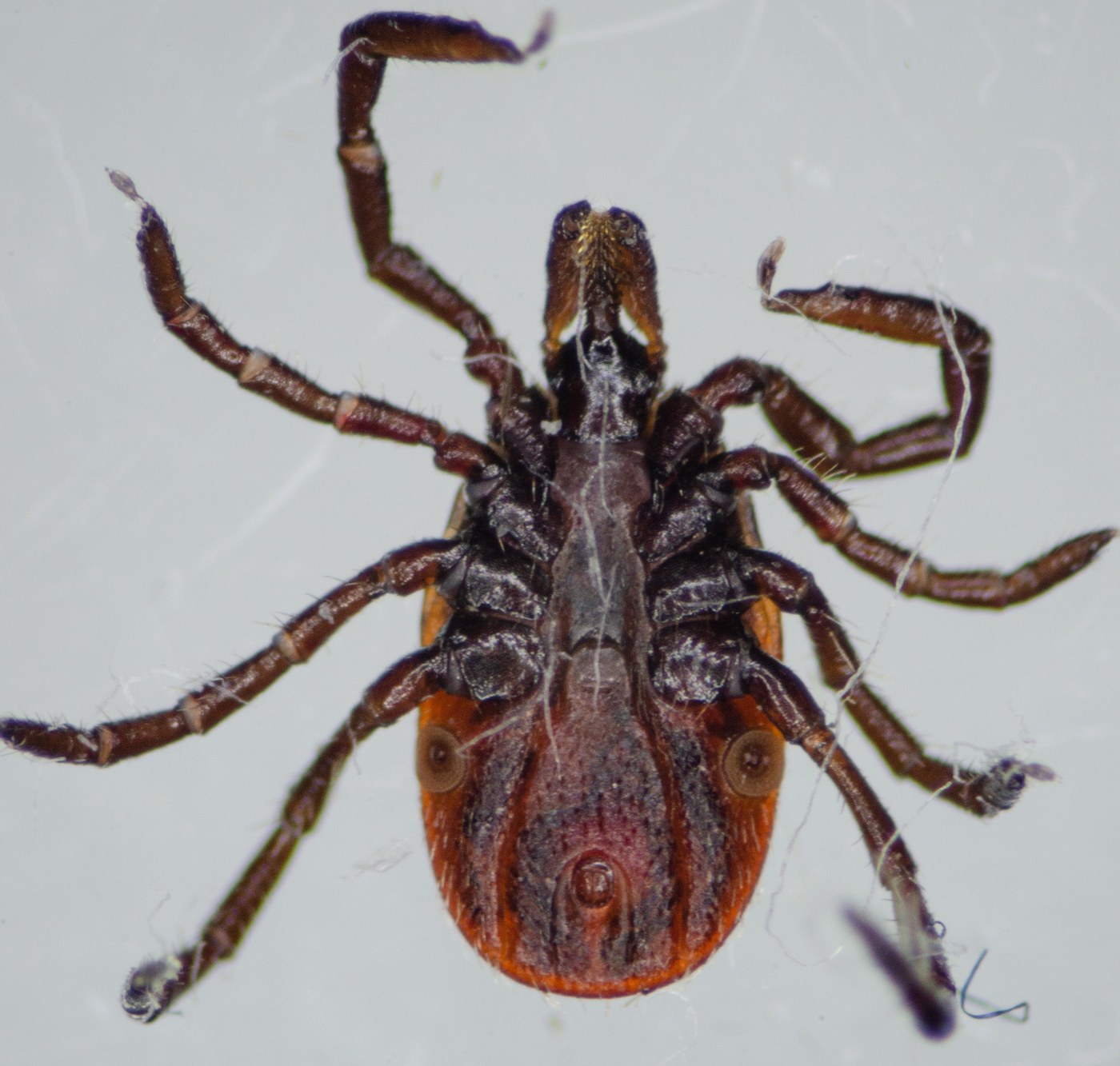
Start with what does not change: this species and the eastern blacklegged (deer) tick look almost exactly alike. Both have a reddish-orange abdomen, a dark brownish-black shield covering the front half of the back, and brownish-black legs. Two independent university sources describe the two species in nearly identical terms, and no university extension or federal source documents a reliable size or color difference that separates them by sight.
Sizes
Adult female about 1/8 inch unfed, expanding to 3/8 inch or more when engorged. Adult male smaller, oval, brownish-black, and attaches to people far less often than the female. Nymph about the size of a poppy seed, with a dark plate on its back and a translucent abdomen. Larva pinhead-sized with only six legs.
The real tell is range, not appearance
If a reddish-orange, dark-shielded, black-legged tick turns up on the West Coast, in California or the Pacific Northwest, it is functionally certain to be the western blacklegged tick rather than the eastern species, since the two ranges do not meaningfully overlap. Season backs this up too: cold-season adult activity and a lack of the classic summer-only pattern point to this species rather than its eastern cousin.
A naming note worth knowing
"Deer tick" is a common nickname for the eastern blacklegged tick, but no reliable source applies that name to this West Coast species specifically. Calling it a western blacklegged tick, or by its scientific name Ixodes pacificus, is the accurate way to refer to it.
Signs of Infestation
The sign is the tick itself
As with any tick, there is no structural infestation to watch for indoors, this species lives entirely outdoors. The habit that matters is checking after every outing: under the arms, in and around the ears, inside the belly button, the back of the knees, in and around the hair, between the legs, and around the waist.
Symptoms for a few weeks after
Watch for symptoms for a few weeks after a bite. Fever, chills, headache, fatigue, and muscle aches are the common thread across tickborne diseases carried by this species. Lyme disease can add joint pain and the erythema migrans rash.
Lyme risk is lower here
Lyme disease risk is real but lower than the eastern species. In parts of northern California, roughly 1 to 2 percent of adult ticks and 2 to 15 percent of nymphs carry the Lyme bacterium, on average, well below the infection rates documented in some eastern blacklegged tick populations. Researchers attribute much of that gap to the tick's habit of feeding heavily on the western fence lizard, whose blood kills the Lyme bacterium inside a feeding nymph before it can be passed along.
Anaplasmosis too
Anaplasmosis is also carried by this species along the West Coast, with symptoms including fever, chills, severe headache, muscle aches, and nausea, and the potential to become serious if treatment is delayed, especially in people 65 and older or with a weakened immune system.
Alpha-gal is an uncommon risk here
Alpha-gal syndrome, the tick-triggered red meat allergy, is a minor and uncommon risk for this species. It is primarily associated with the lone star tick, but a small number of cases have followed bites from western blacklegged ticks, so it is worth knowing about without treating it as this species' main concern.
Prevention and When to Call a Pro
Removal follows CDC guidance
Removal and personal protection follow the same CDC guidance that applies to any tick. Grasp it as close to the skin as possible with clean fine-tipped tweezers and pull straight up with steady pressure, do not twist, and never use petroleum jelly, heat, or nail polish to try to make it let go. Clean the bite site and your hands afterward. Do it as soon as possible rather than waiting for an appointment, and watch for fever or rash over the following weeks.
Repellents and treated clothing
They work the same way here as anywhere else. Use an EPA-registered repellent containing DEET, picaridin, IR3535, Oil of Lemon Eucalyptus, para-menthane-diol, or 2-undecanone, applied after sunscreen. Clothing or gear treated with 0.5 percent permethrin stays protective through several washes, and a hot dryer cycle after coming indoors kills any ticks riding along.
One addition for this species
One addition worth knowing for this species specifically. Tucking your shirt into your pants and your pant legs into your socks, on top of full-length pants and a long-sleeved shirt, is standard California guidance for time spent in the brush and leaf litter where nymphs concentrate.
Shower within two hours
Shower and do a full body check within two hours of coming inside. Manage the yard as well as the trail: clear leaf litter, cut back brush at the lawn's edge, and keep a wood chip or gravel barrier between lawn and any adjoining woods or wildland edge.
Reset the calendar for your area
Reset the calendar for where you live. Because California risk runs essentially year round and Pacific Northwest activity concentrates November through June, West Coast homeowners cannot safely confine tick precautions to summer the way generic national advice suggests. Winter and spring vigilance matters here, not just the warm months.
What a pro can and cannot do
What a pest professional can and cannot do. A tick bite is a medical matter first, remove it and then watch for symptoms. Property-level treatment targets tick habitat at the vegetated yard edge and trail margins where nymphs and questing adults wait. It supports personal protection, it does not replace it.
Frequently Asked Questions
Is the western blacklegged tick the same thing as a deer tick?
No, but it looks almost identical. The western blacklegged tick (Ixodes pacificus) is a separate species from the eastern blacklegged, or deer, tick (Ixodes scapularis). Both share the same reddish-orange body, dark shield, and black legs, and are told apart by range, West Coast versus East, and by season, not by appearance.
Why is tick season backwards on the West Coast?
Because this species runs the opposite calendar from the classic Northeast pattern. California sees western blacklegged tick activity essentially year round, and the Pacific Northwest's activity peaks roughly November through June, the reverse of the summer-focused warnings most people expect.
Do western blacklegged ticks carry Lyme disease?
Yes, but usually at a lower rate than the eastern blacklegged tick. In parts of northern California, roughly 1 to 2 percent of adults and 2 to 15 percent of nymphs carry the Lyme bacterium, compared to rates that run considerably higher in some eastern populations. Much of that difference is credited to this species' habit of feeding on the western fence lizard, whose blood kills the Lyme bacterium in a feeding tick.
How long does a western blacklegged tick live?
About three years from egg to adult, a year longer than the eastern blacklegged tick's roughly two-year cycle, with a single blood meal at each of three mobile life stages.
Can I tell a western blacklegged tick apart from a deer tick just by looking at it?
Not reliably. The two species share the same reddish-orange body, dark shield, and black legs, and no university or federal source documents a size or color difference that consistently separates them. Range is the practical answer: a tick like this found in California or the Pacific Northwest is almost certainly the western blacklegged tick.
Sources
- Lyme Disease in California University of California Statewide Integrated Pest Management Program (UC IPM)
- Where Ticks Live Centers for Disease Control and Prevention
- How Lyme Disease Spreads Centers for Disease Control and Prevention
- About Anaplasmosis Centers for Disease Control and Prevention
- About Alpha-gal Syndrome Centers for Disease Control and Prevention
- Tick Data Washington State Department of Health
Image Credits
- Image: Don Loarie via iNaturalist. CC BY 4.0.
License.