Seasonal Timeline
Active spring through autumn across its range, with adults peaking in late spring to early summer. Adult females are the life stage most likely to bite people.
Active spring through autumn across its range, with adults peaking in late spring to early summer. Adult females are the life stage most…
The South Central window is described broadly on purpose. Region-specific studies for Texas, Oklahoma, Arkansas, and Louisiana are limited, so the safer guidance is to expect activity across spring, summer, and into fall rather than a tight peak window.
Where They're Found
Widely distributed east of the Rocky Mountains, with limited populations in parts of the Pacific coast. This is not the same species as the Rocky Mountain wood tick (Dermacentor andersoni), which is found in the Rocky Mountain region itself and is a separate species with its own range, even though both are named Rocky Mountain spotted fever vectors. If you are east of the Rockies, an ornate, mottled tick is almost certainly the American dog tick, not the wood tick.
Life Cycle
Like other hard ticks, this species feeds once at each mobile stage and moves to a larger host each time: small rodents for the larva and nymph, then dogs and other larger mammals as an adult. The full cycle from egg to a dead, spent adult female runs about two years in the field, though a tick can survive many months unfed while it waits for the right host to pass by.

Larva
Nymph
Adult
Engorged Adult
Identification
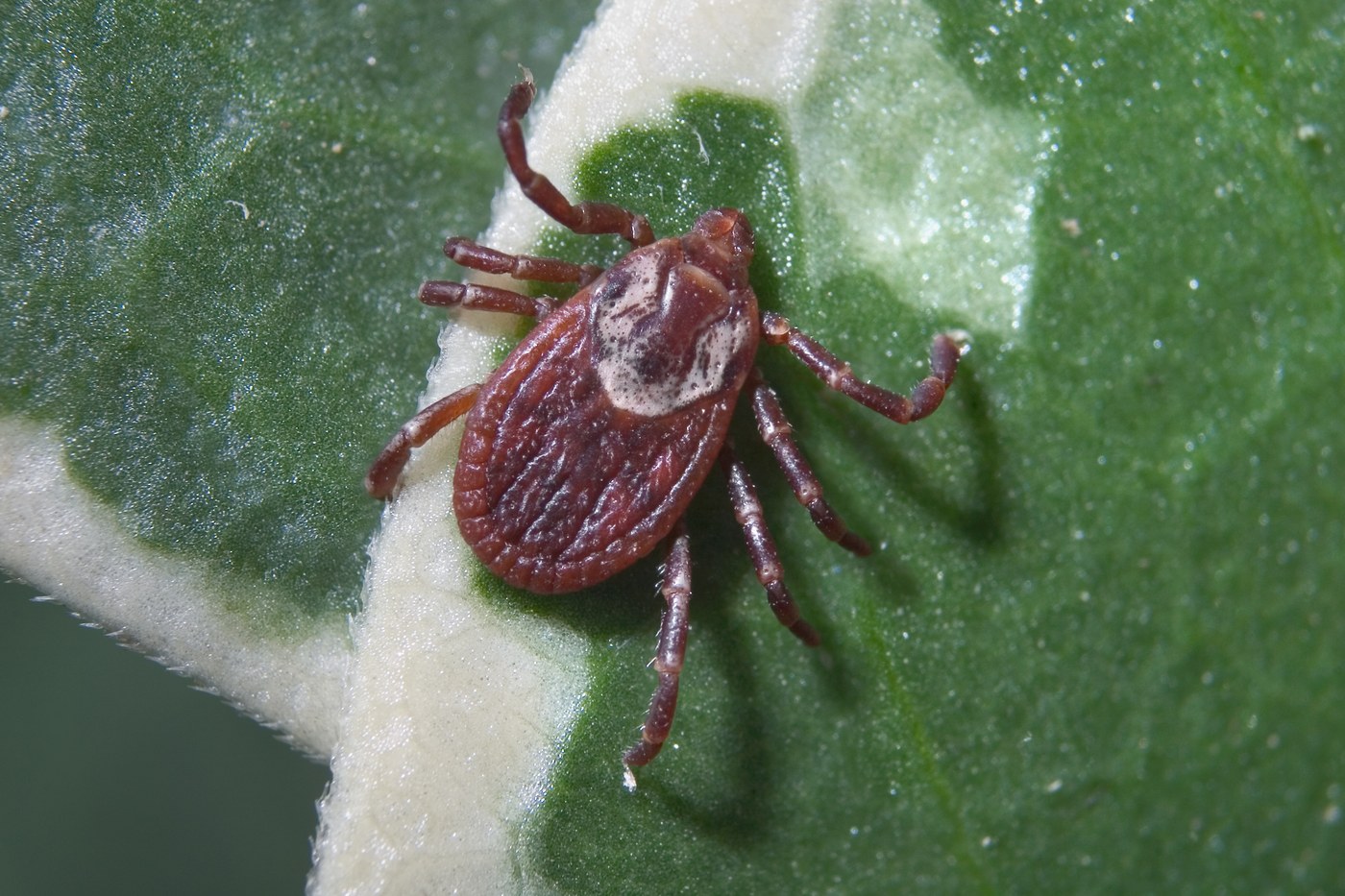
The ornate mottled shield
Look for the ornate, off-white or gray mottled shield. This marbled pattern on the back is the American dog tick's clearest field mark, and it's the opposite of the plain, solid dark shield carried by both blacklegged tick species. On females the mottling only shows near the head, with a plain reddish-brown body behind it; on males, the mottling covers nearly the whole back.
Size is a second clue
This species runs larger-bodied than the blacklegged and western blacklegged ticks, and an engorged female can swell to nearly 15mm long, noticeably bigger than a fed blacklegged tick.
Not the Rocky Mountain wood tick
Do not confuse it with the Rocky Mountain wood tick. Both are in the same genus, both carry an ornate shield, and both spread Rocky Mountain spotted fever, so appearance alone is not a reliable way to tell them apart. The dependable difference is range: the American dog tick is found broadly east of the Rocky Mountains, while the Rocky Mountain wood tick stays in the Rocky Mountain region itself.
Strong association with dogs
Adults specifically target dogs as a preferred host, which is where the common name comes from and why dog owners are this species' most frequent point of contact.
Signs of Infestation
Finding it attached
The sign is the tick itself, most often found attached to a person or a dog after time outdoors in grass, scrub, or along the edge of a trail.
Symptoms in the weeks after a bite
Watch for Rocky Mountain spotted fever symptoms in the weeks after a bite, including fever, headache, rash, nausea, stomach pain, muscle pain, and loss of appetite. This is the species' single most important health risk, and it deserves to be treated with more urgency than a typical tick bite.
The rash behaves differently than Lyme's
It usually shows up 2 to 4 days after fever starts, much sooner than the week or more it can take for Lyme's erythema migrans rash to appear, and it can look like red splotches or pinpoint dots. It often appears late in the illness, which is part of what makes the disease hard to catch early, so don't wait for a rash before seeing a doctor if fever follows a bite.
Spotted fever moves faster than Lyme
Rocky Mountain spotted fever moves faster and hits harder than Lyme disease when it isn't treated. More than 20% of untreated cases are fatal, compared to roughly 5% with prompt antibiotic treatment. Children are at higher risk of a fatal outcome than adults. Treatment with doxycycline works best when started early, so a doctor visit should not wait for lab confirmation.
Tularemia is a second, less common risk
It can cause a high fever, an ulcer at the bite site, and swollen, tender lymph nodes, usually within a few days to a couple of weeks of exposure. It is treatable with antibiotics.
Dogs can be affected too
Heavy feeding by this species is believed to be able to cause a toxin-driven, ascending paralysis in dogs, most often when a tick attaches near the base of the skull. This risk is documented by a single source, so treat it as real but less firmly established than the Rocky Mountain spotted fever risk. Removing the tick typically resolves it within a few days.
Prevention and When to Call a Pro
The basics live on the Ticks page
General tick removal, repellent choice, and yard management follow the same CDC guidance covered on the Ticks overview page: grasp the tick with fine-tipped tweezers as close to the skin as possible, pull straight up with steady pressure, and remove it as soon as it's found rather than waiting.
Adults target dogs specifically
Because adults target dogs specifically, routine tick prevention products for pets and a tick check on the dog after every outdoor walk matter more for this species than for most others.
They quest along trail edges
Adults wait along the edges of trails and roads to quest, so staying to the center of trails, already good general practice, is a particularly direct countermeasure here.
Cut rodent harborage at the edge
Reduce rodent harborage at the property edge. Larvae and nymphs depend on mice, voles, and similar small mammals as their first hosts, so clearing brush piles, tall grass, and leaf litter interrupts that part of the life cycle before ticks ever reach the adult stage that targets people and pets.
The attachment window
Some academic sources cite a transmission window of roughly 6 to 8 hours of attachment for Rocky Mountain spotted fever specifically, per University of Florida IFAS Extension. That figure comes from academic literature, not from the CDC, so the safer guidance to follow is CDC's own instruction: remove an attached tick as soon as it's found rather than treating any window as safe to wait out.
What a pro visit can do
A pest control visit can reduce tick pressure around a property by targeting the vegetated edges where ticks quest and the harborage that feeds the rodent hosts. It is a useful supporting step, not a substitute for personal tick checks and prompt removal.
Frequently Asked Questions
How do I tell an American dog tick from a deer tick?
Look at the shield and the size. The American dog tick is larger and carries an ornate, off-white or gray mottled shield. The blacklegged (deer) tick is smaller with a plain, solid dark shield and black legs, no mottling at all.
What is Rocky Mountain spotted fever, and how serious is it?
It's a bacterial disease spread mainly by the American dog tick, and it's genuinely more urgent than Lyme disease. More than 20% of untreated cases are fatal, versus roughly 5% with prompt antibiotic treatment, and the disease can progress in days rather than weeks. Fever, headache, and a rash that appears 2 to 4 days after fever starts are the symptoms to watch for.
Is the American dog tick the same as the Rocky Mountain wood tick?
No, they're different species. Both are in the same genus and both spread Rocky Mountain spotted fever, but the American dog tick is found broadly east of the Rocky Mountains while the Rocky Mountain wood tick stays in the Rocky Mountain region itself. Range, not appearance, is the reliable way to tell them apart.
Where in the country is the American dog tick found?
Broadly east of the Rocky Mountains, including the Northeast, Midwest, South Central, and Southeast regions, plus some limited populations along the Pacific coast. It is not the only tick species active in the Southeast, so a tick found there could also be a lone star tick.
Can my dog get sick from an American dog tick?
Yes. Beyond spreading Rocky Mountain spotted fever, heavy feeding by this species, especially near the base of a dog's skull, has been linked to a toxin-driven paralysis in dogs that typically resolves within a few days of removing the tick.
Sources
- About Rocky Mountain Spotted Fever Centers for Disease Control and Prevention
- Clinical Overview of Transmission and Epidemiology (RMSF) Centers for Disease Control and Prevention
- American Dog Tick Surveillance Centers for Disease Control and Prevention
- Clinical Care of Rocky Mountain Spotted Fever Centers for Disease Control and Prevention
- About Tularemia Centers for Disease Control and Prevention
- American Dog Tick, Dermacentor variabilis (Say) (Arachnida: Ixodida: Ixodidae) University of Florida IFAS Extension, Featured Creatures
- Dermacentor variabilis, American Dog Tick (Ixodida: Ixodidae) LSU AgCenter
Image Credits
- Image: Adobe Stock, licensed.