Seasonal Timeline
Nymphs are the summer risk, peaking May through July. Adults are the cold-weather risk, staying active from October through May in the Northeast, with a shorter, more defined off-season in the Midwest.
Nymphs are the summer risk, peaking May through July. Adults are the cold-weather risk, staying active from October through May in the…
The Midwest gets a real winter break that the Northeast does not. Colder, longer Midwest winters push blacklegged ticks into a defined off-season from November through February, while Northeast adults can still be questing on any above-freezing day deep into the cold months.
Where They're Found
Blacklegged ticks are established across the entire eastern United States, and the map reflects that full range: the Northeast, the Midwest, the Southeast, and the South Central states. Lyme disease, though, is concentrated in a smaller footprint. The CDC identifies the Northeast, mid-Atlantic, and upper Midwest as where Lyme occurs most commonly, and southern populations of this tick bite people far less often. A tick found in the South or lower Midwest is a real blacklegged tick, just much less likely to be carrying Lyme.
Life Cycle
The whole cycle takes about two years from egg to adult, and entomologists call it the 2-3-4 rule: a two-year life cycle, three separate hosts, four life stages. Each mobile stage feeds exactly once, on a different animal, which is why a poppy-seed-sized nymph feeding in July can be more dangerous than the adult a homeowner actually notices in October.

Egg
Larva
Nymph
Adult2
Identification
The plain dark shield
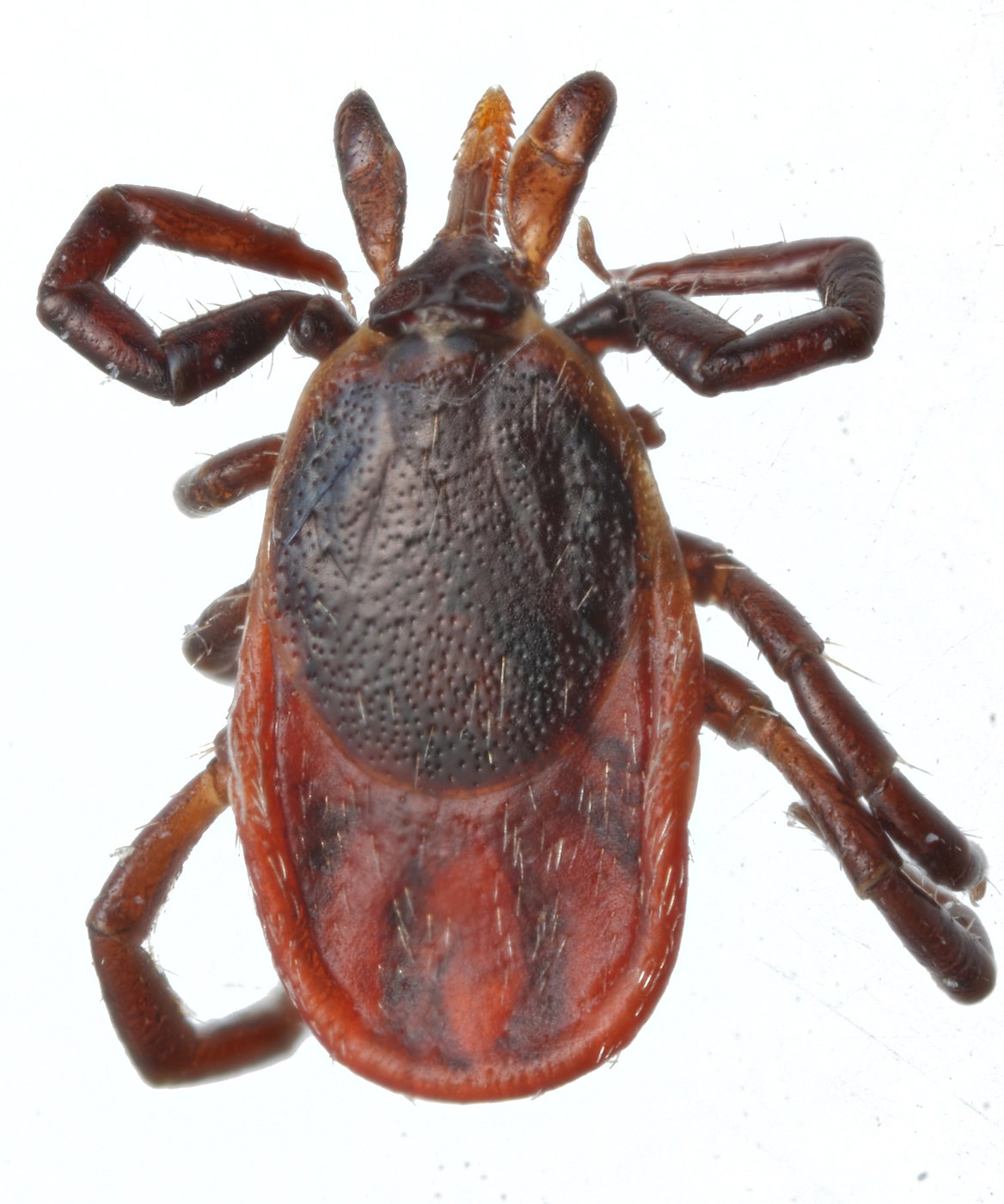
The single most useful field mark is a plain, solid, unmarked dark shield directly behind the head, reddish-black with no mottling or ornamentation. Adult females pair that shield with a reddish-orange body and black legs, the source of the name. Adult males are uniformly dark brown to black.
Size matters as much as color
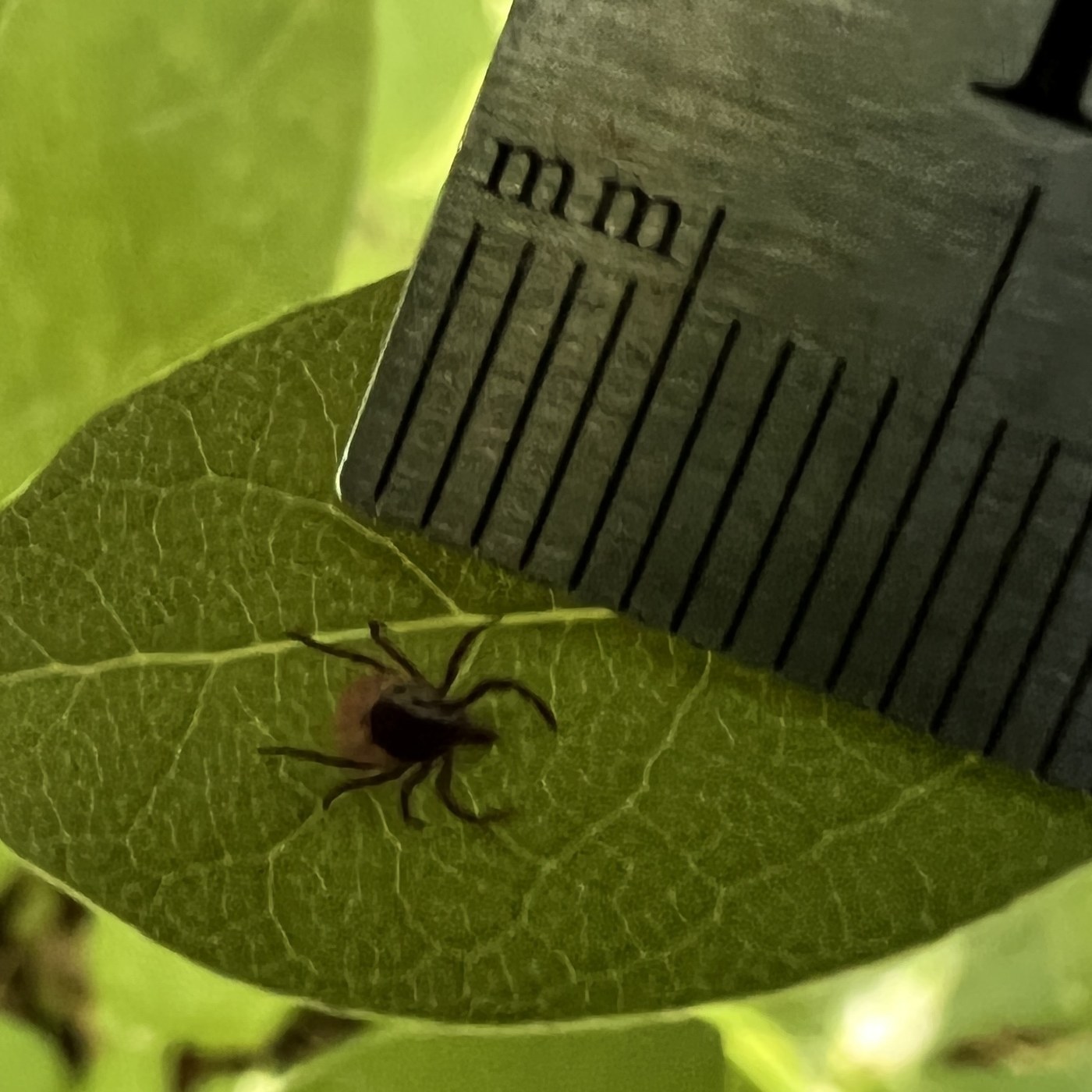
Unfed adults run about 1/8 inch, roughly the size of a sesame seed. Nymphs are smaller still, about the size of a poppy seed. An engorged, fed female can swell to about 1/2 inch and turn tan, gray, or dark brown.
American Dog Tick, most common mix-up
The blacklegged tick's plain, unmarked shield is the tell against the American dog tick, which is noticeably larger, with a mottled, ornate, off-white and tan-and-brown shield. These two species together account for the large majority of tick identification questions, so this is the comparison worth knowing.
Same look, different map
Western Blacklegged Tick, same look, different map. The western blacklegged tick shares the same reddish-orange body, the same plain dark shield, and the same black legs. Appearance will not tell the two apart. Range and season do the work instead: the western blacklegged tick occupies the Pacific Coast, runs a three-year life cycle instead of two, and peaks roughly November through June, the opposite calendar from this species in the Northeast.
Signs of Infestation
No indoor infestation
There is no indoor infestation to watch for with this species. The real sign is an attached tick found on a person or pet after time in leaf litter, brush, or tall grass, which is why checking after every outing matters more than watching for something around the house.
Symptoms in the days and weeks after
Watch for symptoms in the days to weeks after a bite. Fever, chills, headache, fatigue, and muscle or joint aches are the common early pattern across all three diseases this species carries.
The rash is often absent or atypical
A rash does not always show up, and when it does, it rarely looks like the textbook picture. The erythema migrans rash of Lyme disease appears in over 70 percent of cases, per the CDC, meaning close to 3 in 10 infections produce no visible rash at all. Even when a rash does appear, the classic ring-within-a-ring bullseye is only one of several documented presentations, not the typical one. CDC's own rash gallery shows expanding rashes with a crusted center, multiple smaller lesions, an oval red plaque, and even a bluish-hued rash alongside the bullseye pattern.
No rash can still mean trouble
Flu-like symptoms without a rash can still mean trouble. Anaplasmosis and babesiosis, the two other diseases this species carries, often present as fever, chills, headache, and body aches with no rash at all. Babesiosis in particular is frequently rash-free, and some infected people have no symptoms whatsoever.
Prevention and When to Call a Pro
How to remove a tick
Remove an attached tick with fine-tipped tweezers, grasped as close to the skin as possible, and pull straight out with steady, even pressure. Do not twist. Clean the bite site afterward with soap and water or rubbing alcohol, and do it as soon as the tick is found rather than waiting for a doctor's appointment.
Choosing a repellent
Use an EPA-registered repellent containing DEET, picaridin, IR3535, Oil of Lemon Eucalyptus, para-menthane-diol, or 2-undecanone, and treat clothing and gear with 0.5% permethrin. Ten minutes in a hot dryer kills ticks on clothing that is already dry, and the reason is drying rather than heat. Peer-reviewed testing on this species found ticks die in a dryer from rapid moisture loss, so damp clothing needs longer. Wash first if you like, but run the dryer either way.
Manage the yard, not just the trail
Clear leaf litter, keep a wood-chip or gravel barrier where lawn meets woods, and mow regularly to reduce questing habitat close to the house.
Two host-reduction steps
Both are especially worth it for this species. Because white-tailed deer are the key adult host and white-footed mice are the key host for larvae and nymphs, fencing to discourage deer traffic and removing deer-attracting plantings near the house, plus keeping woodpiles and brush away from the foundation to reduce rodent harborage, target this tick's life cycle directly rather than just its habitat in general.
When a yard treatment is worth it
A professional yard-based tick treatment is worth a call when a property borders woods or brush, sees regular deer traffic, or a household member or pet has already had a confirmed tick bite or a diagnosed tickborne illness. It is a supplement to personal protection and prompt removal, not a replacement for either.
Frequently Asked Questions
Why is the blacklegged tick also called the "deer tick"?
Because its preferred adult host is the white-tailed deer. The two names refer to the same species, and blacklegged tick is the accepted primary name, with deer tick retained as the popular synonym.
How do you tell a blacklegged tick apart from an American dog tick?
Size and shield pattern. The blacklegged tick is smaller with a plain, unmarked dark reddish-black shield. The American dog tick is larger, with an engorged female able to reach the size of a grape, and carries a mottled, tan-and-brown ornate shield.
Is tick season over when it gets cold?
Not for adult blacklegged ticks in the Northeast. They stay active from October through May, well past the first frost, which means a warm winter day is not a safe day to skip a tick check.
Does every Lyme disease infection cause the bullseye rash?
No. The erythema migrans rash appears in over 70 percent of Lyme cases per the CDC, and even when it appears, the classic ring-within-a-ring bullseye is only one of several documented presentations, not the typical one. CDC's own rash gallery shows crusted, disseminated, oval-plaque, and bluish-hued variants alongside the bullseye.
Can a blacklegged tick bite make me sick with something other than Lyme disease?
Yes. The same species also transmits anaplasmosis and babesiosis, both with their own flu-like symptom patterns and their own antibiotic or supportive treatments.
Sources
- Tick Lifecycles Centers for Disease Control and Prevention
- About Lyme Disease Centers for Disease Control and Prevention
- Lyme Disease Rashes Centers for Disease Control and Prevention
- About Anaplasmosis Centers for Disease Control and Prevention
- About Babesiosis Centers for Disease Control and Prevention
- General Distribution of Blacklegged Ticks Centers for Disease Control and Prevention
- Common Ticks and Tick-borne Diseases in Pennsylvania Penn State Extension
- Blacklegged Tick University of Minnesota Department of Entomology
- What to Do After a Tick Bite Centers for Disease Control and Prevention
- Preventing Tick Bites Centers for Disease Control and Prevention