Seasonal Timeline
Wandering garter snakes are day-active and non-migratory, denning below the frost line through winter, sometimes communally with other snakes, and emerging in spring to mate.
Wandering garter snakes are day-active and non-migratory, denning below the frost line through winter, sometimes communally with other…
Elevation drives this species' calendar more than latitude does, and that is worth knowing in a region with as much elevation range as the Mountain West. Colorado Parks and Wildlife documents females giving birth usually in July in lowland areas of southern Colorado, but not until August or September in the mountains, a straightforward elevation delay in the same state. Animal Diversity Web adds that high-elevation or lake-adjacent populations of this species tend toward shorter lifespans and faster reproduction, while lower-elevation populations tend toward longer lifespans and slower maturation, so two populations a short drive apart can be running genuinely different life histories.
The species is also documented across an unusually wide elevation band. Animal Diversity Web places the wider species from sea level up to roughly 13,100 feet, and Colorado's own agency notes it occurs throughout most of the state at elevations below 11,000 feet. A wandering garter snake found well up a mountainside in August is not an anomaly, it is a population running its own local schedule.
Winter is straightforward by comparison. This species hibernates below the frost line, sometimes communally with other snakes, and is not migratory. It resumes activity and mates again the following spring once dens open back up.
Where They're Found
The wandering garter snake is the most widespread subspecies of the western terrestrial garter snake, and its full range runs from the Canadian Prairie provinces south through the Rocky Mountain states into New Mexico and Arizona. The strongest state-agency documentation for it sits in the Mountain West. Montana's own Natural Heritage Program describes it as relatively common within suitable habitat and widely distributed across the western portion of the state, generally found west of a line running roughly from Billings to Shelby, and gives it a secure state conservation rank. Colorado Parks and Wildlife documents it throughout most of Colorado, excluding most of the plains region in the state's northeastern quarter. Idaho Fish and Game lists it as native and present statewide, with a secure conservation rank and a standard protected nongame classification. Wyoming, Utah, and Nevada also sit within this subspecies' documented range, though Montana, Colorado, and Idaho are the three states with dedicated agency pages confirming in-state status directly.
Habitat inside that range is genuinely broad, which is the whole reason this species carries two names. Montana's field guide describes it using nearly all habitats, but most commonly at lower elevations around water, including rocky cliffs, brushy talus at high elevations, and brushy bottomland on prairies. Colorado's agency puts it more directly: it adapts to almost any terrestrial or wetland habitat near flowing or non-flowing water, and frequently occupies terrestrial habitat far from water entirely. That is the biological basis for both halves of its name. It favors water, and it does not need to stay near it.
Alaska and Hawaii carry no population of this species. No record places any subspecies of the western terrestrial garter snake in Alaska, and Alaska's own wildlife agency lists no snake species at all as occurring in the state. Hawaii has no established wild snake population of any kind.
Life Cycle
Lifespan is a genuine, disclosed disagreement rather than a settled number. Animal Diversity Web's species-level estimate, extrapolated from the closely related common gartersnake, puts average wild survival around two years despite captive lifespans of six to twelve years. A National Park Service account for this exact subspecies instead states a typical lifespan around ten years. Both figures stand as published rather than one being chosen, since they may reflect different populations or different methods (a general species-wide estimate versus a specific subspecies account) rather than a true contradiction. What both sources agree on is the reproductive pattern: one litter per year, timed to elevation, is typical.

Mating
Gestation
Birth
Juvenile
Adult
Identification
Count the upper lip scales
The countable tell that separates this species from other gartersnakes: count the upper lip scales. The wandering garter snake carries eight scales along the upper lip, with the sixth and seventh visibly enlarged because of a salivary gland underneath them. The common gartersnake (Thamnophis sirtalis), a different species, carries seven. This is a photo-and-count exercise, not a reason to pick a snake up.
Color and stripes are unreliable
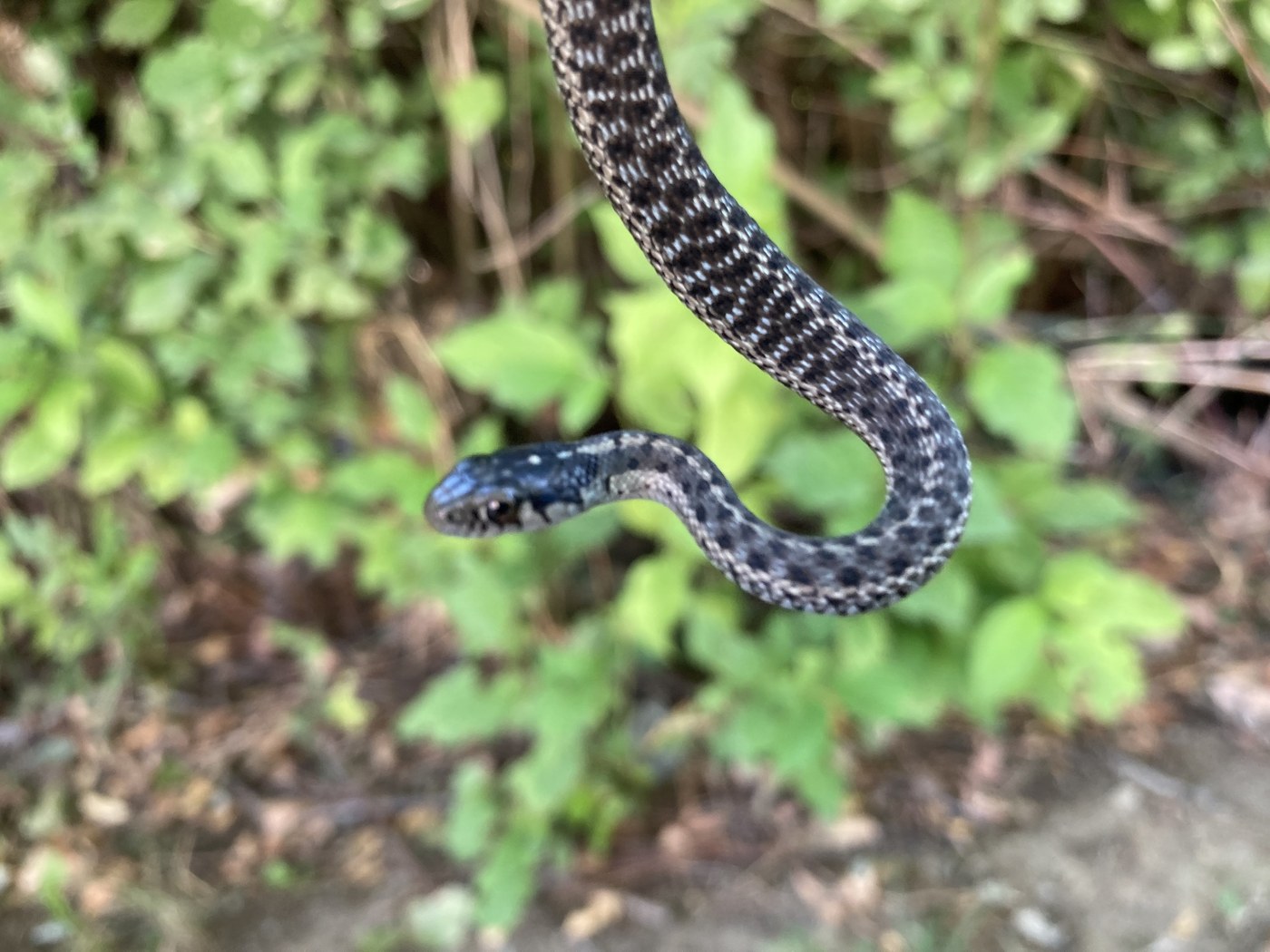
Color and stripe pattern are unreliable here, more so than on most gartersnakes. The dorsal stripe, when present, runs straight down the back in yellow, orange, cream, or white, but it can also be dull, incomplete, or missing entirely on some individuals. Ground color between the stripes ranges brownish, olive, greenish, black, or bluish-gray, and all-black individuals occur occasionally. Do not expect a clean three-stripe animal every time.
Three marks worth checking
Keeled body scales (each scale carries a raised ridge down the center), typically 21 rows of scales at midbody, and often two large black marks on the neck just behind the head. A series of dark blotches usually covers much of the belly.
Size
Most individuals encountered stay under 30 inches, with a documented range up to 43 inches. Newborns run roughly 6.5 to 9 inches.
The plains gartersnake
It shares the same ground in the eastern Mountain West. Two tells separate them. The plains gartersnake carries a bold, well-defined yellow or orange central stripe as its default look, where the wandering garter snake's stripe is frequently dull or absent. The plains gartersnake's pale side stripes also sit on the third and fourth scale rows above the belly scales, a specific and countable difference from the wandering garter snake's own stripe placement. Dark bars on the upper lip appear on both species, so that mark alone will not separate them.
The common gartersnake matters more
A second, more consequential look-alike is the common gartersnake, a different species that also reaches parts of the Mountain West. The same upper lip scale count settles it: eight on the wandering garter snake, with the enlarged sixth and seventh scales, against seven on the common gartersnake.
Two words, one animal
"Wandering" and "terrestrial" are not two different animals. Mountain West state wildlife agencies generally use "Terrestrial Gartersnake" for the species in their own official field guides, and "Wandering Garter Snake" is the specific name for this subspecies. Both names describe the same snake.
Signs of Infestation
No damage to look for
There is no damage to look for, because this species causes none. No gnawing, no burrowing into structures, no chewed wiring, no droppings pattern to identify, no entry hole to find. This species does not enter wall voids or living space.
The visual sighting, and where it happens
A striped snake basking on rock, moving through sagebrush or grass, or sheltering under talus, brush, or debris, near a pond, stream, or irrigation ditch, or well away from any obvious water, since this species wanders readily into upland terrain.
A musky odor after a disturbance
A sharp musky odor after something disturbed a snake. Musking is this species' primary defensive response, discharged from glands near the tail. A sudden unpleasant smell after a dog nosed into brush, or on your hands after handling a snake, is a strong tell that this species or a related harmless snake was just there.
Nothing to hear
This species is silent. There is no rattle, no buzzing, no scratching in a wall to listen for.
Prevention and When to Call a Pro
Leave it alone
The default recommendation is to leave it alone. This species causes no property damage, poses no disease risk, and eats slugs, worms, grasshoppers, and other yard invertebrates. The realistic goal for a homeowner who is uncomfortable is fewer encounters, not removal.
Take away the cover
If you want fewer sightings, take away the cover. Rock piles, brush piles, stacked wood, and dense ground-level vegetation near a foundation, walkway, or ditch bank are exactly the microhabitats this species shelters in. Clearing them reduces how often you cross paths with one.
Seal the ground-level gaps
Seal ground-level gaps if you do not want one sheltering against the structure. Gaps around sheds, crawl space vents, and foundation edges are worth closing with standard exclusion work. This is about keeping a snake from tucking in against the building, not about keeping one out of living space, since this species does not go there.
The bite, musk and mild venom
The bite, the musk, and the mild venom. This species will bite if handled or cornered, and will discharge foul-smelling musk. It also carries a genuinely mild venom in its saliva, delivered by a chewing action and built to work on small prey. State wildlife agencies and academic sources agree it is not considered dangerous to a person, and documented human bite cases have been limited to local swelling with no systemic symptoms. The practical scenario is the same as any other gartersnake: a startled dog or a curious child getting nipped or musked, not a medical event. The simplest way to avoid both is not to pick the animal up.
Nongame protections apply
Standard nongame protections apply across most of this species' range. Idaho classifies it as protected nongame with no open season, a common baseline for native, unlisted reptiles rather than a special restriction. State rules on handling or relocating wildlife vary and change, so a homeowner who wants a snake physically relocated rather than simply left alone should check current state regulations first and default to a licensed nuisance wildlife professional if uncertain.
Uncertainty is what warrants a call
The one situation that genuinely warrants a call is uncertainty, not danger. If you cannot confidently tell whether the striped snake in your yard is this harmless species versus something else, do not attempt to handle it. Call a wildlife control professional or your state wildlife agency for an identification.
What not to bother doing
What you should not bother doing. There is no removal product to buy, no trapping program to run, and no reason to treat a yard for this animal. The whole of the practical advice is habitat management around the house, and doing nothing at all is a completely reasonable option here.
Frequently Asked Questions
Is the wandering garter snake venomous?
It carries a genuinely mild venom in its saliva, delivered through a chewing action rather than a strike and built to work on small prey. State wildlife agencies and academic sources agree it is not considered dangerous to a person. Documented human bite cases have been limited to local swelling with no systemic symptoms, a real but minor effect rather than a medical emergency.
What is the difference between a wandering garter snake and a terrestrial garter snake?
Nothing. They are the same animal. Mountain West state wildlife agencies generally use "Terrestrial Gartersnake" for the species in their own official field guides, while "Wandering Garter Snake" is the more specific name for this particular subspecies. The "wandering"/"terrestrial" naming reflects how comfortably this species ranges into dry upland habitat, not just streambanks and pond edges.
Why do I find this snake far from any water?
Because it genuinely wanders. State wildlife agencies describe it occupying almost any terrestrial or wetland habitat, including rocky talus, sagebrush flats, and dry prairie bottomland, not only the immediate edges of ponds and streams. It favors water but does not need to stay near it.
Does this snake squeeze its prey like a constrictor?
Yes, and it is unusual among gartersnakes for doing so. Colorado wildlife officials document it as the only garter snake species with a well-documented tendency to constrict prey, though the technique is inefficient compared to a true constrictor snake.
Should I remove a wandering garter snake from my yard?
No removal is necessary. It causes no property damage, does not enter living space, and helps control slugs, worms, grasshoppers, and other yard pests. If you want fewer sightings, clear rock piles, brush, and dense ground cover near the foundation instead, and check your state's current wildlife regulations before any hands-on relocation.
Sources
- Terrestrial Gartersnake (Thamnophis elegans): Montana range, size, diet study, habitat, and reproduction Montana Natural Heritage Program / Montana Fish, Wildlife & Parks
- Terrestrial Garter Snake: Colorado description, size, scale counts, habitat, diet, venom, constriction behavior, and reproduction timing by elevation Colorado Parks and Wildlife
- Common Garter Snake: used to confirm Thamnophis sirtalis is catalogued as a separate species from the terrestrial garter snake in Colorado's own species pages Colorado Parks and Wildlife
- Thamnophis elegans (Western Terrestrial Garter Snake): upper labial scale count, mild neurotoxic venom, life history, diet, defensive behavior, and habitat Animal Diversity Web, University of Michigan Museum of Zoology
- Wandering Garter Snake (Thamnophis elegans vagrans) species profile U.S. Fish and Wildlife Service
- Thamnophis elegans (Terrestrial Gartersnake): Idaho native status, protected nongame classification, and state conservation rank Idaho Fish and Game Species Catalog
- Wandering Garter Snake: identification, diet, habitat, elevation range, behavior, and reproduction U.S. National Park Service, Bighorn Canyon National Recreation Area
- Plains Garter Snake: Colorado description and stripe pattern, used for the look-alike comparison Colorado Parks and Wildlife
Image Credits
- Image: Torsten Watkins via iNaturalist. CC0 1.0.
License.