Seasonal Timeline
California red-sided gartersnakes are day-active hunters that mate in late winter to early spring, with live young born from mid-summer into early fall. Multiple individuals share communal winter dens, so sightings often cluster near a den site at both ends of the season.
California red-sided gartersnakes are day-active hunters that mate in late winter to early spring, with live young born from mid-summer…
This is a native reptile rather than a structural pest, so its calendar follows its own biology rather than a treatment schedule. The pattern is straightforward: mating in late winter to early spring, gestation of roughly two to three months, and live young arriving from mid-summer into early fall.
A second fall litter is documented for some populations of the same species elsewhere in the country, but no California-specific record confirms it for this subspecies, so do not expect one.
Where They're Found
The California red-sided gartersnake is endemic to California. Its range runs from Humboldt County south along the North Coast ranges, excluding much of the San Francisco Peninsula itself, east of San Francisco Bay through the greater East Bay, and then south along the central and south coasts to San Diego County. Named counties within that range include Humboldt, Marin, Sonoma, Alameda, Contra Costa, Santa Clara, Santa Cruz, and Monterey, continuing southward. It does not range outside California, and no record places it in Alaska or Hawaii.
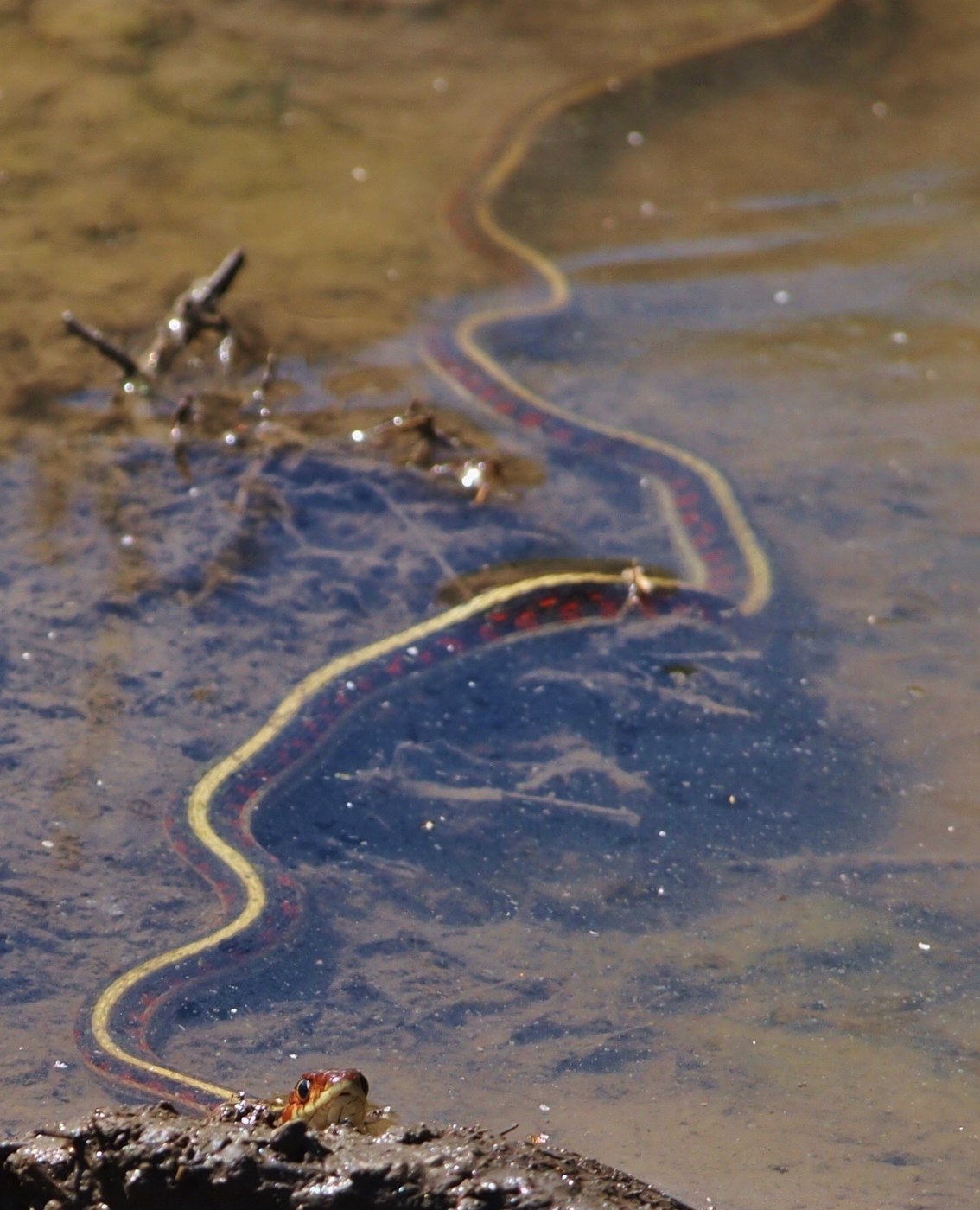
Habitat is strongly tied to water. Freshwater coastal marshes, ponds, slow-moving streams, grassland, and coastal dunes are all typical, and these are skilled swimmers that hunt in and around water. One habitat feature is worth naming because it is genuinely unusual: sag ponds, the water-filled depressions that form along the San Andreas Fault rift zone, are specifically associated with this subspecies' range. Individuals also turn up in drier grassland and dune habitat well away from standing water, so proximity to a marsh is a strong hint rather than a requirement.
The part of the range that carries legal weight is the Bay Area. This subspecies' own documented range includes Santa Clara, Santa Cruz, and Alameda counties. The Endangered San Francisco gartersnake survives in a much narrower area, in what the Golden Gate National Parks Conservancy describes as only five isolated populations, all in San Mateo County, historically extending from near the southern San Francisco County line south to Rancho del Oso State Park in Santa Cruz County and inland to Crystal Springs Reservoir. Those two descriptions overlap, and both subspecies favor the same reedy marsh and pond edges. That overlap, not distance, is why San Mateo, Santa Cruz, Santa Clara, San Francisco, and Alameda counties call for a separate, higher level of caution.
Life Cycle
Two figures are unknown for this subspecies. No California-specific lifespan study was found, so wild lifespan for California red-sided gartersnake is unknown. Figures published for the species as a whole elsewhere in North America have not been verified for this subspecies. Likewise, one litter per year is typical for the species, and while some populations of the wider species elsewhere are documented breeding again in fall, no California-specific record supports a second fall litter.

Mating
Live Birth
Juvenile2
Adult
Identification
Near San Francisco Bay, read this
Read this first if you are anywhere near San Francisco Bay: the San Francisco gartersnake look-alike is the single most important thing to know about this snake. The San Francisco gartersnake has been federally listed as Endangered since 1967, is separately state-listed as Endangered in California and additionally designated Fully Protected, and it shares range and habitat with the California red-sided gartersnake across the Peninsula and East Bay. In San Mateo, Santa Cruz, Santa Clara, San Francisco, and Alameda counties, a striped snake cannot be reliably assigned to one subspecies or the other by looking at it. That is a statement about the animals, not about the observer.
Why the pattern fails as a test
Why the "diagnostic" pattern does not work as a field test. Careful sources do not agree on what the tell even is. Stanford University's habitat conservation documentation describes San Francisco gartersnake as showing four stripes and California red-sided gartersnake as showing three, with the red on this subspecies broken into a checkered stripe. Taxonomic literature summarized from federal sourcing frames the same difference differently, as red blotching and spots on California red-sided gartersnake versus a single continuous red stripe on San Francisco gartersnake. Those are two different tests, not one test stated twice. When the specialists describing a mark cannot phrase it the same way, it is not a mark a homeowner should be betting a federal listing on.
Intergrades defeat it where it counts
Intergrades defeat the pattern outright in exactly the area where it matters. Stanford's own documentation states that intergrade individuals often show asymmetrical color patterns and that individuals from intergrade populations can look very similar to either subspecies. The garter snakes on Stanford's land in San Mateo County are documented as intergrades between the two, and most of them display the alternating red and black markings that are considered characteristic of red-sided gartersnakes. So even the pattern that looks like a confident answer can be coming from an intergrade population.
This is not a homeowner skill gap
The record says so. From 1996 to 2000 there was active professional disagreement over how to separate San Francisco gartersnake from California red-sided gartersnake and a third subspecies, red-spotted gartersnake, resolved only when the International Commission on Zoological Nomenclature settled the naming dispute in 2000. Molecular work since has suggested the color-pattern differences that define San Francisco gartersnake reflect local selection rather than long isolation, which means the visual boundary is genuinely fuzzy biology and not merely a hard-to-learn field mark. Specialists have disagreed about this in print. A glance across a yard is not going to settle it.
Color makes photo matching worse
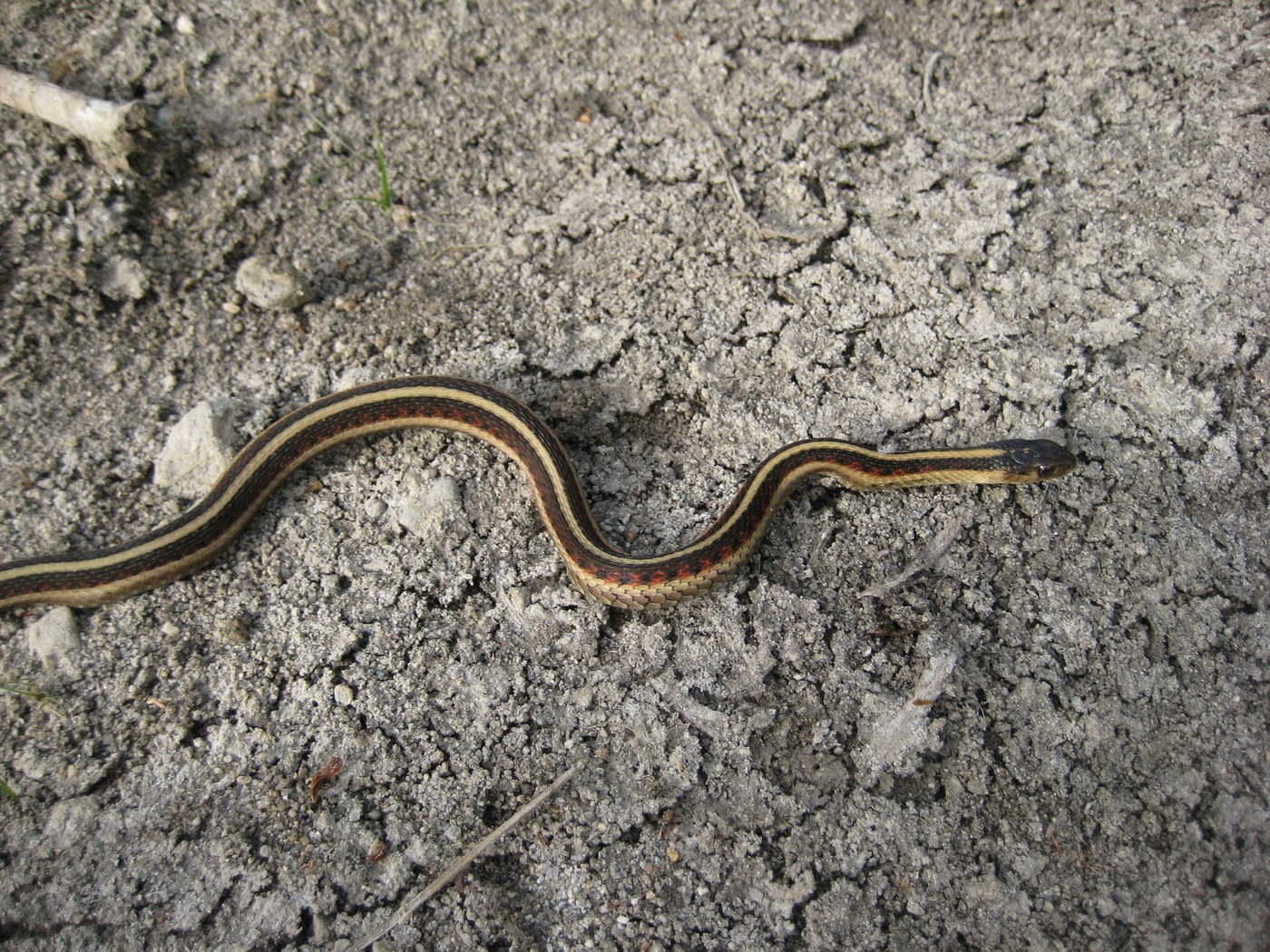
Color is unusually variable in this subspecies, which makes photo matching worse rather than better. Typical animals are dark olive to black with a wide, well-defined yellowish to bluish stripe down the back, a red or orange head, red bars alternating with the ground color along the sides, and a bluish-gray underside sometimes carrying dark markings. The light side stripes are often not very distinct. On top of that, a blue-striped, blue-bellied blue morph occurs north of the Bay Area into Sonoma County, documented at least as far as Sebastopol and Santa Rosa, and California herpetological sources flag it specifically as similar in coloring to the San Francisco gartersnake while being a different subspecies. If your snake does not match the photo you found online, that is normal and it does not tell you which subspecies you have.
Size sets expectations only
Size and build set expectations without settling identity. Adults run 18 to 55 inches, averaging under 36 inches. This is a medium-sized snake with a head barely wider than the neck, keeled dorsal scales meaning each scale carries a raised ridge down its center, and relatively large eyes for a gartersnake. Scale counts run to 7 upper labial scales, occasionally 6, 8, or 9, often marked with black wedges, 10 lower labial scales, and an average of 19 scale rows at mid-body. None of that separates it from the endangered look-alike in the field.
What is settled: it is not venomous
Whichever subspecies is in front of you, a gartersnake is non-venomous and causes no property damage. The identification question here is a legal one, not a safety one. Nobody is in danger from this animal. The reason to get it right is that handling, moving, or removing the wrong one is a federal and state wildlife issue.
Signs of Infestation
No damage to look for
There is no damage to look for, because this species causes none. No gnawing, no chewed wiring, no burrowing into structures, no droppings pattern, no entry hole. This is a strictly outdoor animal that does not enter wall voids or living space. The only real sign is the snake itself, which is why identification matters more than tracking an infestation.
The sighting, and where it happens
The visual sighting, and where it tends to happen. A striped snake, often showing red-and-dark blotching along the sides, basking or moving through grass and garden beds. Odds rise sharply near marshy or wetland ground, sag ponds, coastal wetlands, and slow-moving water, which is the habitat this subspecies favors. Sightings near that kind of habitat anywhere on or around the San Francisco Peninsula are precisely the ones that warrant the caution described below.
Nothing to hear
Gartersnakes are silent. There is no rattle, no buzzing, and no scratching in a wall or attic to listen for. If you are hearing something inside a structure, this animal is not the cause and one of the rodent or wildlife pages is the one you want.
A musky odor after a disturbance
A sudden musky odor after a snake has been disturbed. Musk released from glands near the tail is this animal's primary defense, and it is foul-smelling and completely harmless. An unpleasant smell after a dog nosed into mulch or marsh-edge vegetation is a reliable sign a gartersnake was just there. It is also a good reason not to pick one up, entirely apart from the legal reasons.
Prevention and When to Call a Pro
Start with where you are
The answer changes by county. In San Mateo, Santa Cruz, Santa Clara, San Francisco, and Alameda counties, do not attempt do-it-yourself handling, relocation, trapping, or removal of a gartersnake of any kind. Leave the snake where it is. If it genuinely has to be moved, get a professional identification first from a licensed nuisance wildlife control operator or the California Department of Fish and Wildlife. That is the whole recommendation for those five counties. The steps below apply to the rest of the state.
Elsewhere, leave it alone
Everywhere else in this subspecies' California range, the default is to leave it alone. The California red-sided gartersnake is non-venomous, causes no property damage, and does not enter living space. It is a beneficial animal on most properties. For a homeowner who simply wants fewer encounters, the realistic goal is fewer sightings, not removal, and the way to get there is habitat management rather than any product or trapping program.
Take away the ground cover
If you want fewer sightings, take away the ground-level cover. Woodpiles, scattered boards and debris, and thick unmanaged ground cover against foundations and along walkways are the microhabitats this snake shelters in. Moving woodpiles away from the house, clearing debris, and thinning heavy ground cover near doors and paths does more than anything else to reduce how often you cross paths with one.
Seal the obvious gaps
Seal obvious ground-level gaps if you would rather one did not tuck in against the structure. Gaps at foundations, crawl space vents, and sheds are worth closing with standard exclusion work. Set expectations correctly: this keeps a snake from sheltering against the building, and it is not about keeping one out of your house, because this animal does not go into living space in the first place.
The five-county overlap
California red-sided gartersnake and the Endangered, Fully Protected San Francisco gartersnake share range and habitat on and around the San Francisco Peninsula, documented intergrades between the two occur there, and the color pattern that supposedly separates them is described inconsistently even by specialists. A homeowner in San Mateo, Santa Cruz, Santa Clara, San Francisco, or Alameda County who handles, relocates, or removes a snake on the assumption that it is the common subspecies is making a guess with an endangered species on the other side of it. Do not make that guess. Call a licensed wildlife control professional or CDFW and let identification happen first.
San Mateo County closes take
California law closes take of any gartersnake in San Mateo County outright, whatever subspecies it is. Under California's reptile-take regulation, take of any common gartersnake is prohibited entirely in six counties: San Mateo, Los Angeles, Orange, Riverside, San Diego, and Ventura. Note that this closure list is not the same as the five-county identification caution zone above. They share only San Mateo County. In San Mateo County both apply at once, which means collecting, trapping, or relocating a gartersnake yourself is not a legal option there regardless of how confident anyone is about the identification.
The general California framework
This is context for outside those counties. California generally prohibits capturing, collecting, possessing, or transporting native reptiles except as specifically permitted under Title 14 of the state code. For common gartersnakes, the standard limit is 2 per day with a sportfishing license, taken only by hand or with hand-operated devices such as snake tongs or hooks, and collection is prohibited in state parks, national parks, and designated ecological reserves. Two taxa are carved out of that allowance entirely and may not be taken at all: the San Francisco gartersnake and the South Coast gartersnake. The South Coast gartersnake is a separate California taxon of the same species found along the coastal plain from Ventura County south to San Diego County and classified as a Species of Special Concern, so a gartersnake in the southern coastal counties may also be a separately protected animal rather than California red-sided gartersnake.
When to Call a Wildlife Control Operator
In the five caution-zone counties, call before doing anything at all with a gartersnake, and treat professional identification as the first step rather than a second opinion. In San Mateo County specifically, add that state law closes take there outright. Elsewhere in California, most encounters need no professional response whatsoever, because a confirmed gartersnake is harmless and beneficial. The situation that does warrant a call outside the caution zone is uncertainty: if you cannot confidently tell whether a snake in your yard is a harmless striped species or something venomous, do not handle it or move it, and get a wildlife control professional or CDFW to close the identification question first.
Frequently Asked Questions
Is the garter snake in my yard the endangered San Francisco garter snake?
If you are in San Mateo, Santa Cruz, Santa Clara, San Francisco, or Alameda County, that question genuinely cannot be answered by looking, and not just by a homeowner. The California red-sided gartersnake and the Endangered San Francisco gartersnake share range and wetland habitat there, they interbreed in that area with documented intergrade populations, and the color-pattern difference that is supposed to distinguish them is described differently by different careful sources. Get a professional identification from a licensed nuisance wildlife control operator or the California Department of Fish and Wildlife before doing anything with the snake, rather than guessing. Outside those five counties the endangered subspecies is not credibly present and the usual harmless-gartersnake framing applies.
Is it legal to catch or move a garter snake in California?
Sometimes, and not everywhere. Under California's reptile-take regulation, common gartersnakes are limited to 2 per day with a sportfishing license, by hand or hand-operated devices only, with collection prohibited in state parks, national parks, and designated ecological reserves. Two taxa may not be taken at all: the San Francisco gartersnake and the South Coast gartersnake. On top of that, take of any common gartersnake is closed entirely in six counties: San Mateo, Los Angeles, Orange, Riverside, San Diego, and Ventura. Rules change, so verify the current regulation before any hands-on removal, and in the Bay Area caution zone get an identification first regardless.
Are California red-sided garter snakes dangerous?
No. They are completely non-venomous. The worst outcome from handling one is a minor defensive nip and a foul-smelling musk released from glands near the tail, the same as gartersnakes elsewhere in the country. Neither is a medical problem. The reason for caution in parts of the Bay Area is legal, not medical: the endangered look-alike is protected, not hazardous.
Why does my garter snake look different from the ones I see online?
Because this subspecies is unusually variable. Individuals range from dark animals with red blotching along the sides to a blue-striped, blue-bellied blue morph found north of the Bay Area into Sonoma County, documented at least as far as Sebastopol and Santa Rosa. California herpetological sources flag that blue morph specifically as similar in coloring to the San Francisco gartersnake while being a different subspecies. Color pattern alone is not a reliable way to identify which gartersnake you are looking at.
Should I remove garter snakes from my property?
Outside the San Mateo, Santa Cruz, Santa Clara, San Francisco, and Alameda caution zone, the standard advice is to leave them alone. They are harmless, they cause no property damage, and they help control garden pests. If you want fewer sightings, remove ground-level cover such as woodpiles, debris, and thick unmanaged ground cover near the house. Inside that five-county zone, do not remove or relocate the snake yourself at all. Get professional identification first, because of the endangered look-alike, and in San Mateo County state law closes take of any gartersnake outright.
Sources
- San Francisco garter snake (Thamnophis sirtalis tetrataenia) ECOS species profile: federal Endangered listing effective March 11, 1967, and range U.S. Fish and Wildlife Service
- San Francisco Garter Snake (Thamnophis sirtalis tetrataenia) species page: listing status and Peninsula range U.S. Fish and Wildlife Service
- South coast garter snake (Thamnophis sirtalis ssp.) ECOS species profile: separate taxon and coastal plain range U.S. Fish and Wildlife Service
- San Francisco Garter Snake: identification characters for both subspecies, documented intergrades on the San Francisco Peninsula, and asymmetrical intergrade color patterns Stanford University Habitat Conservation Plan
- Cal. Code Regs. Tit. 14, Section 5.60 (Reptiles): common gartersnake bag limit, hand-capture requirement, park and reserve closures, San Francisco and South Coast gartersnake take prohibition, and six-county special closure Cornell Law School Legal Information Institute
- California Red-sided Gartersnake (Thamnophis sirtalis infernalis): California range and counties, size, coloration, scale characters, and the Sonoma County blue morph CaliforniaHerps.com
- San Francisco Gartersnake (Thamnophis sirtalis tetrataenia): California state Endangered listing effective June 27, 1971 and Fully Protected designation CaliforniaHerps.com
- South Coast Gartersnake (Thamnophis sirtalis ssp.): range and Species of Special Concern status CaliforniaHerps.com
- San Francisco Garter Snake: five surviving isolated populations in San Mateo County, historical habitat loss, marsh-edge habitat, and defensive musking Golden Gate National Parks Conservancy