Seasonal Timeline
These are day-active snakes with a long warm season. Washington's Department of Fish and Wildlife puts common gartersnake activity at roughly March through early November at low elevations, with the snakes brumating through the coldest stretch and emerging to breed in spring.
These are day-active snakes with a long warm season. Washington's Department of Fish and Wildlife puts common gartersnake activity at…
The Northwestern gartersnake runs an unusual calendar for a snake, and it is worth knowing because it explains two separate bursts of sightings. Animal Diversity Web documents two distinct mating windows for this species, one in late March and early April and a second in late September and early October, each lasting roughly three weeks. Those two windows sit at the front and back edges of the active season, which is exactly when a homeowner is most likely to see several snakes in a short stretch of days and assume something has changed on the property. Nothing has. They are breeding, and then they are going down for winter.
Midsummer moves the schedule rather than stopping it. Oregon State University Extension notes that garter snakes shift toward morning and evening activity during hot weather and shelter from the midday heat, so a July sighting is more likely at the cool ends of the day than at noon. Both species hibernate through winter, sometimes communally in shared dens and cavities that do not freeze, and occasionally alongside other snake species entirely.
Where They're Found
All four taxa live in Washington and Oregon, across the Pacific Northwest. Washington's Department of Fish and Wildlife states directly that three subspecies of common gartersnake occur in the state, and it gives each of them its own in-state territory: Red-spotted gartersnake along the Pacific Coast and southern Puget Trough, Valley gartersnake in eastern Washington, and Puget Sound gartersnake in the Puget Trough lowlands. That geography is the single most useful shortcut, because where you are standing narrows the answer before you ever look at the snake. In Oregon, the Red-spotted gartersnake is the Willamette Valley form, which is also where the subspecies was first described, and the Valley gartersnake is the broader statewide form.
The habitat split between the two species is real and it is the other half of the shortcut. Common gartersnake is normally found in or near water, per Oregon State University Extension, largely because so much of what it eats is aquatic or semi-aquatic. Washington's own agency lists wetlands, bogs, ponds, lakes, creeks, and rivers, plus the sunny terrestrial ground next to them: meadows, oak patches, forest openings, and shrubby edges. Oregon's account widens that to grasslands, shrublands, forests, pond and stream edges, rocky hillsides, and residential areas, from sea level up to 6,000 feet on Mount Hood. Northwestern gartersnake is the more terrestrial of the two. It uses damp vegetated ground and open sunny clearings, lowland thickets, meadows, forest clearings and forest edges, frequently close to houses and frequently under boards and other flat surface cover, and it typically turns up away from open water rather than beside it. When threatened it escapes into vegetation rather than into water, though it swims perfectly well.
Neither species is a structural animal. Neither enters wall voids or living space, and neither burrows into a foundation. Both will shelter under debris, boards, rock piles, and along the base of a building, which is why they get met at close range while somebody is moving a woodpile. Beyond Washington and Oregon, Northwestern gartersnake's range continues north into southwestern British Columbia and south into the far northwest corner of California. Alaska and Hawaii carry no population of any of these snakes. The Alaska Department of Fish and Game's own listing of reptiles found in the state includes no snake of any kind, and Hawaii has no established wild snake population either.
Related Pests
Life Cycle
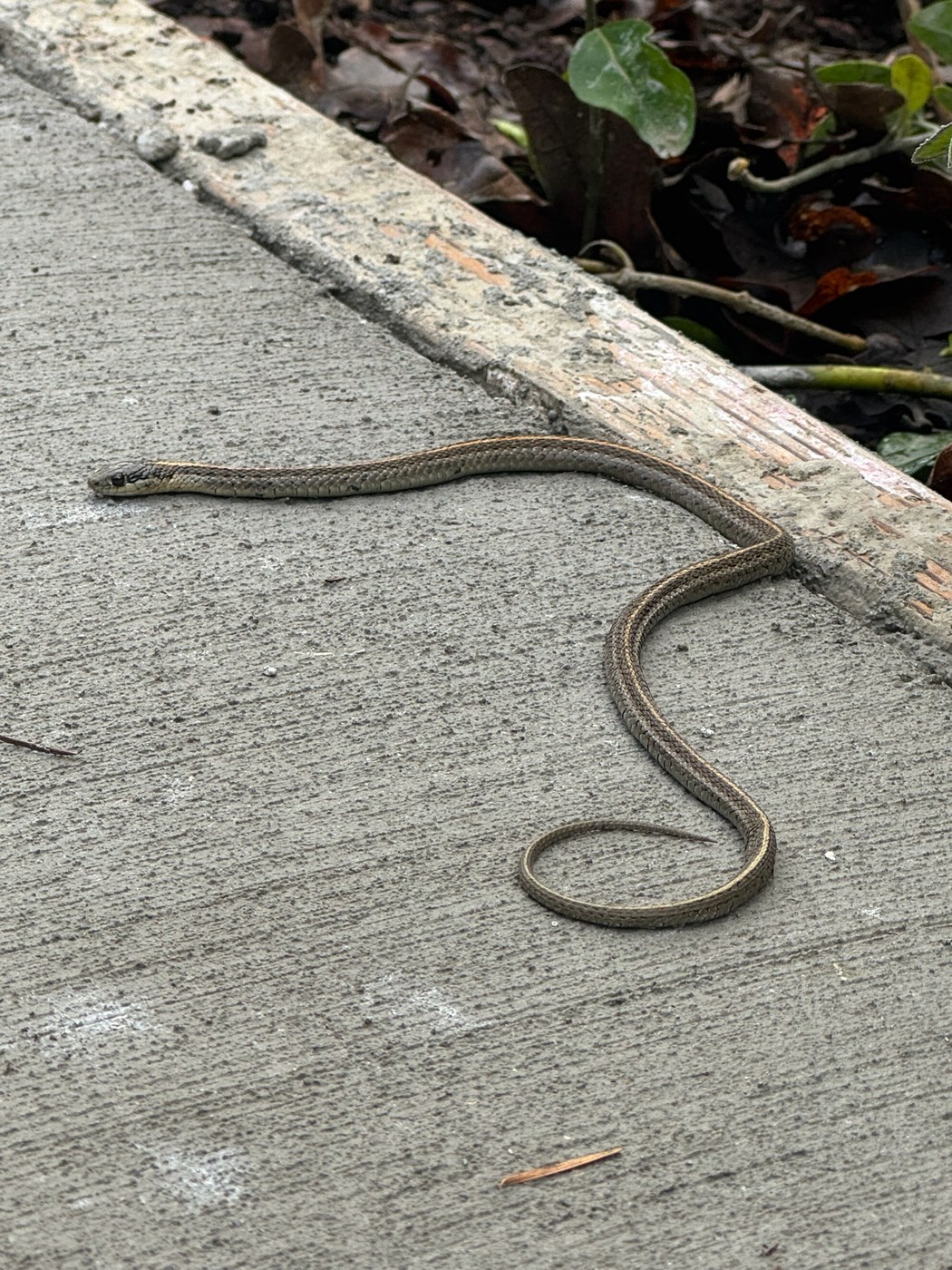
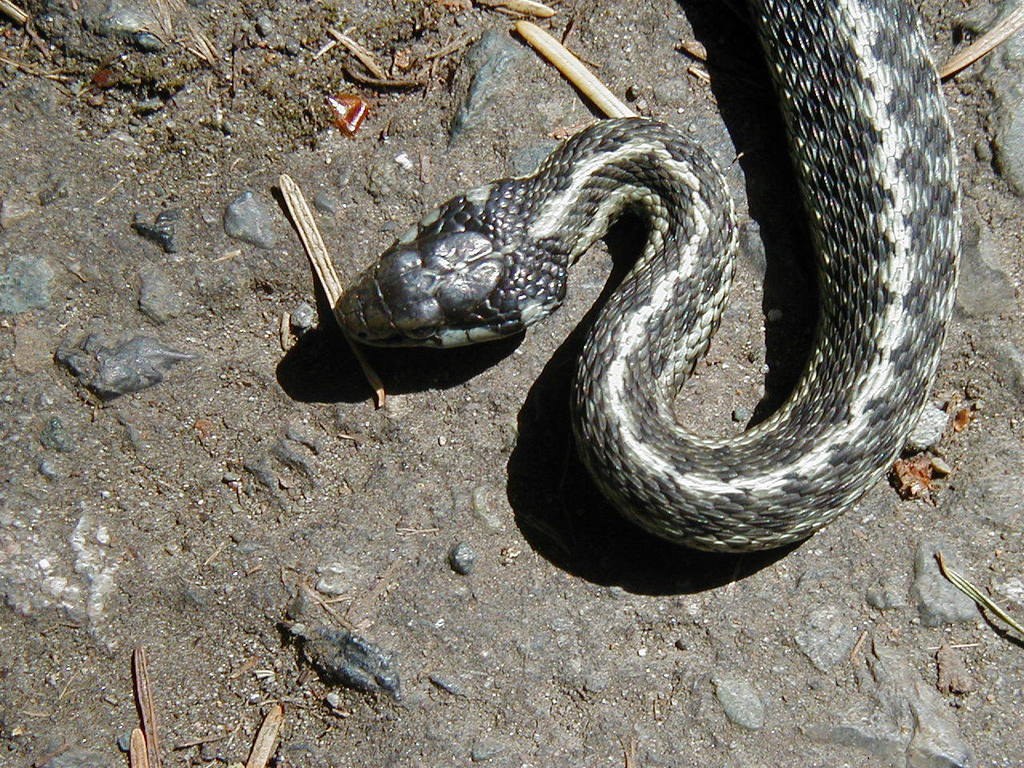
Three of these numbers are ranges rather than settled figures. First, gestation length is documented for Northwestern gartersnake at roughly nine weeks, but no published source gives a gestation figure for the Puget Sound, Valley, or Red-spotted subspecies individually. Oregon State University Extension simply reports common gartersnake young arriving July through September without stating how long the female carried them. Second, birth timing for Northwestern gartersnake is given as late August by the academic source and as July through September by a broader account, which agree on the season and differ on the peak. Third, litter size is not one number: 5 to 9 for Northwestern gartersnake against 3 to 80 for common gartersnake, a spread driven mostly by female size. Lifespan carries the same spread the whole genus does, with common gartersnake documented to 10 years in captivity by Oregon's extension account and the National Park Service describing a considerably wider wild-versus-captive gap.

Mating/courtship
Gestation
Birth/live young
Juvenile2
Adult3
Identification
None of the four is venomous
None of these four snakes is venomous in any medically meaningful sense, and that is the first thing to settle. Washington's Department of Fish and Wildlife states that of all the snakes in Washington, only the Western rattlesnake is capable of inflicting a venomous bite. A rattlesnake is separated from all four by its rattle and its heavy, thick body, and it is not a striped snake. If you are looking at a slender striped or spotted snake in a Pacific Northwest yard, you are looking at a harmless animal, and the only question left is what to call it.
Step one: look at the head
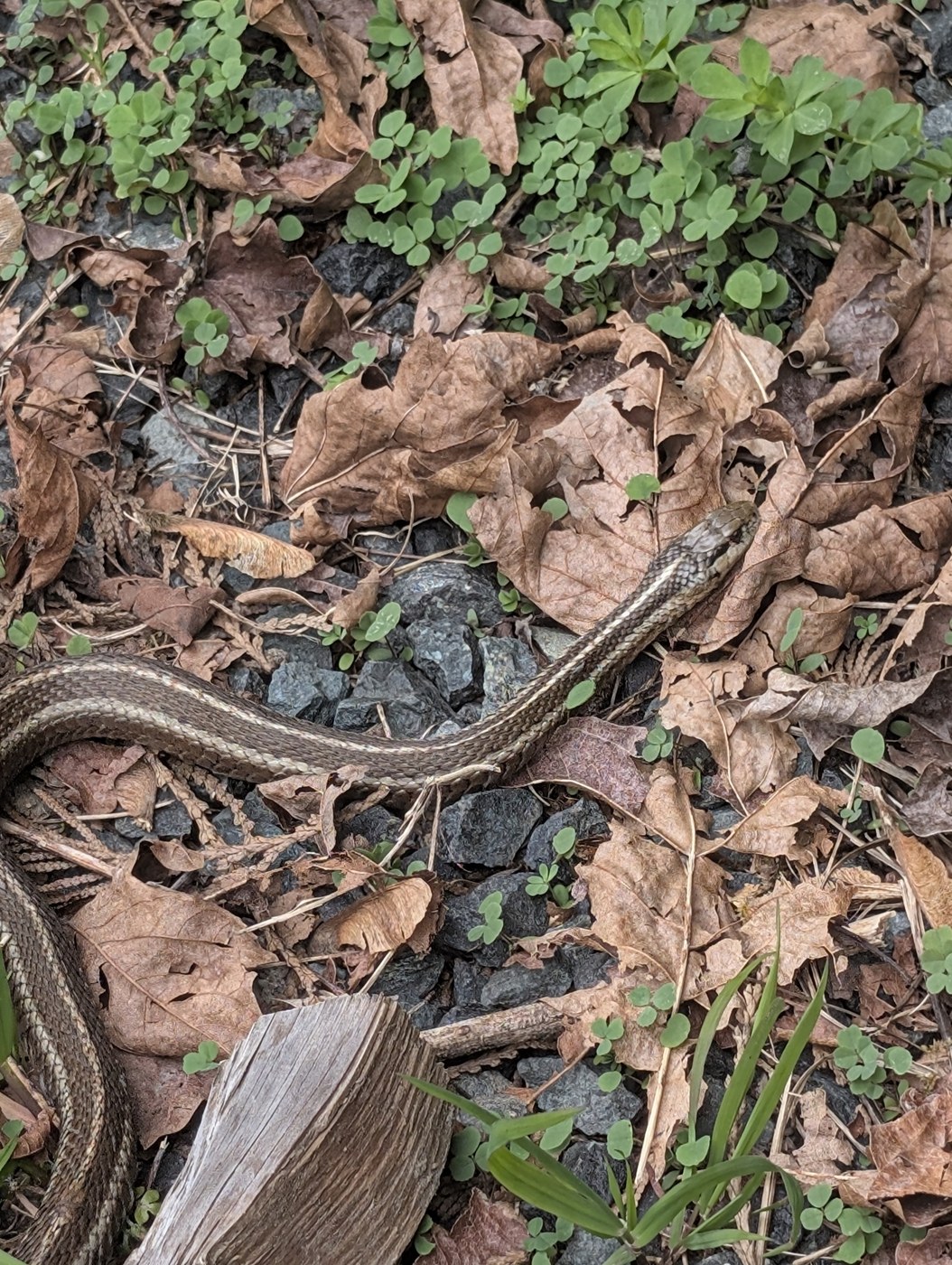
Step one: is it a Northwestern gartersnake or a common gartersnake? Look at the head. This is the tell that works in the field and it needs no measuring. Northwestern gartersnake has a relatively small head with small eyes. Common gartersnake, per Animal Diversity Web, has a larger, longer head with bigger eyes. The size difference backs it up: Northwestern gartersnake is the smallest of Washington's gartersnakes according to the Burke Museum, with most adults between 12 and 24 inches, while a common gartersnake in the same yard is often noticeably longer and thicker through the body.
Step two: geography does half
Step two, and geography does half the work here. If it is a common gartersnake, where you are standing narrows which subspecies it is before you look at a single scale. Washington's Department of Fish and Wildlife assigns each of the three a distinct part of the state: Puget Sound gartersnake in the Puget Trough lowlands, Red-spotted gartersnake along the Pacific Coast and the southern Puget Trough, and Valley gartersnake in eastern Washington. In Oregon, the Red-spotted form is the Willamette Valley snake and the Valley gartersnake is the broader statewide one. Start with your own location, then check color against the subspecies you would expect to have.
Puget Sound: turquoise stripes
Puget Sound gartersnake: black base, and stripes that can be turquoise. The Burke Museum describes it as slender and black, with turquoise or black bellies and bright yellow or turquoise stripes. Occasional vertical red flecks show along the sides. A slim black snake with blue or turquoise striping in the Puget lowlands is not a mystery animal, it is this one.
Valley: one tidy row of red
Valley gartersnake: red kept in a single tidy row, and thick yellow stripes. The practical tell is where the red sits rather than whether red is present at all. On a Valley gartersnake the red coloring is usually confined to the area just above the lateral stripes, in a single row, against a dark gray, black, or brown ground color, and the head stays dark without extensive red. The Burke Museum describes it as showing more pronounced red side blotches and thicker yellow dorsal and lateral stripes than the Puget Sound form, often with red bellies. Washington's own agency notes that eastern Washington individuals, which is where this subspecies lives, show black bodies with bright yellow stripes and distinct red side blotches.
Red-spotted: red along the sides
Red-spotted gartersnake: red everywhere along the sides, not in one row. This is the vivid one, and it is the easiest of the three to call once you have seen it. The body is deep black with extensive, brilliant red lateral spotting and a bright yellow, orange, or cream stripe down the center of the back. The head is black with faint red or orange highlights, and the underside is often blue-gray or checkered. It is widely regarded as one of the most vividly colored subspecies of the common gartersnake anywhere in its range. If the red is bold and spread across the sides rather than lined up in a single row above the side stripe, you are looking at Red-spotted rather than Valley.
Do not lean on color here
Color is a weak tell for Northwestern gartersnake specifically, so do not lean on it. This species is the variable one. Its dorsal stripe can be red, orange, gold, yellow, greenish, blue, white, or tan, and it can also be narrow, dull, or effectively absent. The ground color underneath runs blackish, olive, brownish, bluish, or gray, often with reddish tints, and the belly ranges yellowish through brown, gray, or black, sometimes with dark spots or red flecks. Trying to match a Northwestern gartersnake to a photograph by color will fail more often than it works. Match head size first.
For certainty, count scales
If you have a clear photo and want certainty, count scales. This is the objective version of the same question, and it is the tell Washington's Department of Fish and Wildlife uses itself. Northwestern gartersnake carries 17 mid-body scale rows, occasionally 19, with 7 upper-lip scales and 8 to 9 lower-lip scales. Common gartersnake carries 19 mid-body scale rows, with 7 upper-lip scales and 10 lower-lip scales. The lower-lip count, 8 or 9 against 10, is the cleanest single number in the comparison. This is a photo exercise, not a reason to pick a snake up.
Two more garters share this ground
Western terrestrial gartersnake and western aquatic gartersnake are separate species also found in Oregon and Washington, which is why Oregon State University Extension counts four kinds of garter snake in that state and says plainly that they look very much alike and often live together in the same area. Oregon's four is a slightly different set of four. One field tell is worth carrying anyway: on a Northwestern gartersnake, the dark dorsal spots do not invade the stripe running down the center of the back, while on a western terrestrial gartersnake the upper spots do invade it.
Signs of Infestation
No damage to look for
There is no damage to look for, because none of these snakes causes any. No gnawing, no chewed wiring, no burrowing into a foundation, no droppings pattern, no entry hole. None of the four enters wall voids or living space. The sign is the snake, and the only useful question is which one it was.
The sighting, and where it happens
The visual sighting, and the two places it tends to happen. A striped or red-spotted snake basking on rocks, pavement, or bare warm soil near cover, or moving through grass, garden beds, pond edges, or damp shaded ground. Where it happens is itself a clue. Common gartersnake favors sites in or near water, while Northwestern gartersnake is more often found well away from open water in vegetated cover, frequently under a board or a piece of flat debris.
Nothing to hear
These snakes are silent. No rattle, no buzzing, no scratching inside a wall. If you are hearing something in a structure, this animal is not the cause. Look at rodents or other wildlife instead.
A smell means someone got close
There is a real smell sign, and it means somebody already got too close. Handled, cornered, or nosed by a dog, both species smear a foul-smelling musk from glands near the tail. Oregon State University Extension describes the odor as much like a skunk. A sudden sharp musky smell after a pet went into the mulch is a strong tell that a garter snake was right there. The musk is unpleasant and completely harmless.
A cluster means a season
A cluster of sightings usually means a season, not a population change. Several snakes in one corner of a property in early spring or in fall commonly points to a shared overwintering den nearby or to one of the two breeding windows, and a run of small snakes in late summer is simply one female's litter dispersing. Neither is an infestation, and neither calls for a response.
Prevention and When to Call a Pro
Leave the snake alone
The default recommendation from every source is to leave the snake alone. Both species earn their keep. Northwestern gartersnake specializes heavily in slugs, particularly banana slugs, and in earthworms, with the occasional snail or small amphibian. Common gartersnake takes a much broader menu including frogs, toads, salamanders, fish, slugs, earthworms, leeches, insects, small mammals, and birds. On a Pacific Northwest property, a garter snake is a slug control program that showed up on its own. The realistic goal for a homeowner who is uncomfortable is fewer encounters, not removal.
Take away the cover first
If you want fewer sightings, take away the cover first. Washington's Department of Fish and Wildlife recommends removing rock piles, woodpiles, and unmowed tall grass immediately next to the house. Flat boards, scattered debris, and heavy ground-level cover along foundations and walkways are exactly the microhabitats these snakes shelter in, and clearing them does more to reduce how often you cross paths with one than anything else on this list.
Cut the food supply
The target is the prey, not the snake. Securing birdseed and other rodent attractants matters here for an indirect reason: reducing the prey base near a structure removes the reason a snake lingers there. This is the same guidance Washington's own agency gives, and it is a food-source fix rather than a snake fix.
Seal the ground-level gaps
Seal ground-level gaps so a snake cannot tuck in against the building. Washington's Department of Fish and Wildlife recommends closing cracks and holes in foundations and exterior walls with quarter-inch mesh hardware cloth, caulk, or concrete patching, and installing metal flashing under garage doors with tight weather-stripping as an added barrier. Set expectations correctly: this is about keeping a snake from sheltering against the structure, not about keeping one out of your living space, because these snakes do not go there.
Survey before you mow
Wet ground and sunny forest edges are where it matters. This is a specific piece of Washington guidance, and it is the one prevention step that protects the snake as much as the homeowner. Where tall grass adjoins a wet area or a sunny forest edge known to hold snakes, the agency's recommendation is to leave it unmowed. If mowing is necessary, walk the area first and move or direct any snakes to safety before you cut.
The bite and the musk, honestly
The bite and the musk, stated honestly rather than softened. These snakes rarely bite and flee first, but a handled or cornered one may strike and will musk. Washington's Department of Fish and Wildlife states that only the Western rattlesnake is capable of a venomous bite among Washington's snakes and treats a non-venomous snake bite as essentially harmless, cleaned and watched like a minor cut. One honest footnote belongs alongside that: Oregon State University Extension states that garter snake saliva seems to be toxic to amphibians and other small animals and can produce swelling in some people. That is real, and it is minor. It means a bite is not literally zero-effect, not that these snakes are venomous. There are no fangs and no delivery system behind it, any reaction is localized and short-lived, and the whole scenario requires you to have picked the animal up. Do not, and none of this applies.
Washington regulates handling
Washington law regulates handling any snake, and this is worth knowing before you move one. Per Washington's Department of Fish and Wildlife, it is unlawful to import into the state, hold, possess, offer for sale, sell, or release any snake species into the wild without the proper license. That is a general wildlife-handling rule covering all snakes in Washington, native and non-native alike. It is not a special protection attached to these four taxa, and none of them is listed as threatened, endangered, or otherwise specially protected in Washington or Oregon. Neither state publishes a trapping season, bag limit, reporting requirement, or possession permit specific to these snakes. State rules do vary and they do change, so verify the current rule where you live before any hands-on removal.
When to Call a Wildlife Control Operator
Most encounters need no professional response at all, and doing nothing is a completely reasonable choice here. Call when the answer is uncertainty rather than danger: if you cannot confidently tell whether the snake in front of you is one of these harmless species or Washington's one venomous species, do not handle it, and get an identification from a wildlife control professional or your state wildlife agency. Washington's Department of Fish and Wildlife also advises that if a snake gets into the house and you are not comfortable removing it yourself, contact a wildlife control company or your local Fish and Wildlife office for a referral. A licensed operator is the safer default over a do-it-yourself capture, both because handling and release are regulated in Washington and because the identification question gets answered by someone qualified to answer it.
Frequently Asked Questions
What is the difference between a garter snake and a Northwestern garter snake?
They are not the same animal. The common gartersnake, Thamnophis sirtalis, and the Northwestern gartersnake, Thamnophis ordinoides, are two distinct species that share Washington and Oregon. The fastest way to tell them apart in the field is the head. Animal Diversity Web describes the common gartersnake as having a larger, longer head with bigger eyes, while the Northwestern gartersnake's head is noticeably small. The Northwestern gartersnake is also the smaller snake overall, with most adults between 12 and 24 inches.
Why does Washington have so many kinds of garter snakes?
Because it genuinely does. Washington's Department of Fish and Wildlife documents three distinct subspecies of common gartersnake inside the state on their own, the Puget Sound, Valley, and Red-spotted gartersnakes, and the Northwestern gartersnake is a separate species on top of those three. That is four garter and gartersnake taxa sharing one state, plus two more garter snake species in the same states, and they are routinely confused with one another. Where you are standing narrows it down faster than color does, since Washington's agency gives each subspecies its own part of the state.
Are garter snakes in the Pacific Northwest venomous?
Not in any sense that matters to you. Washington's Department of Fish and Wildlife states that only the Western rattlesnake is capable of inflicting a venomous bite among Washington's snakes, and a rattlesnake is easy to separate from a garter snake by its rattle and heavy build. One honest detail belongs with that answer: Oregon State University Extension notes that garter snake saliva seems to be toxic to amphibians and other small animals and can produce swelling in some people. A bite is therefore not completely without effect, but it is minor, localized, resolves on its own, and only happens to someone who picked the snake up.
Do garter snakes really eat rough-skinned newts, even though the newts are toxic?
Yes, and it is one of the better stories in Pacific Northwest natural history. Washington's Department of Fish and Wildlife documents common gartersnake successfully preying on the highly toxic rough-skinned newt and sequestering the newt's tetrodotoxin in its own tissues. It is a predator and prey arms race concentrated in the Pacific Northwest and California, with the newts getting more toxic and the snakes getting more resistant over evolutionary time.
Should I kill or remove garter snakes from my yard in Washington or Oregon?
No. Every state agency and university extension source recommends leaving them alone. They are harmless, and they are useful, since Northwestern gartersnake eats slugs and earthworms while common gartersnake works through a much broader list of yard and garden prey. Washington law is also relevant here: per the state's Department of Fish and Wildlife, it is unlawful to hold, possess, sell, or release any snake species in Washington without the proper license. That is a general rule covering all snakes rather than a special protection for these ones, but it is a real reason to route any hands-on removal to a licensed professional. If you simply want to see fewer of them, remove the cover instead: rock piles, woodpiles, scattered boards, and tall unmowed grass right against the house.
Sources
- Common garter snake (Thamnophis sirtalis) species profile: three Washington subspecies and their in-state ranges, size, habitat, seasonal activity, diet, and rough-skinned newt tetrodotoxin sequestration Washington Department of Fish and Wildlife
- Living with wildlife: Snakes: only the Western rattlesnake is venomous in Washington, foundation and wall sealing, cover reduction, mowing-season guidance, snake-handling license requirement, and when to call for help Washington Department of Fish and Wildlife
- Terrestrial gartersnake (Thamnophis elegans) species profile, carrying the scale-row and labial scale-count comparison table for common, Northwestern, and terrestrial gartersnakes Washington Department of Fish and Wildlife
- Common Garter Snake, EC 1602: four Oregon garter snake species that look very much alike and live together, habitat and elevation range, diet, live birth and litter size, defensive musk, saliva toxicity, and hot-weather activity shift Oregon State University Extension Service
- Thamnophis ordinoides (Northwestern Garter Snake) species account: head and eye size versus common gartersnake, two mating windows, gestation, litter size, maturity ages, lifespan, and habitat Animal Diversity Web, University of Michigan Museum of Zoology
- Northwestern Gartersnake: the smallest of Washington's gartersnake varieties, description, and Washington occurrence Burke Museum, University of Washington
- Common Gartersnake: side-by-side comparison of Puget Sound and Valley gartersnake coloration, stripes, and belly color Burke Museum, University of Washington
- Common Garter Snake: species-wide life cycle and lifespan corroboration National Park Service
- Reptiles and Amphibians Found in Alaska Alaska Department of Fish and Game
- Thamnophis ordinoides species entry: confirms Northwestern gartersnake as a full species distinct from common gartersnake, with its own synonymy and Puget Sound type locality The Reptile Database
- Thamnophis sirtalis species entry: recognized subspecies list and type localities for pickeringii, fitchi, and concinnus The Reptile Database
Image Credits
- Image: Moe Meikle via iNaturalist. CC BY 4.0.
License. - Image: Michele Wiseman via GBIF. CC BY 4.0.
- Image: humon via iNaturalist. CC BY 4.0.