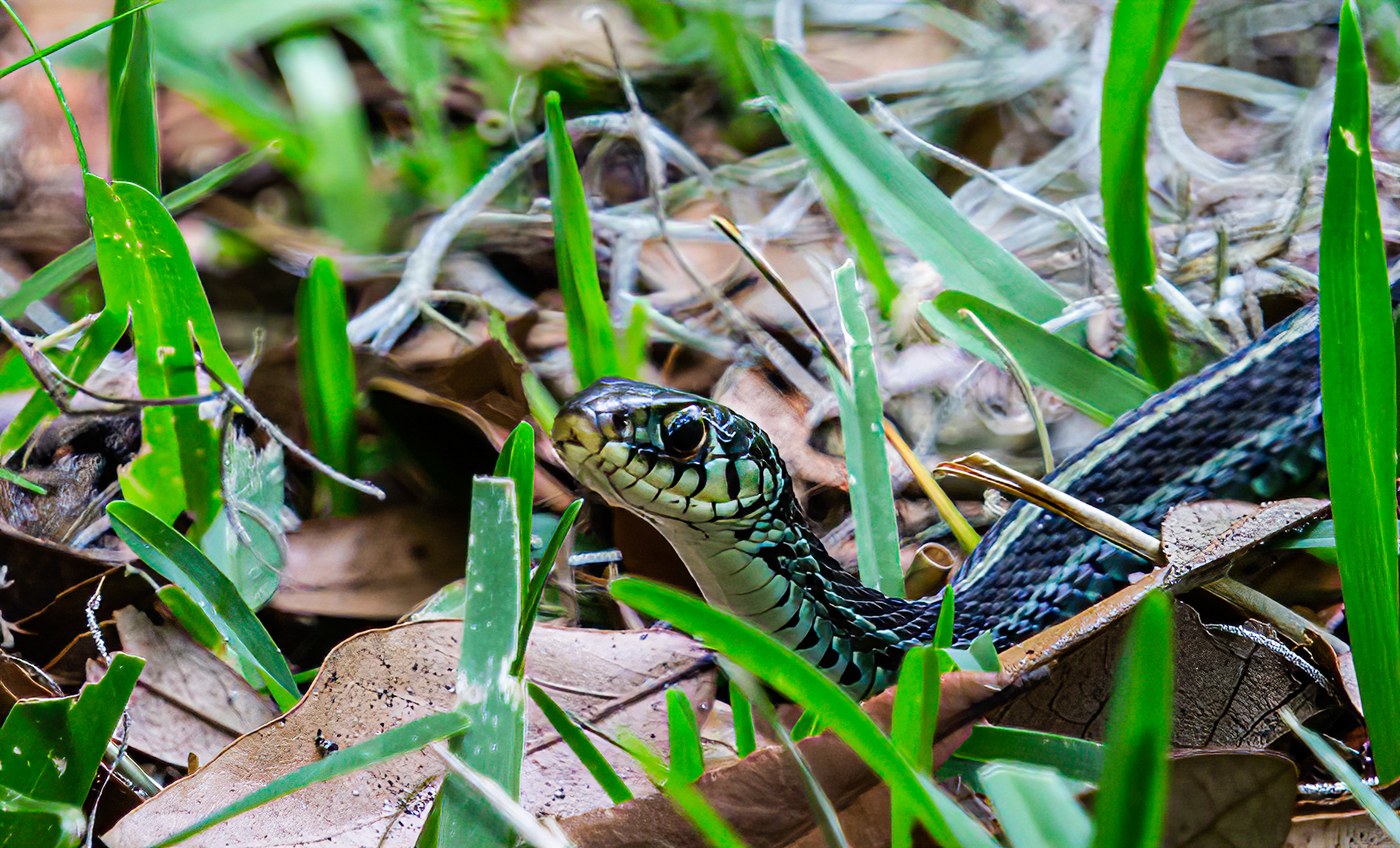
Seasonal Timeline
Eastern gartersnakes are day-active and unusually cold-tolerant for a snake. They are typically the first species out of the winter den in spring and the last to go down in fall, and in mild-winter stretches they can be seen basking in any month of the year.
Eastern gartersnakes are day-active and unusually cold-tolerant for a snake. They are typically the first species out of the winter den in…
This species runs a longer calendar than most snakes because it tolerates cold better than most snakes. State wildlife agencies describe it as active across a wider temperature range than its relatives, first out of the den in spring and last in, and Virginia's own species account puts activity from March through November with documented sightings in every month of the year during mild winters. A gartersnake basking on a warm rock in February is not remarkable.
The late-season half of the calendar is the one worth knowing. Mating happens in spring right after emergence, gestation runs roughly two to three months, and young are born live from late July into October. That means small, fully independent newborn snakes are moving through the same mulch beds and grass edges the adults have used all summer, at the exact time of year people are cleaning up gardens and stacking wood for winter.
Winter is the other distinctive part. Gartersnakes are solitary through the active season but hibernate communally, sometimes in large shared dens, and state agency accounts describe some dens holding hundreds of snakes coiled together to hold a survivable body temperature. That is a natural-history fact rather than a homeowner problem, but it explains why sightings often cluster heavily at both shoulders of the season near a den site.
Where They're Found
The eastern gartersnake occupies the eastern and central United States, across three regions: Midwest, Northeast, and Southeast. It wants wet, open, grassy ground. Old fields, pond and stream margins, wetland and woodland edges, suburban lawns and gardens, vacant lots, cemeteries, and old farmsteads are all standard habitat. It is often but not always found near permanent water, and it will travel well away from water when it needs to.
The Southeast belongs in its range, and it is worth naming the evidence, since this species is often filed as a northern animal. The North Carolina Wildlife Resources Commission describes it as common throughout that state. The Virginia Herpetological Society's account for this subspecies documents it as relatively common across multiple named survey areas, including George Washington National Forest and the Blue Ridge Parkway corridor. The University of Georgia's Savannah River Ecology Laboratory reports garter snakes as common throughout the Southeast. Tennessee's wildlife agency states the subspecies occurs from border to border in that state, and Alabama's state wildlife agency describes it as fairly common statewide and ranging south to Florida.
One legal detail rides along with that Southeast range and it is specific to a single state. The University of Georgia's Savannah River Ecology Laboratory states plainly that this species is protected throughout the state of Georgia, even though gartersnakes are common and largely unregulated across the rest of the region. That is a real, documented exception rather than a general rule, so a Georgia homeowner should check with the state before any hands-on removal.
Two edges of the range need a note. Alabama's own distribution language runs the subspecies westward toward Minnesota, eastern Oklahoma, and Texas, and the Missouri Department of Conservation notes a genuine identity question in southwestern Missouri where this subspecies meets the Texas gartersnake, saying outright that future genetic study should settle it. Because the source closest to that boundary hedges rather than confirms, and because Minnesota and Missouri already sit inside the Midwest, South Central is not claimed. Alaska and Hawaii carry no population of this subspecies at all. No published record places it in either state, and Hawaii has no established wild snake population of any kind.
Within the Midwest there is a second form worth recognizing so it does not get mistaken for a different animal. The Chicago gartersnake is a checkerboard-patterned subspecies of the same species found in the Chicago region, sitting alongside the eastern gartersnake proper. A checkered snake in that area is very likely still a gartersnake.
Life Cycle
How long a wild gartersnake lives is not settled. Published accounts genuinely disagree. Animal Diversity Web gives an average of roughly two years in the wild and reports that most individuals die in their first year. A peer-reviewed Kansas field study, cited through the Virginia Herpetological Society's species account, found eight-year natural longevity achievable with about 50 percent annual adult survival. Captive individuals commonly reach 6 to 10 years, with one record of 20. These may reflect different populations and different methods rather than a true contradiction, so both are stated. What is not in dispute is the reproductive pattern: one litter per year is typical, with a second fall mating and litter documented in some populations.

Mating
Neonate
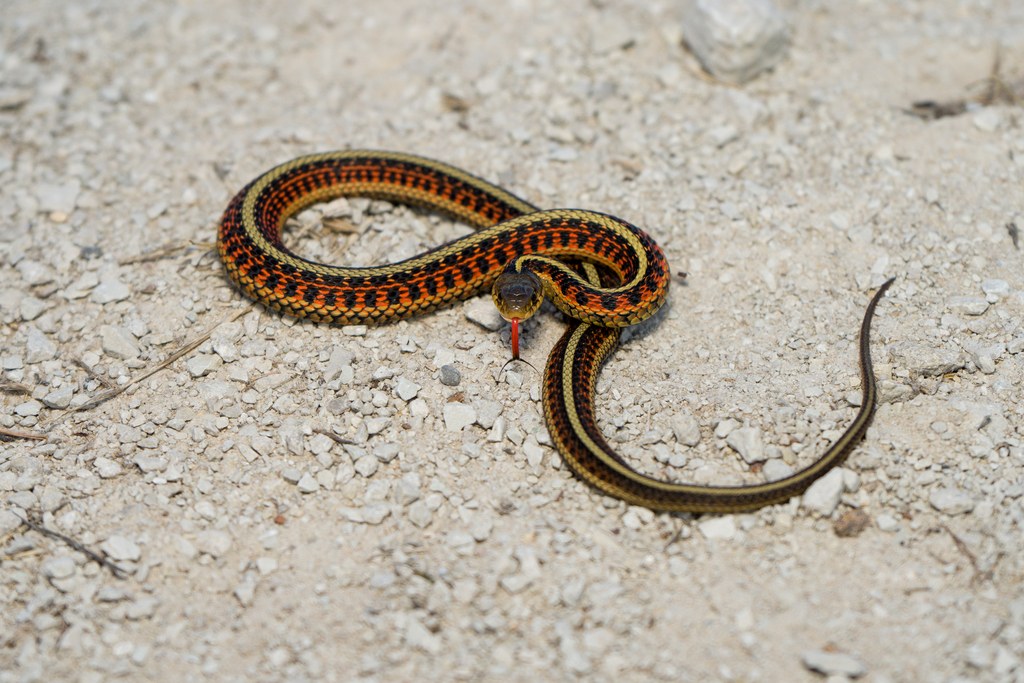
Juvenile2
Adult
Identification
Three light stripes on a dark body
That is the starting point, and the base color is almost useless. The stripes run the length of the animal, one down the center of the back and one along each side, and they can be yellow, white, or occasionally blue or green. The base color underneath them is wildly variable: brown, olive, gray, greenish, reddish, or black. If you are trying to match a photograph by color, you will fail. Match the stripe arrangement instead.
The pattern is not always clean
That trips people up. Some individuals show a checkered pattern instead of crisp stripes, and the stripes themselves can be faint or effectively absent. A double row of dark spots often runs between the stripes. The belly is white, pale yellow, or greenish with faint dark spotting, and the tongue is red with a black tip.
Three small marks confirm it
Narrow dark bars between the scales of the upper lip, keeled body scales meaning each scale carries a raised ridge down its center, and round pupils. The round pupils matter on their own, because the venomous pit vipers have vertical elliptical pupils instead.
The ribbon snake matters
The ribbon snake is the look-alike that actually matters. The eastern ribbon snake is a close relative sharing the same three-stripe pattern and much of the same range. Three tells separate them. The ribbon snake has a white or pale mark directly in front of the eye, which the gartersnake lacks. The ribbon snake's tail is roughly 30 percent or more of its total length against under 25 percent on a gartersnake, giving it a noticeably more slender, longer-tailed build. And the gartersnake has those narrow dark bars between its upper lip scales, which the ribbon snake does not. This pairing is confirmed independently by state wildlife agencies and university extension sources across three states in this range. Both animals are harmless, so getting it wrong carries no risk beyond the naming.
A lower-frequency mix-up: DeKay's brownsnake
Tennessee's wildlife agency flags it as an occasional confusion, and it is settled quickly. DeKay's brownsnake has no light side stripes at all. If you can see stripes running along the sides, it is not that species.
Size sets expectations
It does that more than it identifies. Most adults you encounter will be 18 to 26 inches, with the occasional individual to 36 inches. Newborns are 5 to 9 inches. A striped snake substantially longer than three feet in this range is worth a second look, because it is outside what is typical for this subspecies.
Two names, not interchangeable
Common gartersnake and eastern gartersnake are not quite interchangeable terms. The eastern gartersnake is one subspecies of the common gartersnake, a species with roughly a dozen recognized subspecies across North America. Other subspecies carry their own regional names and their own ranges. The checkerboard-patterned Chicago gartersnake, found in the Chicago region, is one of them and is the same species rather than a different animal.
"Garden snake" is a folk name, not a species
The name gets used constantly across this range because the animal turns up in gardens so often. It refers to this snake. There is no separate garden snake to look up.
Signs of Infestation
No damage to look for
There is no damage to look for, because this species causes none. No gnawing, no burrowing into structures, no chewed wiring, no droppings pattern to identify, no entry hole to find. Gartersnakes do not enter wall voids or living space. The only real sign is the snake itself, so identifying it matters more than tracking it.
The visual sighting, and where it happens
A striped snake basking in the open, moving through grass or a garden bed, or sheltering under debris, mulch, boards, logs, rocks, or landscaping timbers. Damp shaded ground and anywhere near water raises the odds considerably. Lifting a board or moving a woodpile is the classic way people meet one.
A musky odor after a disturbance
A sharp musky odor after something disturbed a snake. Musking is this species' primary defensive response, discharged from glands near the tail. A sudden unpleasant smell after a dog nosed into the mulch, or on your hands after handling a snake, is a strong tell that a gartersnake or a related harmless species was just there. The odor is foul and completely harmless.
Nothing to hear
Gartersnakes are silent. There is no rattle, no buzzing, no scratching in a wall to listen for. If you are hearing something in a structure, this animal is not the cause. Look at rodents or other wildlife instead.
Season-edge clusters mean a den
Clusters of sightings at the shoulders of the season usually mean a den, not an infestation. This species hibernates communally, and several sightings in the same corner of a property in early spring or late fall commonly points at a shared overwintering site nearby rather than a population explosion. The same is true of a run of small snakes in late summer, which is simply that year's young dispersing.
Prevention and When to Call a Pro
Leave it alone
The default recommendation is to leave it alone, and that comes from the state agencies. Published state wildlife agency guidance consistently recommends leaving gartersnakes where they are and specifically advises against killing them in and around a garden. They eat slugs, snails, insects, and other garden invertebrates, and they are a net benefit on most properties. This is worth weighing honestly rather than presenting as pure pest control, since earthworms are their preferred prey and earthworms are good for soil too. The realistic goal for a homeowner who is uncomfortable is fewer encounters, not eradication.
Take away the cover
If you want fewer sightings, take away the cover. Stacked wood, dense ground-level debris piles, and thick unmanaged ground cover against foundations and along walkways are exactly the microhabitats this species shelters in. Moving woodpiles away from the house, thinning heavy ground cover near doors and paths, and clearing scattered boards and debris is the step most likely to cut how often you cross paths with one.
Seal the ground-level gaps
Seal ground-level gaps if you do not want one sheltering against the structure. Gaps around sheds, crawl space vents, and foundation edges are worth closing with standard exclusion work. Set expectations correctly, though: this is about keeping a snake from tucking in against the building, not about keeping one out of your house. Gartersnakes do not go into living space.
The bite and the musk, plainly
The bite and the musk, stated plainly so nobody is surprised. A gartersnake will bite if it is handled, restrained, or cornered, and it will discharge foul-smelling musk. State wildlife agencies describe a bite from even a large individual as no more severe than a minor scratch. There is no venom involved and no disease-vector or allergen risk is documented for this species. The practical scenario is a startled dog or a curious child getting nipped or musked, which is a wash-your-hands event, not a medical one. The simplest way to avoid both is not to pick the animal up.
Uncertainty is what warrants a call
The one situation that genuinely warrants a call is uncertainty, not danger. If you cannot confidently tell whether the striped snake in your yard is a harmless gartersnake or ribbon snake versus something you should not be near, do not attempt to handle it or move it. Call a wildlife control professional or your state wildlife agency for an identification. That call is about closing the identification question, not about the gartersnake being a threat, because a confirmed gartersnake needs no response at all.
Georgia is a legal exception
Georgia is a documented legal exception and it changes the answer there. The University of Georgia's Savannah River Ecology Laboratory states that this species is protected throughout the state of Georgia. A Georgia homeowner who wants a gartersnake physically relocated rather than simply left alone should use a licensed nuisance wildlife professional instead of doing it themselves. Elsewhere in the range the baseline is different: North Carolina, for example, treats it as nongame with no open season and allows take or possession of small numbers of nongame reptiles without a collection license under a set numeric threshold. State rules vary and they change, so check your own state's current rule before any hands-on removal.
What not to bother doing
There is no removal product to buy, no trapping program to run, and no reason to treat a yard for this animal. The whole of the practical advice is habitat management around the house, and the option of doing nothing at all is a completely reasonable one here.
Frequently Asked Questions
Are garter snakes poisonous or venomous?
No. Eastern gartersnakes are completely non-venomous and harmless to people and pets. The worst outcome from handling one is a defensive bite that state wildlife agencies describe as no worse than a minor scratch, plus a foul-smelling but harmless musk released from glands near the tail. There is no venom, and no disease or allergen risk is documented for this species.
Why do I keep finding garter snakes in my garden?
Because a garden is close to ideal habitat for them. They want moist soil, low ground cover to shelter under, and abundant earthworms and slugs, which are their preferred prey. A watered, mulched, well-planted bed supplies all three. That is exactly why the folk name "garden snake" attached itself to this species in the first place, even though the correct name is gartersnake.
What is the difference between a garter snake and a ribbon snake?
Three things separate them, and both animals are harmless either way. A ribbon snake has a pale mark directly in front of its eye, and a gartersnake does not. A ribbon snake's tail is about a third of its total length, giving it a visibly more slender, longer-tailed build, against under a quarter on a gartersnake. And a gartersnake has narrow dark bars between the scales of its upper lip, which a ribbon snake lacks. The eye mark is usually the fastest of the three to check.
Do garter snakes bite, or spray a smell?
Both, if you handle or corner one, and neither is a health problem. The bite is defensive and is not medically significant. The smell is musk discharged from glands near the tail, and it is strong, unpleasant, and harmless. Musking is actually this species' first-choice defense, which is why a sudden sharp odor after a pet noses into the mulch is a reliable sign a snake was just there.
Should I kill or remove garter snakes from my yard?
No. Published state wildlife agency guidance consistently recommends leaving them alone. They are harmless, they help control slugs, snails, and insects in a garden, and in Georgia they are legally protected statewide. If you simply want to see fewer of them, remove the cover they shelter in: move woodpiles away from the house, clear ground-level debris, and thin heavy ground cover near foundations and walkways.
Will a garter snake get into my house?
No. This is a strictly outdoor animal. It does not enter wall voids, attics, or living space, and it causes no structural damage of any kind. It will shelter under boards, woodpiles, debris, and along foundation edges close to a house, which is why ground-level sealing at sheds and crawl space vents is worth doing if you would rather it not tuck in against the building.
I found a bunch of small striped snakes in late summer. Is that a nest?
Not a nest, and not an infestation. Eastern gartersnakes do not lay eggs. Young are born live, fully formed and independent, from late July through October, in litters that commonly run 10 to 40. Newborns are 5 to 9 inches long, look exactly like miniature adults, get no parental care, and disperse immediately to find their own food. A cluster of small striped snakes in late summer is one female's litter going its separate ways.
Why do garter snakes show up so early in spring?
They tolerate cold better than most snakes. This species is typically the first out of the winter den in spring and the last to go down in fall, and it can be found basking on rocks on mild winter days. Virginia's records show activity from March through November, with sightings documented in every month of the year during mild stretches. They also hibernate communally, sometimes in large shared dens, so a burst of sightings in one corner of a property in early spring usually means a den site nearby rather than a sudden increase in snakes.
Sources
- Eastern Gartersnake (Thamnophis sirtalis sirtalis) species account: Virginia range, seasonal activity, IUCN status, and cited Kansas survival and longevity data Virginia Herpetological Society
- Eastern Gartersnake and Red-Sided Gartersnake: identification marks, habitat, defensive bite and musk, and the southwestern Missouri subspecies boundary question Missouri Department of Conservation
- Eastern Garter Snake: statewide abundance, description, diet, ribbon snake comparison, and North Carolina nongame status North Carolina Wildlife Resources Commission
- Eastern Garter Snake: Alabama distribution, coloration and pattern variation, litter size, and defensive behavior Alabama Department of Conservation and Natural Resources, Outdoor Alabama
- Thamnophis sirtalis (Common Garter Snake) species account: reproduction, sperm storage, maturity ages, lifespan figures, and diet Animal Diversity Web, University of Michigan Museum of Zoology
- Common Garter Snake: live birth and litter size, communal hibernation, cold tolerance, toad-toxin tolerance, and habitat Vermont Fish and Wildlife Department
- Eastern Garter Snake (Thamnophis sirtalis): Southeast abundance, habitat and cover use, defensive musk, and Georgia statewide protection Savannah River Ecology Laboratory Herpetology Program, University of Georgia
- Common Gartersnake: Midwest range, Chicago gartersnake subspecies, and diet Indiana Department of Natural Resources, Division of Fish and Wildlife
- Common Gartersnake: Tennessee statewide distribution, ribbon snake and DeKay's brownsnake look-alikes, juvenile appearance, and breeding information Tennessee Wildlife Resources Agency
- Systematics of the Common Garter Snake, Thamnophis sirtalis: subspecies structure and regional diet variation Louisiana State University, doctoral dissertation, LSU Digital Commons
- Common Garter Snake (Thamnophis sirtalis) exposure factor dataset, citing Michigan stomach-content study on earthworm dietary frequency California Office of Environmental Health Hazard Assessment, CalEcotox
Image Credits
- Image: Adobe Stock, licensed.
- Image: evangrimes via iNaturalist. CC BY 4.0.
License.