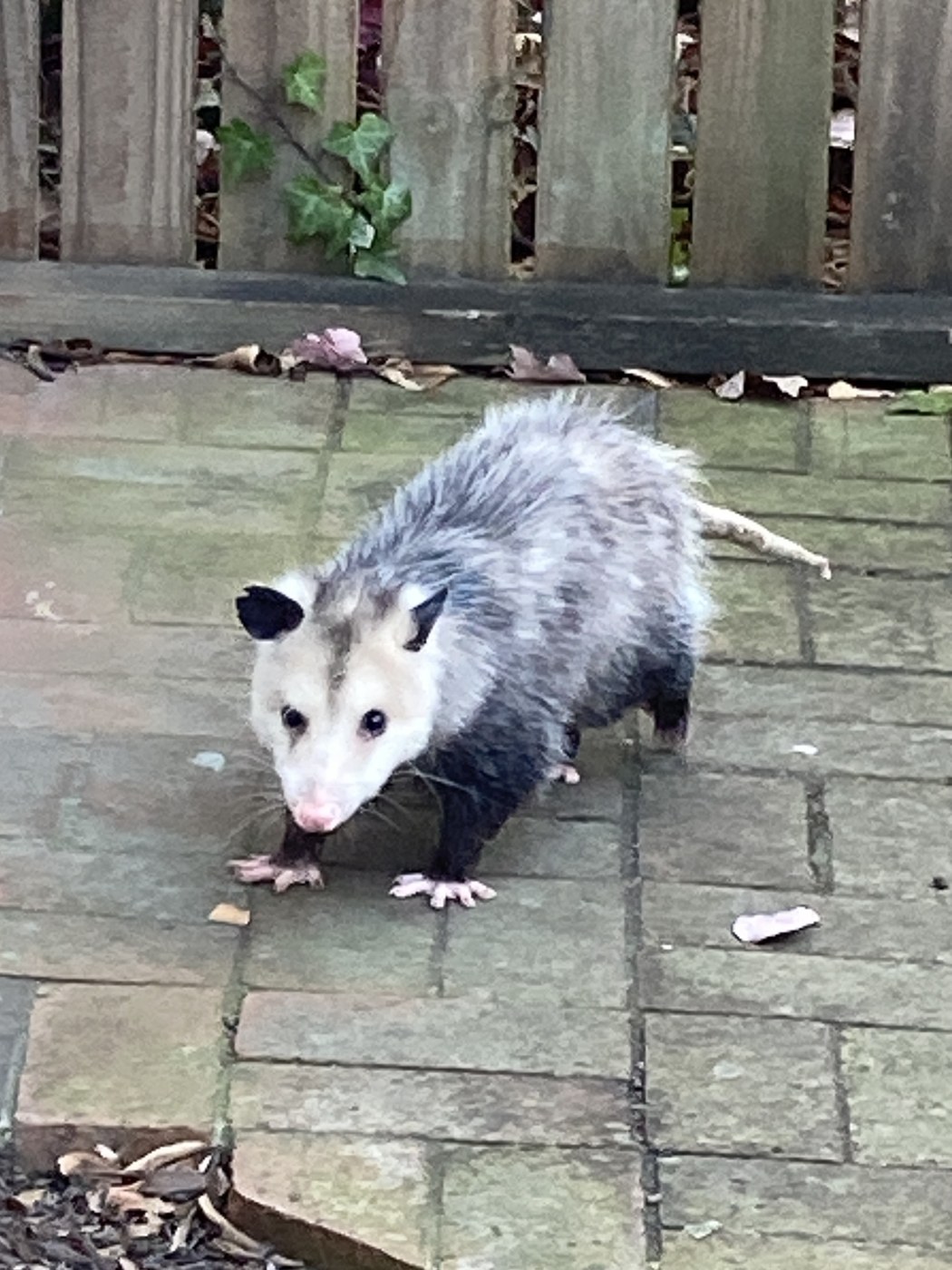
Seasonal Timeline
Opossums are active year round and do not hibernate, though they reduce activity and may stay denned through severe cold. The calendar that matters is the breeding calendar. Breeding runs roughly January through July in warmer parts of the range, and starts about a month later and ends about a month earlier in the north.
Opossums are active year round and do not hibernate, though they reduce activity and may stay denned through severe cold. The calendar that…
The reason the breeding calendar is short and the nuisance calendar is long comes down to one number. Gestation is about 12 to 13 days, among the shortest of any mammal, so a female moves from mating to a pouch full of young inside two weeks. The young then stay in the pouch about 7 to 8 weeks, leave it somewhere around 2 to 3 months, and continue riding on the mother's back and returning to nurse until roughly 3 months old. Add that up and a single litter keeps a female tied to one den site for the better part of a season, which is why an opossum that has moved under your deck in spring is not going to move back out on its own next week.
The second reason activity never really stops is that opossums do not hibernate and have poor cold tolerance at the same time. In cold weather they stay denned rather than sleeping through the season, which means a warm structure is more attractive to them in winter, not less.
Where They're Found
Opossums are broadly tolerant animals, at home in arid and moist country, wooded and open, but they are strongly drawn to habitat near streams, swamps, and other water. The single most useful thing to know about their denning is that they do not dig or build. An opossum takes over what is already there: a burrow another animal dug, a tree cavity, a brush pile, a hollow log, a heap of fallen debris. Around a house that same borrowing habit reads as an attic, a garage, a shed, a crawl space, or the space under a deck or porch, lined with dry leaves or shredded paper into a messy den rather than a built nest.
What actually caps the northern edge of the range is not food or competition, it is heat loss. Opossums have thin, poorly insulated fur and inadequate thermoregulation for a mammal pushing into cold climates, and their bare ears and nearly hairless tail are prone to frostbite. If you see a northern opossum with a tail that looks oddly short for its body, that is usually frostbite loss rather than natural anatomy.
Two range questions are worth answering directly. The Southwest is a real part of the range, not a stray-sighting rumor: Arizona's own state wildlife agency lists the Mexican opossum subspecies as a Species of Greatest Conservation Need with a modeled habitat range and a disjunct-population designation, and peer-reviewed records document the animal in southeastern Arizona going back to 1947, near the Rincon Mountains east of Tucson in 1999, and in Yavapai County in central Arizona. That said, the researchers behind the Yavapai record cautioned that one collected animal does not establish a population there, so read the Southwest as an established but limited and disjunct presence rather than an animal you will meet in any Arizona backyard.
Alaska and Hawaii are both outside the range, and both have a better story than a flat absence. Opossums are classified as invasive in Alaska, and the state's wildlife agency works actively to remove any found in the wild around Homer. That policy has been tested: a single female stowaway who arrived in a shipping container from Washington State in spring 2023, nicknamed Grubby, roamed Homer for over a month, gave birth while at large, and prompted a real effort to catch the joeys before they could establish a wild population. Five were caught and rehomed to zoos. Hawaii shows the same pattern on repeat, with individual opossums arriving in cargo and being captured before they can settle, from Hickam Air Force Base in 2005 through a downtown Honolulu office building in July 2024 and harbor captures in 2025. Neither state has an established population, and in both cases that is the result of agencies working to keep it that way.
Life Cycle
One to two litters a year, and the pouch is what makes the timing unforgiving. Gestation is only 12 to 13 days, but pouch development runs another 7 to 8 weeks on top of that, and the young are not fully weaned until roughly 3 months old. Warmer climates commonly see 2 litters and rarely 3, while 1 litter a year is typical in northern populations. That means for a large part of the year an opossum denning under a deck is a female with young you cannot see and cannot count. Confirm the den is empty before anything gets closed up.
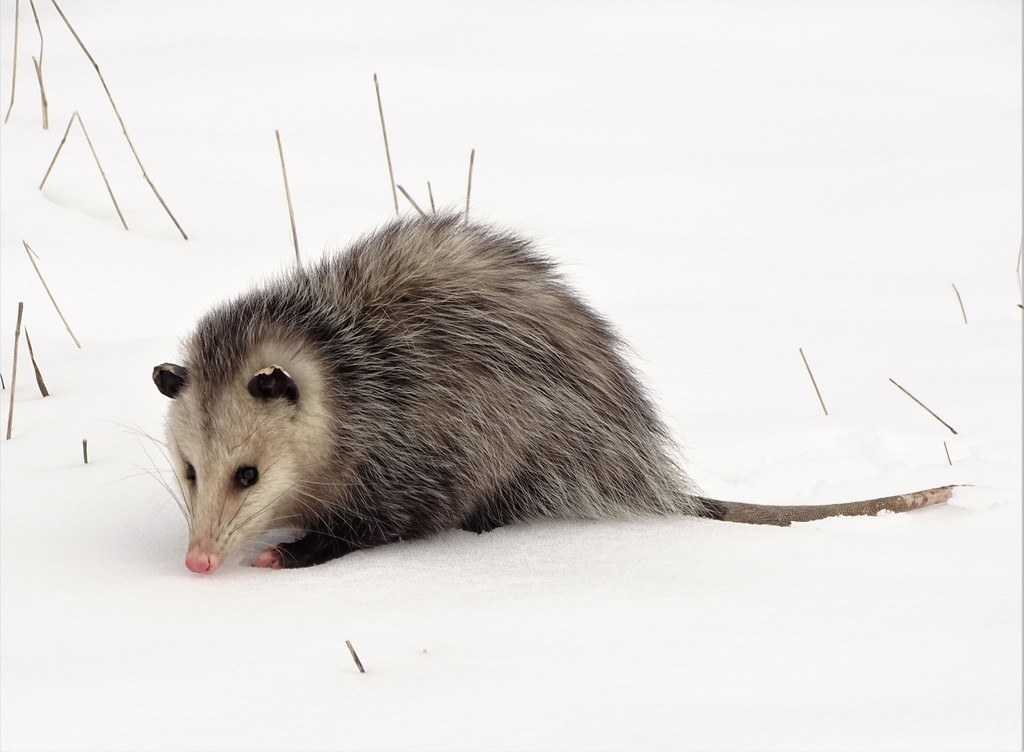
Mating2

Neonate
Juvenile
Adult
Identification
Size and build put it in house-cat territory
Adults run 24 to 33 inches of total length including the tail, with a documented maximum around 40 inches, and weigh 4 to 15 pounds. Males average 6 to 7 pounds and reach about 14, while females average closer to 4. The tail is slightly less than half the total length.
Color is the least distinctive part
Color is the least distinctive thing about it. The fur is white or grayish, tipped with gray or black guard hairs. What reads at a glance instead is the head: a long, narrow, pointed snout ending in a pink nose, and bare, rounded ears that are black on the inside.
Three features separate it
Nothing else on the continent has all three. It has 50 teeth, more than any other North American land mammal. Its tail is prehensile, nearly hairless, and rat-like, running almost as long as the body. And each hind foot carries an opposable, clawless inner toe that works like a thumb, which is what makes an opossum a genuinely good climber.
Raccoon, settled by tracks
The animal to rule out is the raccoon, and tracks settle it. Both leave five-toed prints and both get blamed for the same overturned garbage can at 2 in the morning. The difference is the hind track: an opossum's shows that opposable thumb toe with no claw, which gives the print an odd baby-handprint look, while a raccoon's hind track reads as an ordinary foot. From a distance the face and tail do the same job. An opossum has no mask and no ringed tail, just a plain pointed snout and a bare tail.
A stubby tail is frostbite
A northern opossum with a stubby tail or ragged ears is not a different animal. Both the ears and the tail carry almost no fur and are highly prone to frostbite in cold-climate populations. A tail that looks too short for the body is usually tissue lost to frostbite rather than natural variation, and it is one of the more reliable tells that you are looking at an animal living at the cold edge of the range.
Signs of Infestation
Tracks, and specifically the hind track
Five toes register on both front and hind feet, but the hind foot's opposable clawless thumb toe is the giveaway, producing that small handprint impression nothing else in the yard leaves. Front and rear tracks usually fall close together, with the rear landing on or just behind the front. A tail-drag mark may show if the animal was moving slowly, though opossums normally carry the tail up while walking.
A borrowed den rather than a built one
Because opossums do not dig or construct dens, the sign is disturbance rather than excavation: insulation pushed around in an attic, nesting material dragged into a garage or shed, dry leaves or shredded paper heaped under a deck or porch. It tends to look messy and improvised, because it is.
Sound is a weak sign here
That is itself useful to know. Unlike a raccoon's chattering or a skunk's warning stomp, there is no distinctive passive noise that tells you an opossum has moved in. The documented vocalizations, hissing, growling, and screeching, are defensive and happen when the animal is directly confronted, not while it is quietly denning. Do not wait to hear something.
A warning sequence, then the famous one
If you get close, you will get a warning sequence, and then possibly the famous one. A threatened opossum typically bares its teeth, growls, and hisses first, and may exude a smelly greenish fluid from its anal glands. Only if the bluff fails does it play possum, and that is worth understanding correctly: the collapse is an involuntary, fainting-like catatonic state, not a performance the animal decides to put on. It is more common in young opossums than in adults, which more often just stand their ground or leave. A motionless opossum in the yard is usually neither dead nor sick. The right response is to give it distance and time rather than to handle it or dispose of it.
Odor is real but mild
A denning opossum can leave a musky, sometimes garbage-like smell, and a cornered one can release defensive musk from its anal glands. Both are far milder and far less persistent than skunk spray, and the smell alone will not tell you which animal you have.
Raided food is the first complaint
Raided food sources are the most common first complaint. Opossums are opportunistic omnivores and scavengers whose main dietary component is carrion, supplemented with insects, earthworms, fruits, berries, bird eggs, amphibians, and plants. Near people that translates directly into garbage cans, compost piles, bird feeders, and pet food dishes left out overnight, which is what brings most of them onto a property in the first place.
Prevention and When to Call a Pro
Start with the food
Start with food, because food is what brought the animal to the property. Do not leave pet food outdoors overnight. Clean up spilled birdseed under feeders. Secure garbage in cans with tightly fastened lids, and if the lid still comes off, a rubber strap across it is the specific low-cost fix the USDA and university extension wildlife damage handbook names. Compost piles and fallen fruit belong on the same list. An opossum is a scavenger before it is anything else, and a property with nothing worth scavenging is a property it passes through rather than settles on.
Close the denning sites
An opossum can only take over a space that already exists. Shut off the area under decks and porches with hardware cloth in half-inch or one-inch mesh, running it from the top of the joists down into a trench at least 10 inches deep and angling the buried edge outward at the base. Check and repair loose fascia boards, chimney caps, and attic vents on a regular schedule, because those are the openings an opossum will use if it finds them. Store firewood away from the structure and at least a foot off the ground so it stops functioning as cover. Confirm nothing is inside before sealing anything, especially in spring and summer, when a female may have young in the pouch or riding on her back.
If you use wire mesh, add a wire
If a wire-mesh fence is the barrier, add one wire. Opossums are capable climbers, so mesh alone does not stop them. A tightly stretched electric fence wire near the top of the fence, offset a few inches out from the mesh, deters climbing over. This is a specific, tested detail from the USDA and university extension wildlife damage handbook rather than a general fencing suggestion.
Horse owners have a reason
No other property owner does. The Virginia opossum is the only confirmed definitive host in North America for Sarcocystis neurona, the parasite responsible for the great majority of cases of Equine Protozoal Myeloencephalitis, a degenerative and potentially fatal neurological disease in horses. Horses pick it up by eating feed or drinking water contaminated with sporocysts shed in opossum droppings. The horse is a dead-end host and cannot pass it on. Veterinary guidance is blunt about how tightly the two are linked: the range of the opossum defines the geographic range of clinical EPM in horses. The practical step is straightforward, which is to keep feed and water sources sealed and inaccessible to opossums on any horse property.
Do not feed them on purpose
Do not feed opossums on purpose, and the usual reason people do is not true. The popular claim that an opossum eats thousands of ticks a season traces to a 2009 laboratory study that put 100 larval ticks on 4 captive opossums, recovered only about 3.5 ticks on average from the cage floors afterward, and extrapolated from that gap to a figure above 5,000 per season. A national conservation magazine amplified a related version of the number in 2015. Nobody in the original study checked the animals' stomach contents or combed them before release. When researchers did exactly that in 2021, dissecting the stomachs of 33 wild-caught Virginia opossums, they found worms, fleas, and a French fry, and zero ticks in any of them. The same team reviewed 23 earlier diet studies covering more than 1,280 opossums going back to 1851 and found not one report of ticks in the diet. Their proposed explanation for the missing lab ticks is that opossums have a lower metabolism, body temperature, and blood pressure than the other species tested, ticks feed more slowly under those conditions, and the ticks that seemed to vanish were most likely still attached and feeding when the animals were released. Opossums do eat insects and other invertebrates as part of a broad omnivorous diet, and that much is real, just modest and unquantified. Feeding them anyway also draws in raccoons, feral cats, rats, foxes, and coyotes, and raises disease-contagion risk across all of them.
On rabies, this one breaks the pattern
On rabies, this species genuinely breaks the pattern, and the nuance matters. An opossum's body temperature runs about 94 to 97 degrees Fahrenheit, low enough that the rabies virus has a harder time surviving and replicating, and low enough that an opossum is unlikely to survive an attack by a rabid animal in the first place. That mechanism is not folklore. It is stated by the National Park Service, by a peer-reviewed veterinary case report, by a University of Illinois Extension wildlife source, and by a university mammal database, all independently. The Virginia opossum is not among the species identified as rabies reservoirs the way raccoon, skunk, fox, and bat are. None of that adds up to immunity. Resistant is not immune, opossums can still carry and transmit the virus, and any bite or scratch from one still needs to be treated as a possible exposure and evaluated by a physician, exactly as you would treat a bite from any wild mammal. Opossums are also documented carriers of a long list of internal and external parasites, including fleas and ticks, which is a separate matter from the diet question above.
Rules vary, two examples
Trapping and relocation rules vary by state, and two documented examples show how much. Illinois treats the opossum as a protected furbearer with an open trapping season and requires a nuisance animal removal permit from a district wildlife biologist for a homeowner who wants to trap and remove one in an urban area, or a hunting or trapping license in rural areas. New York's own nuisance-wildlife take rules require a state environmental agency permit to take an opossum specifically for being a nuisance. Those are two states' answers, not a national rule, and several states restrict moving a captured animal off the property where it was caught even more tightly than they restrict removing it. The USDA and university extension wildlife damage handbook says the same thing in general terms, that laws protecting opossums vary from state to state, and advises contacting local wildlife authorities before removing a nuisance animal. Check your own state's current rules before you trap anything.
Who to Call, and When
Call for any opossum denning under a deck, porch, or shed, or inside an attic, garage, or crawl space, because sealing an entry point without confirming the animal and any young have left traps them in a space you cannot reach. Call a physician for any bite or scratch, regardless of how minor it looks or how low-risk this species is in general. Call your veterinarian for any horse showing unexplained neurological symptoms on a property where opossums are present, so an EPM workup can run alongside the feed and water exclusion steps above. And call a licensed nuisance wildlife control operator for anything involving a trap. Opossums are easy to live-trap and are not trap-wary, which is exactly what makes it tempting to do it yourself and exactly why the legal side is worth handing to someone who works under a permit.
Frequently Asked Questions
Do opossums really get rabies less often than other wild animals?
Yes, and there is a mechanism behind it rather than just a rumor. An opossum's body temperature runs around 94 to 97 degrees Fahrenheit, low enough that the rabies virus has trouble surviving and replicating, and an opossum is also unlikely to survive an attack by a rabid animal in the first place. That finding is stated independently by the National Park Service, a peer-reviewed veterinary case report, a University of Illinois Extension wildlife source, and a university mammal database, and the opossum is not among the species identified as rabies reservoirs alongside raccoon, skunk, fox, and bat. Low risk is not zero risk, though. Opossums can still carry and transmit rabies, so any bite or scratch should still be treated as a possible exposure and seen by a physician.
Do opossums really eat thousands of ticks a season?
No. That figure came from a 2009 laboratory study that placed 100 larval ticks on 4 captive opossums, recovered only about 3.5 ticks on average from the cage floors, and extrapolated the missing ticks into a number above 5,000 per season. The animals were never combed and their stomach contents were never examined. In 2021, researchers dissected the stomachs of 33 wild-caught Virginia opossums and found zero ticks, and a review of 23 earlier diet studies covering more than 1,280 opossums going back to 1851 turned up no reports of ticks in the diet at all. The likely explanation for the original result is that opossums have a lower metabolism, body temperature, and blood pressure than the other animals tested, ticks feed more slowly under those conditions, and the missing ticks were probably still attached when the animals were released. Opossums do eat insects and other invertebrates as part of a broad diet. There is just no support for the thousands-of-ticks number.
Why is a nuisance opossum a special concern for horse owners?
Because the Virginia opossum is the only confirmed definitive host in North America for the parasite that causes Equine Protozoal Myeloencephalitis, a degenerative and potentially fatal neurological disease in horses. Horses become infected by eating feed or drinking water contaminated with sporocysts shed in opossum droppings, and the horse itself is a dead-end host that cannot pass the parasite on. Veterinary guidance describes the link directly: the range of the opossum defines the geographic range of clinical EPM in horses. On a horse property, keeping feed and water sealed and inaccessible to opossums is the practical step, and any horse with unexplained neurological symptoms should get a veterinary workup.
Is the opossum really the only marsupial in North America?
It is the only marsupial native to the United States and Canada, which is the accurate way to say it. Mexico alone has several other native marsupial species. Within the US and Canada, though, the Virginia opossum stands alone: pouch development instead of a long gestation, 50 teeth, a prehensile tail, and an opposable clawless toe on each hind foot. These are also not related to Australia's possums, which belong to an entirely different family.
Is it legal to trap and relocate a nuisance opossum?
It depends on your state, and the differences are real. Illinois classifies the opossum as a protected furbearer and requires a nuisance animal removal permit from a district wildlife biologist for a homeowner trapping one in an urban area, or a hunting or trapping license in rural areas. New York requires a state environmental agency permit to take an opossum specifically for being a nuisance. Several states restrict moving a captured animal off the property where it was caught more tightly than they restrict the removal itself. The USDA and university extension wildlife damage handbook summarizes the situation as laws that vary state to state and advises contacting local wildlife authorities first. Verify your own state's current rules, or hand the job to a licensed nuisance wildlife control operator who already works under one.
Sources
- Virginia Opossum (identification, habitat, damage, prevention and control) Wildlife Illinois (University of Illinois Extension / Illinois Department of Natural Resources)
- Debunking the Myth: Opossums Don't Eat Ticks Outdoor Illinois Journal (University of Illinois Extension / Illinois Department of Natural Resources)
- Opossums (Prevention and Control of Wildlife Damage Handbook) University of Nebraska-Lincoln Cooperative Extension / USDA APHIS Animal Damage Control
- Didelphis virginiana californica (Mexican Opossum), Arizona Wildlife Conservation Strategy Arizona Game and Fish Department
- Equine Protozoal Myeloencephalitis (EPM) University of California, Davis School of Veterinary Medicine, Center for Equine Health
- Opossums U.S. National Park Service
- Naturally Acquired Rabies in White-Eared Opossum, Brazil (peer-reviewed case report, PMC10683831) PubMed Central, U.S. National Library of Medicine
Image Credits
- Image: psammead via GBIF. CC0 1.0.
- Image: Shirley Zundell via iNaturalist. CC BY 4.0.
License.