Seasonal Timeline
Raccoon problems run on one clock almost everywhere. Females look for den sites in late winter and raise a single litter in spring, and that is when the noise in the attic, the chimney, and the soffit all arrive at once.
Raccoon problems run on one clock almost everywhere. Females look for den sites in late winter and raise a single litter in spring, and…
There is only one seasonal driver here, and it is a simple one. Breeding happens mainly in February or March, gestation runs about 63 days, and most litters are born in April or May. Females start looking for a den weeks ahead of that, and an attic, a chimney flue, a soffit, or a space under a shed or porch is an entirely adequate substitute for a hollow tree. Every regional peak is that same event, shifted by climate. In California, the Southwest, and South Central, milder late winters pull the whole window about a month earlier than in the colder regions.
Two regional details are worth knowing if you are reading a calendar. In the Southeast, the denning window is sharper in the Carolinas than it is in the Deep South and Florida, where the season is less sharply defined and activity spreads across a flatter, longer stretch of the year. In the Mountain West and the Southwest, raccoons are not spread evenly across the map at all. Mountain West activity concentrates in lower-elevation river valleys and in the urban and suburban corridor along the Front Range rather than up in the mountains, and Southwest activity concentrates near urban water features, canals, and riparian corridors rather than out in the arid country between them.
Some late-breeding females, typically ones that lost a first litter, will not give birth until June, July, or August, so a summer discovery is not proof that whatever is up there has no young with it. Raccoons also do not truly hibernate. They hole up and go inactive during severe winter weather, for a day or two at a time in the South and for weeks or months at a stretch in the North, which is why a structure they moved into in March can stay occupied long after the noise stops.
Where They're Found
Raccoons occur throughout the United States, with the exception of higher mountain elevations and some areas of the arid Southwest, and they are more common in the wooded eastern regions than on the arid western plains. They prefer hardwood forest near water, but they also do well around farmsteads and livestock watering areas well away from any permanent natural water. Mild, wet climates support dense urban populations, and the Seattle and Portland metros carry raccoon densities comparable to any major American city.
Natural den sites include hollow trees, ground burrows, brush piles, muskrat houses, barns and abandoned buildings, dense cattail clumps, haystacks, rock crevices, and sewers. Around a house, the list gets shorter and more familiar: attics, chimneys, crawl spaces, and the space under sheds and porches. In urban and suburban areas, raccoons specifically learn that an uncapped chimney works as well as a hollow tree, and they use them heavily in spring.
Range is worth one footnote. Raccoons are not native to Alaska, and the only Alaska presence on record traces to fur-trade introductions in the 1940s and 1950s, eight animals released on one island off Prince of Wales Island that may still persist there and on a neighboring island, and a second release near Sitka that does not appear to have taken. That is a narrow historical curiosity, not an established population. Raccoons are not native to Hawaii either, where the occasional animal that turns up arrives as a stowaway and is treated as an invasive risk rather than a resident species.
Life Cycle
One litter a year, and the timing is the whole reason the calendar matters. Breeding concentrates in February and March, births concentrate in April and May, and young are not mobile enough to leave on their own for weeks after that. That means the months when a den is most obvious, because it is noisiest, are exactly the months when sealing it shut does the most damage. Late litters born as far out as August widen that window rather than close it. Confirm every animal has left before anything gets capped.

Mating and Denning
Kit
Juvenile
Adult
Identification
There is really only one thing to check
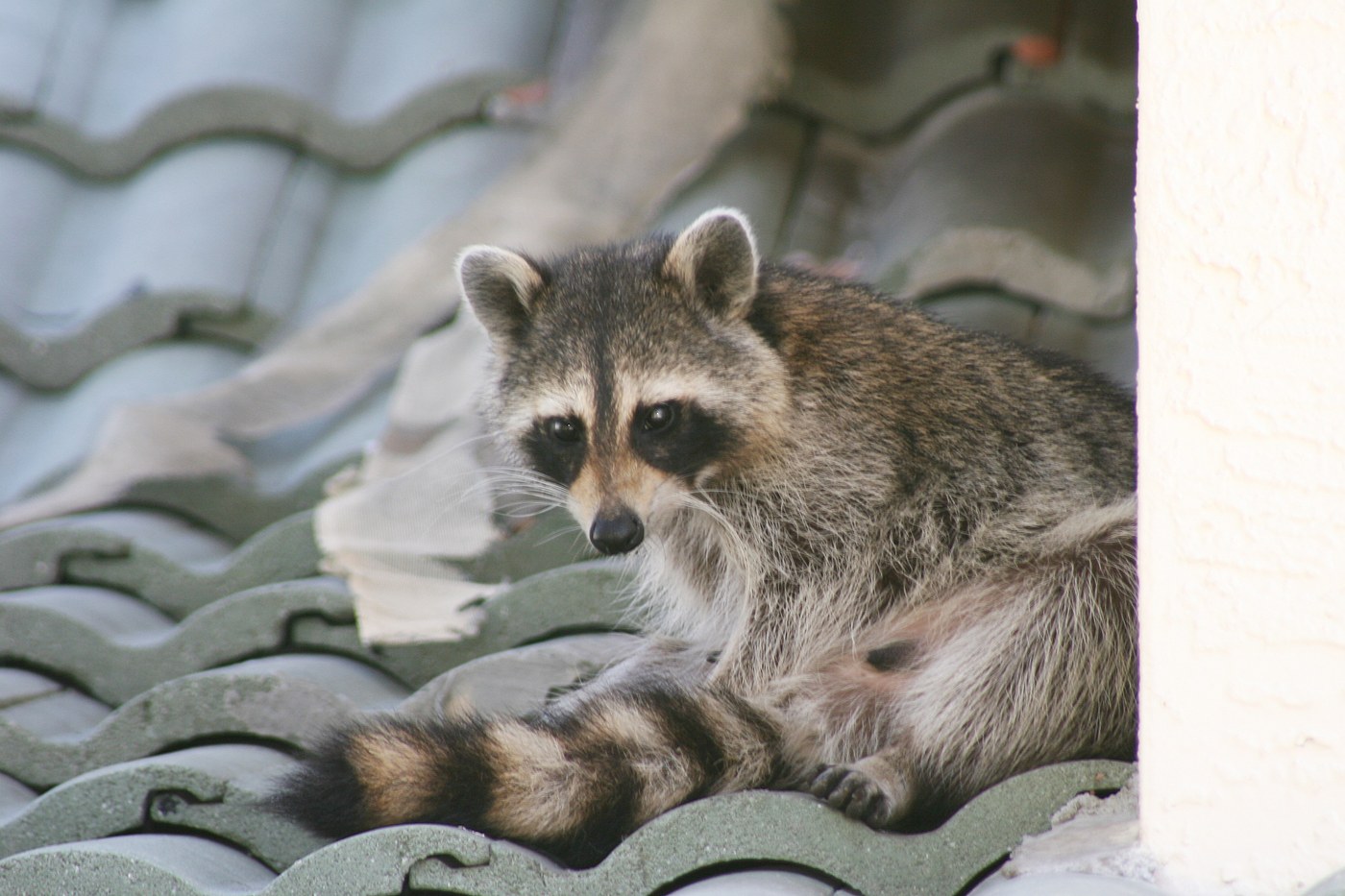
A prominent black mask across the eyes plus a heavily furred, ringed tail. No other North American structural mammal carries that combination, so unlike coyote versus dog, misidentifying a raccoon against a similar species is not a practical problem.
Size and build
Stocky, about 2 to 3 feet long, typically 10 to 30 pounds. New York's state wildlife agency separately puts the adult average at about 15 pounds. Both figures describe the same animal, one as a range and one as an average.
A grizzled salt-and-pepper coat
Color is grizzled salt-and-pepper gray and black above, and some individuals are strongly washed with yellow. Raccoons from prairie areas of the western Great Plains tend to run paler than those from the eastern portions of the region.
The tracks give it away
The tracks are the giveaway when the animal is not around. Front tracks are distinctly hand-like with five long toes. The heel of the hind foot seldom registers except in soft mud or sand, and tracks often smear into smudges where raccoons climb downspouts.
The confusion is symptoms, not species
The confusion that actually matters here is not species, it is symptoms. Canine distemper is common in raccoons and usually fatal to them, and it produces tame or confused behavior, loss of coordination, and eventual death. Those signs look a great deal like rabies to an untrained observer. Distemper cannot be transmitted to people or to vaccinated pets, and rabies can, which is why a raccoon acting strangely is a reason for distance and a phone call rather than a diagnosis either way.
Signs of Infestation
Noise from an attic at dusk
Noise from an attic, chimney, or soffit, usually at dusk or dawn. Scratching, rustling, thumping, and chirring. Young kits add mewing, twittering, and crying sounds. Adults produce chirps, coos, chatter, distress calls, purrs, and complaints.
Structural entry damage
Torn shingles or fascia boards where a raccoon forced its way into an attic or a wall space, and breached attic screens and roof vents. A raccoon needs only a 4-inch gap to get in, so the opening is often smaller than people expect to find.
Latrines, which are both a sign and a hazard
Raccoons return to the same spot to defecate, and those spots tend to be open to the sky: roofs, sandboxes, fallen trees, decks. Treat any latrine as a health risk in its own right, and never disturb one bare-handed or in a way that stirs up dust.
Five long toes, hand-like prints
Tracks with five long toes and hand-like front prints, most readable in soft mud or sand, and often smudged along downspouts and other climbing routes.
Poultry losses with a distinctive pattern
Heads bitten off and left some distance from the body, crop and breast torn and chewed, entrails sometimes eaten, bits of flesh left near water. Young birds in pens may lose legs or feet to a raccoon reaching through wire mesh. Eggs may be removed whole or eaten in place, with the fractured shell lying along the egg's long axis and the nest materials disturbed.
Garden and crop damage
Sweet corn ears partially eaten with the husks pulled back, stalks broken from climbing, and freshly laid sod rolled up in a search for earthworms and grubs, most often in mid to late summer as young raccoons learn to forage.
Watermelon damage separates it
Watermelon damage, which separates raccoon from coyote cleanly. A raccoon digs a small hole into the melon and rakes the contents out with a front paw. A coyote bites a single hole through and eats the center out. Same crop, two different signatures.
Prevention and When to Call a Pro
Never handle a raccoon
At any age, at any time of year. This comes before everything else. Raccoon is one of the wildlife species most frequently found with rabies in the United States, alongside bats, skunks, and foxes, and more than 90 percent of all reported animal rabies cases nationally occur in wildlife. That applies to adults and to kits found in an attic or a chimney alike. A mother defending young, or any raccoon behaving aggressively, salivating heavily, or dragging paralyzed hind legs, has to be treated as a potential rabies risk and not handled or cornered. If a raccoon has bitten or scratched anyone, or if contact with saliva is possible, that is a call to your health department right away, not a wait-and-see situation.
Never disturb a latrine casually
A second, separate hands-off rule: never disturb a raccoon latrine casually. Raccoon roundworm (Baylisascaris procyonis) is a parasite that can cause severe disease in people if it invades the eye, organs, or brain. Human infection is rare, but it happens by swallowing infectious eggs, most often in small children who put contaminated dirt or animal waste in their mouths. Recent studies have found up to 60 percent of raccoons carrying the worm, so treat any latrine as contaminated regardless of how healthy the animal looked. Eggs passed in feces take 2 to 4 weeks to become infectious, which makes prompt, careful removal genuinely worthwhile. Never bare-handed, never in a way that stirs up dust, and contaminated decking or patio surfaces should be treated with boiling water or a propane flame gun rather than swept. Soil near a latrine counts too, because rain carries eggs outward from the pile.
Daylight does not mean rabid
Do not assume that a raccoon out in daylight is automatically rabid. Raccoons are normally nocturnal, and unusual daytime activity in a normally nocturnal species is one of the things public health guidance says to watch for. But a raccoon can be seen in daylight without being sick. The real warning sign is daytime activity paired with disoriented, aggressive, or otherwise abnormal behavior, not daylight by itself. Canine distemper, which people cannot catch, produces very similar-looking behavior. Either way the answer is the same: keep your distance and call animal control instead of getting close enough to judge.
Attractant removal is the base
With those covered, attractant removal is the practical foundation. Secure garbage in metal or plastic containers with tight-fitting lids, held down with a bungee cord or wire if needed, and store the cans inside a secure building where you can. Never leave pet food or water outside overnight. Keep poultry in fenced, predator-proof enclosures at night. Put only plant and vegetable matter in compost, never meat, eggs, fats, or oils. Bring bird feeders in at night or hang them from a baffled pole or wire suspension. If you have the choice, avoid planting sweet corn near creek bottoms or wooded areas.
Exclusion, and the timing rule
Exclusion, not extermination, is the correct long-term fix, and the timing is not optional. Sealed properly, a structure stops being a den site permanently. Chimneys need a securely fastened cap made of heavy material. Roof and wall openings as small as 4 inches need attention. Overhanging branches should be trimmed back from rooflines to cut off climbing access. But a flue or attic that a raccoon has already denned in must not be sealed until every animal has actually left, young included. Raccoons regularly use uncapped chimneys as natal dens straight through weaning, and capping early traps kits inside a space you cannot reach. This is the same seasonal caution that applies to bats in an attic, applied here to raccoon kits.
What is realistic to do yourself
The honest answer is a short list. Electric fencing, where it is legal, protects gardens, sweet corn, and poultry runs, and it needs to be switched on before dusk and off after daybreak. Wrapping ripening corn ears in filament tape cuts raccoon damage by 70 to 80 percent. Frightening devices such as lights, radios, scarecrows, streamers, and pie pans give short-term relief at best and should not be relied on. Ro-Pel is the one registered contact repellent, applied to surfaces only and never to edible plants or fruit-bearing crops. No toxicant is registered for raccoon control at all. Trapping, shooting, and removing an animal from an active chimney or attic den, including handling any young found there, are licensed-operator jobs. The equipment, the timing judgment, and the permit requirements are not a homeowner project.
The legal picture varies by state
The legal picture varies more by state than most people assume, and one real example shows how much. Raccoons are protected furbearers in most states, with established hunting and trapping seasons, and most states have some provision letting a landowner deal with a furbearer that is damaging property. New York is a concrete illustration. There, no one may possess a raccoon without a license, and hunting or trapping requires one, but an unlicensed homeowner or farmer may destroy a raccoon that is actively damaging property, provided they have first tried removing food and shelter attractants. New York's own nuisance-wildlife rules draw the line precisely: taking a raccoon simply because it is a nuisance requires a state permit, while taking one that is damaging property does not, subject to a requirement that an animal taken outside the regular season be buried or cremated immediately. That is where New York draws the line. Other states draw it elsewhere. Missouri, for one, is looser, allowing an out-of-season take of a damage-causing raccoon without any permit. Check your own state before acting.
Relocation is not a clean fix
Relocation is not the clean, humane fix it sounds like, and the two versions of it are not the same question. Releasing a trapped raccoon on the same property is workable where it is legal, but the animal may simply reinvade your home or a neighbor's, and release should happen away from traffic with children and pets kept clear. Moving an animal to a different property is far more restricted. Translocation is not recommended for raccoons: survival rates are low, released animals may travel up to 25 miles from the release site, and many states forbid moving raccoons specifically because they are a rabies vector. In some states, New York among them, moving any captured wild animal off the property where it was caught is flatly illegal, and a licensed nuisance wildlife control operator is the required path instead.
Who to Call, and When
Call for any active den in a chimney, attic, or wall space, especially if young are present, because the timing risk and the direct-contact risk are both real. Call your health department, immediately and before anything else, for any bite, scratch, or possible saliva contact involving a person or a pet. Call for any raccoon behaving abnormally: aggression, heavy salivation, disorientation, paralyzed hind legs, or daytime activity paired with any of those. Call for any latrine large enough that cleanup feels like more than a quick, gloved job. And call for any situation that would otherwise have you reaching for a trap or a firearm, or thinking about hauling an animal somewhere else, since all three carry legal restrictions that change at the state line.
Frequently Asked Questions
Is it true that raccoons carry rabies?
Yes. Raccoons are one of the animal groups most frequently found with rabies in the United States, alongside bats, skunks, and foxes, and more than 90 percent of all reported animal rabies cases nationally occur in wildlife. Raccoon rabies reached New York in 1990, for example, and has been widespread there since. A rabid raccoon may act aggressively, salivate heavily, or show paralyzed hind legs. Never handle a raccoon directly, and treat any bite, scratch, or possible saliva contact as a reason to call your health department right away.
What is making that scratching, chirring noise in my attic or chimney?
Most often it is a female raccoon that has denned there to raise young. Kits make mewing, twittering, and crying sounds that carry through an attic floor or a chimney flue, and adults add scratching, rustling, and thumping, usually around dusk and dawn. Do not seal the opening until you are certain every animal has left, young included. Raccoons use uncapped chimneys as natal dens through weaning, and capping early traps kits inside.
Can I just have a nuisance raccoon relocated somewhere else?
Usually not, and in some places it is specifically illegal. Many states restrict moving raccoons off the property where they were caught, in part because raccoon is a rabies vector species. Translocated raccoons also have low survival rates and may travel up to 25 miles from the release site anyway, so the problem often does not stay solved. New York, for example, prohibits moving any captured wild animal off the capture property at all, and routes the work to a licensed nuisance wildlife control operator instead.
Is it legal for me to trap or remove a raccoon myself?
It depends heavily on your state and on why you are removing it. Raccoons are protected furbearers in most states. New York requires a state permit to take a raccoon that is simply a nuisance, but allows an unlicensed homeowner to remove one that is actively damaging property, after first trying to remove food and shelter attractants. Missouri is looser, allowing an out-of-season take of a damage-causing raccoon without a permit. Check your own state's rules, or work with a licensed nuisance wildlife control operator.
What is the actual health risk from raccoon droppings?
Raccoon roundworm, which recent studies have found in up to 60 percent of raccoons. If the eggs are accidentally swallowed, most often by small children, the parasite can invade the eye, organs, or brain and cause severe disease. Eggs take 2 to 4 weeks after being passed to become infectious, so prompt and careful removal of a latrine genuinely matters. Never handle it bare-handed, avoid stirring up dust, and remember that soil near the pile can carry eggs too, since rain spreads them outward.
Sources
- Raccoons (identification, legal status, biology, damage identification, prevention and control methods, handling) Internet Center for Wildlife Damage Management (University of Nebraska-Lincoln / USDA APHIS Wildlife Services)
- About Rabies, and Rabies Prevention and Control Centers for Disease Control and Prevention
- About Raccoon Roundworm (Baylisascaris infection) Centers for Disease Control and Prevention
- Raccoon species profile New York State Department of Environmental Conservation
- Remove Or Take Nuisance Animals Legally New York State Department of Environmental Conservation
Image Credits
- Image: Adobe Stock, licensed.