Seasonal Timeline
Structure entry is driven by cold-weather cavity seeking, and that behavior is shared by both species. These are forest canopy animals that need a sheltered hollow to sit out the cold, and when a hollow tree is not available, an attic, a soffit, or a wall void serves the same purpose. Expect the heaviest indoor activity in the colder months, and expect the noise at night, because both species are strictly nocturnal.
Structure entry is driven by cold-weather cavity seeking, and that behavior is shared by both species. These are forest canopy animals that…
The peak is a cold-weather aggregation, not a breeding season. Several animals den together in an attic for warmth from October into February, and the noise is strictly nocturnal, which is what separates these calls from a daytime gray or fox squirrel complaint.
Where They're Found
Both species are independently confirmed by state and federal wildlife agencies across the Midwest and Northeast, which is exactly why the identification question comes up here and not farther south. In the Midwest, northern flying squirrel is documented in northern Minnesota, most of Michigan, and northern Wisconsin by each state's own wildlife authority, the Minnesota DNR, the Wisconsin DNR, and the Michigan Natural Features Inventory. Southern flying squirrel is separately confirmed present in those same three states. In the Northeast, U.S. Geological Survey work in Maine documents the two species co-occurring, and notes that south central Maine sits near the northern edge of the southern species' range, so which species you have there is genuinely uncertain without a look at the animal. Northern flying squirrel is additionally documented in New Hampshire, Vermont, and Massachusetts, and the co-occurrence zone extends to the Appalachian fringe of New York.
The two species do sort themselves out somewhat by forest type, which is a soft hint rather than a rule. Southern flying squirrel favors mast bearing hardwood forest with some conifer in the mix. Northern flying squirrel favors coniferous and mixed coniferous and deciduous forest, which within these same two regions tends to mean cooler ground, higher elevation, or higher latitude. Around a structure, both species use the same short list of openings: attics, soffits, wall voids, and any cavity about the size of an old woodpecker hole.
One point of geography is worth separating out clearly, because it is easy to blur. The Appalachian fringe of New York is inside the Northeast range. The far southern Appalachians, meaning western North Carolina, southwest Virginia, and eastern Tennessee, are not. That distinction matters, and the prevention section below explains why.
Life Cycle
Read the life cycle above as two species, not one. The breeding and rearing figures given here are documented for southern flying squirrel. No published source independently confirms the same numbers for northern flying squirrel, so rather than assume they match, treat that as an open gap. What is safe to act on is the part both species share. Young are raised in a cavity, they cannot glide out on their own for a stretch after birth, and both species shelter in structures during cold weather. That is enough to set the timing rule under prevention below.

Mating
Den and nest
Juvenile
Adult southern flying squirrel
Adult northern flying squirrel
Identification
Size is a real difference
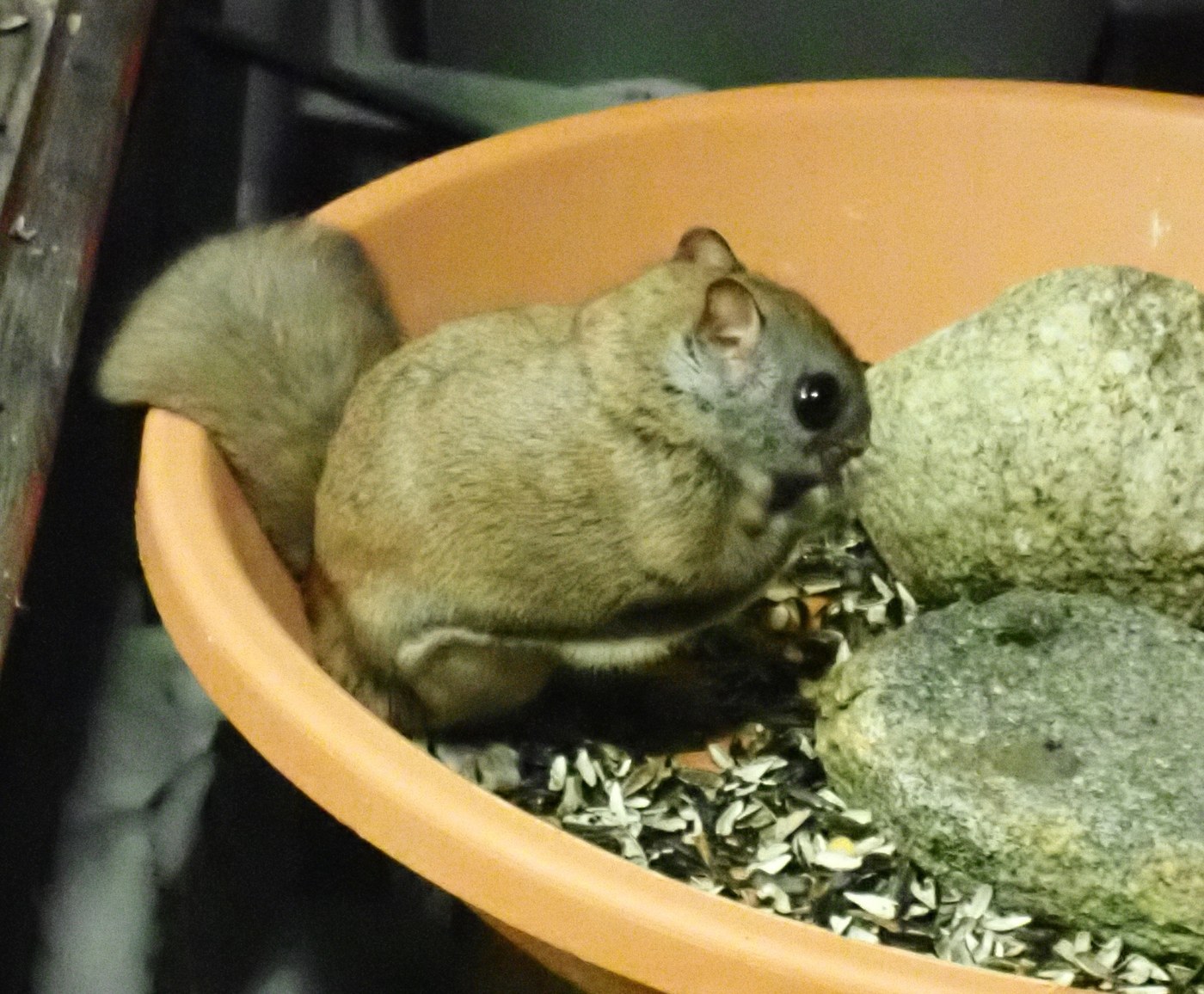
Size is the first thing to check, and it is a real difference. Northern flying squirrel runs about 10 to 12 inches in total length at roughly 70 to 130 grams. Southern flying squirrel runs about 8.3 to 10 inches at roughly 50 to 75 grams, with individuals recorded up to about 82 grams. That gap is consistent enough to be useful, though it works best when you have the animal in hand or in a sharp photo rather than as a shape crossing a beam of light.
Belly fur is the reliable tell
Part the fur on the underside and look at the base of the hairs, not the tips. In southern flying squirrel the hairs are white all the way to the base. In northern flying squirrel the hairs are slate gray at the base with white or cream tips. Both animals look broadly similar from above, grayish brown to reddish brown, so the top side will not settle it.
The membrane names the group
The gliding membrane is shared, so it identifies the group, not the species. Both species carry the patagium, a loose fur covered membrane running from wrist to ankle along each side. At rest it hangs as a fold of skin along the flank. Extended, it turns the animal into a glider. Neither species flies under power.
Big eyes and a flat tail, shared
Large dark eyes and a flattened tail are also shared. Both species are strictly nocturnal and both have outsized eyes to match, plus a flattened tail used as a rudder in a glide. Useful for confirming you are looking at a flying squirrel rather than a gray or fox squirrel. Not useful for telling the two flying squirrels apart.
Forest type is a hint, not an answer
Southern flying squirrel leans toward mast bearing hardwood forest with some conifer. Northern flying squirrel leans toward coniferous and mixed forest, which in these regions usually means cooler, higher, or farther north. Worth weighing, but plenty of properties sit where both descriptions fit.
What does not work here is location
In the Midwest and Northeast both species are documented in the same states, so ruling one out because of where you live is not sound. That is why the two have to be considered together rather than one at a time.
No third species is a realistic mix up
Within this overlap zone, the confusion is between these two and nothing else. If it glides and it is out after dark, you are choosing between southern and northern flying squirrel.
Signs of Infestation
A small, customized entry hole
Look along the roofline, at dormers, ridge vents, eaves, and attic vents. Often it is an old woodpecker cavity that has been worked open a little wider. Both species use the same kind of opening.
Night noise, not day noise
Scratching and scampering in walls or ceilings after dark. Both species are strictly nocturnal, so a racket overhead in the middle of the afternoon points at a different animal.
An old woodpecker hole being used as a den
A cavity about that size, whether in a tree at the edge of the yard or in the structure itself, is the kind of opening both species look for.
A concentrated odor in one spot
When a group uses the same toilet area repeatedly, the smell concentrates in one part of an attic rather than spreading evenly. This pattern is documented for southern flying squirrel. It is plausible for northern flying squirrel but has not been separately confirmed, so treat a strong localized odor as a sign of flying squirrels generally rather than as a species clue.
Chewed electrical wiring
It turns up inside an infested space. Both species gnaw, and damaged wiring in a structure is a fire safety issue, not a nuisance.
Prevention and When to Call a Pro
Seal the entry points
Know which ones matter. Connecticut's state wildlife agency identifies the access points flying squirrels use around a house: gaps around dormers, ridge vents, eaves, the roofline generally, and attic vents. An opening about the size of an enlarged woodpecker hole is all either species needs.
Work the whole opening list
Not just the obvious holes. The openings above are small, and the ones people miss are the small ones. An attic vent or a gap where a soffit meets the roofline reads as too minor to matter right up until something is living behind it.
Confirm the space is empty
Do it before you close the last opening. This is the rule that gets broken most often, and it applies whichever species you have. Assume more than one animal is present. Communal cold weather denning is documented for southern flying squirrel and is plausible but not confirmed for the northern species, so either way a single sighting is a poor headcount. Assume young may be present in a space during and after the breeding season, because they cannot glide out on their own. A premature seal turns an exclusion job into a much larger repair.
Keep the advice general
The identification is not settled. Until you know which species you have, it is a mistake to act on claims specific to one of them. The species differ in habitat and diet, and health findings documented for southern flying squirrel have not been shown to apply to northern flying squirrel. Sealing entry points, confirming the space is empty, and cleaning up after removal are the steps that hold either way.
Who to Call, and When
Call for any suspected active cold weather den, since more than one animal is the likely case and getting that wrong is expensive. Call when do it yourself exclusion is not holding, which usually means an opening smaller than the ones already covered. And call when the species identification actually drives a decision you are about to make, because a wildlife professional or your state wildlife agency can confirm which animal it is far more reliably than a homeowner guess in the dark.
State rules can still apply
Neither common flying squirrel is federally protected, but state rules can still apply. Neither the common southern nor the common northern flying squirrel populations across the Midwest and Northeast carries a federal listing. State status is a separate question: Wisconsin's Department of Natural Resources lists the northern flying squirrel as a Special Concern species and a Protected Wild Animal under NR 10.02 of the Wisconsin Administrative Code. A licensed nuisance wildlife control operator is still the safer default over buying a trap, mostly because of the risk of sealing animals in. As always with wildlife, state and local rules on trapping and relocating can differ and can change, so verify locally before you handle an animal.
One geographic caution
It sits outside the Midwest and Northeast. A high elevation subspecies of northern flying squirrel, the Carolina northern flying squirrel, is listed as federally Endangered by the U.S. Fish and Wildlife Service, and it lives in isolated mountaintop forests of the far southern Appalachians in western North Carolina, southwest Virginia, and eastern Tennessee. That is well south of both regions, and the populations described here carry no such listing. If you are in that far southern Appalachian high country rather than the Midwest or Northeast, get a professional identification before you act on anything.
Frequently Asked Questions
How can I tell a southern flying squirrel from a northern flying squirrel?
Belly fur is the reliable tell. Part the fur on the underside and look at the base of the hairs. In the southern species they are solid white right down to the base. In the northern species they are gray at the base with white or cream tips. Size backs it up. The northern species is noticeably larger, about 10 to 12 inches and roughly 70 to 130 grams, against about 8.3 to 10 inches and roughly 50 to 75 grams for the southern species.
Do both flying squirrel species really live in the same state?
Yes. Across parts of the Midwest and Northeast their ranges genuinely overlap, and Minnesota's and Wisconsin's own wildlife agencies each list two flying squirrel species present in the state. Federal survey work in Maine documents both species there as well. That is why you cannot narrow it down by address.
Do flying squirrels eat mushrooms?
The northern flying squirrel does, heavily. The National Park Service reports that about 90 percent of its diet is the underground fruiting bodies of mycorrhizal fungi, known as truffles. The fungal spores pass through the animal unharmed and get spread across the forest, which gives the species a documented role in moving those fungi to new tree roots. The southern species eats a more familiar squirrel diet of nuts, seeds, and buds, plus a real animal food component.
Is either flying squirrel protected in my state?
Neither common flying squirrel carries a federal listing, but state rules are worth checking. Wisconsin is the known example: its Department of Natural Resources lists the northern flying squirrel as a Special Concern species and a Protected Wild Animal under NR 10.02. There is a second exception worth knowing, and it sits outside both regions. A few high elevation subspecies of the northern flying squirrel in the Appalachians are federally listed, including the Carolina northern flying squirrel. If you are in the far southern Appalachians rather than in the Midwest or Northeast range described here, get a professional identification before assuming otherwise. Trapping and relocation rules also vary by state and change over time, so verify locally either way.
Why does it matter which flying squirrel is in my attic?
Mainly for accurate expectations. The two species differ in habitat preference and diet, and some findings documented for one have not been shown to apply to the other, so knowing which animal you have keeps you from acting on the wrong information. It is not a legal question. Neither common species in the Midwest and Northeast carries a restriction the other does not.
Sources
- Northern Flying Squirrel (Glaucomys sabrinus): body size, belly fur base color, Wisconsin distribution, diet, the two nightly activity windows, and Special Concern and Protected Wild Animal status under NR 10.02 Wisconsin Department of Natural Resources
- Glaucomys volans species account: size, color, range, and reproduction including breeding peaks, litter size, gliding age, and weaning Animal Diversity Web, University of Michigan Museum of Zoology
- Flying squirrel: two flying squirrel species documented present in Minnesota Minnesota Department of Natural Resources
- Glaucomys sabrinus species description: Michigan distribution and coniferous and mixed forest habitat association Michigan Natural Features Inventory, Michigan State University
- Status and habitat relationships of northern flying squirrels on Mount Desert Island, Maine: both species documented in Maine and the south central Maine range limit uncertainty U.S. Geological Survey
- Northern Flying Squirrel (Glaucomys sabrinus) species profile: range including New Hampshire, Vermont, and Massachusetts U.S. Fish and Wildlife Service
- Glaucomys sabrinus vertebrate collection account: species comparison context within the shared Wisconsin range University of Wisconsin-Stevens Point Vertebrate Collection
- Species Spotlight, Flying Squirrels: northern flying squirrel truffle diet and mycorrhizal spore dispersal U.S. National Park Service
- Problems with Squirrels: flying squirrel entry points around dormers, ridge vents, eaves, roofline, and attic vents, plus exclusion guidance Connecticut Department of Energy and Environmental Protection
- Southern Flying Squirrel species account: cavity use, nocturnal and arboreal behavior, and cold weather denning SUNY College of Environmental Science and Forestry, Adirondack Ecological Center
- Carolina Northern Flying Squirrel (Glaucomys sabrinus coloratus) species profile: federal Endangered listing and isolated high elevation southern Appalachian range U.S. Fish and Wildlife Service
Image Credits
- Image: Dominique Bérubé via iNaturalist. CC0 1.0.
License.