Seasonal Timeline
Entry into structures is driven by winter cavity-seeking. These squirrels are forest-canopy animals that need a warm hollow, and when a hollow tree is not available an attic, soffit, or wall void serves the same purpose. Activity inside buildings is heaviest in winter, when communal denning concentrates several animals in one space.
Entry into structures is driven by winter cavity-seeking. These squirrels are forest-canopy animals that need a warm hollow, and when a…
There is one driver behind winter structure entry, and it is the search for a warm cavity. In the wild that cavity is a hollow tree or an abandoned woodpecker hole. Around a house it is an attic, a soffit, or a wall void, and the opening a squirrel needs is no larger than an old woodpecker hole. Because the species is solitary in summer and strongly communal in winter, the same entry point that admits one animal in November can be serving a group of them by January.
Breeding runs on two peaks rather than one, a spring peak in February and March and a summer peak in May through July. Not every female that breeds in spring goes on to produce a second litter that year. Gestation runs about 40 days, young are born hairless and helpless, and maternal care lasts roughly 8 weeks, so young may be present in a nest for a stretch after either peak.
Where They're Found
Southern flying squirrel is a core resident across the South Central and Southeast regions. The species ranges west from Minnesota south to Texas and south to Florida, and Texas Tech's own Texas mammal account confirms presence well into the western end of that swath. Habitat is hardwood mast-bearing forest with some conifer component, where the animals use hollow trees and abandoned woodpecker cavities. Around a structure the list is short: attics, soffits, wall voids, and any cavity roughly the size of an old woodpecker hole.
There is one narrow geographic exception worth knowing about, and it is elevation-driven rather than region-wide. In the high-elevation forests of the southern Appalachians, specifically western North Carolina, southwest Virginia, and eastern Tennessee, a second and much rarer animal lives in isolated mountaintop pockets: the Carolina northern flying squirrel, a subspecies of the separate northern flying squirrel species. The U.S. Fish and Wildlife Service lists it as federally Endangered, a listing that dates to 1985 and remains in place. It is confined to those isolated high-elevation forests, so it is not what you are dealing with in a valley or suburban attic. But if you are up in that specific high country, the flying squirrel you are looking at may not be the common southern flying squirrel, and that is worth confirming before you act. Southern flying squirrel itself carries no such protection.
Neither Alaska nor Hawaii is part of this species' range. Its range is bounded on the west by the prairie tree line and does not reach Alaska, and no source places a population in Hawaii.
Life Cycle
Two breeding peaks a year, and young that cannot glide for more than a month, are what set the timing on exclusion work. Pups are born hairless and helpless, do not begin gliding until 5 to 6 weeks, and are not weaned until about 65 days. Closing an attic or soffit during that stretch risks sealing dependent young into a space no one can reach. Combine that with communal winter denning, where up to 19 animals may share one cavity, and the rule follows directly: confirm the space is empty before final closure.

Mating
Gestation
Birth and litter
Juvenile and gliding
Adult
Identification
Size and build
8 to 10 inches in total length, including a tail of roughly 3 to 4.5 inches, weighing about 1.6 to 2.9 ounces. Small rounded head and a flattened tail the animal uses as a rudder in a glide.
Color
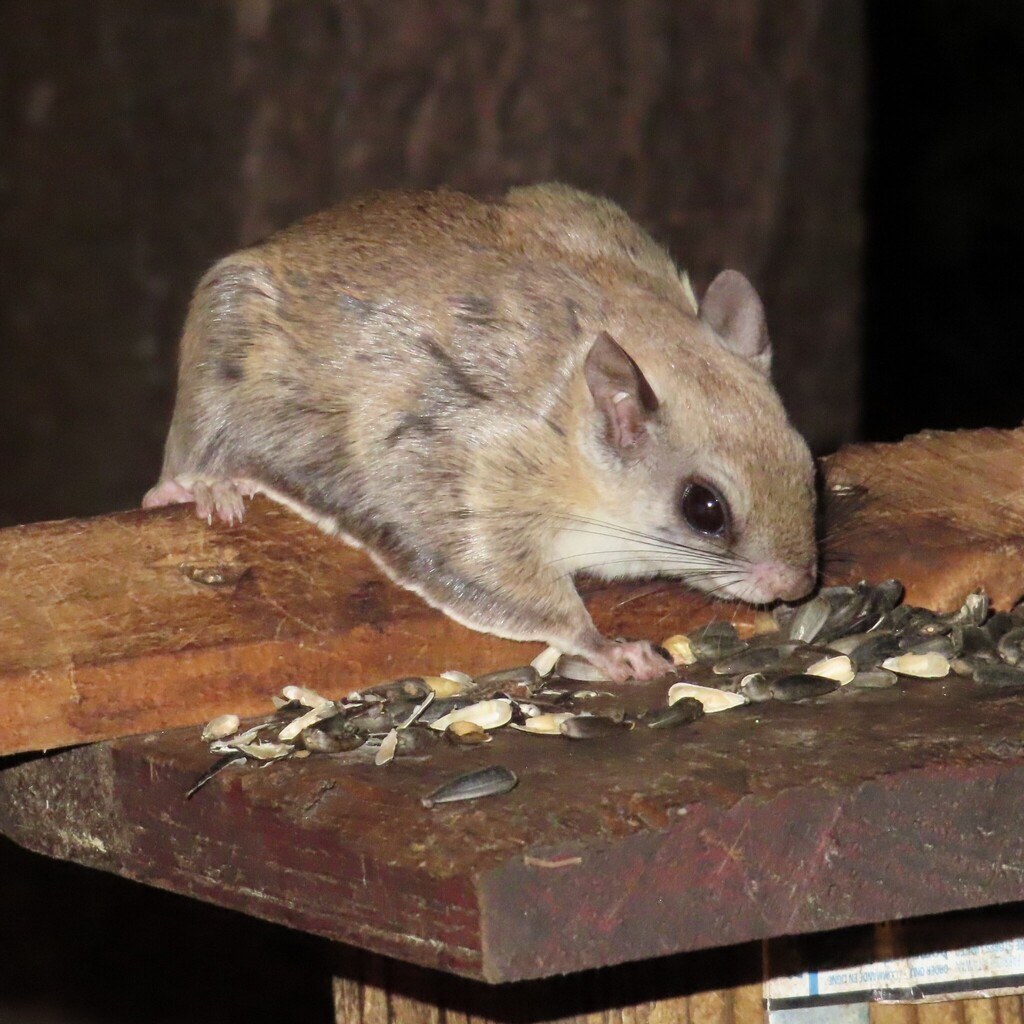
Grayish-brown to reddish-brown on the back and sides, with fully white underparts. The belly hairs are white all the way to the base, with no gray at the root.
The gliding membrane
It is the single clearest tell. A loose, fur-covered membrane called the patagium runs from wrist to ankle along each side. At rest it hangs as a fold of loose skin along the flank. Extended, it turns the animal into a glider. This is gliding, not powered flight.
Very large black eyes
Outsized dark eyes are an adaptation to strictly nocturnal activity, and they are obvious even at a glance in poor light.
Southern versus northern flying squirrel
Belly fur is the reliable tell. Part the fur on the underside: in the southern species the hairs are white to the base, while in the northern species they are white-tipped but gray at the base. Size backs it up, with the southern species smaller at 8 to 10 inches and the northern species larger at 10 to 12 inches. Range alone is not a reliable tell farther north, where the two species overlap, but in the South Central and Southeast regions the southern species is the flying squirrel you would expect.
Signs of Infestation
A small, customized entry hole
Roughly 1.5 to 2 inches across, frequently an old woodpecker cavity that has been enlarged. Check the roofline, dormers, ridge vents, eaves, and attic vents.
Night noise, not day noise
Scratching, scampering, and light thumping in walls or ceilings, concentrated after dark. This species is strictly nocturnal, so daytime activity overhead points to a different animal.
Accumulated nesting debris
It piles up in an attic or a soffit.
A concentrated odor in one spot
A communal group repeatedly uses the same toilet area, so the smell tends to be strong in one part of an attic rather than spread evenly through it. That pattern is a direct consequence of communal winter denning.
Chewed electrical wiring
It turns up inside an infested space. Squirrels gnaw, and damaged wiring in a structure is a fire-safety concern rather than a nuisance.
Prevention and When to Call a Pro
Seal the entry points
Know which ones to look for. Connecticut's state wildlife agency identifies the specific access points flying squirrels use around a house: gaps around dormers, ridge vents, eaves, the roofline generally, and attic vents. An opening the size of an enlarged woodpecker hole, roughly 1.5 to 2 inches, is all that is needed.
Gray-squirrel-proofing is not enough
It does not cover this animal on its own. Flying squirrels squeeze through openings larger squirrels cannot use, so covering only the big gaps leaves the real entry points open. Look specifically at soffit intersections and gable vents, where the gaps are small enough to be overlooked.
Never close the last opening early
Never close the final opening until you are certain the space is empty. This is the one that trips people up here more than with other squirrels. Up to 19 animals have been documented sharing a single winter cavity, so one missed animal is a poor assumption. A single premature seal can shut in far more than one squirrel, and during and after either breeding peak it can shut in young that cannot glide out.
If fleas are suspected
If fleas or lice are suspected, treat the void as well as sealing it. The transmission route in the documented typhus cluster is not settled. Ectoparasites the squirrels carried are one candidate, alongside nesting material, dander, and arthropod feces. Where ectoparasites are suspected, professional treatment of the void alongside exclusion is the safer approach rather than exclusion alone.
Who to Call, and When
Call for any suspected active winter den. Communal nesting means one confirmed animal is very likely not the only one present, and getting that wrong turns a sealing job into a much larger repair. Call when do-it-yourself exclusion is not holding, which usually means an entry point smaller than the ones already covered. And there is one referral that is not a pest question at all: if anyone in the household develops unexplained fever, severe headache, and body aches after time spent near a flying-squirrel-infested space, that belongs in front of a doctor. Four confirmed cases of sylvatic epidemic typhus were documented in exactly that circumstance at a Pennsylvania camp between January 2004 and January 2006, in counselors sleeping against an infested cabin wall. It is an uncommon outcome, but the symptoms are worth taking to a physician rather than waiting out.
No special legal restriction
Southern flying squirrel is not federally protected, and no state publishes a restriction specific to it. A licensed nuisance wildlife control operator is still the safer default over buying a trap, mostly because of the communal-denning problem above rather than because of any permit issue.
Frequently Asked Questions
Do flying squirrels actually fly?
No. They glide. A fur-covered membrane between the wrists and ankles catches air once the animal launches from height, and a typical glide covers about 30 feet. Launched from a tall tree on a downward angle, a glide can reach roughly 270 feet. In the air they move at 20 to 30 miles per hour, can loop or reverse direction, and land belly-first on shock-absorbing feet.
I have seen one flying squirrel in my attic. How many are actually up there?
Probably more than one, especially in winter. Up to 19 individuals of both sexes have been documented nesting together in a single cavity to conserve body heat. They are solitary in summer and communal in winter, which is why one animal spotted in cold weather is a poor guide to how many are present. It is also the main reason the space has to be confirmed empty before the last opening is sealed.
Can flying squirrels make people sick?
It is uncommon, but there is one documented route worth knowing about. A peer-reviewed CDC journal report traced four confirmed human cases of sylvatic epidemic typhus to a Pennsylvania wilderness camp between January 2004 and January 2006. All four were counselors who slept in a bunk against a cabin wall infested with southern flying squirrels. The exact path from squirrel to person is not fully understood, but fleas and lice carried by the squirrels are implicated. Symptoms in that cluster were fever, body aches, severe headache, chills, sweats, and confusion, and none of the four had the classic rash. Almost all reported cases occur in the eastern United States.
How is a southern flying squirrel different from a northern flying squirrel?
Belly fur is the reliable tell. Part the fur on the underside. In the southern species the hairs are solid white right down to the base. In the northern species they are white-tipped but gray at the base. Size supports it, with the southern species smaller at 8 to 10 inches and the northern species larger at 10 to 12 inches.
Is it legal to remove a flying squirrel from my house?
No published federal or state restriction covers this common species specifically. Even so, a licensed nuisance wildlife control operator is the safer default over do-it-yourself trapping, because of the risk of sealing animals inside. Winter groups can run to well over a dozen animals in one cavity, and young cannot glide out on their own for the first 5 to 6 weeks of life.
Sources
- Southern Flying Squirrel species account: size, color, patagium and gliding, nocturnal and arboreal behavior, communal winter denning, diet SUNY College of Environmental Science and Forestry, Adirondack Ecological Center
- Glaucomys volans species account: range, physical description, and reproduction including breeding peaks, gestation, litter size, and weaning Animal Diversity Web, University of Michigan Museum of Zoology
- Species Spotlight, Flying Squirrels: diet, glide speed and maneuvering, and ultrasonic communication U.S. National Park Service
- Problems with Squirrels: flying squirrel entry points around dormers, ridge vents, eaves, roofline, and attic vents, plus exclusion guidance Connecticut Department of Energy and Environmental Protection
- Mammals of Texas, Glaucomys volans: distribution within the South Central range Texas Tech University Natural Science Research Laboratory
- Flying Squirrel-Associated Sylvatic Epidemic Typhus, United States: the four-case Pennsylvania cluster, symptoms, and suspected flea and louse transmission Emerging Infectious Diseases, Centers for Disease Control and Prevention
- Carolina Northern Flying Squirrel (Glaucomys sabrinus coloratus) species profile: federal Endangered listing and high-elevation southern Appalachian range U.S. Fish and Wildlife Service
Image Credits
- Image: Annie Bélair via iNaturalist. CC BY 4.0.