Seasonal Timeline
Fox squirrel entry into structures peaks in late summer and early fall, when a fall litter and cooling temperatures push animals to find a winter den site. A smaller push follows in late winter and early spring.
Fox squirrel entry into structures peaks in late summer and early fall, when a fall litter and cooling temperatures push animals to find a…
One driver sits behind all four regional peaks, and it is the same one everywhere. Fox squirrels den in tree cavities and leaf nests, and they settle for buildings when a cavity is not available. As temperatures drop in late summer and fall they are looking for a winter den site at the same time a fall litter is coming up, which is why the noise usually arrives in July through October rather than in the dead of winter. The smaller late-winter and early-spring shoulder tracks the main breeding period, which runs mid-December into early January, with a small share of the population breeding again in June.
Three of the four regions run about a month ahead of the Midwest on a milder climate. The Midwest peaks August through October. The Mountain West, South Central, and California all peak July through September. The entry points barely change from region to region: attics, soffits, roof edges, and gable vents, plus farm outbuildings in the Midwest and South Central specifically. Chewed wiring shows up as a reported problem most often in the Mountain West and California.
Where They're Found
Fox squirrel's natural range covers most of the eastern and central United States, north into the southern prairie provinces of Canada, west to the Dakotas, Colorado, and Texas, and south into northern Mexico. Even inside that broad footprint the species is absent from New England, New Jersey, most of New York, and northern and eastern Pennsylvania. Eastern Colorado sits on the natural western edge of the range, which is why the map lights Colorado but not Wyoming, Montana, or Idaho within the Mountain West. Fox squirrel is not found in Alaska or Hawaii. No range description or documented introduction reviewed places it in either state.
The habitat preference is the real dividing line between fox squirrel and eastern gray squirrel. Fox squirrel favors forest edges, open woodland, and agricultural woodlots and fence rows rather than closed-canopy forest interior. That preference is exactly why fox squirrel does so well across the open Midwest landscape, where several state wildlife agencies treat it as equally or more common than gray squirrel. The South Central region splits east to west on the same logic. Fox squirrel leads across most of Texas and Oklahoma's open country, while gray squirrel leads in the wetter, more wooded eastern portion of the region: East Texas, Arkansas, and Louisiana. Home ranges run anywhere from 1 to 100 acres depending on season and food supply, and when population pressure is high, individuals may travel 50 miles or more looking for better habitat.
The Mountain West story is more complicated, and the sources disagree on how it started. Denver Parks and Recreation's own account says fox squirrels were deliberately introduced to Denver and Colorado Springs in the 1930s and 1940s, brought in from eastern and Midwestern states specifically so residents would have squirrels in the city parks. A separate account says they arrived more gradually in the late 1800s and early 1900s, riding in with the nonnative ornamental trees settlers planted, on the natural western fringe of the species' range rather than as one discrete stocking event. Both accounts agree on the outcome even though they disagree on the mechanism. Fox squirrel is now the dominant tree squirrel in Denver, Boulder, Fort Collins, and Colorado Springs, and it is essentially absent from the region's native forested mountain habitat. That is a genuine urban versus wild split.
California is the clearest introduced population of the four. Eastern fox squirrel was introduced to the Los Angeles Basin around 1904, and genetic work has since identified multiple separate introduction events feeding the Los Angeles, Bay Area, and Sacramento-area populations independently of one another. It is now widespread across Southern California's urban parks, campuses, and neighborhoods.
Life Cycle
One litter is typical, a second is possible, and that is what sets the control window. Breeding runs mid-December into early January, with a small percentage of the population breeding again in June, so young may be present February through August. Any exclusion or control work inside that window risks separating young from the adult and leaving them behind in a space no one can reach.
A note on the numbers above. The litter size and lifespan figures come from the Internet Center for Wildlife Damage Management, which is the most authoritative source available for fox squirrel reproduction. Looser figures circulate in secondary wildlife content, including wider litter ranges and much longer lifespans. The longer lifespan claims in particular appear to confuse captive animals with wild ones, so the figure given here is the wild-mortality one rather than an average of the two that nobody actually measured.

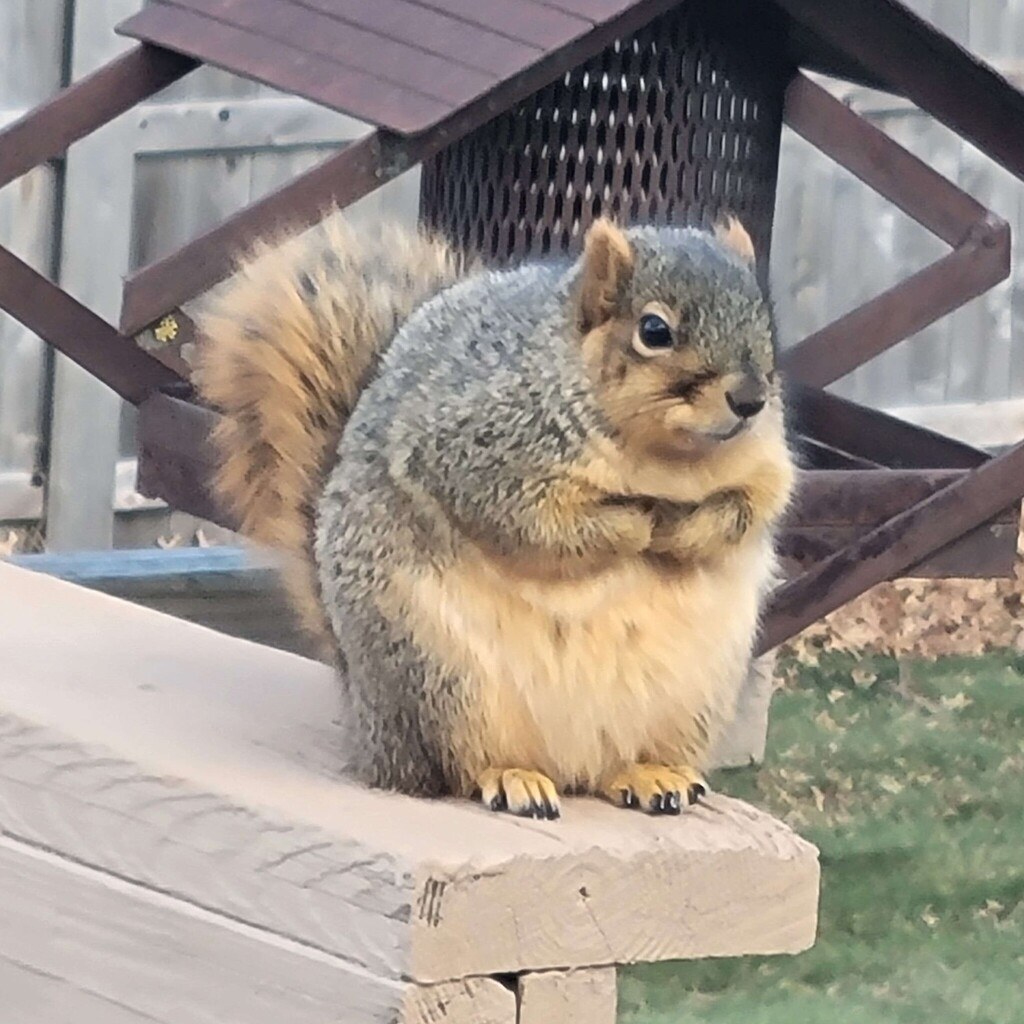
Newborn nestling
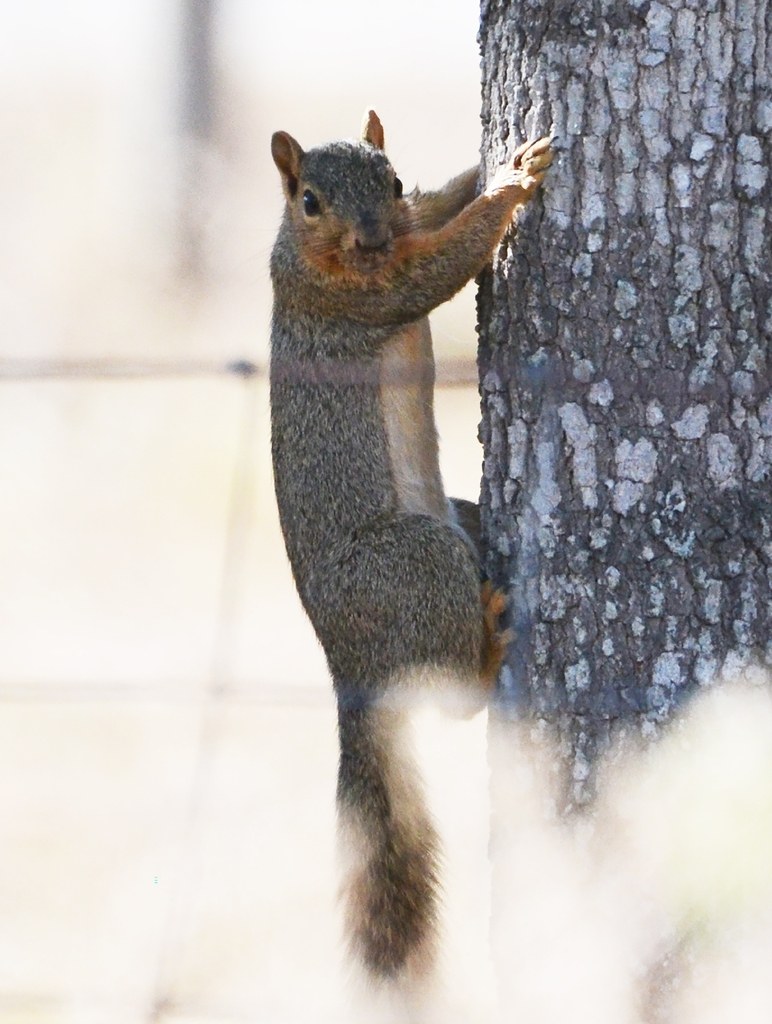
Juvenile2
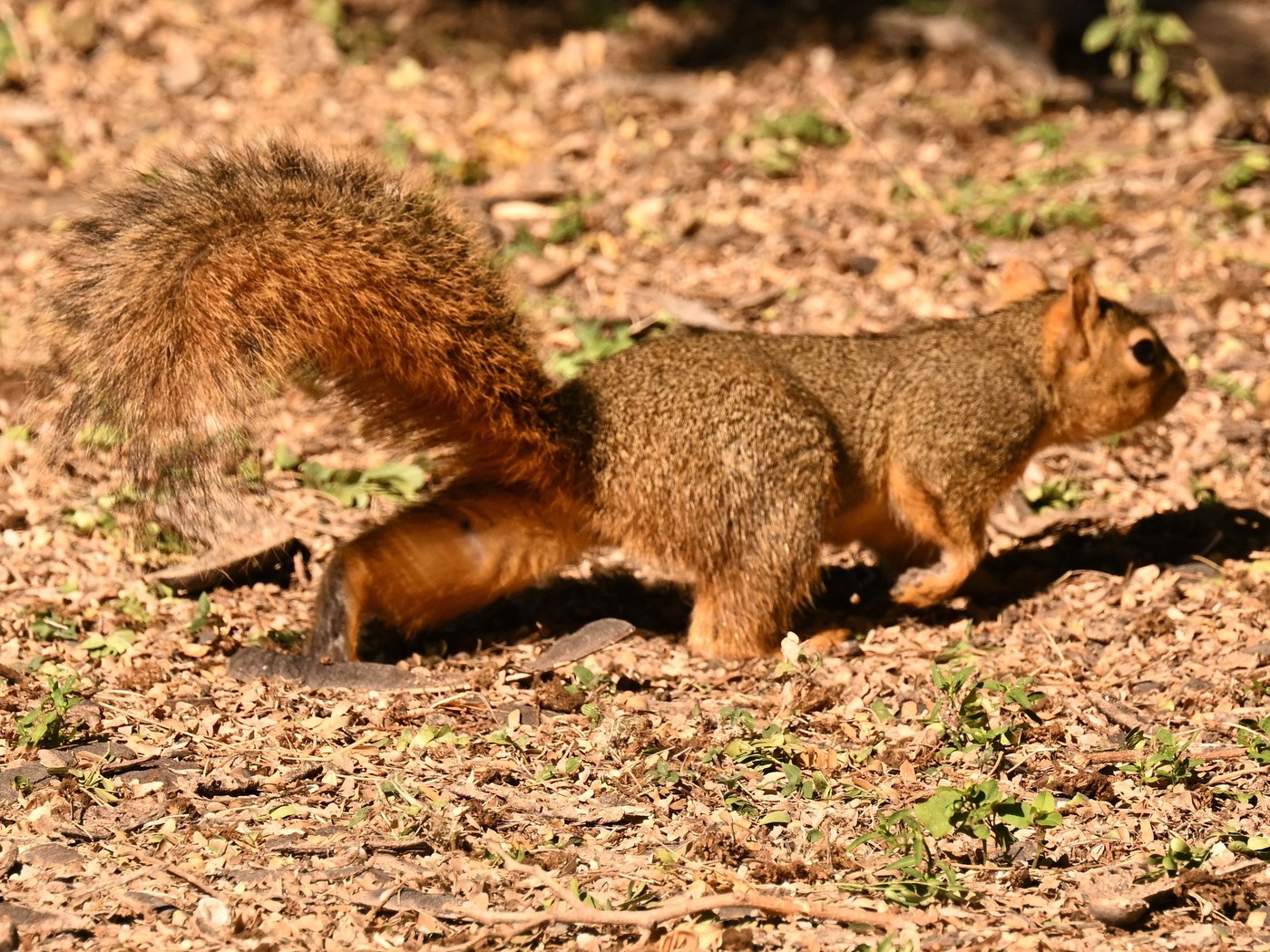
Adult3
Identification
Size and build
18 to 27 inches nose to tail tip, weighing about 1 3/4 to 2 1/4 pounds. Heavy-bodied, with a long bushy tail and strong hind legs built for leaping. This is the largest tree squirrel in North America.
Color varies more than any other
No other tree squirrel varies this much. At least 12 to 13 color varieties exist, running from orange-brown to all black to silver-gray. The typical animal shows reddish-yellow mixed with gray on the back, a rusty reddish-yellow tail and belly fringe, a white nose and ears, and a black face and feet. Regional variants are real. Ohio and Michigan fox squirrels tend to run grizzled gray-brown above with an orange underside.
Against eastern gray squirrel
Fox squirrel versus eastern gray squirrel is the one comparison worth learning. These are two distinct species that share the same neighborhoods across the Midwest and South Central regions, and the ranges genuinely overlap. Three tells separate them. Size: fox squirrel is 18 to 27 inches and about 1 3/4 to 2 1/4 pounds, and gray squirrel is clearly smaller and lighter. Color: fox squirrel is rusty or reddish-brown with a reddish belly fringe, gray squirrel has a gray back and a white or light-gray belly. Habitat: fox squirrel prefers forest edges and open clusters of trees, gray squirrel prefers closed-canopy forest interior.
The one case where color will fool you
A rare all-black color morph occurs in both species, so an all-black squirrel cannot be identified by color alone. Fall back on size and habitat.
A real tell nobody can use
A tell nobody can use in the field. Fox squirrels have 20 teeth. Eastern gray squirrels have 22. This settles the question definitively on a specimen in hand and is useless from a back porch, but it is the actual anatomical difference underneath the size and color tells above.
Daytime activity identifies it
Daytime activity is a genuine identifying sign, not just a detail. Fox squirrels are diurnal. Scratching and running noises during daylight hours point to a squirrel rather than to a rat, a mouse, a bat, or a flying squirrel, all of which are more active at night.
Regional names
In parts of Texas and Oklahoma the fox squirrel is informally called a cat squirrel. It is the same animal.
Signs of Infestation
Gnaw holes about the size of a baseball
That size comparison separates fox and gray squirrels from red squirrel, which leaves golf-ball-sized holes, and from flying squirrels, which leave holes about the size of a quarter. It is the most reliable single sign at the structure.
Daytime scratching overhead
Daytime scratching and running noises in an attic, soffit, wall space, or gable vent. Farm outbuildings are a common entry target in the Midwest and South Central regions specifically.
Chewed and gnawed electrical wiring
This is reported most often in the Mountain West and California, and it is the sign that changes a squirrel problem from a nuisance into a safety issue. Squirrels also short out pole-mounted transformers by traveling power lines.
Bark stripping on branches and trunks
Fox squirrels strip bark from live trees. The clearest documented case is damage to loblolly and other pines in the Southeast, but the behavior itself travels with the species. Extended gnawing on structural wood can also weaken rafters over time.
Yard and orchard damage
Nuts eaten prematurely off the tree, mature nuts carried away, and chewed ornamental trees and shrubs. Bird feeders are a primary attractant and are usually the first thing a homeowner notices.
What this species does not leave behind
A single large pile of cached food, for example a heap of pine cones in an attic, is red squirrel work. Fox and gray squirrels are scatter cachers that store individual nuts in many separate spots across their home range, so they do not build one big pile.
Prevention and When to Call a Pro
Chewed wiring is a fire risk
It comes first for that reason. Squirrels chew electrical lines, and that chewing leads to fires. They also short out pole-mounted transformers when they travel power lines, and gnawing left long enough can weaken structural rafters. That is the reason exclusion matters more than tolerating the noise, and it is why chewed wiring anywhere on the property is a reason to call rather than a reason to wait.
Never seal an opening too early
Never seal an opening until you are certain every squirrel is out. This is the counterintuitive one. Sealing while young may be present, February through August, traps animals inside a space no one can reach. The recommended alternative is a one-way door rather than a straight seal: an 18-inch section of 4-inch plastic pipe mounted at 45 degrees, paired with an apron at least a foot square around the hole so the animal cannot simply chew a new opening beside it.
Habitat modification comes first
Habitat modification is the practical first step and it is homeowner-doable. Trim limbs and trees back 6 to 8 feet from the structure so squirrels cannot jump to the roof. Install 2-foot-wide metal collars around isolated trees, positioned 6 feet above the ground, or wrap sheet metal bands or aluminum flashing directly around trunks. Cap chimneys and secure vents.
Protect the wires first
Protect the wires before they get chewed. A 2 to 3 inch diameter plastic pipe, slit lengthwise and placed over a service wire, rotates under a traveling squirrel and tumbles it off rather than letting it cross. This technique is for service wires only. Actual power lines are for professional electricians and power company crews, never a homeowner.
Remove the attractant
Squirrel-proof or remove bird feeders. Feeders draw squirrels to a property independently of any structural entry point, and leaving one up while sealing the house is working against yourself.
If you trap, the specs matter
If you trap, the specifications matter. Cage or box traps should be 5 by 5 by 18 inches or larger, set near den holes or along travel routes, and you should plan on at least 3 traps for fox or gray squirrels rather than one. Bait with orange and apple slices, walnuts, pecans, or peanut butter. Skip nuts in fall, when natural mast is everywhere and your bait is competing with an entire woodlot.
Trapping and shooting are regulated
Trapping, relocating, and shooting are state-regulated, and the specific limits vary more than most people expect. Fox squirrel is a regulated game animal with a season and a bag limit, and the numbers are genuinely different from state to state. Missouri allows 10 squirrels per day with a possession limit of 20, counting fox and gray squirrels together, and is one of only 10 states that runs a late-spring season in addition to the standard fall season. Colorado allows 5 fox squirrels per day with a possession limit of 10, tracked separately from pine and red squirrel. California allows 4 per day with a possession limit of 4, under a general squirrel season that most recently ran September 13 through January 25 and that the state describes as covering eastern fox squirrel and western gray squirrel. Texas splits itself in two: in a long list of specific East Texas counties, including Angelina, Cherokee, and Nacogdoches, the season runs May 1 through 31 and October 1 through the last Sunday in February with a daily bag limit of 10 and a possession limit of 20, while in every other county the season runs essentially year-round with no bag limit at all.
Verify your state rule first
Verify your own state's current rules before you do anything. Those four examples are a demonstration that the rules differ, not a substitute for checking. Seasons and limits change, and the county-level splits are easy to get wrong. Confirm the current rule with your state wildlife agency before trapping, relocating, or shooting a nuisance fox squirrel. Where shooting is legal, .177-caliber pellet guns, .22-caliber rifles, and shotguns with No. 6 shot are the documented options, and the legality check comes first, not second.
It is displacing a native squirrel
In the Mountain West and California, this squirrel is displacing a native one. That does not change your legal obligations, and it does not make fox squirrel unprotected. It is context worth having. In Utah, where fox squirrels first appeared in 2011 and have expanded steadily through the Salt Lake City area since, Utah State University Extension researchers document them displacing native red squirrels through direct aggression, stealing nests and food, a large size advantage, higher sustainable population densities from feeding on human food sources, and pathogens that can kill red squirrels outright. The consequence reaches past a wildlife count. Red squirrels spread native fungi as they forage, and those fungi support forest health, so losing them is a forest-health problem.
California, a different aggressor
In California the same displacement is under way with a different aggressor. Fox squirrel is outcompeting California's native western gray squirrel for food and nesting sites, and western gray squirrel is a California Species of Special Concern. Populations have retreated into mountainous refugia in places like Griffith Park in Los Angeles. In Washington, an introduced eastern gray squirrel is displacing that same native western gray squirrel. Two different introduced eastern tree squirrels, two different states, the same native species losing ground in both.
Ticks, fleas, mange, and parasites
Fox and gray squirrels carry ticks, fleas, mange, and internal parasites. No rabies-vector concern is documented for tree squirrels. The practical risk in a removal is a bite or scratch during handling, which is a good reason not to handle one.
Who to Call, and When
Call for any squirrel confirmed denning in an attic, soffit, or wall void, especially February through August when young may be present and a do-it-yourself seal risks trapping them. Call for chewed or gnawed electrical wiring anywhere on the property, because the fire mechanism makes that a safety threshold rather than a nuisance one. Call before any removal effort that might exceed your state's bag limit or fall outside its season, or any time you are not certain which rules apply to your county. A licensed nuisance wildlife control operator is the safer default over a trap bought off a shelf.
Frequently Asked Questions
Are fox squirrels and gray squirrels the same thing?
No. They are two distinct species that often share the same neighborhoods. Fox squirrel is noticeably larger, at 18 to 27 inches and about 1 3/4 to 2 1/4 pounds, and gray squirrel is clearly the smaller of the two. Fox squirrel is rusty or reddish-brown with a reddish belly fringe, while gray squirrel has a gray back and a white or light-gray belly. Fox squirrel also prefers forest edges and open clusters of trees, while gray squirrel prefers closed-canopy forest interior. One catch: a rare all-black morph occurs in both species, so an all-black squirrel has to be judged on size and habitat instead of color.
Was the fox squirrel in my Colorado or California yard always there?
Probably not. Fox squirrel is native to the Midwest and much of the South Central United States, but Colorado's Front Range and Southern California both have documented introduced populations. Denver Parks and Recreation's account says the Denver and Colorado Springs squirrels were deliberately brought in from eastern and Midwestern states in the 1930s and 1940s to stock the city parks. A separate account says they arrived gradually in the late 1800s and early 1900s alongside nonnative ornamental trees, at the natural western edge of the range. The two accounts disagree on how it happened and agree on the result. California's population traces to a 1904 introduction in the Los Angeles Basin, with genetic evidence of several separate introductions feeding different California cities.
Is a fox squirrel actually hurting anything by being in my yard?
In the Mountain West and California, yes, in a way that goes past property damage. In Utah, fox squirrels are documented displacing native red squirrels by stealing their nests and food, outsizing them, sustaining higher population densities on human food sources, and carrying pathogens that can kill them. Because red squirrels spread the native fungi that support forest health, that displacement is a forest-health problem too. In California, fox squirrel is pushing the native western gray squirrel, a California Species of Special Concern, out of urban areas and into mountainous refugia.
Do I need a license to trap or remove a nuisance fox squirrel?
Almost certainly, and the bag limit varies widely by state. Missouri allows 10 per day, Colorado allows 5, and California allows 4. Texas is split, with a 10-per-day limit in a specific list of East Texas counties and no bag limit at all in the rest of the state. Seasons differ too, and they change. Confirm your state's current rules with its wildlife agency before trapping, relocating, or shooting.
Can chewed wiring from a fox squirrel actually cause a fire?
Yes. Squirrels chewing electrical lines is a documented fire-ignition mechanism, and traveling squirrels also short out pole-mounted transformers. Gnawing left alone long enough can weaken structural rafters. That is why chewed wiring in an attic gets treated as a safety problem rather than a noise complaint.
There is a squirrel in my attic. Can I just seal the hole?
Not until you are certain the space is empty. Young may be present February through August, and sealing an active den traps animals in a space nobody can reach, which produces more damage and a worse problem than the original entry. The recommended approach is a one-way door, an 18-inch section of 4-inch plastic pipe mounted at 45 degrees with an apron at least a foot square around the opening, so the animal can leave but cannot chew back in beside it.
Sources
- Tree Squirrels: identification, physical description, species ranges, biology, reproduction, denning cover, home range, food habits, and legal status Internet Center for Wildlife Damage Management (University of Nebraska-Lincoln / USDA APHIS Wildlife Services)
- Tree Squirrel Damage Prevention and Control Methods, and the companion Tree Squirrel Damage Identification page Internet Center for Wildlife Damage Management (University of Nebraska-Lincoln / USDA APHIS Wildlife Services)
- Eastern Gray Squirrel and Eastern Fox Squirrel field guide comparison: size, coloration, and habitat preference Missouri Department of Conservation
- Squirrel: Regulations, daily bag and possession limits and season structure Missouri Department of Conservation
- Fox Squirrel species profile: physical description and distinguishing features Florida Fish and Wildlife Conservation Commission
- Invasive fox squirrels move into Utah, pushing out native red squirrels: arrival timeline, displacement mechanisms, and forest-health consequences Utah State University Extension and the S.J. and Jessie E. Quinney College of Natural Resources
- Small Game hunting regulations: squirrel season dates, daily bag and possession limits, and the species covered California Department of Fish and Wildlife
- Fox squirrel info sheet: Denver and Colorado Springs introduction history Denver Parks and Recreation
- Fox squirrel (Sciurus niger) species page: native range U.S. Fish and Wildlife Service