Seasonal Timeline
Feral swine are active year-round, with no seasonal peak. What shifts through the year is the time of day they move and the shelter they use, not whether they are around.
Feral swine have no real season, and the reason is the same reason the population grows so fast: breeding is not seasonally gated. Breeding is not tied to a particular time of year, so there is no window where activity reliably drops off and no window where a property owner can assume the problem has paused.
What does change is behavior. Where feral swine are hunted, pressured, or dealing with heat, they move mostly at night or at dawn and dusk. Where they are undisturbed, they are considerably more active during the day. In hot weather they use wallows, shallow mud depressions, to cool off and spend the day shaded or wallowed. In cold weather they pile grass and leaves into insulating nests and bury into them.
The practical consequence is that a property owner seeing no hogs during daylight should not read that as a small problem. A pressured sounder simply shifts to working the property overnight.
Where They're Found
Feral swine have been reported in at least 35 states, with a national population estimated above 6 million and still expanding. USDA APHIS has run its National Feral Swine Damage Management Program in partnership with 41 states and 3 territories and reports full eradication from 11 of them: Colorado, Idaho, Iowa, Maryland, Michigan, Minnesota, New Jersey, New York, Vermont, Washington, and Wisconsin, with 6 of those still inside a two-year post-eradication monitoring window. That eradication list should be read with a date check rather than as a permanent status. Washington appears on it, and the National Invasive Species Information Center separately documents Washington re-establishing a presence since 2016. The population is dynamic enough that any single snapshot ages quickly.
Across the Midwest, South Central, Southeast, Hawaii, and California, the legal treatment is not uniform. Texas, Missouri, North Carolina, South Carolina, and Hawaii all let a landowner remove feral swine with little or no licensing. California requires a hunting license plus a wild pig validation before anyone can take a wild pig at all. That is the single most important thing to confirm before acting on a hog problem in California.
Hawaii is established range, not a stray occurrence. Pigs arrived with Polynesian settlers and larger European boars were added following Captain Cook's arrival in the 1700s. They are now common across the islands and extend out of wild areas into urban and suburban ones. Alaska is outside the established range. No source places an established feral swine population there, the National Invasive Species Information Center's distribution summary does not name it, and APHIS's list of 41 partner states does not include it either.
On the ground, habitat use is broad. Home ranges typically run 0.3 to 3 square miles, and the species' adaptability is specifically cited as a driver of its rapid expansion into new climates. Feral swine do not enter structures the way rodents or raccoons do. This is entirely an outdoor problem, which is exactly why fencing and land management do the work that attic exclusion does for indoor pests.
Life Cycle
Roughly 20 percent population growth a year, and that number is the whole story. Sows can begin breeding before six months of age on a high-quality diet, typically produce one litter a year and sometimes two where nutrition allows, and average 3 to 8 piglets per litter with up to 13 documented. Under favorable conditions the population grows about 20 percent annually. Every state regulation on feral swine follows from that arithmetic. States do not set closed seasons or bag limits on an animal reproducing at that rate, and even California, the one state that requires a license and a validation, imposes no bag limit and no closed season. The legal posture across all five regions is removal, not management.

Piglet
Juvenile
Adult
Identification
Coloration is not reliable
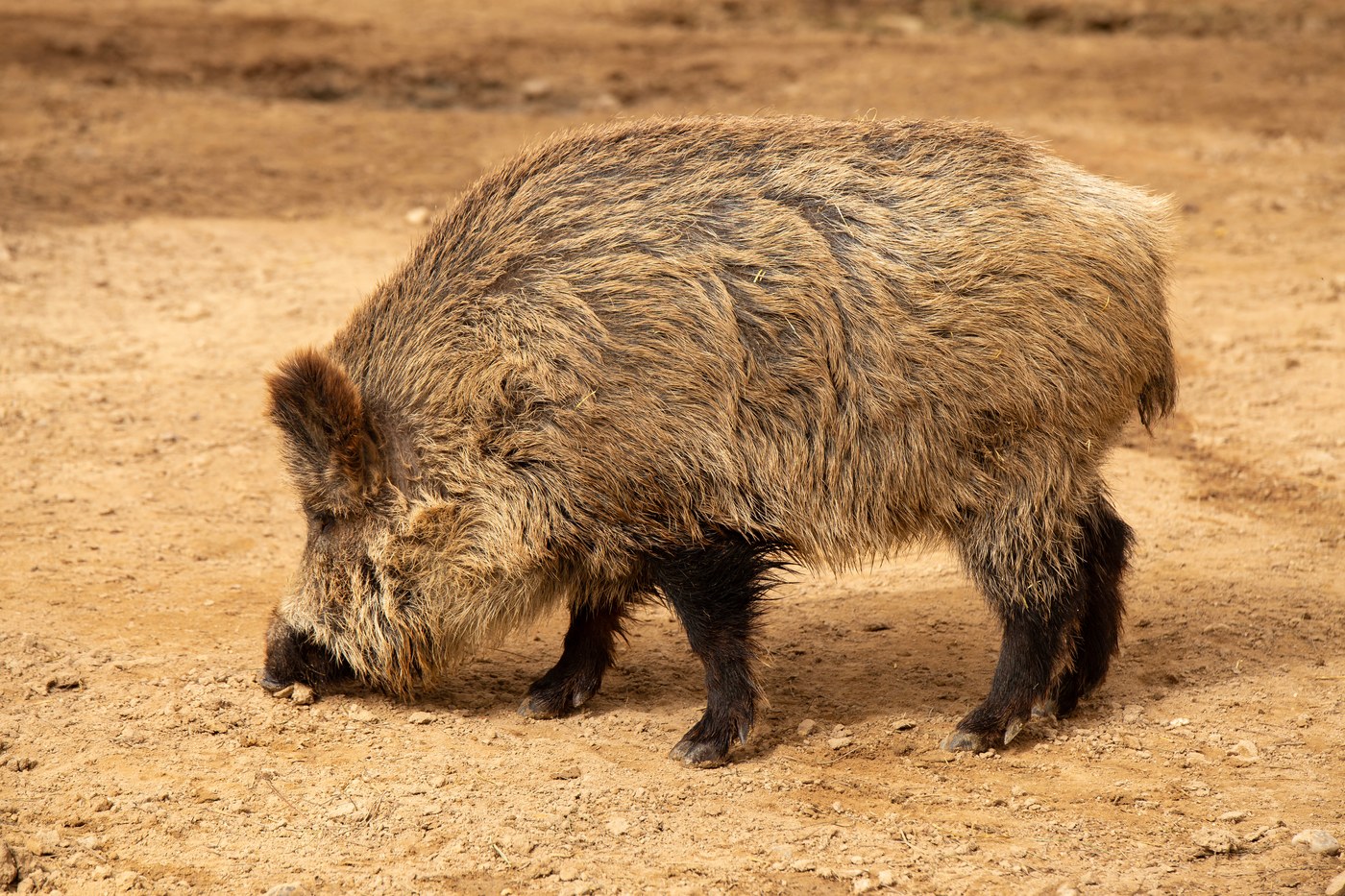
Coloration is not a reliable identifier, and that is itself the tell. Extensive crossbreeding with escaped domestic swine produces white, black, brown, and red in almost any combination, frequently blotched or spotted. If a hog-shaped animal is an unexpected color or pattern, that does not rule out feral swine. It practically confirms it.
How heavy they get
Adults run 75 to 250 pounds on average, with some individuals reaching roughly double that. Up to about 3 feet at the shoulder and about 5 feet long. Boars are larger than sows.
Build separates feral from domestic
Build separates a feral hog from a domestic one. Feral swine are thinner than domestic hogs, carry a thicker hide of coarse bristly hair, and have longer tusks. Tusks typically run 3 to 5 inches and can reach 9 inches, growing continuously in males.
Tracks are blunter and squarer than a deer's
Both animals leave cloven-hoof prints, but a deer track is more pointed and heart-shaped. That is the most useful distinction when the animal itself is not present.
Javelina is a separate species
Javelina is the one look-alike that matters, and it is a separate species. Where South Central range overlaps, Texas especially, javelina (collared peccary, Pecari tajacu) gets mistaken for feral swine. The tells are clear once you know them. Javelina weigh 30 to 55 pounds against feral swine's 75 to 250 and up, are grizzled brown-black with a pale collar of hair around the neck, have small rounded ears, no visible tail, and a squarish body. Feral swine are larger, far more variable in color, have longer pointed ears, and a clearly visible tail, which is why the distinction is worth settling before acting.
Sounders mean you are counting wrong
Females and offspring travel in matriarchal groups called sounders. Adult males are typically solitary outside breeding. One hog on a game camera at night usually is not one hog on the property.
Signs of Infestation
Set the scale first
National damage estimates run between $1.5 billion and $2.5 billion a year. USDA APHIS puts annual damages and control costs at $1.5 billion. The Internet Center for Wildlife Damage Management puts it at $2.5 billion. A more recent USDA Natural Resources Conservation Service estimate, using a wider scope, runs as high as $3.4 billion a year. The methodologies differ, some counting direct agricultural loss and others counting total damage plus control cost, so the honest figure is a range rather than one number.
Rooting is the signature damage
Rooting and grubbing is the signature damage, and it scales from a few square feet to several hundred. Feral swine dig up ground going after roots, tubers, and invertebrates, turning over lawns, pastures, crops, and golf courses.
Wallows near water
Wallows, which are muddy depressions near water. Feral swine use them to cool off in hot weather. Trampled, compacted soil around a pond or creek edge usually accompanies them.
Rub marks on fence posts and structures
Hogs use them as scratching posts, and the rubbing itself can damage the fencing.
Blunter, squarer than deer tracks
Cloven-hoof tracks that are blunter and squarer than deer tracks. Worth checking before assuming deer are responsible for damage near a food plot or garden.
Fouled ponds and cloudier water
Damage to farm ponds and livestock watering holes, plus cloudier water. Wallowing near a water source raises turbidity. On a property with a well, a pond, or livestock water, this is the sign that moves the problem from cosmetic to serious.
Prevention and When to Call a Pro
The honest limit of exclusion
Start with the honest limit: exclusion becomes almost impossible against a persistent, hungry sounder. Fencing is a real tool for small, defined areas such as a yard or a garden. It is not a tool for open acreage. Knowing which of those two situations you are in determines whether fencing is worth the money.
Fencing a small area, tested
If you are fencing a small area, the specification matters and it has been tested. Use heavy-gauge wire fencing with openings no larger than 6 inches. A single electric strand about 6 inches off the ground gives baseline deterrence. A two-strand electric fence with wires at 8 and 18 inches has been shown in trials to cut incursions by roughly half. Solid 34-inch hog panels were the most effective option tested, holding up even under sustained pressure.
Remove the attractants
Remove attractants, because they undercut everything else you try. Traps and exclusion both work markedly less well when preferred natural food such as mast or standing crops is still available nearby. Pull in accessible pet food, secure garbage, and clear fallen fruit and mast where you reasonably can. About 85 percent of the diet is plant material, so food, not shelter, is what holds hogs on a property.
Trapping a sounder is real work
Trapping a whole sounder is coordinated work, not a weekend purchase. Corral-style cage traps, which are stationary and higher capacity, and smaller mobile cage traps are the standard methods, and both need daily monitoring and bait maintenance. Cable restraints are also used. Removing an established sounder, whether by corral trap or by coordinated shooting as a follow-up, is generally a professional or agency-program activity.
Texas, the most permissive
Texas is the clearest example of how permissive this can be. Texas exempts landowners and their agents from needing any hunting license at all to take feral hogs on their own property with landowner authorization, because feral hogs are classified as a non-game, depredating invasive species rather than as game. No closed season, no bag limit, year-round.
Missouri discourages hunting
Missouri is permissive on paper but actively discourages recreational hunting, and the reason is worth understanding. Missouri does not classify feral hogs as game animals, sets no season, and requires only a standard hunting license plus landowner permission on private land. But the Missouri Department of Conservation discourages recreational hunting and prohibits taking feral hogs on department-owned and department-managed conservation land, preferring coordinated trapping. Scattered shooting pressures a sounder into splitting up, which makes eliminating the group entirely much harder. Killing one hog can make the underlying problem worse.
The Carolinas differ
North Carolina and South Carolina sit in the same region with different rules. The North Carolina Wildlife Resources Commission asks the public to report feral swine sightings, damage, or kills directly to its Wildlife Helpline. South Carolina allows year-round trapping on private land with no license or permit required, but makes it illegal to remove a captured hog from the wild alive. Neighboring states, genuinely different obligations.
Hawaii runs a reporting line
Hawaii runs a statewide reporting line, and it is the clearest example of report-alongside-remove. The Hawaii Invasive Species Council operates a reporting hotline at 643-PEST (808-643-7378) and an online tool at 643pest.org for invasive species sightings including feral pigs. A national parallel exists too: USDA APHIS partners with the University of Georgia's Center for Invasive Species and Ecosystem Health on a public reporting tool at squealonpigs.com. Across these regions, reporting programs exist alongside removal rather than instead of it. None of these five regions prohibits removal in favor of report-only.
California makes you buy a tag
California is the one state that makes you buy something first, and it is worth being precise about what changed. Effective July 1, 2024, California reclassified wild pigs from a big-game species to an exotic game mammal, dropping the old individual-tag requirement in favor of an annual, unlimited-take wild pig validation. In practical hunting terms California is just as loose as the invasive-species states: year-round season, no daily bag limit, no possession limit. The difference is the paperwork. California is the only state where taking a wild pig requires purchasing a hunting license plus that wild pig validation. Texas goes furthest the other way and exempts anyone with landowner consent from holding a hunting license at all. Missouri sits between the two: no special hog permit, but a standard hunting license plus landowner permission. If you are in California, confirm you hold both before removing an animal, and confirm current requirements with the Department of Fish and Wildlife, since this rule changed recently.
Brucellosis and leptospirosis
The exposure route is field-dressing, not sighting. Swine brucellosis (Brucella suis) transmits to people through contact with blood, body fluids, or tissue while dressing a carcass, causing fever, sweats, headache, joint and muscle pain, and fatigue, and it can become chronic and recurring. Leptospirosis, if untreated in people, can cause kidney damage, meningitis, liver failure, and respiratory distress. Most human infections trace to field-dressing or cleaning a killed animal, or to eating undercooked meat, rather than to casual contact or a sighting. Wear PPE for any dressing or disposal, keep bare hands away from blood and fluids, and cook meat thoroughly.
Pseudorabies does not affect people
Pseudorabies does not affect humans, and that is worth stating outright. It is the disease of greatest concern to the US livestock industry from feral swine, which is why it comes up constantly, but USDA APHIS confirms it does not affect people and that meat from an infected animal is safe to eat. Bovine tuberculosis, trichinosis, and regionally African swine fever and foot-and-mouth disease also come up in feral swine literature. Published guidance treats those as livestock and surveillance concerns rather than confirmed widespread human risks, and they should be read that way.
Tusks are a real risk
Tusks are a secondary risk, but a real one. Feral swine have sharp, continuously growing tusks and may attack when cornered or defending young. It ranks behind disease and property damage, and it is still a reason not to crowd an animal or walk up on a sounder with piglets.
Call for a sounder, not one pig
Call a professional when it is a sounder, not a single animal. Multiple animals established on or repeatedly visiting a property is the threshold. Single-animal removal rarely resolves a sounder-level problem and can fragment the group, making full removal harder.
Call for damage near water
Call for any rooting or wallow damage near a well, pond, or other water source. That is where the water-contamination and turbidity findings turn a property-damage problem into a health one.
Call before field-dressing
Do it if you are not set up to handle a killed animal safely. The brucellosis and leptospirosis transmission pathway makes this a genuine safety threshold rather than a convenience question.
Report alongside removal
And in the regions with an active reporting program, report alongside removal. Hawaii's 643-PEST line, North Carolina's Wildlife Helpline, and the national squealonpigs.com tool all want the sighting logged. Reporting does not replace professional removal. It runs next to it, and it is how these states track a population that grows 20 percent a year.
Frequently Asked Questions
Are feral pigs, wild hogs, and wild boars all the same animal?
Yes. Feral swine, feral hogs, wild hogs, wild pigs, wild boar, and razorback are all common names for the same species, Sus scrofa. They interbreed freely, including with escaped domestic swine, and the different names are regional usage rather than biology. Feral hog and wild hog dominate in the South Central and Southeast regions, wild pig is the term California's own wildlife agency uses, and razorback is an older colloquialism.
Do I need a hunting license to remove a feral hog from my property?
It depends entirely on the state, and the spread is wide. Texas exempts landowners and their agents from needing any hunting license at all on their own property with landowner authorization. Missouri requires only a standard hunting license plus landowner permission, with no special hog permit. South Carolina requires no license or permit to trap on private land. California is the exception: taking a wild pig there requires a hunting license plus a separate wild pig validation, even though the season is year-round with no bag limit. Confirm your own state's current rules before acting.
Can I relocate a trapped feral hog instead of killing it?
In South Carolina it is specifically illegal to remove a captured hog from the wild alive. That is a state-specific rule rather than a universal one, so it should not be assumed to apply or not apply anywhere else without checking. Given how fast feral swine populations grow, roughly 20 percent a year, moving animals to new ground is exactly the outcome these programs are built to prevent. Check locally before considering relocation anywhere.
Is it safe to eat meat from a feral hog?
Pseudorabies, the disease of greatest concern to the livestock industry from feral swine, does not affect humans, and USDA APHIS confirms meat from an infected animal is safe to eat. The real human risks are brucellosis and leptospirosis, and those transmit mainly through contact with blood, fluids, or tissue while field-dressing the animal, or through eating undercooked meat. Wear PPE while dressing the animal, avoid bare-handed contact with blood and fluids, and cook the meat thoroughly.
Are feral hogs the same as javelina?
No. Javelina, also called collared peccary, is a separate and much smaller species, 30 to 55 pounds against a feral hog's 75 to 250 pounds and up. Javelina are grizzled brown-black with a pale collar of hair around the neck, have small rounded ears, no visible tail, and a squarish body. Feral swine come in far more variable colors, have longer pointed ears, and a clearly visible tail. The two ranges overlap in parts of the South Central region, Texas especially, which is where the confusion usually happens.
How much damage do feral swine actually cause?
Nationally, the estimates differ depending on what gets counted. USDA APHIS puts annual damages and control costs at $1.5 billion. The Internet Center for Wildlife Damage Management puts the figure at $2.5 billion a year. A more recent USDA Natural Resources Conservation Service estimate runs as high as $3.4 billion a year using a wider scope. The methodologies are not the same, some counting direct agricultural loss and others counting total damage plus control cost, so the honest answer is a range between $1.5 billion and $2.5 billion with a higher, broader recent estimate above it, not a single figure.
Sources
- Feral Swine: Managing an Invasive Species, and National Feral Swine Damage Management Program history, state partnerships, eradication status, and national damage estimate USDA Animal and Plant Health Inspection Service
- Disease Risks Associated with Feral Swine: brucellosis, leptospirosis, and the pseudorabies human-safety statement USDA Animal and Plant Health Inspection Service
- Wild Pigs, Wild Pig Biology (size, coloration, tusks, reproduction, population growth, diet, behavior), Wild Pig Damage Identification, and Wild Pig Damage Prevention and Control Methods (fencing specifications, attractant removal, trapping) Internet Center for Wildlife Damage Management (University of Nebraska-Lincoln / USDA APHIS Wildlife Services)
- Wild Pig Hunting: season, bag limit, license and wild pig validation requirements California Department of Fish and Wildlife
- Feral Hogs vs. Javelina, and feral hog hunting license exemption for landowners Texas Parks and Wildlife Department
- Feral Hogs in Missouri, and why the department discourages recreational hunting in favor of coordinated trapping Missouri Department of Conservation
Image Credits
- Image: Adobe Stock, licensed.