Seasonal Timeline
There is no season. Hawaii's climate gives coqui frog no winter dormancy of the kind mainland frogs experience, so calling continues essentially year-round. The cycle that actually matters here is the nightly one: the frogs are silent and near the ground by day, and they climb into vegetation and call from dusk through the night.
There is no season to work against. Most pest species run on a calendar, whether that is a swarm window, a breeding emergence, or an overwintering period. Coqui frog in Hawaii has none. The climate does not force a dormancy break, and calling runs through the year. That is why a coqui problem does not solve itself by waiting, and why homeowners on the Big Island describe the noise as a permanent condition of the property rather than a few bad weeks.
What replaces the seasonal calendar is a nightly one, and it is the reason treatment has two application methods rather than one. By day the frogs are down in leaf litter and low understory. After dusk they climb into vegetation to call. That single behavioral fact is what splits the state's citric acid guidance into a daytime soil drench and an after-dark foliar spray. Time the wrong application to the wrong part of the day and the solution lands where the frogs are not.
Cold is the one thing that does limit this animal, just not anywhere in Hawaii. Coqui frogs cannot tolerate temperatures near freezing. A University of Hawaii thermal tolerance study using an elevation gradient found only a 2 to 3 degree Celsius shift in tolerance after acclimation. That is enough margin to let the species push upslope into cooler high-elevation habitat within the islands, and nowhere near enough to survive a mainland winter.
Where They're Found
Hawaii is the only place in the United States with an established coqui frog population. The species is native to Puerto Rico and a few neighboring Caribbean islands, and it arrived in Hawaii by hitchhiking in shipments of nursery and landscaping plants, first documented on the Big Island in the late 1980s.
Within the islands the picture is uneven, and the unevenness changes what a homeowner should do. Hawaii Island carries by far the heaviest infestation, with an estimated 60,000 acres occupied. Maui and Oahu have established populations. Kauai, Molokai, and Lanai see occasional detections that island invasive species committees are actively working to stamp out before the species takes hold. That gradient is the whole reason the right response differs depending on which island you are standing on.
Density is the part that surprises people who know the frog from Puerto Rico. Coqui reaches far higher population densities in Hawaii than in its native range, by estimates several times higher, and the most commonly given explanation is the absence of the native predators and parasites that hold it in check at home. A Hawaii infestation is not simply the Puerto Rican frog relocated. It is the same animal without any of its brakes, which is why the frog's native-range reputation does not predict the severity of a Hawaii infestation.
The mainland is worth addressing directly, because the same nursery pathway that reached Hawaii also reached the continent. Small introduced populations were documented in Florida and Louisiana. Both are reported to have gone: Florida's did not persist in conditions that did not suit it, and Louisiana's was eradicated by deliberate effort. That mainland introduction and eradication history rests on secondary compilations rather than on the federal record itself. The underlying point, that no established mainland population is currently documented, is consistent across the available sources.
Alaska carries no population and is straightforward to rule out. The frog's freezing intolerance excludes it on climate alone, and there is no introduction pathway or detection on record.
On a property, the frog is where the plants are. Coqui uses dense low vegetation, leaf litter, and landscaping, and toe pads let it climb, so ornamental shrubs and thick ground cover are all working habitat. Nursery and landscaping plant material is also how it moves, which is why the state restricts moving plant material off infested areas between islands. The regulatory lever on this species is aimed at the horticulture trade rather than at the animal, and that is a different shape of control than most pest problems.
Life Cycle
The development cycle of this species is not well documented. No published account describes the egg-to-adult development sequence for the coqui frog: no clutch size, no deposition site, no development timeline, and no age at maturity. What is documented instead is a nightly cycle rather than a developmental one.
That nightly cycle is the more useful one anyway. Every practical decision on this species keys off the same two facts: the frogs are on the ground by day and up in the foliage after dark. That is what determines which citric acid application method works at which hour, it is what makes the noise a nighttime problem specifically, and it is why a homeowner who searches during daylight and hears nothing can still have a heavy infestation. Treat the day and night halves of that cycle as the operating instructions for prevention.

Adult
Daytime refuge
Dusk chorus
Dispersal in plant material
Identification
You will hear it long before you see it
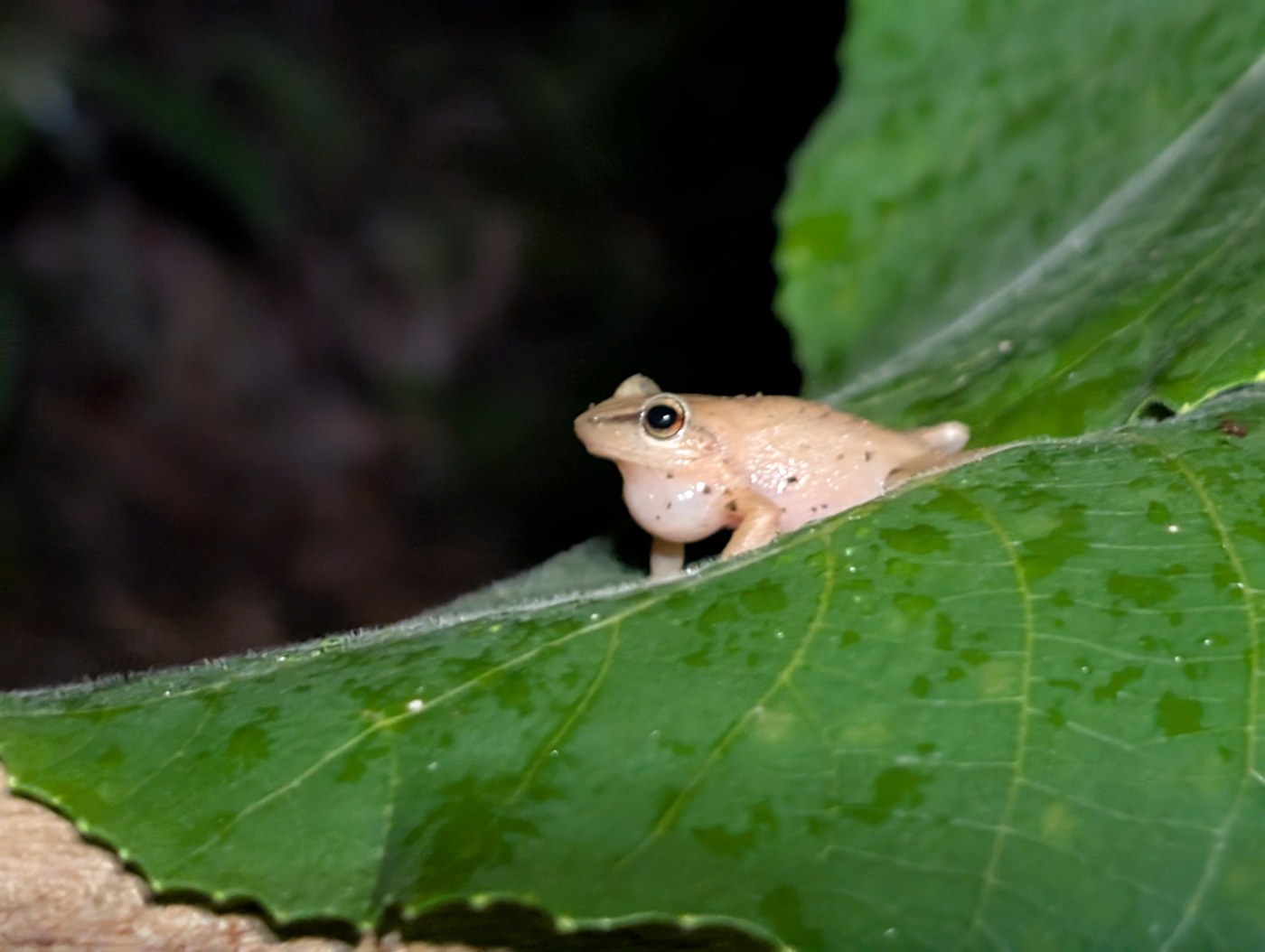
You will identify this species by ear long before you identify it by eye, and that is normal. The two-note "co-QUI" call, repeated from dusk until dawn, is diagnostic and is where the animal's name comes from. The frog itself is small, nocturnal, and well hidden in vegetation, so residents in infested areas often live with a chorus for months without seeing one.
Size is the thing nobody believes
An adult runs roughly 1 to 2 inches. The call from that animal measures 80 to 90 decibels at about half a meter, and up to 100 decibels where populations are dense. Comparable everyday references, drawn from standard occupational and environmental noise figures rather than from any coqui-specific source, are a smoke detector alarm at around 85 decibels and gas-powered lawn equipment at the operator's ear at around 90.
What it looks like, if you get a look
Physical description, for the times you do get a look. Tan to dark brown, round-bodied, with a broad rounded snout and enlarged toe pads that let it climb well into shrubs and trees. There is no bold marking or color pattern that does the identification work here. The call does.
The two notes mean two different things
The "co" is territorial and aimed at other males. The "qui" is directed at females. A dense chorus is therefore both a mating display and a boundary dispute running at the same time, all night.
What it is not
What this animal is not, because the absences rule out most of what people worry about. No published account documents a bite, a sting, venom, a toxin, or a disease transmission risk to people or pets for coqui frog. A coqui frog handled directly is essentially harmless. The only chemical caution with this species attaches to the citric acid treatment solution, not to the frog.
No damage list, and that is the point
Nothing on record describes coqui frog as a threat to structures, wiring, foundations, plants, or stored goods. There are no gnaw marks, no entry holes, and no droppings to work backward from. The complaint is sound, and the sound is the evidence.
Signs of Infestation
A two-note call, night after night
A loud two-note call after dark, night after night, is the sign. In an infested area it starts at dusk and runs through the night, and because Hawaii's climate gives the species no dormancy period, it does not stop for a season. Continuous rather than intermittent is what turns it from a curiosity into sleep loss.
Silence during the day means nothing
The frogs are down in leaf litter and low understory through daylight hours and they are not calling. A daytime walk of the property that turns up nothing is not evidence of absence, which is a common and expensive misread when someone is evaluating a property.
Volume roughly maps distance
Volume tells you distance and density, roughly. The 80 to 90 decibel figure is measured at about half a meter. A call that is loud enough to wake someone through a closed window is a frog in the landscaping near the house, not one in a gulch down the road. Where populations are dense the chorus effect can push toward 100 decibels.
Look at the plants
Not the ground in the open. Dense low vegetation, leaf litter, and thick ground cover are where to search, with a flashlight after dark when the frogs have climbed and are calling. Working toward a call at night is far more productive than searching by day.
New plant deliveries
They are the arrival sign to watch on the islands where the species is not established. Because coqui moves in nursery and landscaping plant material, the first frogs on a clean property usually show up shortly after plants arrived. A single calling frog in a yard on Oahu, Maui, Molokai, Lanai, or Kauai is a reportable event, not a wait-and-see one.
On the Big Island, the paperwork
On the Big Island, the real estate paperwork is a sign in its own right. Hawaii County requires frog presence to be disclosed in real estate transactions on Hawaii Island. If you are buying, that disclosure exists to be read, and it is a more reliable indicator than a single daytime site visit.
Prevention and When to Call a Pro
It depends on your island
What you should do depends entirely on which island you are on, and this is the one piece of guidance for this species that is not universal. On Oahu, Maui, Molokai, Lanai, and Kauai, where the species is either not established or is being actively fought back before it establishes, a coqui sighting or a call you can hear should be reported. On Hawaii Island, where the species already occupies an estimated 60,000 acres, the practical guidance shifts to treating your own property, because reporting every frog on the Big Island is no longer an eradication response.
Not yet established, report it
Not yet established on your island: report it to 643-PEST, at 808-643-7378 or 643pest.org. That is the statewide invasive species reporting line run through the Hawaii Invasive Species Council's network, and it is the same intake point that handles other established invasive wildlife in the islands. Island invasive species committees are actively working to eradicate coqui detections on Kauai, Molokai, and Lanai before the species takes hold, and detections on Oahu and Maui feed control work on populations that are established but not yet everywhere. A report is worth far more than a treatment attempt in these cases, because an early single-frog detection is the only stage at which eradication is realistic. Report first, then treat if you are advised to.
Established, citric acid works
Already established on your island: citric acid is the state-endorsed treatment, and a homeowner can buy and use it. That is genuinely unusual for a wildlife problem. Coqui frog is unprotected, there is no federal endangered species or take-permit question here, and the state publishes a method rather than restricting one. Efficacy testing by USDA Animal and Plant Health Inspection Service Wildlife Services, through its National Wildlife Research Center, together with the Hawaii Department of Agriculture, found that a 16 percent citric acid solution kills nearly all coqui frogs on direct contact. The reason it works is amphibian physiology: these frogs breathe partly through their skin, which makes them far more vulnerable to direct chemical contact than a mammal or an insect would be. The regulatory position is what makes it buyable. UH CTAHR states that the Hawaii Department of Agriculture and USDA Wildlife Services identified citric acid as an effective, legal pesticide for coqui frog, and that the Environmental Protection Agency treats citric acid as a minimum risk pesticide and therefore does not regulate it as one. That is why a homeowner can buy it over the counter.
Apply it on the frog's schedule
This is where most homeowner attempts fail. Two applications, two times of day, because the frogs change level between day and night. Drench the soil, leaf litter, and low ground cover during the day, while the frogs are down at ground level. Spray foliage after dusk, once the frogs have climbed up into vegetation to call. Reverse those and the solution lands where the frogs are not. Working toward audible calling after dark is the most efficient way to target a foliar application, because the animal tells you where it is.
Rinse the plants within a day
Rinse the plants afterward, within about 24 hours. Citric acid residue can cause phytotoxicity on ornamental plants, meaning leaf browning and plant stress, and rinsing it off treated ornamentals within a day limits that. Two numbers are worth keeping apart. 16 percent is the concentration Hawaii uses in the field, and it is what the efficacy testing used. UH CTAHR's plant sensitivity testing was run at 25 percent, where palms and dracaena varieties proved the most tolerant. So treat 16 percent as the field strength, read the plant damage evidence as a 25 percent result, and follow the label on the product you actually buy rather than a number from an article. And treat the solution as the chemical hazard here, since the frog itself is not one. Use the label's own eye, skin, and application guidance.
Large infestations need scale
Large infestations are not a hand-sprayer problem, and the state's own practice shows the scale. Hawaii has twice gone aerial on Oahu where the ground could not be worked. In April 2022 a multi-agency crew treated a remote 4-acre area above Waimanalo with a 16 percent citric acid solution released from helicopter bambi buckets. In September 2024 the Division of Forestry and Wildlife contracted drones for 13 infested acres below the Kuliouou summit, because the slopes there cannot be reached on foot with a hose. The practical lesson for a property owner is one of proportion. Spot treatment works on a yard, a landscaping bed, or a fresh arrival. Acreage, adjacent unmanaged land, or a gulch behind the property is beyond it, and the honest answer there is coordinated control rather than a weekend of spraying.
Deny the habitat
Otherwise the treatment is a chore that repeats. Coqui uses dense low vegetation, leaf litter, and thick ground cover for daytime refuge and climbs into shrubs to call at night. Thinning dense understory near the house, clearing leaf litter and green waste piles, and keeping landscaping less dense against the walls all reduce how much of the property is usable to the frogs. Spraying a yard that immediately reoffers perfect refuge is a schedule, not a solution.
Inspect plants between islands
Inspect plant material before it moves between islands. The species spreads almost entirely by hitchhiking in nursery and landscaping plant shipments, which is why the state restricts moving plant material off infested areas between islands. Check pots, root balls, and mulch before accepting a delivery, and do not move plant material off an infested area to another island. This is the step that protects everyone else, and on the islands still fighting establishment it matters more than any spray.
The property value angle
Take the property value angle seriously, but read the number correctly. A hedonic study published through the University of Hawaii Economic Research Organization found sale prices reduced by roughly 0.16 percent per transaction where a coqui complaint had been lodged within 500 meters of the property, and Hawaii County requires frog presence disclosure in Big Island real estate transactions. That percentage is a small average effect measured across many sales, and it should be read as evidence that the effect is real and measurable rather than as a ceiling or a per-property estimate. Larger localized declines circulate in press coverage but do not trace to that study. The disclosure requirement is the more actionable fact for a homeowner either buying or selling.
Who to Call, and When
Call for a coqui population you cannot get on top of with spot treatment, for infested acreage or adjacent unmanaged land, for a property being prepared for sale where the disclosure requirement applies, and for any situation where you would rather not handle a chemical application yourself. There is no permit or protected-species obstacle here, which means the professional's value is coverage, timing, and repeat treatment rather than legal access. On an island where the species is not established, still make the 643-PEST report first, because eradication response there is a state-funded public program rather than something to buy.
Frequently Asked Questions
How loud is a coqui frog, really?
The call measures 80 to 90 decibels at roughly half a meter, and up to about 100 decibels where populations are dense. Hawaii's own environmental noise standard for residential areas at night is 70 dBA, so the frog exceeds the state's nighttime limit on its own. For everyday comparison, a smoke detector alarm runs around 85 decibels and gas-powered lawn equipment at the operator's ear runs around 90. Those comparison figures come from standard occupational and environmental noise references rather than from a coqui study, and they are offered to make the number relatable. What makes it a genuine quality-of-life problem is not the peak volume but the duration. The calling starts at dusk, continues through the night, and because Hawaii's climate provides no dormancy period, it does not stop for a season.
Are coqui frogs dangerous to my kids or my pets?
No. Nothing on record documents a bite, a sting, venom, a toxin, or a disease transmission risk to people or pets from coqui frog. This is a different situation from a toad like the Colorado River toad, where the animal itself is a veterinary emergency for a dog that mouths one. A coqui frog is essentially harmless on contact. The only chemical caution attached to this species is the citric acid treatment solution, which is a product to handle by its label, not a hazard the frog produces. The harm coqui does is to sleep and to property value, not to health.
Should I report a coqui frog, or just treat it myself?
It depends on your island, and this is the question people get wrong most often. On Oahu, Maui, Molokai, Lanai, and Kauai, report it. Call 643-PEST at 808-643-7378 or file at 643pest.org, the statewide invasive species reporting network. Those islands are either not yet established or are still fighting to prevent establishment, island invasive species committees are actively working to eradicate detections on Kauai, Molokai, and Lanai, and a single early frog is the only stage at which eradication is genuinely achievable. On Hawaii Island, the species already occupies an estimated 60,000 acres, so reporting every frog is no longer an eradication response and the practical guidance shifts to treating your own property with the state-published citric acid method.
Does citric acid actually kill coqui frogs?
Yes, on direct contact, and this is a state-endorsed method rather than a home remedy. Efficacy testing by USDA Wildlife Services through its National Wildlife Research Center, along with the Hawaii Department of Agriculture, found a 16 percent citric acid solution kills nearly all coqui frogs on direct contact, and UH CTAHR states that the Hawaii Department of Agriculture and USDA Wildlife Services identified citric acid as an effective, legal pesticide for the species, with the EPA treating citric acid as a minimum risk pesticide it does not regulate, which is why a homeowner can buy it over the counter. It works because these frogs breathe partly through their skin, which makes direct chemical contact far more effective against them than against a mammal or an insect. Timing is what separates success from a wasted afternoon: drench soil and leaf litter during the day while the frogs are near the ground, and spray foliage after dusk once they have climbed into vegetation to call. Rinse residue off ornamental plants within about 24 hours, because the field concentration can brown leaves and stress plants. Follow the label on the product you buy rather than a percentage from an article.
Do coqui frogs hurt Hawaii's native birds?
Indirectly, and the mechanism is not the one most people assume. Coqui frogs are voracious nocturnal invertebrate predators, with density studies estimating consumption on the order of tens of thousands of invertebrates per hectare per night in heavily infested areas, a commonly cited figure being up to about 114,000 per hectare per night. That much predation reduces the standing insect biomass in the ecosystem, which can suppress food available to native insectivorous birds. But researchers found the frogs are not in direct foraging competition with those birds, because coqui forage in leaf litter and understory while most native Hawaiian insectivores forage in the canopy. The finding that surprised researchers points the other way: peer-reviewed work published in The Condor found coqui presence is associated with greater abundance of non-native birds, apparently because the frogs serve as prey themselves and because effects like increased fly populations from frog waste and carcasses benefit introduced species. So the ecological damage is real, it runs through the food web rather than through head-to-head competition.
Why are coqui frogs so much worse in Hawaii than in Puerto Rico?
Because in Hawaii the species has no brakes. Coqui is native to Puerto Rico, and it reaches far higher population densities in Hawaii than it does at home, by estimates several times higher. The explanation most consistently given is the absence of the native predators and parasites that keep numbers in check in Puerto Rico. A Hawaii infestation is not the same animal relocated. It is the same animal at a density its native range never produces, which is why the frog's native-range reputation is a poor guide to how severe an infestation in the islands actually is.
Could coqui frogs spread to the mainland United States?
Established populations are a Hawaii problem, and cold is why. Coqui frogs cannot tolerate temperatures near freezing, and a University of Hawaii thermal tolerance study using an elevation gradient found only a 2 to 3 degree Celsius shift in tolerance after acclimation. That is enough to let the species move upslope into cooler high-elevation habitat within the islands and nowhere near enough to survive a mainland winter, which also rules Alaska out on climate alone. The nursery plant pathway that carried the frog to Hawaii did reach the continent: small introduced populations were documented in Florida and Louisiana, with Florida's reported not to have persisted and Louisiana's eradicated by deliberate effort. One limitation belongs with that history. The mainland introduction and eradication detail rests on secondary compilations rather than on the federal record, so it is worth confirming with the federal agencies before relying on it.
Sources
- Coqui frog species profile: introduction from Puerto Rico via the nursery plant trade, first documentation on Hawaii Island in the late 1980s, the estimated 60,000 acres occupied on Hawaii Island, island-by-island distribution across Maui, Oahu, Kauai, Molokai, and Lanai, the 80 to 90 decibel call intensity at roughly half a meter, and the unprotected invasive status with no take-permit requirement Hawaii Invasive Species Council, Hawaii Department of Land and Natural Resources
- Control of Coqui Frog in Hawaii, citric acid guidance: the 16 percent citric acid field concentration, the USDA APHIS Wildlife Services National Wildlife Research Center efficacy testing showing near-complete mortality on direct contact, the skin-respiration reason the method works, daytime soil-drench versus after-dusk foliar application timing, and the phytotoxicity caution and 24 hour rinse recommendation for ornamental plants University of Hawaii College of Tropical Agriculture and Human Resources
- Waimanalo Coqui Eradication Effort to Use Aerial Application of Citric Acid, joint HDOA and DLNR news release, April 18 2022: the 16 percent citric acid solution released from helicopter bambi buckets over a remote 4-acre area on Oahu, the multi-agency incident command with DLNR, HISC, OISC and DHHL, and the roughly 500 frogs removed by hand before the aerial work Hawaii Department of Agriculture and Biosecurity
- Economic Impacts of E. Coqui Frogs in Hawaii, Kaiser and Burnett, Interdisciplinary Environmental Review 8(2), 2006: the hedonic property value analysis finding a roughly 0.16 percent reduction in sale price for properties within 500 meters of a registered coqui complaint, a smaller reduction between 500 and 800 meters, and the county-level commodity and accommodation losses University of Hawaii Economic Research Organization
- Invasive coqui frogs are associated with greater abundances of nonnative birds in Hawaii, USA: the association between coqui presence and higher non-native bird abundance, the finding that coqui and native insectivorous birds are not in direct foraging competition because coqui forage in leaf litter and understory while native insectivores forage in the canopy, and the indirect food-web mechanisms including frogs as novel prey and increased fly populations The Condor, via BioOne
- Thermal tolerance and elevation-gradient acclimation study of Eleutherodactylus coqui in Hawaii: intolerance of temperatures near freezing and the finding of only a 2 to 3 degree Celsius shift in thermal tolerance following acclimation, which permits upslope expansion within the islands but not survival of a mainland winter University of Hawaii
- Hawaii's Coqui Frog Management, Research and Education Plan: statewide control strategy, the nursery and horticulture spread pathway underlying restrictions on moving plant material off infested areas, and the documented sleep disruption and visitor accommodation impacts Hawaii Invasive Species Council, Hawaii Department of Land and Natural Resources
- 643PEST statewide invasive species reporting network: the 643-PEST hotline at 808-643-7378 and the online reporting portal used for coqui frog sightings on islands where the species is not yet established Hawaii Invasive Species Council
- New Technology to Curb Invasive Coqui on Oahu, DLNR news release NR24-125, September 25 2024: the June 2024 detection roughly 200 meters below the Kuliouou Ridge Trail summit, the estimated 13 infested acres, and the contracted drone application of citric acid where steep slopes rule out a hose-based system Hawaii Department of Land and Natural Resources, Division of Forestry and Wildlife
Image Credits
- Image: Damien Wallace via iNaturalist. CC0 1.0.
License.