Seasonal Timeline
Axis deer are active year round in Hawaii with no off season and, more unusually, no fixed breeding season. Hawaii's own invasive species coordinating literature reports that axis deer here breed year round, with more than 90 percent of healthy mature females producing a fawn annually, rather than following the April and May breeding season described for the species in its native India and Sri Lanka range.
Drought is the calendar that matters for a property owner. Deer incursion into agricultural and residential areas tracks dry conditions rather than a month on a chart. When upland forage and water dry up, animals move down into pasture, farmland, landscaped yards, and anywhere with an accessible water source. Maui County's consecutive drought driven emergency proclamations describe exactly this pattern, repeatedly, over more than three years.
Time of day is the other real pattern, and the sources disagree about why. Hawaii sources describe axis deer here as elusive and semi nocturnal, and credit that habit with giving the animals meaningful protection from hunting and control efforts. The general species account from Animal Diversity Web, written for the native range, describes axis deer as diurnal and social. No published account reconciles those two characterizations, so both stand. What is consistent on the ground is that deer and vehicle collisions in Maui County are reported to cluster at dawn and dusk, which fits at least some crepuscular movement.
There is no synchronized rut and no synchronized antler cycle. Bucks in hard antler, bucks that have just shed, and bucks in velvet can all stand in the same herd on the same day.
Where They're Found
Axis deer is established in Hawaii, and no published account places a feral axis deer population anywhere else in the United States. It is not present in Alaska, and it is not present anywhere on the mainland as an established population. But treating Hawaii as one uniform block is the single most common way to get this species wrong. The real picture is island by island, and three of the eight main islands are deliberately kept deer free by state law and active monitoring.
Molokai is where it started, and it still carries the state's second largest herd. The original seven or eight animals landed here in December 1867 and January 1868. The herd reached roughly 1,000 within twenty years and reportedly climbed as high as 7,500 before hired hunters killed more than 3,500 in 1900 and 1901 as an early control measure. A 2025 state aerial and machine assisted survey put Molokai at roughly 18,629 deer.
Lanai has been established since 1920, when twelve deer were moved over from Molokai. The 2025 survey put Lanai at roughly 2,682 deer. Lanai and Molokai both operate under a tag requirement that Maui does not share.
Maui is the newest of the three established populations and by far the most politically visible. Nine or ten deer were moved from Lanai to Maui between 1959 and 1960, and accounts differ slightly on the count. What followed is worth stating as a sequence rather than a single number, because the swings themselves are the story: an estimated 2,000 deer on Maui in 2001, roughly 12,000 by 2011, figures as high as 167,000 for Maui County in a 2021 estimate, roughly 65,000 for Maui island in 2023, roughly 34,000 in 2024, and an August 2025 drone and heat sensing survey putting Maui island at roughly 26,330 and Maui County as a whole at roughly 47,641. Those numbers move for two reasons at once. Survey method genuinely improved, and large scale state funded culling and hunting incentive programs genuinely removed animals. Neither explanation alone accounts for the range, which is why the sequence matters more than any single figure.
Hawaii Island, the Big Island, is deer free today, and that is the result of work rather than luck. In December 2009 a helicopter pilot and a Maui rancher covertly moved four axis deer to Hawaii Island in an illegal barter for European mouflon sheep. Nobody knew until February 2011, when a rancher reported an unidentified large mammal; camera traps and field mark verification confirmed axis deer by April 2011. A multi agency task force eradicated the introduced animals within about two years and kept monitoring for more than five years afterward to confirm the eradication held. The Big Island Invasive Species Committee states directly that Hawaii Island is currently deer free, and still asks the public to report any suspected sighting. Both men were prosecuted under the federal Lacey Act, and the pilot's restitution included flight time for the deer location and eradication work.
Oahu is not a never had it island. It is a lost it island. Axis deer were moved to Oahu in 1868, the same year as the Molokai introduction. A combination of hunting pressure and management action extirpated them locally by the mid 1960s. Oahu is confirmed deer free today, and Chapter 123 carries no axis deer season, tag, or hunting area designation for Oahu, consistent with that absence.
Kauai has never had axis deer at any point in the historical record, and Chapter 123 carries no axis deer entries for Kauai either. Kauai does have an introduced deer, Columbian black tailed deer brought from Oregon around 1960, but that is a different species.
The state is actively working to keep it that way, and the mechanism is statutory rather than aspirational. Axis deer sit on Hawaii's Restricted Animal List under Hawaii Administrative Rules section 4-71-6.5, so both import and possession require a permit. Hawaii Revised Statutes section 150A-8 requires a Department of Agriculture permit to move specified animals between islands, and the department has confirmed that no such permit has ever been issued for deer. After the Hawaii Island incident, the legislature in June 2012 enacted a specific ban on interisland possession, transportation, or release of wild or feral deer. The Hawaii Invasive Species Council's own resolution on axis deer said plainly that the Big Island discovery highlighted significant gaps in existing rules on interisland and intraisland movement of restricted species, and recommended pursuing further changes. Maui, Molokai, and Lanai are the deer islands. Oahu, Kauai, and Hawaii Island are kept clear on purpose.
Life Cycle
One number explains the entire regulatory story: 20 to 30 percent annual population growth. Hawaii's invasive species coordinating literature attributes that rate to a stack of conditions that all point the same direction. No natural predators. No disease outbreak or extreme weather event that culls the population. A habitat range running from sea level to above 7,000 feet in elevation. A diet spanning more than 75 plant species. Year round breeding, so no fixed rut or fawning season imposes the natural brake it would elsewhere, with more than 90 percent of healthy mature females producing a fawn every year. Elusive, semi nocturnal habits that reduce hunting success. And in some hunted areas a hunter preference for taking bucks, which does almost nothing to slow reproduction, because one buck breeds many does. A 2025 state survey found roughly nine females for every male on Maui, against the roughly 40 percent male and 60 percent female ratio reported for the species in its native range. That is a herd built to replace losses faster than recreational hunting can create them, which is why the state's own posture shifted from managing a game animal to trying to shrink a population.

Gestation
Fawn
Adult
Identification
The white spots never go away
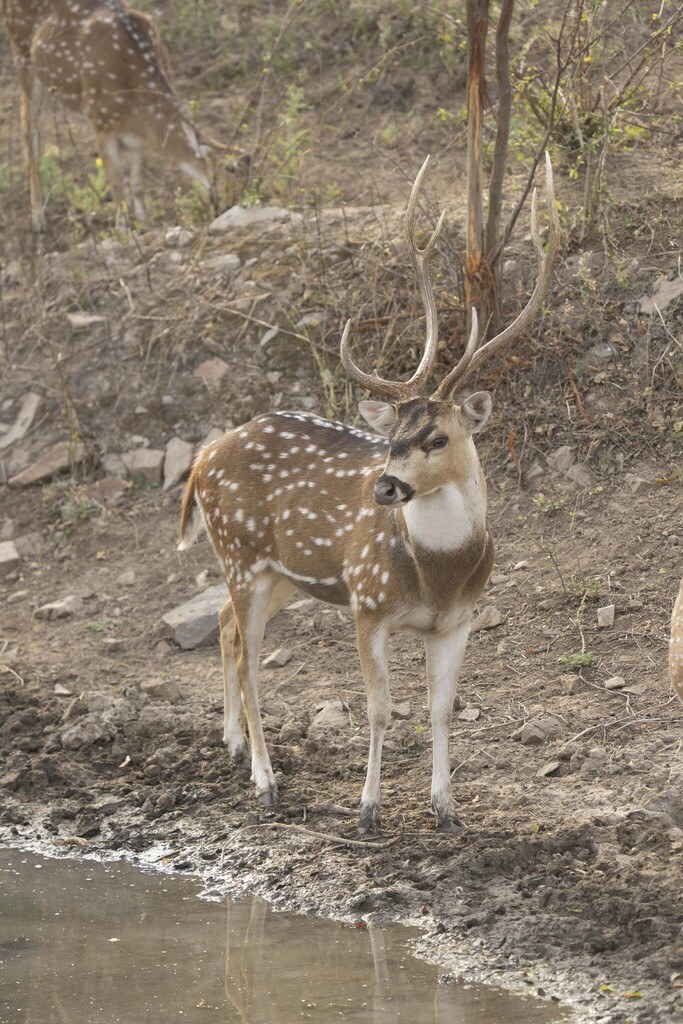
The white spots are the fastest identification, and they never go away. Axis deer carry persistent rows of white spots on a bright reddish brown coat for their entire lives. That is different from a whitetail fawn, which loses its spots as it matures. Add a white underside and throat patch and a dark stripe running down the spine.
Bucks are darker
They also carry black facial markings. Does lack those markings and are antlerless. At distance, a darker animal with a dark face and antlers is a buck.
The antlers
Antlers are lyre shaped and three tined, a main beam, one secondary point about halfway up, and a brow tine, reaching up to roughly 30 inches. They are shed and regrown on each animal's own schedule, so a single herd can hold hard antlered, freshly shed, and velvet antlered bucks at the same time.
Shoulder height is the reliable figure
Shoulder height is the most dependable size figure for this deer. Adult males stand roughly 35 inches at the shoulder, about 0.9 m, which sits inside the 0.6 to 1.0 m range given in the general species account. Adult females are smaller, roughly 26 inches at the shoulder.
Published weights do not agree
Published weight figures for adult males do not agree, and no single number splits them honestly. Hunting and Hawaii focused sources repeat 145 to 250 pounds for adult males. Animal Diversity Web gives roughly 27 to 45 kg for the species generally, which works out to about 60 to 100 pounds, a range that does not overlap the first one at all. Neither figure is broken out for Hawaii's population specifically, and no published account reconciles them. Adult females are reported at roughly 100 to 145 pounds in the same Hawaii and hunting context sources.
On three islands, look again
On the three islands where axis deer are not established, the animal you are looking at is probably not a deer. Hawaii's own invasive species monitoring flags feral goats and mouflon sheep as a real and frequent misidentification on sighting reports. Neither carries white spots. Check for spotting before you report a deer on Oahu, Kauai, or Hawaii Island.
Signs of Infestation
Herds in the open at dawn and dusk
Herds in the open, especially at dawn and dusk and especially in drought. Open pasture, agricultural land, and roadway margins are where deer become visible, and dry conditions push them into developed areas looking for food and water. Drought has concentrated herds of 500 to 700 or more animals on forage grass at a single Maui ranch.
Browse lines
Browse lines and stripped vegetation on trees and shrubs, cut off cleanly at the height a deer can reach and no higher.
Antler rubbing on bark
Antler rubbing damage on tree bark, from bucks polishing antlers. This is not cosmetic. Rubbed trees can be killed outright.
Worn deer trails
Deer trails worn through vegetation, and this sign is the start of a much bigger problem. Repeated trailing wears visible dirt paths through ground cover, and those paths become erosion channels. In wet forest, the same traffic reduces the mossy ground layer that would otherwise hold water and slow runoff.
Divots and torn turf
Deep divots and torn turf on lawns, greens, and landscaped ground. A Maui golf course documented exactly this damage on its championship course, at a cost of thousands of dollars in labor alone.
Fencing jumped rather than dug under
Fencing that has been jumped or gotten around rather than dug under. That distinction matters for diagnosis. Axis deer clear or circumvent standard agricultural fencing built to keep feral pigs out; a pig leaves rooting damage at the base of a fence instead. Same broken perimeter, two different animals and two different fixes.
Droppings and browse near water
Droppings and concentrated browse damage near any accessible water during dry periods. Any accessible water source on a property becomes a focal point once the surrounding country dries out.
Prevention and When to Call a Pro
A game species, not a pest
Start with the legal fact that governs everything else: axis deer is a licensed game species, not an unprotected pest. Hawaii Administrative Rules Title 13, Chapter 123, the rules regulating game mammal hunting, lists axis deer among the game mammals that may be hunted with a valid hunting license and in accordance with that chapter. A property owner cannot simply trap or shoot a nuisance axis deer the way they might handle a rat. Doing it outside a licensed hunting framework or an issued permit is a legal violation, not a gray area. One restriction is worth stating on its own because it surprises people: unless permitted by the department, no person may hunt, kill, or possess a female axis deer at all, under section 13-123-22(f)(2).
The rules differ by island
The rules are not the same on every island, and the primary rule text is specific about where the tags apply. Section 13-123-23 states that tags are required to hunt axis deer on Molokai and Lanai in Maui County, and the chapter's season tables for those units set a bag limit of one deer per hunter per season across a window running mid February through mid May, with separate hunting days for bows, muzzleloaders, and rifles or shotguns, several of them allocated by public lottery. Maui operates differently, and secondary hunting sources describe Maui as having no closed season, no bag limit, and no tag requirement. Those are secondary sources rather than the primary rule text for Maui's units, so confirm current Maui rules with the Division of Forestry and Wildlife before relying on them.
Trapping rules vary and change
Trapping and removal rules for wildlife vary by state and by locality and they change. Verify current state and local wildlife regulations before attempting to trap, remove, or relocate any animal. For axis deer in Hawaii, the safer default is the Department of Land and Natural Resources and its Division of Forestry and Wildlife, or a licensed nuisance wildlife control operator, rather than a trap purchase and a do it yourself plan.
The damage permit pathway
There is a real permit pathway for documented damage, and it comes straight from the rule text. Section 13-123-9, nuisance or crop damage, provides that on receipt of written notice of nuisance or damage to crops, vegetative habitat, or native plants by game mammals, the department or its authorized representative investigates the damage and, based on that investigation, may issue a permit authorizing the destruction or control of the responsible animals. That is the genuine depredation permit route. It is an agency process that starts with written notice and an investigation, not a self directed right to remove deer.
A better funded control pathway
A separate and better funded pathway exists specifically for population control. The state's Landowner Incentive Program, re-opened in a January 2026 solicitation, pays eligible private landowners and lessees on Maui, Molokai, and Lanai up to 50 dollars per qualifying deer tail under a 12 month contract, subject to available legislative funding. All harvest under it still has to comply with Chapter 123. A related public and Department of Hawaiian Home Lands beneficiary effort accounted for more than 350 axis deer removed between February and July of 2024. If the goal is sustained population reduction on acreage rather than one nuisance complaint, this is the program to ask about.
Fencing, and the height spec
Fencing is the state's own most effective recommendation, and the height spec is higher than most people expect. Standard 4 to 6 foot ungulate fencing built to exclude feral pigs does not hold axis deer, which jump or work around it. Hawaii's state and conservation sources recommend at least 8 feet of height specifically for deer exclusion. Construction should use either black plastic tensile polygrid material or 6 to 8 foot hogwire with vertical strands tight locked to the cross wires and spaced no more than 6 inches apart.
Know the cost before you scale
Installed fence cost figures from Hawaii watershed protection work on Maui run roughly 60,000 dollars per mile for deer resistant fence and roughly 210,000 dollars per mile for fully deer proof fence. Those numbers are worth stating plainly, because they are the difference between fencing a garden and fencing a property, and a garden fence will not solve this at acreage scale.
Plant selection is a weak tool
Plant selection is a real tool and a weak one, and Hawaii's own extension program says so directly. The Maui Master Gardeners program reports that highly pungent or waxy leaved plants tend to get ignored by deer, and names Cuban oregano as one candidate. It also states plainly that no plant is 100 percent deer proof, and that the program itself was not able to find a simple answer for a reliably deer resistant ground cover. Against a documented diet of more than 75 plant species, that honesty is the point. Treat plant choice as a secondary measure behind fencing, not a substitute for it.
Manage water and food in drought
Manage water and food access, especially in drought. Deer move into developed property when upland forage and water run short. Securing accessible water features and not leaving pet food, livestock feed, or harvestable garden produce out reduces the reason to come in. This follows from the drought and incursion pattern the state's own emergency proclamations describe rather than from a formal published recommendation.
Call for documented damage
Call the Division of Forestry and Wildlife for any documented crop, landscaping, or vegetative habitat damage you want addressed through removal. That is precisely the trigger for the Hawaii Administrative Rules section 13-123-9 nuisance and crop damage permit process. Request an investigation rather than acting first and asking later.
Report sightings, do not handle
Report, do not handle, any suspected sighting on Oahu, Kauai, or Hawaii Island. These three islands are deer free and the state is actively working to keep them that way, with a statutory interisland transport ban behind that effort. Route a suspected sighting on those islands to the Big Island Invasive Species Committee through 643PEST.org, by phone at 808-933-3340, or by email at biisc@hawaii.edu, and say whether the animal had white spots. That one detail is what separates an axis deer from the mouflon sheep or feral goat it is most often confused with.
Deer and vehicle collisions
Take deer and vehicle collision risk seriously on Maui property roads and driveways. Maui Police Department collision reports rose from 7 in 2018 to 16 in 2019, 25 in 2020, 100 in 2021, and 61 in 2022, and many incidents are believed to go unreported. Deer activity concentrates at dawn and dusk, which is also when most people are driving in and out. This is not a pest control call, but it belongs in the same conversation about what a deer population on your property actually costs.
Livestock disease questions
Route livestock disease questions to the state, and keep the human risk in proportion. Bovine tuberculosis has been present on Molokai since the 1940s and has been found there in mongoose, feral swine, and axis deer. The documented pathway of concern is deer to livestock and deer to deer, not deer to people, and no confirmed human case has been tied to axis deer. The disease is zoonotic in principle, most often through unpasteurized dairy and more rarely through close contact with infected tissue, which is reason enough to avoid bare handed contact with a dead or sick animal without treating it as a crisis. If you keep cattle where axis deer range, that is a conversation for the Department of Agriculture and the Department of Land and Natural Resources rather than a do it yourself one.
Frequently Asked Questions
Are axis deer found on all the Hawaiian Islands?
No, and this is the most common misunderstanding about the species. Established, breeding populations exist only on Maui, Molokai, and Lanai. Oahu had axis deer starting in 1868 but they were extirpated by the mid 1960s. Hawaii Island, the Big Island, received four deer in an illegal 2009 introduction, which was detected in 2011 and fully eradicated within about two years, followed by more than five years of monitoring to confirm it held; the island is deer free today. Kauai has never had axis deer at all. State law now specifically bans interisland possession, transportation, or release of wild or feral deer, enacted in June 2012 in direct response to the Big Island incident.
Can I trap or shoot an axis deer that is damaging my property?
Not on your own initiative. Axis deer is a state licensed game species under Hawaii Administrative Rules Chapter 123, and killing or possessing one outside a valid hunting license or an issued state permit is a legal violation. Female deer carry an additional restriction: unless permitted by the department, no person may hunt, kill, or possess one. If you have documented crop, landscaping, or native plant damage, the route is section 13-123-9, which lets you give written notice to the Department of Land and Natural Resources, triggers an investigation, and can result in a permit authorizing control of the responsible animals. Rules of this kind vary by state and locality and do change, so verify current requirements with the state agency or a licensed nuisance wildlife control operator before acting.
Why are there so many axis deer on Maui?
Hawaii's invasive species coordinating literature puts the annual population growth rate at 20 to 30 percent and attributes it to a combination of factors: no natural predators, no disease or extreme weather die offs, a habitat range from sea level to above 7,000 feet, a diet spanning more than 75 plant species, elusive and semi nocturnal habits that limit hunting success, and a hunter preference in some areas for taking bucks, which barely dents reproduction. The biggest single driver is that axis deer in Hawaii breed year round rather than following the April and May season described for the species in its native India and Sri Lanka range, which lets more than 90 percent of healthy mature females produce a fawn every year.
Do axis deer really damage Hawaii's coral reefs?
Indirectly, yes, and the mechanism is documented from several independent Hawaii sources. Overbrowsing strips native watershed vegetation and the animals' repeated trailing wears dirt paths through ground cover, both of which accelerate soil erosion. In wet forest, deer traffic also reduces the mossy ground layer that would otherwise retain water and slow runoff. The resulting sediment runoff reaches the coast, where it has been documented altering nearshore ocean water chemistry in ways that damage coral. That mechanism is the stated justification for state funded revegetation work above Kihei on Maui, where an 11 acre restoration project was completed in 2025 specifically to reduce axis deer driven erosion and protect water quality.
Will a normal fence keep axis deer out?
Not reliably. Hawaii's state and conservation sources report that axis deer jump or get around standard 4 to 6 foot agricultural fencing built for feral pigs, and recommend at least 8 feet of height for effective exclusion. Build it from black plastic tensile polygrid or 6 to 8 foot hogwire with vertical strands tight locked to the cross wires no more than 6 inches apart. Budget honestly: installed fence costs from Maui watershed protection work run roughly 60,000 dollars per mile for deer resistant fence and roughly 210,000 dollars per mile for fully deer proof fence.
Can I catch a disease from an axis deer?
The documented concern is livestock, not people. Bovine tuberculosis has been present on Molokai since the 1940s, and mongoose, feral swine, and axis deer have all been found infected there. The Hawaii Department of Agriculture's own guidance reports that a hunter submitted axis deer from Molokai's West End tested positive in April 2022 during the largest Molokai outbreak in 50 years, and describes overall prevalence in axis deer there as very low based on slaughter and hunter surveillance. Two state sources conflict on this point, and the conflict is unresolved: a June 2025 gubernatorial emergency proclamation states that the Department of Land and Natural Resources has tested hundreds of animals, including axis deer, with no positive results detected. No published account reconciles the two statements. Bovine tuberculosis can infect people in principle, most often through unpasteurized dairy, but no confirmed human case has been tied to axis deer, and the documented pathway of concern is deer to livestock and deer to deer.
Is Hawaii treating axis deer as game or as an invasive species?
Both at once, and Hawaii's own sources say so nearly in the same breath. The Hawaii Invasive Species Council's resolution on axis deer opens by noting the animals were introduced to Molokai, Lanai, and Maui, where they are hunted for recreation and food, then immediately finds that their presence costs millions of dollars a year in impacts to agriculture, public health and safety, and natural resources. The practical balance has shifted toward control: the Governor issued at least 21 consecutive emergency proclamations relating to axis deer overpopulation in Maui County between March 2022 and June 2025, which suspended ordinary procurement, historic preservation, coastal zone, and environmental review requirements so the state could move faster on deer fencing, aerial culling, and trap procurement. That same June 2025 proclamation cites deer running across the Kalaupapa airport runway on Molokai as a public safety concern alongside the livestock disease risk. A state wildlife biologist's summary of the situation, quoted in coverage of the Hawaiian home lands control effort, was simply that there are too many deer.
Sources
- Hawaii Administrative Rules Title 13, Chapter 123, Rules Regulating Game Mammal Hunting: axis deer as a licensed game mammal, section 13-123-9 nuisance and crop damage permits, section 13-123-22(f)(2) female deer restriction, section 13-123-23 tag requirement on Molokai and Lanai, and per island hunting area designations Hawaii Department of Land and Natural Resources, Division of Forestry and Wildlife
- Resolution No. 11-5, Regarding Axis Deer: the game species and invasive threat framing, statewide agricultural loss figure, 8 foot fence recommendation, trailing and erosion mechanism, and the interisland movement rule gaps exposed by the Hawaii Island discovery Hawaii Invasive Species Council, Hawaii Department of Land and Natural Resources
- Private Landowners on Maui Nui Sought to Assist Axis Deer Control: Landowner Incentive Program mechanics, the 50 dollar per tail rate, island scope, and the Chapter 123 compliance requirement Hawaii Department of Land and Natural Resources
- The Anatomy of an Eradication Effort: Removing Hawaii's Illegally Introduced Axis Deer U.S. Geological Survey
- Axis Deer pest profile: current Hawaii Island deer free status, public sighting reporting contacts, and the mouflon sheep and feral goat misidentification caution Big Island Invasive Species Committee, University of Hawaii
- Twenty-First Proclamation Relating to Axis Deer, June 3, 2025: the emergency proclamation sequence since March 2022, law suspensions for fencing, procurement and aerial culling, the Kalaupapa runway safety concern, and the animal testing statement Office of the Governor, State of Hawaii
- Axis axis: taxonomy, physical description and shoulder height range, native range breeding season, gestation and litter size, sexual maturity, lifespan, and social structure Animal Diversity Web, University of Michigan Museum of Zoology
- Ground Cover Resistant to Axis Deer: the pungent and waxy leaved plant guidance, Cuban oregano, and the explicit finding that no plant is 100 percent deer proof Maui Master Gardeners, University of Hawaii Cooperative Extension
- Bovine Tuberculosis in Animals on Molokai, frequently asked questions, updated May 16, 2022: the April 2022 axis deer positive test, outbreak context, and the very low prevalence finding Hawaii Department of Agriculture, Animal Industry Division
Image Credits
- Image: Luciano Massa via iNaturalist. CC BY 4.0.
License.