Seasonal Timeline
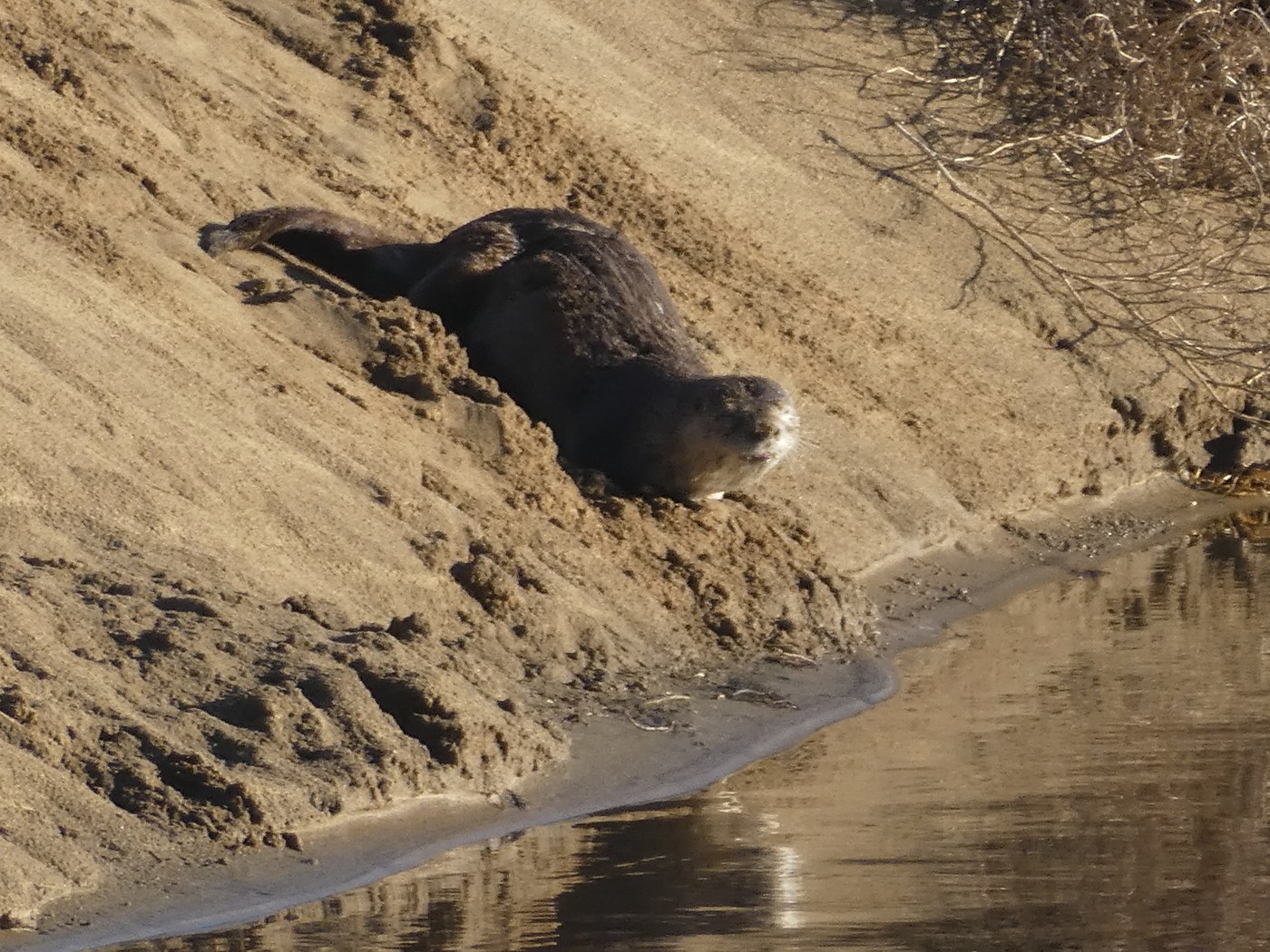
River otters are active year round in Alaska and do not hibernate. Breeding happens in spring, usually May, but pups are not born until the following year, late January through June, because of delayed implantation. Winter is when they are most visible on the landscape, since they tunnel and build feeding dens in snow over frozen water and leave bound-and-slide trails across it.
River otters are active year round in Alaska and do not hibernate. Breeding happens in spring, usually May, but pups are not born until the…
The reproductive calendar looks wrong until you know about delayed implantation. Alaska otters breed in spring, usually May, and mating can happen in or out of the water. Pups arrive the following year, any time from late January through June, after a nominal gestation of 9 to 13 months. Almost all of that is a dormant period in which the fertilized egg has not implanted. Active fetal development is only the last stretch. Alaska's own wildlife agency states the mechanism plainly, and it is the same mechanism seen in American marten.
Winter is when the fish complaints start, and there is a documented reason. Otters run on two main prey groups, fish and crayfish, and the balance flips with water temperature. A federal bioenergetics study in the Ozarks measured crayfish appearing in 85.0 percent of summer scat and only 42.3 percent of winter scat, with fish running the opposite direction at 13.3 percent in summer and 57.7 percent in winter. Cold water slows fish down and makes them catchable. That is also why channel catfish, which go lethargic in cold months, take the heaviest losses.
Nothing about this animal shuts down for the season. Otters stay active through the Alaska winter, digging elaborate tunnels and feeding dens in the snow over a frozen lake or bay, using the cracks left by shifting water levels to come and go. In colder country they concentrate at rapids, waterfalls, and lake outflows that stay ice free. Camera and scat studies of latrine sites, done in the lower 48, found visitation peaking in winter by every method tested.
Where They're Found
River otter needs permanent water and forage fish, and in Alaska it has both nearly everywhere. The state's own wildlife agency draws the range with unusual precision: the river otter is found throughout Alaska with the exception of the Aleutian Islands, the offshore islands of the Bering Sea, and the area adjacent to the arctic coast east of Point Lay. The National Park Service adds that river otters are more abundant in the northern part of the state, and that both river and sea otters turn up in Gulf of Alaska parks. Along the shores of Southeast Alaska the state describes the animal as fairly common, denning just inside the forest edge and foraging on the beach and close to shore.
Coastal Alaska otters are studied more closely than almost any other population in the country, and the numbers are worth stating. A state and university mark-recapture survey along 110 km of coastline in the northern Knight Island Archipelago in western Prince William Sound estimated 145 otters, a density of about 132 river otters per 100 km of shoreline. An earlier estimate for nearby Herring Bay, made about a year after the Exxon Valdez oil spill, put density at 36 to 42 otters per 100 km. Researchers have found and sampled more than 300 latrine sites in that archipelago since 1989.
Habitat is water plus fish plus a den somebody else built. Otters use lakes, rivers, streams, bays, estuaries, and the riparian ground beside them, in fresh, brackish, and salt water, and they reach higher densities in coastal and brackish habitat than inland. Federal wildlife damage guidance is blunt that vegetation and altitude matter far less than water quality, the availability of forage fish, and suitable denning sites. Since otters do not excavate their own dens, they take over abandoned beaver lodges, muskrat dens and houses, cavities under tree roots, rock piles, log jams, and thickets, usually with an entrance below the waterline. They also den in the inlet and outlet tubes of impoundments, which is the one piece of built infrastructure they routinely occupy.
Two things worth ruling out. First, river otter is not documented entering, denning in, or damaging a house, attic, crawl space, or wall void. Unlike raccoons, bats, and rodents, there is no structural exclusion story with this animal at all. The structures that get used are docks, piers, boathouses, boats, and pond outlet pipes. Second, there is no otter of any kind in Hawaii. Every range description found for this species confines it to North America north of Mexico.
One honest note on scope. The legal and behavioral detail is sourced from Alaska. The species itself is far more widespread than one region: it occupies most of North America north of Mexico, and state wildlife agencies from Washington to North Carolina run their own river otter programs. Outside Alaska, the biology still applies. The trapping law does not.
Life Cycle
Two figures do not agree between sources, and both are stated rather than blended. Lifespan is the larger gap. Alaska's wildlife agency states that otters can live and breed for more than 20 years. Animal Diversity Web gives a typical wild lifespan of 8 to 9 years with a captive maximum of 21. The most defensible reading is that 20-plus is a documented ceiling rather than a normal outcome. Weaning is the smaller gap: 5 months from the state source against about 3 months from Animal Diversity Web.
Size is treated the same way. Alaska figures run 15 to 35 pounds and 40 to 60 inches. Published figures from the lower 48 run lighter, commonly 10 to 30 pounds and 34 to 53 inches. In Alaska, expect the higher figures. Elsewhere, expect the lighter lower-48 range. Averaging the two would produce a figure nobody measured.

Pup
Juvenile
Adult
Signs of Activity
Identification
Sea otter is the legal confusion
Sea otter is the confusion that matters most in Alaska, and getting it wrong is a legal problem, not just an embarrassing one. The National Park Service gives the fastest tell there is: only sea otters float on their backs, they are clumsy on land and rarely leave the ocean, while river otters glide easily between shore and water. Alaska Sea Grant says the same from the other side: river otters swim and roll at the surface like sea otters but never float on their backs. Sea otter is also 2 to 5 times heavier, rafts in groups, sleeps wrapped in kelp, and uses rocks as tools on its chest. Sea otter is a federally protected marine mammal under the Marine Mammal Protection Act, the Southwest Alaska stock is listed as threatened under the Endangered Species Act, and Alaska's trapping regulations list sea otter as no open season in every game management unit in the state. None of this guidance applies to one.
Land otter is the Alaska name
Land otter is the correct Alaska name, and it is in the law. Alaska's wildlife agency uses it in its own species profile and notebook series, and the state's trapping regulations code this species as Otter, land in the seasons table, with Otter, sea listed separately immediately below as a closed entry. That is a legal distinction, not a folk one.
Alaska size
Alaska size: 15 to 35 pounds and 40 to 60 inches in total length, with females about 25 percent smaller than males. Thickset body with short legs, a neck no smaller than the head, inconspicuous ears, and a body broadest at the hips. Published ranges from elsewhere in the country run lighter, commonly 10 to 30 pounds, so a smaller animal is not automatically something else.
The tail settles the other three
The tail settles the beaver, muskrat, and nutria question on its own. A river otter's tail is thick at the base, tapering, furred, muscular, and a little more than a third the length of the head and body. A beaver's is flat, scaly, and paddle-shaped. A muskrat's is thin, scaly, and flattened side to side, and it visibly undulates as the animal swims. A nutria's is long, round in cross-section, and rat-like. Only the otter's is furred.
Black-brown, with a lighter belly
Color runs black-brown, with the belly slightly lighter than the back and the chin and throat grayish. A dense undercoat sits under longer guard hairs. Some accounts describe the sides of the head, chin, throat, and chest as pale brown to brownish-gray against a deep brown body.
Five toes, and a webbing dispute
Five toes on every foot, and a real disagreement about webbing that the sources do not resolve. Alaska's wildlife agency states flatly that only the hind feet are webbed. Wildlife Illinois describes five webbed toes on each foot, and Missouri's conservation department describes fully webbed feet. Those cannot all be literally true as written. What every source agrees on is that the hind feet are strongly webbed and that webbing is often invisible in a real track.
Mink, settled by size
Mink is the look-alike within the same family, and size is the tell. University of Kentucky extension puts it directly: otters are large, close to 4 feet long, while mink are under 2 feet. Mink tracks look like otter tracks but max out around 2 inches by 2 inches. A mink's tail is short and slightly bushy against the otter's long, thick, tapered one. This matters in Alaska beyond identification, because the legal minimum trap size for river otter changes depending on whether mink and marten seasons are open in that unit.
Not a rodent, and it shows
Not a rodent, and that single fact predicts the damage profile. Beaver, muskrat, and nutria are order Rodentia. River otter is order Carnivora, family Mustelidae, alongside mink, marten, and weasel. No orange incisors, no gnawing, no felled trees, no stripped vegetation. If a caller describes wood damage or grazed marsh, the animal is not an otter, though an otter may well be living in the den that animal built.
A note on the scientific name
The state's own page and the taxonomic authority disagree. The Integrated Taxonomic Information System lists Lontra canadensis as the valid name and records Lutra canadensis as invalid, a superseded name combination. Alaska's wildlife agency still uses Lutra canadensis on its species profile and in its notebook series, as do several older Alaska research publications. Newer Alaska work uses Lontra. Both names refer to the same animal.
The voice is specific enough to identify by
Otters growl, caterwaul, and whine. Alarmed, an individual gives an explosive hah. Two or more together produce a mumbling noise that sounds like conversation. A bird-like chirp signals anxiety and is heard most when members of a group get separated.
Signs of Infestation
A latrine site is the signature
No other pond animal leaves one. These are communal toilet and social spots on land, revisited every single time otters are in the area. Missouri's conservation department notes they are almost always evident around the shoreline of a pond an otter is using, usually on the highest bank of the dam or on a point extending into the water, and can sit up to 20 yards back from the water's edge. Repeated use often kills the vegetation around them. A trail usually leads from the water up to the site.
What is in the scat is the diagnosis
Otter scat is packed with fish scales, crayfish shell, and bone, and fresh scat carries a distinct fishy smell whether or not the animal has recently eaten fish. Because otters are strict carnivores, you will never find berries or plant material in it. That is the clean tell against raccoon, which leaves scat in similar concentrated spots but eats fruit, and against coyote, whose scat is full of fur.
Docks and boat covers as latrines
Docks, piers, boardwalks, and boat covers get used as latrines, and that is the actual complaint in developed areas. Extension guidance names ongoing cleanup, damage to boat carpet and seats, and disease risk from accumulated scat as the routine issues. Federal damage guidance adds torn boat covers. Smithsonian researchers found otters readily using docks and boardwalks in daily human use as latrine sites.
Slides at the water's edge
Published widths differ, so here is the range rather than one number: 6 to 10 inches per University of Kentucky extension, 8 or more inches per Missouri, and about a foot per Washington's wildlife department. They appear in grass, dirt, sand, or snow, usually with a trail running up from the water. A useful directional detail: an uphill slide is punctuated by track marks, while a downhill slide runs continuous.
Bound-and-slide trails in snow
Bound-and-slide trails across snow, which is the fastest winter identification there is. Otters take two or more bounds and then slide on their bellies, leaving what Missouri's conservation department describes as a series of dots and dashes resembling Morse code. Slide marks of 10 to 20 feet between track clusters are normal.
Tracks with five toes and often a tail drag
Front tracks run roughly 2 to 3 inches, hind tracks 2.5 to 5 inches depending on the source and substrate, asymmetrical with a C-shaped palm pad. Webbing sometimes prints in soft mud but frequently does not, and tracks often show only four toes with no claw marks. A tail drag shows as a line about 12 inches long, wider at the base than the tip. Loping animals leave 18 to 30 inches between track clusters.
Fish remains with a species-specific pattern
Otters usually eat all of a small catfish except the head and the major spines, so intact catfish heads on the shoreline are a strong sign. Small trout, salmon, and scaled fish may be eaten whole, leaving only scales, fins, and blood on the snow. Federal guidance adds a useful exclusion: uneaten carcasses with large puncture holes are more likely a heron than an otter.
What you will not find
It is worth saying out loud. No dam. No lodge the otter built. No felled or girdled trees, no angled gnaw cuts, no wood chips. No stripped marsh vegetation. No burrow driven into a levee or pond bank. No plugged culvert. Every one of those belongs to a beaver, a muskrat, or a nutria. An otter may be living in the den one of them left behind, which is exactly how the four get confused on the same pond.
Prevention and When to Call a Pro
In Alaska it is not simply removable
Start with the legal question, because in Alaska river otter is not a species you can simply remove. Alaska's trapping regulations require a trapping license to take a river otter, and the hunting regulations say it from the other direction: if you want to take fisher, marmot, marten, mink, muskrat, river otter, or weasel, you must follow trapping regulations. That is a real distinction from beaver, coyote, fox, lynx, squirrel, wolf, and wolverine, which may be taken under either license. Rules are reset annually by the Board of Game and published in late July, and can change mid-season by emergency order, so verify current rules with the state wildlife agency before doing anything.
Seasons are set per unit
Seasons are set per game management unit, and there is no single statewide Alaska otter season. Under the 2025-2026 regulations, land otter runs November 10 to March 31 in Units 1 through 5 and in Units 6, 9 through 11, 13, 14A, 14B, and 16 through 18; November 10 to the last day of February in Units 7, 14C, and 15; November 10 to January 31 in Unit 8; and November 1 to April 15 in Units 12 and 19 through 26. Every one of those lines carries no bag limit. The state's own management page puts it plainly: river otters are currently under no direct management in Alaska and are open to trapping with no bag limit.
The hide must be sealed
It is the requirement most people have never heard of. A river otter hide has to be sealed by the state, and state furbearer reporting describes that sealing happening within 30 days after the trapping season closes. Confirm the current requirement with the state wildlife agency before relying on a date. The trapper has to present the hide in person and it has to be unfrozen, because frozen hides will not be sealed. The sealing officer records when, where, and how the animal was taken and may measure the hide. If you cannot appear in person, a signed temporary sealing certificate has to travel with the hide. Otter hides brought into Alaska from outside the state must be sealed too, the hide must be salvaged if you take the animal, and the pelt has to be sealed before it can be bought or sold.
A trap-size rule from elsewhere
There is also a trap-size rule that keys off a completely different species' season. When trapping river otter in a unit where the mink or marten seasons are closed, you must use a snare, a killer-style body-grip trap, or a foothold trap with an inside jaw spread of 5 7/8 inches or greater. That is the kind of rule nobody discovers on their own at a hardware store, and it is a good reason to route this to a licensed operator rather than a DIY purchase.
Sea otter is a hard stop
There are no exceptions. Alaska's regulations list sea otter as no open season in Units 1 through 26, and the species is federally managed by the U.S. Fish and Wildlife Service under the Marine Mammal Protection Act, with the Southwest Alaska stock listed as threatened. If the animal floats on its back, rafts with others, or will not readily come ashore, stop and call the state wildlife agency.
Rule the otter out first
Rule the otter out before you do anything at all. Both university extension sources lead with this warning rather than burying it, because otters get blamed constantly for damage they did not cause. Partially eaten fish on a bank is not proof: fish that die of natural causes float up and become available to raccoons, skunks, mink, herons, and birds of prey. Check the pond first. Aging ponds shallower than about 8 feet are prone to low dissolved oxygen fish kills in summer and winter extremes. Confirm with a combination of fish heads, tracks, slides, and latrine scat containing fish scales, and a trail camera if you have one.
Take away the den, not the otter
This is the most otter-appropriate step there is, and it follows directly from the animal not building its own shelter. Missouri's conservation department is explicit: because otters do not build dens, they usually will not stay at a pond unless a den is already there, so removing resident beaver and muskrats and destroying the lodges and dens may discourage them. Extension guidance adds sealing existing den sites and water impoundment outlets such as culverts and drainage pipes, using barriers and flap gates that let water through but keep otters out.
Fencing works on small water
Exclusion fencing works, but only around small, concentrated water. Federal wildlife damage guidance gives a real spec: 3 by 3 inch mesh wire or smaller can be economically effective at relatively small aquaculture sites or wherever fish are concentrated, such as raceways, tanks, and small ponds. Hog wire fencing has worked too, but it needs periodic checking to make sure the lower meshes have not been spread apart or lifted. Fencing a whole natural pond or lake is usually neither practical nor affordable.
Electric fencing is a supplement
It is not a solution. Federal guidance describes electric fence as requiring frequent inspection and maintenance and being most useful as a supplement to a perimeter fence around a facility rather than as protection for individual small ponds or raceways. Where one is warranted, Missouri's spec is a properly maintained high-tensile electric fence with at least four strands spaced at 4 to 5 inch intervals.
Give the fish somewhere to hide
Reconsider what you stock, too. Both extension sources recommend maintaining aquatic vegetation and adding brush piles or other structure so fish can escape. This is one of the few situations where adding cover is the recommendation rather than clearing it. On stocking: self-sustaining scaled fish like bass, bluegill, and crappie generally absorb occasional otter predation, while channel catfish populations that depend on repeated restocking are the most vulnerable and are sometimes eliminated outright. Missouri's guidance goes as far as saying that if you are not managing for channel catfish, otters probably are not your problem.
There is no chemical option
This is worth stating, because people go looking for one. Federal wildlife damage guidance lists, for river otter: repellents, none registered; toxicants, none registered; fumigants, none registered. It also notes that opportunities to use frightening devices are infrequent. No spray, bait, or noisemaker on the market is a documented answer here.
The honest limit on prevention
It is the reason an otter is handled differently from a burrowing animal. Alaska's wildlife agency states that otters travel over a wide area and that apparently there are no exclusive territories. Washington's wildlife department puts numbers on it: otters follow a regular circuit covered in one to four weeks, males can travel 150 miles within a watershed and its tributaries in a year, and a family may range 10 to 25 miles in a season. Published home ranges run from 2 to 78 km of waterway, and genetic work in California tracked one female moving 45 km between wetlands and another covering 37.8 km inside 24 hours. The practical consequence is that an otter is not a resident you can evict. Remove one animal and another can arrive from miles away, because the watershed is the home range, not your pond. Protect the fish and close the den site. Do not try to defend a perimeter.
Do not corner or trap one
Do not attempt to handle, corner, or trap an otter yourself. Beyond the licensing, sealing, and trap-size rules above, otters are strong, fast on land and in water, and are documented biting people and dogs. Federal wildlife damage guidance notes that otters can kill small domestic dogs. Trapping for otter is water-set trapline work with body-grip traps placed below or partly below the surface at narrow runs and crossings, and it belongs to a licensed trapper.
Keep dogs out of the water
Keep dogs out of water where otters have been seen. The Anchorage pattern is specific: most reported attacks involve a dog that is swimming, often playing fetch, when several otters converge on it underwater. Alaska's wildlife agency has repeatedly posted warning signage at Anchorage dog parks for exactly this and advises giving otters plenty of space and keeping dogs out of the water where they have been reported. Off-leash lake access and a thrown tennis ball is the scenario to avoid, not a walk along the bank.
Call the moment a group gets bold
Call a professional the moment a group of otters starts behaving boldly toward people or pets. That is exactly the situation Alaska's wildlife agency responded to in a September 2021 public advisory, after a child was chased and bitten by a group of four river otters near Dowling and Lake Otis and a woman was bitten rescuing her dog at University Lake. The department said it would locate and remove only the specific animals showing the unusual behavior, and rejected relocation outright on the grounds that the aggressive behavior would simply move with the animals to a new location. It also said plainly that removing that group would not remove the population from the area. That is an agency decision, not a homeowner one, and the same advisory asks the public to report otter sightings and any aggressive wildlife to the nearest office or through the online wildlife encounter report form, with 911 for immediate safety concerns.
Get medical care after a bite
After any bite or scratch, get medical care first and report the animal second. Confirmed rabid river otters are on record with the Florida Department of Health, the Maine CDC, and the CDC's own Emerging Infectious Diseases journal. Treat any otter bite as a possible rabies exposure, clean the wound, and see a provider immediately so post-exposure treatment can start if needed. Worth keeping in proportion, though: in the Anchorage advisory Alaska's wildlife agency stated there had not been a reported case of rabies in river otters in southcentral Alaska in recent years, and said animals removed for aggression would be tested precisely because the question was open rather than because rabies was expected.
Wear gloves to clean a latrine
Wear gloves when you clean a latrine off a dock, and keep dogs from eating the scat. The accumulated deposits, not the animal, are the realistic exposure point. Otters are documented carrying parasites including Toxoplasma gondii and Giardia, and researchers describe them as a sentinel species for watershed contamination. A 2025 study of Chesapeake Bay latrines did not detect any parasites in the otters that infect humans, but noted that some were closely related to ones that do, and that risk rises as otters move further into urban and suburban water. Ordinary caution is the right level here, not alarm.
A hatchery needs a program
For a hatchery, aquaculture operation, or high-value stocked water, treat this as a facility program rather than a one-off. Federal guidance frames perimeter fencing, raceway fencing, and any trapping at that scale as requiring an assessment of whether nonlethal measures can do the job, and confirmation that any lethal measure complies with state and federal law. Damage there is frequently learned behavior by one otter or one family, which is why targeted, professional response works better than a general program.
Frequently Asked Questions
Is a river otter the same thing as a sea otter?
No, and in Alaska the difference is legal as well as biological. River otter, also called land otter, is a 15 to 35 pound semi-aquatic weasel that moves freely between shore and water. Sea otter is the largest member of the weasel family, roughly 2 to 5 times heavier, rarely comes ashore, and is the only one of the two that floats on its back. The National Park Service gives that as the fastest field tell. Sea otter is a federally protected marine mammal under the Marine Mammal Protection Act with no open season in any Alaska game management unit, and the Southwest Alaska stock is listed as threatened under the Endangered Species Act. None of this guidance applies to one.
Is a river otter a kind of beaver, muskrat, or nutria?
No. Those three are rodents. River otter is a carnivore in the weasel family, the same family as mink and marten, which is why it eats fish rather than wood and vegetation. It leaves no dam, no lodge of its own, no gnawed or felled trees, and no burrow in your pond bank. Otters do commonly move into dens that beavers and muskrats built and abandoned, and that is the main reason the four animals get confused on the same water.
Will otters wipe out the fish in my pond?
It depends almost entirely on what you stock. Missouri's conservation department reports that self-sustaining scaled fish such as bass, bluegill, and crappie generally absorb occasional otter predation, while channel catfish populations that need periodic restocking are the most vulnerable and are sometimes eliminated outright, because catfish do not use cover and go lethargic in cold water. Extension sources also warn that otters get blamed for fish kills actually caused by low dissolved oxygen in ponds shallower than about 8 feet, so rule that out first. For scale, a federal bioenergetics study estimated an otter consumes somewhere around 77 to 116 pounds of prey per month.
What is the pile of black droppings full of fish scales on my dock?
That is an otter latrine. Otters use fixed communal sites on land to defecate, socialize, and scent-mark, and they revisit them every time they are in the area. The scat is packed with fish scales, crayfish shell, and bone, smells distinctly fishy when fresh, and never contains berries or plant material, which is how it is told apart from raccoon scat. Docks, piers, boardwalks, boat covers, and the high bank of a pond dam are all documented latrine spots, sometimes as far as 20 yards back from the water.
Can I trap a nuisance river otter myself in Alaska?
Only with a trapping license, inside your unit's open season, using a legal trap, and with the hide sealed by the state within 30 days after the season closes. River otter cannot be taken under a hunting license. Seasons are set per game management unit and genuinely differ: November 10 to March 31 in Units 1 through 5, November 10 to January 31 in Unit 8, November 1 to April 15 in Units 12 and 19 through 26, and so on. There is no bag limit anywhere in the state. In a unit where mink and marten seasons are closed, a foothold trap must have an inside jaw spread of at least 5 7/8 inches. Rules are reset annually, so verify with the state wildlife agency first, and a licensed nuisance wildlife control operator is the safer default.
Are river otters dangerous to people or dogs?
Uncommonly, but genuinely, and more so than beaver, muskrat, or nutria. In a September 2021 public advisory, Alaska's wildlife agency reported that a child had been chased and bitten by a group of four river otters near Dowling and Lake Otis, and that a woman had been bitten while pulling her dog away from a group of otters at University Lake, with a second dog bitten elsewhere on the same lake that day. The department described attacks in Anchorage as rare but recurring over several years. Dogs are the more common target: the reported pattern is a dog swimming, often playing fetch, when several otters converge on it. A 2023 review in the IUCN Otter Specialist Group Bulletin counted 20 reported otter attacks on humans worldwide from 2011 to 2021, 71 percent of them in North America, 53 percent during water-related activity, peaking in July. Federal wildlife damage guidance notes otters can kill small domestic dogs. Treat any bite as a rabies exposure and see a provider.
Do river otters carry rabies?
They can, though they are not one of the primary rabies reservoir species the way raccoons, skunks, foxes, and bats are. Confirmed rabid river otters are on record with the Florida Department of Health, which reported a rabid otter biting a dog and then a person in 2023; the Maine CDC, whose 2018 surveillance report describes an otter that chased beachgoers, bit a person, and tested positive; and the CDC's Emerging Infectious Diseases journal, which documented a rabid otter on Long Island traced by whole-genome sequencing to a raccoon-variant clade. So otters can contract and transmit rabies but do not maintain a variant of their own.
Why can't I just fence the otter out?
Because there is nothing to fence out. Alaska's wildlife agency states that otters travel over a wide area and that apparently there are no exclusive territories. Washington's wildlife department reports that males can travel 150 miles within a watershed in a year and a family may range 10 to 25 miles in a season, following a circuit that takes one to four weeks to complete. The watershed is the home range, not your pond. Fencing only works around small, concentrated water like a raceway or tank, using 3 by 3 inch mesh or smaller. Everywhere else, the workable moves are sealing the den and pond outlet pipes, giving fish cover to escape into, and changing what you stock.
Sources
- River Otter Species Profile and Wildlife Notebook Series entry: Alaska range excluding the Aleutians and the arctic coast east of Point Lay, size and weight, delayed implantation and the 9 to 13 month gestation, pup development, social groups and the no-exclusive-territories statement, vocalizations, winter snow dens, and the 1,200 to 2,400 annual pelt harvest Alaska Department of Fish and Game
- River Otter Wildlife Notebook Series (PDF), text by J.D. Solf and Howard Golden Alaska Department of Fish and Game
- River Otter Management and Research: river otters are currently under no direct management in Alaska and are open to trapping with no bag limit Alaska Department of Fish and Game
- 2025-2026 Alaska Trapping Regulations No. 66, effective July 1 2025 to June 30 2026: unit-by-unit land otter seasons, no bag limit, the 30-day sealing requirement, the unfrozen-hide rule, the 5 7/8 inch jaw spread rule, sea otter closed in Units 1 through 26, and sealing of hides brought in from out of state Alaska Department of Fish and Game
- 2025-2026 Alaska Hunting Regulations, Fur Animals and Small Game: river otter may be taken only under trapping regulations, and the hide must be salvaged Alaska Department of Fish and Game
- Furbearer Management Report and Plan, Game Management Unit 1A: sealing within 30 days of season close by department staff or a state-appointed sealer, hide measurement at sealing, and unit harvest and pelt price records Alaska Department of Fish and Game
- Northern Sea Otter (Enhydra lutris kenyoni) Species Profile: sea otter size, Marine Mammal Protection Act transfer to the U.S. Fish and Wildlife Service in 1972, and the Southwest Alaska stock listed as threatened under the Endangered Species Act Alaska Department of Fish and Game
- Wildlife Viewing podcast episode, River Otters: Southeast Alaska abundance, denning just inside the forest edge, and the viewing distinctions against sea otter and harbor seal Alaska Department of Fish and Game
- Otters, Alaska Nature and Science: only sea otters float on their backs, sea otters are clumsy on land and rarely leave the ocean, and river otters are more abundant in the northern part of the state U.S. National Park Service
- River Otters, Prevention and Control of Wildlife Damage handbook (Edward P. Hill): hatchery and pond damage evidence, the 3 by 3 inch exclusion mesh spec, no registered repellents, toxicants, or fumigants, torn boat covers, the threat to small dogs, and the finding that total damage effects are believed to be insignificant Internet Center for Wildlife Damage Management, University of Nebraska-Lincoln with USDA APHIS Wildlife Services
- Otter Damage Identification: scats and toilets containing scales and exoskeletons as evidence of ongoing damage, boat damage, and otters killing small domestic dogs Internet Center for Wildlife Damage Management, University of Nebraska-Lincoln with USDA APHIS Wildlife Services
- Identifying and Addressing River Otter Damage Issues in Kentucky, FOR-173: the fish and crayfish seasonal switch, scat contents and the raccoon and coyote distinctions, dock and pier latrines, track and slide dimensions, den and impoundment outlet sealing, and the mink size comparison University of Kentucky Cooperative Extension Service
- Missouri's River Otter, A Guide to Management and Damage Control: latrines up to 20 yards from water, the Morse-code bound-and-slide trail, channel catfish vulnerability, the 8-foot pond depth and low-oxygen fish kill warning, otters not building their own dens, flap gates on outlet tubes, and the four-strand electric fence spec Missouri Department of Conservation
- River otter (Lontra canadensis) living with wildlife: year-round activity, the one to four week circuit, 150 miles per year for males and 10 to 25 miles per season for a family, and slide dimensions Washington Department of Fish and Wildlife
- Lontra canadensis (northern river otter): taxonomy, measurements, home ranges of 2 to 78 km of waterway, slight territoriality and mutual avoidance, the documented function of play behavior, and the 8 to 9 year wild lifespan against a 21 year captive maximum Animal Diversity Web, University of Michigan Museum of Zoology
- Report: Lontra canadensis, TSN 180549, current standing valid, with Lutra canadensis (TSN 180572) recorded as an invalid subsequent name or combination Integrated Taxonomic Information System (ITIS)
- Assessment of the River Otter Population in Prince William Sound: 145 otters estimated along 110 km of Knight Island Archipelago coastline in 2009, a density of 132 otters per 100 km against 36 to 42 per 100 km in 1990, and more than 300 latrine sites sampled since 1989 Alaska Department of Fish and Game with the University of Wyoming and the USDA Forest Service Chugach National Forest
- Modeling Behavior by Coastal River Otter (Lontra canadensis) in Response to Prey Availability in Prince William Sound, Alaska: social male groups of 3 to 18 cooperatively foraging on schooling fish, solitary females on intertidal and demersal fish, latrines used as communication centers, and home range measured as shoreline length rather than area Public Library of Science, PLOS ONE
- Bioenergetics assessment of fish and crayfish consumption by river otter: crayfish in 85.0 percent of summer scat against 42.3 percent in winter, fish at 13.3 percent in summer against 57.7 percent in winter, and total biomass consumption of 35,079 to 52,653 grams per month U.S. Geological Survey
- Diet of the North American river otter in North Carolina using 2 methods: 522 stomachs examined, decapods in 41 percent, Perciformes making up 62 percent of fish prey, and no Salmonidae found by manual examination North Carolina State University, Department of Forestry and Environmental Resources, published in Wildlife Society Bulletin
- Florida Department of Health in Palm Beach County identifies otter with rabies, September 25 2023: a confirmed rabid otter bit a dog and then a person in Jupiter, Florida Florida Department of Health
- Animal Rabies, Maine Surveillance Report 2018: an otter chased beachgoers including children, bit a person, tested positive for rabies virus, and the exposed person received post-exposure prophylaxis Maine Center for Disease Control and Prevention
- Origin of 3 Rabid Terrestrial Animals in Raccoon Rabies Virus-Free Zone, Long Island, New York, USA, 2016-2017, Emerging Infectious Diseases 26(6): a rabid river otter confirmed and traced by whole-genome sequencing to a raccoon-variant clade Centers for Disease Control and Prevention
- Reported Worldwide Otter Attacks on Humans over the Last Decade (2011-2021), IUCN Otter Specialist Group Bulletin 40(2): 20 reports over ten years, 71 percent in North America, 53 percent during water-related activity, a July peak, and 59 percent of wild-attack victims treated preventatively for rabies IUCN Otter Specialist Group
- North American river otters consume diverse prey and parasites in a subestuary of the Chesapeake Bay, Frontiers in Mammal Science: 18 latrines assessed, otters readily using docks and boardwalks as latrines, finfish and crabs at 93 percent of prey items, and no human-infecting parasites detected in this study Smithsonian Environmental Research Center
- Leptospira, Parvovirus, and Toxoplasma in the North American River Otter in North Carolina, Journal of Wildlife Diseases: of 220 otters tested, 1 percent positive for Leptospira interrogans, 19 percent for parvovirus, and 24 percent for Toxoplasma gondii National Institutes of Health, National Library of Medicine (PubMed)
- Sea Otters and Polar Bears, Marine Fissipeds field guide: river otters swim and roll at the surface like sea otters but never float on their backs Alaska Sea Grant, University of Alaska Fairbanks
- North American river otter: home range up to 30 square miles with a typical territory of 3 to 15, the family unit lasting seven to eight months, and the mother coaxing pups into the water for their first swim Smithsonian's National Zoo and Conservation Biology Institute
- Species account of the Northern River Otter, Mammals of Texas online edition: den types with underwater entrances, otters taking over beaver lodges and muskrat dens, and radio-telemetry activity peaking in winter and in the morning crepuscular period Museum of Texas Tech University, Natural Science Research Laboratory
- Effects of the Exxon Valdez Oil Spill on River Otters in Prince William Sound, Alaska: latrine abandonment rates, home range and diet changes in oiled areas, and chronic health effects in the affected population University of Alaska Fairbanks Institute of Arctic Biology with the Alaska Department of Fish and Game
- Public advisory, Beware of Aggressive River Otters Around Anchorage Waterways, September 24 2021: a child chased and bitten by a group of four river otters near Dowling and Lake Otis on September 1, a woman bitten rescuing her dog at University Lake, the department's decision against relocation because it would move the dangerous behavior elsewhere, the statement that removing this group will not remove the entire population from the area, and the note that there has not been a reported case of rabies in river otters in southcentral Alaska in recent years. Archived advisory, listed through the department's releases and notices index Alaska Department of Fish and Game
Image Credits
- Image: datadan via iNaturalist. CC BY 4.0.
License.