Seasonal Timeline
Nutria are active year-round, with no off season. Breeding runs continuously with reproductive peaks in late winter, early summer, and mid-autumn, and the animals stay on the water through the cold months rather than going dormant.
What shifts through the year is the diet, not the activity level. Through most of the year nutria feed on cordgrasses, bulrushes, cattails, and arrowheads, eating roughly 25 percent of their body weight daily. When preferred marsh vegetation thins out in winter, they move to roots and tree bark, which is when damage to plantings and young trees near a waterline tends to show up.
Cold is the one real brake on the species. The Internet Center for Wildlife Damage Management states directly that extreme cold is the primary limit on nutria range expansion, which is why the established range runs along the Gulf Coast, the Atlantic Coast, and the Pacific Northwest rather than across the northern interior. Within that established range, though, winter slows nutria down without stopping them.
Nutria are primarily nocturnal and crepuscular, but in undisturbed areas they are readily visible during the day. Seeing nothing at midday on a pond or ditch does not mean nothing is there.
Where They're Found
Nutria is native to temperate South America and was introduced to the United States primarily for fur farming. It is now established in at least 22 states, with at least a third of those carrying viable breeding populations. The historical core of the US range is southwest Louisiana and southeast Texas, where animals dispersed widely after 1940s hurricanes. Habitat is consistent everywhere it occurs: freshwater and brackish marshes, swamps, wetland margins, drainage ditches, ponds, and slow-moving waterways. Louisiana home ranges run about 32 acres, with most daily movement under 600 feet. Nutria do not enter structures the way rodents or raccoons do. The damage shows up at waterlines and earthworks rather than in attics and crawlspaces.
California is the most unusual case. Nutria were present in the Central Valley and South Coast in the 1940s and 1950s and were declared eradicated by the 1970s. In 2017 a new reproducing population turned up in the San Joaquin Valley, in Merced County. The California Department of Fish and Wildlife has since removed 7,841 nutria at a cost of roughly $5 million a year, working through visual surveys, motion-activated cameras, and detection dogs trained to find nutria droppings.
A five-year genomic study by CDFW's Wildlife Genetics Research Unit, funded by California's Department of Water Resources in partnership with USDA APHIS, then answered the question of where those animals came from. The current California population is most genetically similar to populations in central Oregon, and it traces back to a single maternal lineage rather than the multiple lineages found in historical California specimens. That combination points away from an undetected remnant population quietly rebuilding itself and toward a deliberate human reintroduction. CDFW program manager Valerie Cook put it plainly: "This study supports our long-held belief that the current invasion is the result of reintroduction rather than explosive growth of a remnant, undetected population."
The Pacific Northwest is the likely source of that reintroduction, per the same study. Nutria are established on the west side of the Cascades from northern California to southern British Columbia, and the population is still expanding. Oregon lists nutria as a Prohibited species under OAR 635-056-0050. Washington classifies it as a Prohibited Aquatic Animal Species. Both states run public reporting lines, covered in the prevention section below.
South Central is the historical core of the United States range. Louisiana's nutria population peaked badly enough that surveys documented roughly 102,585 acres of wetland damage between 1998 and 2002.
One out-of-region precedent is worth knowing, because it is the only one of its kind. Maryland's Chesapeake Bay Nutria Eradication Project, a partnership of the US Fish and Wildlife Service, USDA Wildlife Services, and Maryland DNR launched in 2002, removed roughly 14,000 nutria over two decades. Half of those came off private land, with more than 700 landowners participating. In 2022 the partnership declared nutria eradicated from Maryland's Eastern Shore, protecting over 250,000 acres of Delmarva Peninsula marsh. A 2004 estimate had put Maryland's annual economic, environmental, and social-service losses from nutria at $5.8 million. Maryland's is the first documented full eradication of an established US nutria population, and it is the reason the programs in California, Oregon, Washington, and Louisiana are structured the way they are.
Nutria are not established in Alaska or Hawaii, as far as the published record shows. Every national distribution summary lists the Gulf Coast, the Atlantic Coast, and the Pacific Northwest as nutria's established US range, with cold specifically named as the limiting factor on further spread, and none names Alaska. A state-by-state confirmation against the US Geological Survey's nonindigenous species database is not available, so treat this absence as likely rather than fully confirmed.
Life Cycle
Fast replacement against fast losses, and the replacement wins. Nutria reach sexual maturity at about 5 months, breed year-round with peaks in late winter, early summer, and mid-autumn, and produce up to 3 litters a year averaging 4 to 5 young. At the same time, this is a short-lived animal in the wild: annual mortality runs 60 to 80 percent and most individuals do not see their third year, even though captive nutria have reached 15 to 20 years. Those two facts together, not either one alone, are why nutria is treated as a continuous-removal problem. Heavy natural attrition would collapse most populations. Here it barely keeps pace, so any gap in removal effort is refilled from within. That is the reasoning behind California's ongoing eradication program, Louisiana's standing bounty, and Maryland's 20-year commitment to a job that was eventually finished only by never stopping.

Kit
Juvenile
Adult
Identification
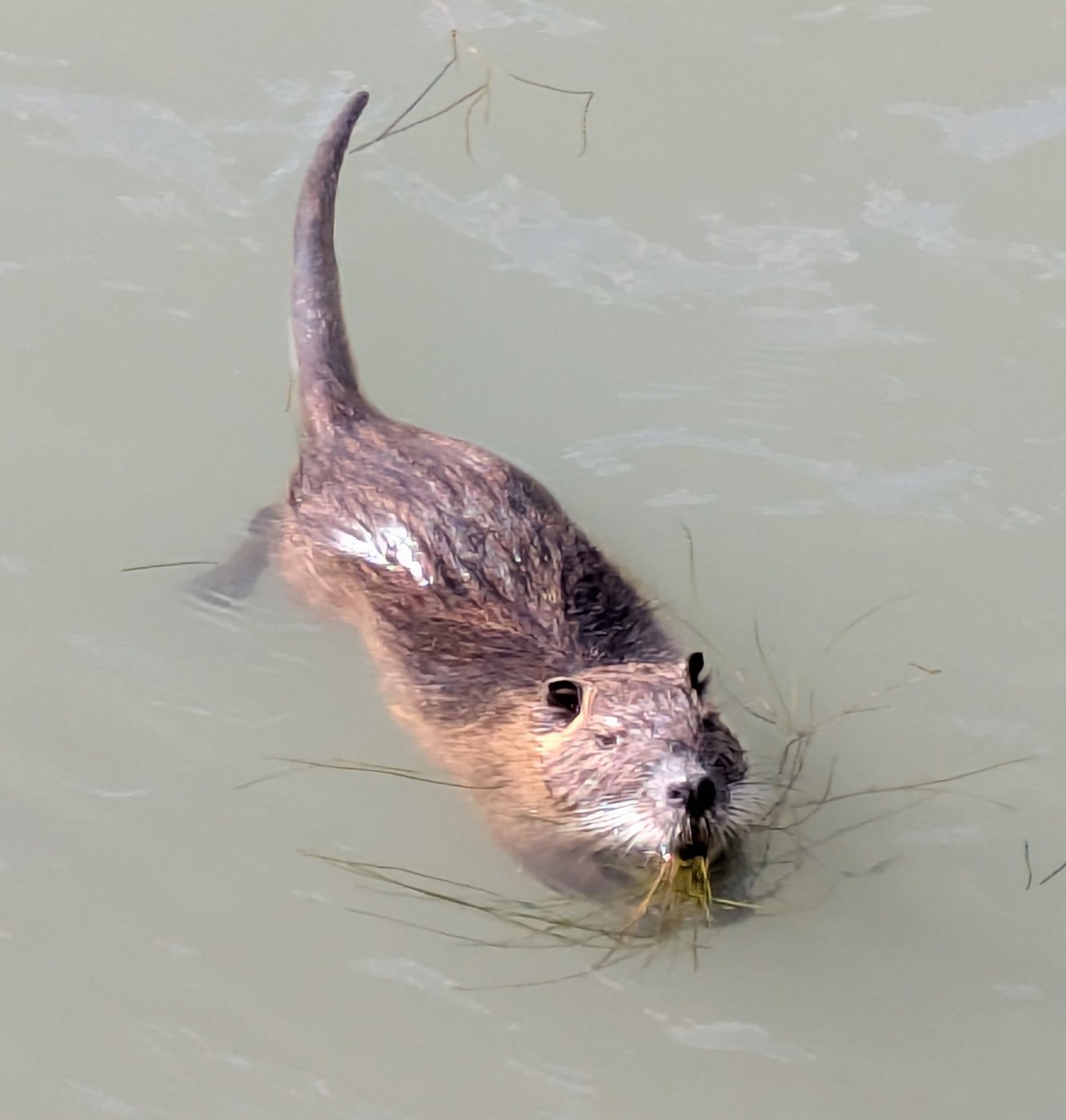
The tail is the fastest tell
Round, sparsely haired, and 13 to 16 inches long. A beaver's tail is flat and paddle-shaped. A muskrat's is laterally flattened. Nutria's is a rounded rat-like tail on a much larger animal.
Size settles the muskrat question on its own
Nutria run roughly 12 to 20 pounds against a muskrat's 2 to 4. Body length is about 24 inches, with males up to 20 pounds and females up to 18. The Internet Center for Wildlife Damage Management describes the resemblance to both beaver and muskrat as superficial.
Orange front incisors
Front incisors are yellow-orange to orange-red on the outer surface and unmistakable at close range.
The coat
Dense gray underfur beneath long, glossy guard hairs that run from dark brown to yellow-brown.
Eyes and ears sit high
Eyes, ears, and nostrils sit high on the head, a semi-aquatic adaptation paired with valves in the nostrils and mouth that seal out water while swimming and diving. On a swimming animal, very little other than the top of the head breaks the surface.
An unusual identifier: the mammae
A genuinely unusual identifier: the mammae sit high on the sides of the body rather than on the belly, so young can nurse while the female stays in the water.
Short legs, arched body, webbed feet
Short legs on a robust, highly arched body. Front paws carry 4 clawed toes plus a vestigial fifth. Hind feet carry 4 webbed clawed toes plus a fifth unwebbed outer toe, and the hind legs are noticeably larger than the front.
The sounds are specific
Nutria are vocal, and the sounds are specific. A low, nasal call often described as a moo, and a distinct nasal sound written as nan-cy.
Signs of Infestation
Droppings are the best field sign
Droppings are the most field-identifiable sign. Dark green to black, cylindrical, about 2 inches long and half an inch across, with deep parallel grooves running the full length. They turn up floating in water, along trails, and near feeding sites, and no other animal in the same habitat leaves that grooved shape.
Burrows, slides, and crawl-outs
Burrow entrances along exposed banks, with slides, trails, and crawl-outs leading down to the water. Burrows run 4 to 6 feet long with interior chambers.
A tail drag mark between footprint tracks
This is a quick, reliable confirmation in soft mud, and it is a tell most identification guides skip.
Floating vegetation platforms
They reach up to 3 feet high. Nutria flatten marsh vegetation into circular platforms. These are not beaver lodges, which are built of sticks and mud, and confusing the two sends a property owner after the wrong animal.
Marsh vegetation eaten down to bare soil
Nutria consume roughly 25 percent of their body weight daily, favoring cordgrasses, bulrushes, cattails, and arrowheads, then moving to roots and bark in winter.
A dock that has started to lean
A boat dock or wharf that has started to lean or sink. Nutria burrow into Styrofoam floats under docks, and the structure settles unevenly before anyone connects it to an animal.
Prevention and When to Call a Pro
In California, report first
In California the first step is to report, not to trap. Oregon and Washington want the report too, but they also allow trapping or hunting on property where the animals are present, so there the two run alongside each other. California, Oregon, Washington, and Louisiana all run active state programs, and each one wants to know where the animals are. That is a different starting point than most invasive-species pages, where the state posture is closer to unrestricted do-it-yourself removal. Route a suspected sighting to the relevant program before deciding what to do about it.
California, photograph and report
California: photograph the sighting and report it, and let the state handle removal. CDFW guidance states that suspected observations or potential signs of nutria in California should be photographed and immediately reported, through an online form, by email, or by phone at 866-440-9530. The state is running detection and removal as a single coordinated program, using cameras, surveys, and detection dogs, so a homeowner setting traps independently works against the effort rather than alongside it. Note also that nutria are restricted in California and cannot be imported, transported, or possessed without a permit. Invasive status does not mean no rules apply.
Oregon and Washington, remove too
Oregon and Washington: report it, and you may also remove it. This is a genuinely different posture from California's. Oregon lists nutria as Prohibited under OAR 635-056-0050 and asks for sightings through the Oregon Invasive Species Hotline at 1-866-INVADER or OregonInvasivesHotline.org, but trapping or hunting nutria is allowed on property where they are present. Washington classifies nutria as a Prohibited Aquatic Animal Species, takes reports at 1-877-9-INFEST or invasivespecies.wa.gov, and adds two hard requirements: any live-trapped nutria must be euthanized rather than released, and transporting nutria within the state requires a permit. Reporting and removal run together in both states rather than one replacing the other.
Louisiana pays you
Louisiana: the state pays you to remove them. Louisiana's Coastwide Nutria Control Program, a roughly $1.7 million federal and state effort, pays hunters a bounty of $6 per nutria tail. Rather than asking the public to stand back and report, Louisiana subsidizes the public to do the removal directly.
Fencing works on a defined feature
Fencing works on a defined water feature and not on open wetland. Sturdy wire fencing that extends below the waterline can keep nutria from establishing a burrow on a specific pond bank or waterfront edge. At marsh or open-acreage scale it is not a realistic tool. Knowing which of those two situations you are in decides whether fencing is worth the money.
Take away the burrow sites
Take the cover too. Removing floating vegetation platforms and clearing dense marsh-edge growth near a structure reduces how appealing a waterline is for burrowing. This is a maintenance habit rather than a one-time fix, since vegetation grows back.
Wear gloves in the water
Wear gloves and keep bare skin out of water where nutria are active. Nutria carry Strongyloides myopotami, a parasite released into water through their feces. On skin contact the larvae burrow partway in and cause an intense, localized itch with visible creeping tracks, a condition described in the peer-reviewed dermatology literature as nutria itch. The larvae cannot complete their life cycle in a human host, so the reaction is a self-limiting inflammatory response rather than an internal infection, but it is genuinely unpleasant. A Loyola University New Orleans source puts the parasite's prevalence in Louisiana's nutria population at roughly 85 percent.
Call at once for a levee burrow
Call immediately for any active burrow near a levee, dam, dike, or roadbed. Nutria tunneling can weaken flood-control levees so badly that water flows unobstructed and the structure requires complete reconstruction. Burrows also compromise banks, dams, dikes, and roadbeds, and the risk climbs when soil is saturated or when vehicles and equipment are crossing above. That call goes to the relevant water-management agency as much as to a pest-control company.
Call for any West Coast sighting
Call for any sighting in California, Oregon, or Washington. All three states are actively coordinating detection and removal. Report first, using the contacts above, before attempting anything yourself.
Call for a colony on farmland
Call for an established colony on agricultural land. Nutria clip rice stems at the water line in flooded fields and gnaw or cut sugarcane stalks during the growing season, with corn, grain sorghum, beets, alfalfa, wheat, barley, oats, peanuts, melons, and other vegetables also vulnerable. In Louisiana, nutria feeding on seedling baldcypress can cause complete stand failure. Route this to a state agriculture extension office or a licensed wildlife control operator for a coordinated removal plan rather than one-off trapping.
See a doctor for skin irritation
See a doctor for persistent skin irritation after wading or swimming in water where nutria are present. Nutria itch is self-limiting, but the itch can be severe and a medical evaluation can confirm it and rule out other causes.
Frequently Asked Questions
Is a nutria the same thing as a beaver or a muskrat?
No. All three are semi-aquatic rodents that can look similar while swimming, but a nutria has a round, sparsely haired tail rather than a beaver's flat paddle tail, and it is far larger than a muskrat, roughly 12 to 20 pounds against a muskrat's 2 to 4. The Internet Center for Wildlife Damage Management describes the resemblance to both animals as superficial. If you get a clear look at the tail or the size, the question is settled.
How did nutria come back to California after being eradicated in the 1970s?
The evidence points to a deliberate reintroduction rather than a population that survived undetected. A five-year genomic study by CDFW's Wildlife Genetics Research Unit found that the population discovered in Merced County in 2017 is most genetically similar to populations in central Oregon, and that it traces to a single maternal lineage rather than the multiple lineages present in historical California specimens. Both findings point to a deliberate human reintroduction rather than an undetected remnant population regrowing on its own. As CDFW program manager Valerie Cook put it, "This study supports our long-held belief that the current invasion is the result of reintroduction rather than explosive growth of a remnant, undetected population."
If I see a nutria in California or Oregon, should I trap it myself?
Report it first. California asks that suspected nutria observations or signs be photographed and immediately reported, by online form, email, or phone at 866-440-9530, and the state handles removal through its own eradication program. Oregon takes reports at 1-866-INVADER and does allow trapping or hunting on property where nutria are present. Washington takes reports at 1-877-9-INFEST, requires that any live-trapped animal be euthanized rather than released, and requires a permit to transport nutria within the state. Louisiana is the outlier: its Coastwide Nutria Control Program pays a $6-per-tail bounty for direct removal.
Can wading in water where nutria live make me sick?
It can cause nutria itch, a real condition first described in the peer-reviewed dermatology literature. Larvae of Strongyloides myopotami, released into water through nutria feces, seek out a host and burrow partway into human skin on contact, producing an intense localized itch with visible creeping tracks. The parasite cannot complete its life cycle in a person, so the reaction is uncomfortable but self-limiting rather than a lasting infection. Roughly 85 percent of Louisiana's nutria population is estimated to carry it. Wear gloves and avoid bare-skin contact with water where nutria are active.
Do nutria carry rabies?
Nutria is not among the species commonly cited as a rabies vector, which is consistent with rodents generally. The documented health concern specific to nutria is nutria itch. Broader claims that nutria carry diseases such as leptospirosis or tularemia circulate widely online, but no authoritative source confirms them for nutria specifically, so treat them as unverified.
Do nutria actually cause that much damage?
Yes, at a scale most people do not expect from a 12-pound rodent. Louisiana surveys documented roughly 102,585 acres of wetland feeding damage at the peak of the problem between 1998 and 2002. Because nutria strip out the vegetation that holds marsh soils together, that feeding contributes directly to coastal erosion. Maryland estimated $5.8 million in annual losses in 2004 before a 20-year federal and state partnership declared the species eradicated there in 2022. Burrowing is the other half of it: nutria tunneling has been documented weakening flood-control levees badly enough to require complete reconstruction.
Sources
- Nutria: species overview, identification, tracks and droppings, behavior, and legal status Internet Center for Wildlife Damage Management (University of Nebraska-Lincoln / USDA APHIS Wildlife Services)
- Nutria Biology: reproduction, lifespan, diet, home range, and burrow structure Internet Center for Wildlife Damage Management (University of Nebraska-Lincoln / USDA APHIS Wildlife Services)
- Nutria Damage Identification: marsh vegetation loss, levee and flood-infrastructure burrowing, crop and dock damage Internet Center for Wildlife Damage Management (University of Nebraska-Lincoln / USDA APHIS Wildlife Services)
- Nutria: reporting instructions, permit and possession restrictions, and the 1940s to 1970s eradication history California Department of Fish and Wildlife
- Nutria in Oregon: Prohibited species listing under OAR 635-056-0050 and the Oregon Invasive Species Hotline Oregon Department of Fish and Wildlife
- Nutria: Prohibited Aquatic Animal Species classification, euthanasia and transport-permit requirements, and reporting Washington Department of Fish and Wildlife
- Coastwide Nutria Control Program: the $6 per tail bounty, program funding, and annual wetland damage surveys Louisiana Department of Wildlife and Fisheries
- Nutria: An Invasive Species, including the Chesapeake Bay Nutria Eradication Project timeline and the 2004 damage estimate Maryland Department of Natural Resources
- Decades-long Partnership Eradicates Destructive Nutria Rodents from Maryland U.S. Fish and Wildlife Service
- Nutria Itch: dermatitis in a human volunteer infected with Strongyloides of nutria and raccoon National Library of Medicine (PubMed), National Institutes of Health
Image Credits
- Image: Denis Otkydach via iNaturalist. CC BY 4.0.
License.