Seasonal Timeline
Dam-building and food-caching peak from September through November across the lower 48 regions, as beavers reinforce dams and stockpile branches ahead of winter. Alaska runs on a shorter, ice-driven calendar, with the working season compressed into roughly July through September.
Dam-building and food-caching peak from September through November across the lower 48 regions, as beavers reinforce dams and stockpile…
What gets damaged varies more by region than when it happens. Midwest calls skew toward agricultural drainage tile, South Central toward rice-field levees in Louisiana and East Texas, and Mountain West and Southwest toward irrigation canals and ditches. Northeast and coastal regions see more culvert, driveway, and septic-field flooding. Alaska's activity window is compressed rather than differently timed: it effectively stops for half the year once water freezes.
Where They're Found
Beavers need a constant source of water and show up wherever one exists: streams, rivers, ponds, lakes, roadside ditches, irrigation canals, and even storm drains and water-treatment facilities. They build lodges in ponds and lakes, and bank dens in flowing streams and rivers where a freestanding lodge could not hold up to the current.
Beavers are established across nearly all of North America, with two documented exceptions: the extreme arctic tundra and desert areas with no free-flowing water. That second exception explains why Southwest activity concentrates almost entirely along specific river corridors, the Colorado, Rio Grande, Verde, Gila, and Salt, rather than spreading broadly across the region's dry interior. In the Southeast, beavers are widespread but thin out in the driest, most developed parts of the Florida peninsula rather than being absent from the state entirely. Alaska carries an active, well-documented population of its own, concentrated in coastal and interior waterways with a working season that ends once everything freezes over.
There is no established beaver population in Hawaii.
Life Cycle
Gestation length and weaning age are both unsettled. Sources disagree on gestation length (roughly 105 versus 128 days) and how quickly kits are weaned. Neither conflict changes anything practical about identification or timing, so both are better treated as unsettled than pinned to a single invented number.

Kit
Juvenile
Adult
Signs of Activity
Identification
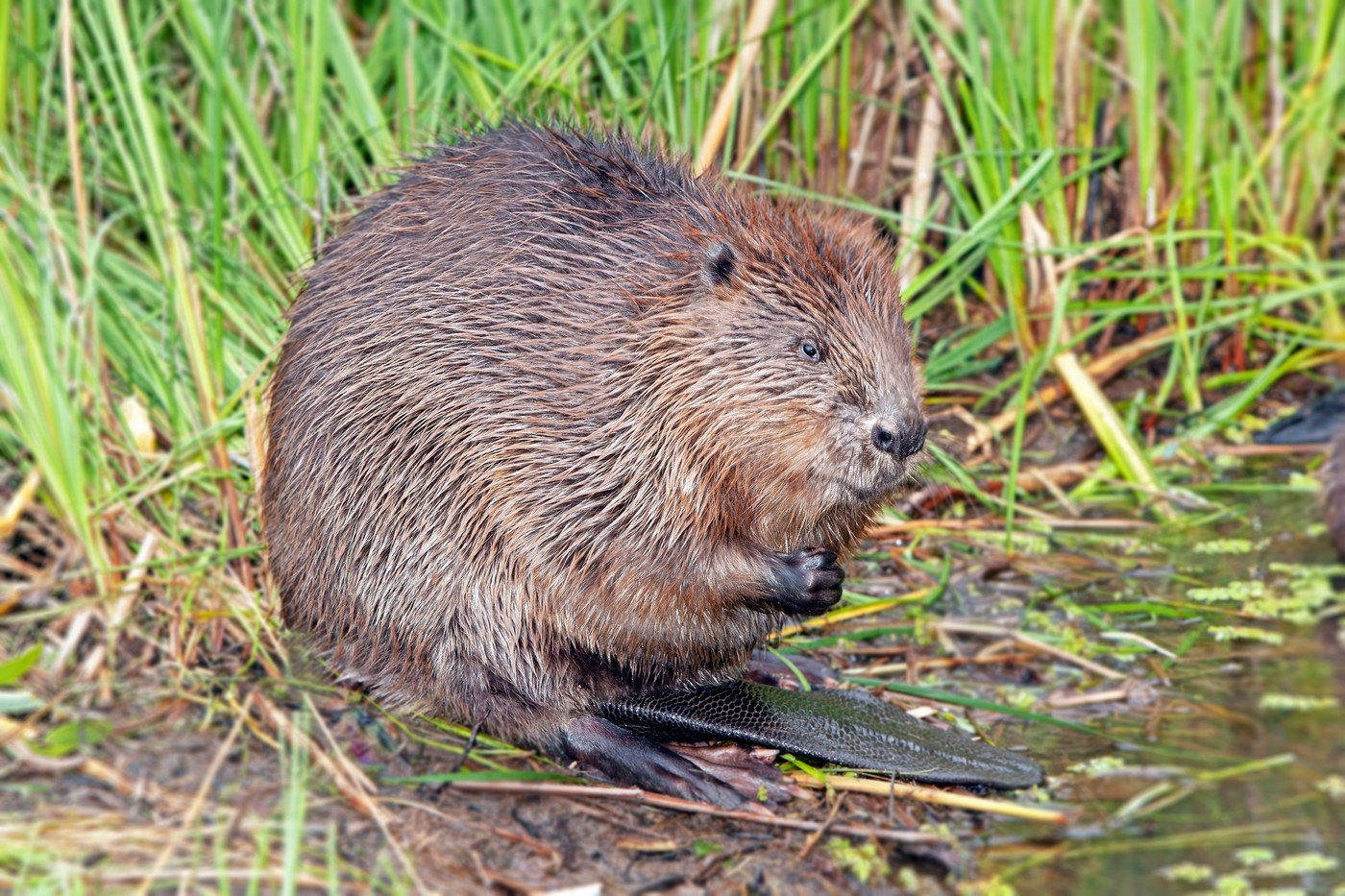
The largest rodent in North America
Most adults weigh 35 to 50 pounds, and some top 100.
The tail is the single clearest tell
Large, flat, paddle-shaped, scaled, and nearly hairless. It works as a rudder while swimming, a prop while sitting upright, and a warning signal when slapped against the water.
Bright orange incisors
Front incisors are bright orange on the front face and never stop growing. Constant gnawing keeps them sharp and worn down.
The coat
Dense gray underfur under long guard hair that runs from yellowish-brown to black, most commonly reddish-brown.
Webbed hind feet, unwebbed front
Webbed hind feet built for swimming, versus small, unwebbed front feet used for handling food and building material.
Not the same animal as a mountain beaver
Despite the name, the mountain beaver is a different family entirely, doesn't build dams, and shows up as a forestry and Christmas-tree-farm pest in the Pacific Northwest rather than a water-and-flooding problem. If a Pacific Northwest caller describes a burrowing animal damaging young conifers rather than a dam or lodge, it is worth confirming which animal is actually involved.
The tail, against a muskrat
A true beaver's tail is unmistakable next to a muskrat's thin, rope-like tail, and muskrats are far smaller overall. No single source states that side-by-side comparison directly.
Signs of Infestation
A dam across a stream or ditch
Built from branches, packed mud, and whatever else is available, including fence posts, corn stalks, or soybean vines where wood is scarce.
A lodge or bank den
A dome-shaped lodge can rise 3 to 6 feet above the water. In flowing streams, beavers dig bank dens into the shoreline instead, which are easiest to spot when water levels drop.
Girdled or felled trees
Cuts run at an angle with wood-chip debris scattered at the base. Tree size ranges from 1-inch saplings to 6-foot hardwoods, and some trees are girdled without being felled at all.
A plugged culvert or drain
A plugged culvert, drain pipe, or bridge structure causing standing water or flooding where there wasn't any before.
Scent mounds along the bank
Small piles of mud marked with a musky secretion, used to mark territory. These turn up year-round but more often in spring.
Sudden flooding
Sudden flooding of a road, yard, septic field, or crop with no other obvious cause is often the first sign anyone notices, well before the dam or lodge itself is spotted.
Prevention and When to Call a Pro
Check your state rule first
Beaver legal status varies by state, and this matters before doing anything else. Some states protect beavers except during a defined trapping season, while others treat them as a nuisance species that can be removed once they're causing damage. Rules genuinely differ and change, so check with a state wildlife agency or a licensed nuisance wildlife control operator before attempting any removal, even on private property.
Protect trees, not the property
Protect individual trees, not the whole property. Wrap the trunks of valuable trees near water in heavy-gauge wire mesh or hardware cloth from ground level to about 4 feet up. It's a partial measure, not a guarantee: beavers can still chew through wire, and rising water can submerge low fencing.
A repellent, with mixed results
A repellent exists, with mixed results. A mixture of fine sand and oil- or latex-based paint, applied to bark, can reduce gnawing on some protected trees. It should not be used on young trees under 6 feet, and it is not a substitute for physical exclusion where that's practical.
Two things that do not work
Two things that flatly do not work. No frightening device has been shown effective against beaver, and no chemical repellent or toxicant is currently registered for beaver control.
Flood control is a pro project
Flood control is a professional-grade project. Devices that manage water flow through a dammed culvert without removing the beaver exist, but they have to match local water depth, slope, and flood conditions correctly, and installing one may itself require a permit where it interacts with a dam or public waterway. This is work for a wildlife-management professional or the relevant local agency, not a DIY weekend project.
Never trap or shoot one yourself
Do not attempt trapping or lethal removal yourself. Beyond the legal question above, working around beaver habitat carries real drowning and hypothermia risk, especially near ice, and the equipment used by licensed trappers is precision gear that can injure an inexperienced operator. This is a call-a-professional situation, not a DIY one.
Frequently Asked Questions
Is it legal to trap or remove a beaver on my own property?
It depends on your state. Beaver legal status varies. Some states protect beavers except during a defined trapping season, others allow removal once they're causing damage. Check with your state wildlife agency or a licensed nuisance wildlife control operator before doing anything yourself.
Why is a beaver dam near my property a real problem, not just a nuisance?
Dam failures have caused flooding damage estimated in the millions of dollars in single events and have led to road, railroad, and even airport runway collapses, in some cases with fatalities. A dam that looks stable can fail with little warning.
Can I just wrap my trees to keep beavers from cutting them down?
Wrapping trunks in heavy-gauge wire mesh or hardware cloth up to about 4 feet helps, but beavers can still chew through wire and rising water can submerge low fencing, so it's a partial measure, not a guarantee.
Can you get sick from a beaver or a beaver pond?
Yes. Beavers can contaminate water with Giardia lamblia, which causes an intestinal illness sometimes called beaver fever, and can carry tularemia, which spreads through direct contact. Avoid splashing water from a beaver-active area on your face, and wash your hands thoroughly after any contact.
Do beavers carry rabies?
It's possible but very uncommon. Beaver is not classified as a primary rabies-vector species the way raccoons, skunks, foxes, and bats are.
Is a mountain beaver the same animal?
No. Despite the name, it's a different family entirely, doesn't build dams, and shows up in the Pacific Northwest as a pest of young conifers and Christmas tree farms rather than a water-and-flooding problem.
Sources
- Beavers (species overview, biology, damage identification, control methods) Internet Center for Wildlife Damage Management (University of Nebraska-Lincoln / USDA APHIS Wildlife Services)
- Beavers, Wildlife Damage Management Technical Series USDA APHIS Wildlife Services
- Giardia Infection: Causes and How It Spreads Centers for Disease Control and Prevention
- Controlling Beaver Damage (G1434) Nebraska Extension Publications
Image Credits
- Image: Adobe Stock, licensed.